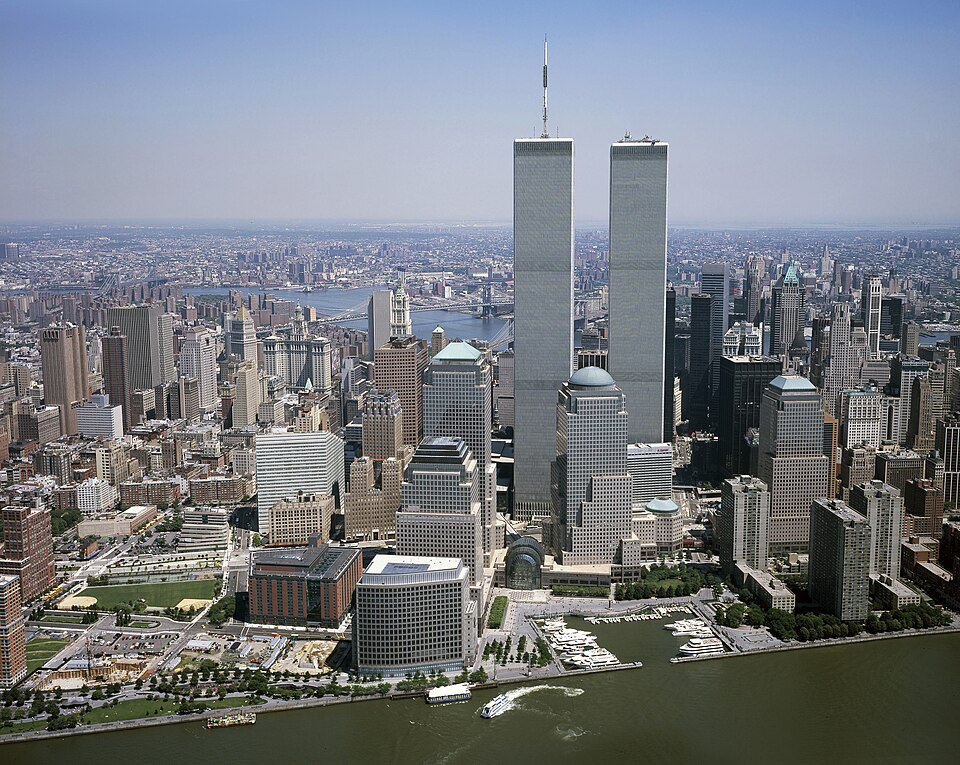
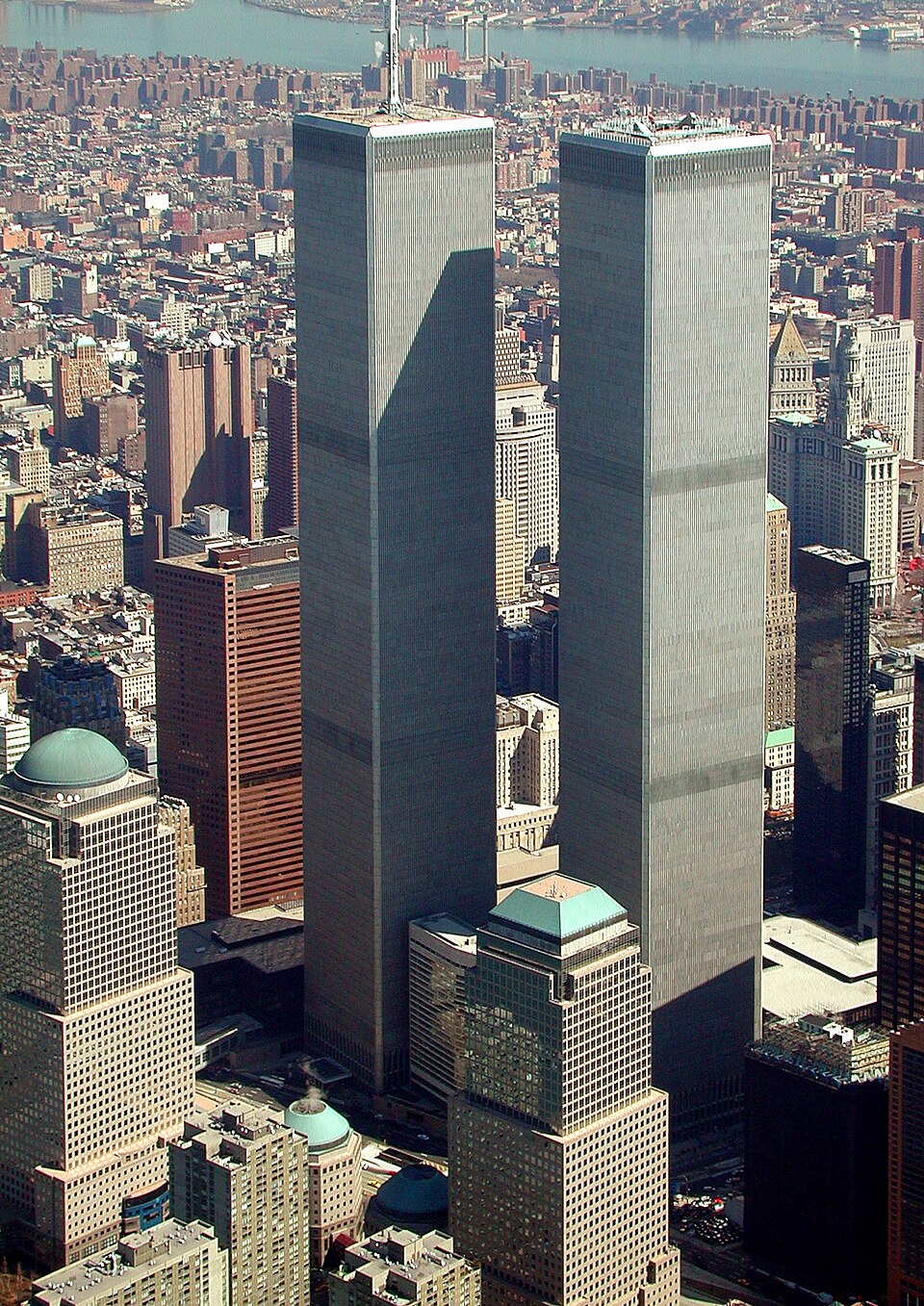
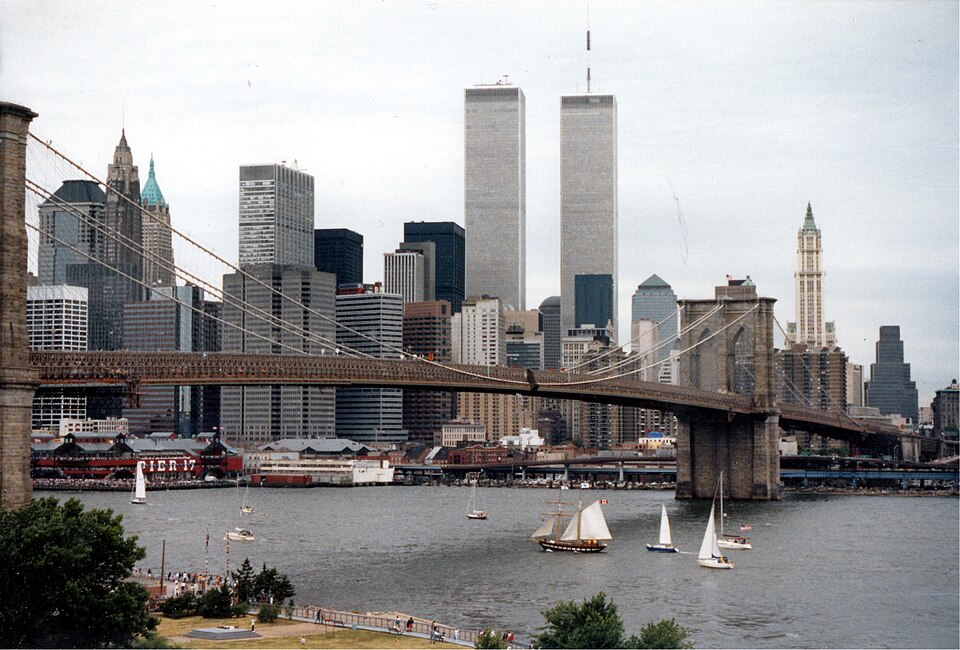
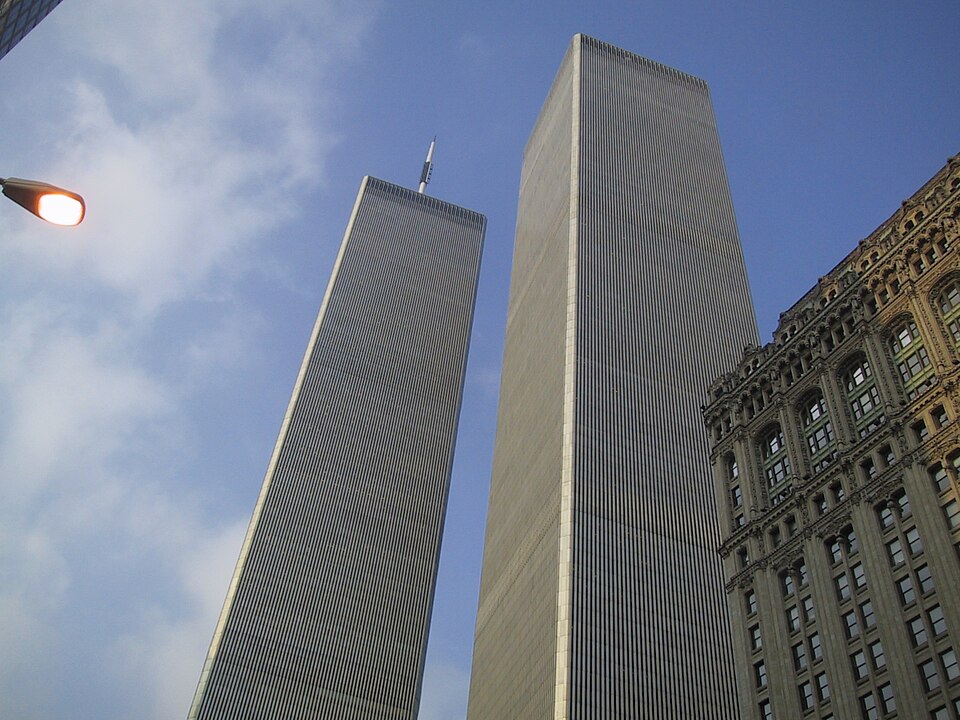
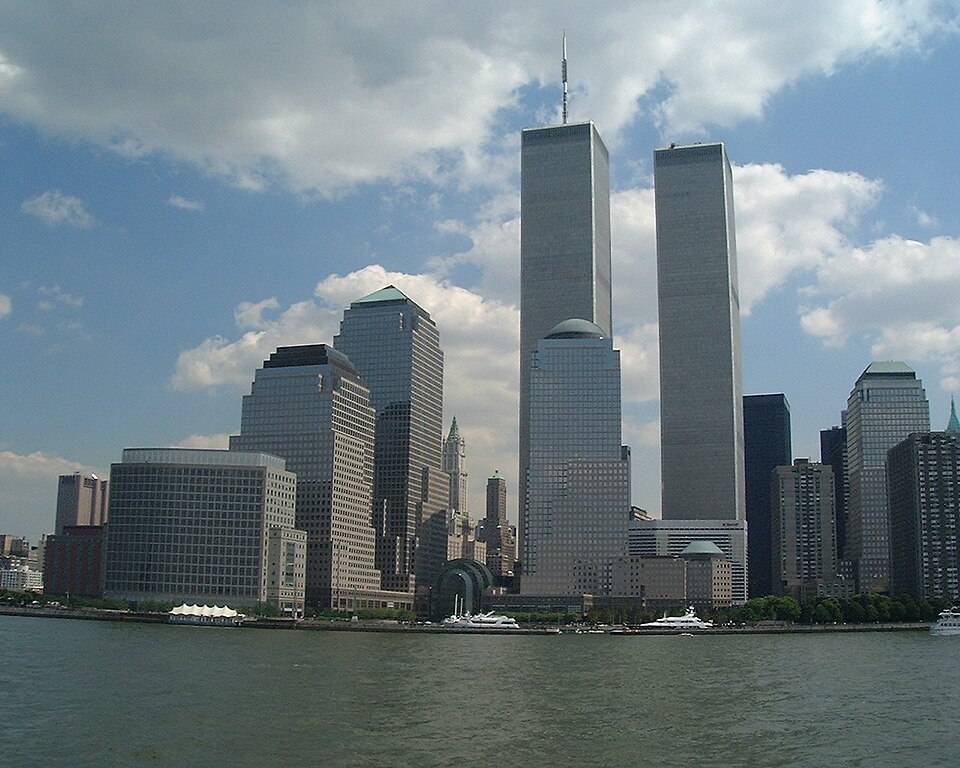
September 11, 2001

World Trade Center, September 11, 2001World Trade Center, September 11, 2001World Trade Center, September 11, 2001World Trade Center, September 11, 2001World Trade Center, September 11, 2001

What the record says

Every passage on this page is quoted as printed in a federal investigation of September 11 and linked to the page it sits on. 2,203 passages from 25 source files. Each cited page is cut out as its own one-page PDF, so a citation opens on the sentence.

The day

Nineteen hijackers took four commercial airliners, each carrying up to 11,400 gallons of jet fuel, and flew them into their targets. WTC 2 fell at 9:58:59 a.m. and WTC 1 at 10:28:22. Flight 77 struck the Pentagon at 9:37, killing all 64 aboard and 125 people inside the building. Flight 93 went into the ground in southwestern Pennsylvania around 10:03. At the trade center site 2,830 people died, 403 of them emergency responders, and ten major buildings partially or totally collapsed, about 30 million square feet of office space. WTC 7 was hit by no aircraft and burned for roughly seven hours before it came down at 5:20:52 p.m. It had been evacuated and nobody in it was killed.

The investigations

Four bodies produced the documents indexed here. Each set its own scope. FEMA's Building Performance Study reached the site first and declined to judge whether the towers met code. NIST's NCSTAR 1 reconstructed the towers up to the initiation of collapse and no further, leaving WTC 7 to a separate report that took three more years. The Congressional Joint Inquiry and the 9/11 Commission covered the intelligence and the response and carry no structural analysis of any collapse. Where two of them cover the same fact both are quoted, including where they disagree.

Cause

Both agencies put the cause at aircraft impact followed by fire. The impact into the north tower stripped the sprayed fireproofing off 43 of its 47 core columns and the fires then ran on bare steel. WTC 7 took no impact. Thermal expansion buckled Column 79, the failure spread from there, and NIST records it as the first known case of a tall building collapsing entirely because of fire. Neither agency faulted the construction. FEMA found no structural feature it would call substandard and noted that before that morning no protected steel-frame building had ever collapsed from fire.

Denials

On demolition, NIST concluded blast events could not have occurred at WTC 7 and found no evidence of any. Silverstein Properties is in the record stating that "pull it" meant withdrawing the firefighters still in the building. NIST timed the roofline's 18-story descent at 5.4 seconds, roughly 40 percent longer than free fall. In the intelligence volumes, the Commission recorded that the community had looked for al Qaeda-Iraq linkages before and never found any real ones.

Failures

The Joint Inquiry found no intelligence that would have given specific advance warning of the time, place or details, then documented what was in hand. Systemic Finding 1 says CIA employees failed to watchlist al-Mihdhar and al-Hazmi, two men already tied to al Qaeda, on at least three occasions between January 2000 and August 2001, leaving what was known about them dormant inside the community for as long as eighteen months. FBI agents believed, incorrectly, that nothing from a FISA case could be shared with criminal investigators at all. The FAA first saw the Phoenix memo when Joint Inquiry staff told them it existed, in early 2002.

Withheld and out of scope

The White House refused the Joint Inquiry access to the covert-action documents it asked for. NORAD's public account of its own timeline was found incorrect by the Commission on the notice it had for American 77. 59 passages here are a report naming a matter as outside its own scope. Those sort to the top of every section with the 202 denials.

In the record: 1,942 (88.2%) Denied on the record: 202 (9.2%) Outside scope: 59 (2.7%)

National Institute of Standards and Technology · The document itself · 188 claims

Denied on the recordNCSTAR 1 · p.146 · PDF p.196

Controlled demolition hypothesis

NIST found no corroborating evidence that the towers were brought down by controlled demolition with explosives planted before September 11.

NIST
“NIST found no corroborating evidence for alternative hypotheses suggesting that the WTC towers were brought down by controlled demolition using explosives planted prior to September 11, 2001.”

Stated in the collapse-initiation events section immediately after describing the observed collapse sequence

Denied on the recordNCSTAR 1 · p.141 · PDF p.191

No evidence the WTC floor fireproofing was ever tested

NIST found no evidence for the technical basis behind the floor truss insulation material or thickness selection, and no evidence that fire resistance tests of the WTC floor system were ever conducted.

NIST
“However, NIST found no evidence regarding the technical basis for the selection of insulation material for the floor trusses or for the insulation thickness to achieve a 2 hour rating. Further, NIST has found no evidence that fire resistance tests of the WTC floor system were conducted.”

Fire performance of the composite floor system was documented as a concern to owners/designers at the time

Denied on the recordNCSTAR 1 · p.90 · PDF p.140

Maximum steel temperature reached

NIST's metallurgical analysis found no evidence that any recovered steel sample had reached temperatures above 600 degrees Celsius.

NIST
“Using metallographic analysis, NIST determined that there was no evidence that any of the samples had reached temperatures above 600 °C.”

Well below steel's melting point, addressing claims steel melted

Denied on the recordNCSTAR 1 · p.146 · PDF p.196

Missiles fired at the towers

NIST found no evidence that missiles were fired at or hit the towers.

NIST
“NIST also did not fmd any evidence that missiles were fired at or hit the towers.”

Immediately follows the controlled-demolition denial in the same paragraph

Denied on the recordNCSTAR 1 · PDF p.231

Weld and joining integrity

NIST found no evidence that the joining method, materials, or welding procedures used in the towers were improper; the welds appeared to perform as intended.

NIST
“There was no evidence to indicate that the type of joining method, materials, or welding procedures were improper. The welds appeared to perform as intended.”
Denied on the recordNCSTAR 1 · p.42 · PDF p.92

Jet fuel largely did not burn off immediately

Less than 15 percent of the jet fuel in WTC 2 burned in the initial interior spray cloud and only 10 to 25 percent burned in the exterior fireballs, leaving well over half of the jet fuel remaining afterward.

NIST
“As in WTC 1, less than 15 percent of the jet fuel burned in the spray cloud inside the building. Roughly 10 percent to 25 percent was consumed in the fireballs outside the building. Thus, well over half of the jet fuel remained after the initial fireballs.”

Counters the claim that jet fuel burned off within minutes and could not have sustained the fires.

Denied on the recordNCSTAR 1 · p.89 · PDF p.139

Quality of the structural steel

NIST found about 87 percent of tested perimeter and core column steel exceeded its required minimum yield strength, and the below-spec remainder did not affect the towers' safety on September 11, 2001.

NIST
“Overall, approximately 87 percent of all perimeter and core column steel tested exceeded the required minimum yield strengths specified in design documents. Test data for the remaining samples were below specifications, but were within the expected variability and did not affect the safety of the towers on September 11, 2001.”

Denies that substandard steel contributed to the collapse

Denied on the recordNCSTAR 1 · p.26 · PDF p.76

NYPD helicopter could not attempt roof rescue

The first NYPD aviation unit arrived at 8:52 a.m. to evaluate roof rescue at WTC 1 but reported it was unable to land due to heavy smoke.

NIST
“At 8:52 a.m., the first New York City Police Department (NYPD) aviation unit arrived to evaluate the possibility of roof rescue, but reported they were unable to land on the roof due to the heavy smoke.”

Addresses claims that a helicopter rescue from the roof was feasible.

Denied on the recordNCSTAR 1 · p.141 · PDF p.191

Intact insulation prevented significant steel strength loss

Even near the fires, columns and trusses whose insulation remained intact never reached temperatures at which significant loss of strength occurred.

NIST
“Even in the vicinity of the fires, the columns and trusses for which the insulation was intact did not heat to temperatures where significant loss of strength occurred.”

From the summary of Tables 6-8/6-9 mapping regions where steel exceeded 600°C

WTC 7 collapse coverage

This report on the Twin Towers does not itself contain the collapse analysis for WTC 7, which was published in a separate report.

NIST
“Extensive details are found in the 42 companion reports. The final report on the collapse of appear in a separate report. WTC 7 will”

WTC 7's collapse mechanism was later published separately as NCSTAR 1A, not in this document

Denied on the recordNCSTAR 1 · PDF p.32

NIST's authority to assign fault

NIST explicitly states it lacks the statutory authority to find fault or negligence by any individual or organization.

NIST
“NIST does not have the statutory authority to make findings of fault nor negligence by individuals or organizations.”

From the Preface, describing the legal scope of NIST's investigative authority

WTC 7 outside this report's scope

This report addresses only the collapse of the WTC towers; the collapse of the 47-story WTC 7 is covered in a separate report.

NIST
“This report covers the WTC towers, with a separate report on the 47-story WTC 7.”

WTC 7's collapse is analyzed in NIST NCSTAR 1A, not this document

Denied on the recordNCSTAR 1 · p.13 · PDF p.63

Buildings not designed for a fuel-laden jetliner

High-rise buildings, including the WTC towers, were not required by code or designed to withstand the impact of a fuel-laden jetliner.

NIST
“However, buildings were not (and still are not) required by the building codes or designed to withstand the impact of a fuel-laden jetliner.”

directly rebuts the claim that the WTC was engineered to survive a jetliner strike

Denied on the recordNCSTAR 1 · p.26 · PDF p.76

Roof evacuation was not possible

NIST states there was no hope of roof evacuation from WTC 1 because it was neither planned nor practical and the roof exit doors were locked.

NIST
“Some of the people went toward the roof. However, there was no hope because roof evacuation was neither planned nor practical, and the exit doors to the roof were locked.”

Directly addresses claims that people could have been rescued via the roof.

FDNY fatalities outside the WTC towers

NIST estimated approximately 160 FDNY fatalities occurred outside the WTC towers, while the total number of responder casualties in WTC 1 specifically is unknown.

NIST
“emergency responders entered the building nor how many of the 421 responder casualties occurred in WTC 1. NIST estimated that approximately 160 FDNY fatalities occurred outside the WTC towers.”

Report explicitly states the exact count of responders who entered WTC 1, or their casualties there, could not be determined.

Denied on the recordNCSTAR 1 · p.68 · PDF p.118

Quality of WTC perimeter column steel

NIST's testing found the steel used in the WTC perimeter columns met its intended specifications for chemistry, mechanical properties, yield strengths, and tensile properties.

NIST
“The steels in the perimeter columns met their intended specifications for chemistry, mechanical properties, yield strengths, and tensile properties.”

rules out the claim that substandard or off-spec steel was used in construction

Scope of the investigation

NIST states its 'probable collapse sequence' covers only up to the initiation of collapse and does not include the structural behavior of the towers once collapse became inevitable.

NIST
“For brevity in this report, this sequence is referred to as the "probable collapse sequence," although it does not actually include the structural behavior of the tower after the conditions for collapse initiation were reached and collapse became inevitable.”

Footnote defining the boundary of the modeled collapse sequence

Denied on the recordNCSTAR 1 · p.132 · PDF p.182

Insulated steel columns not significantly weakened before collapse

NIST concluded the fires would not have been able to significantly weaken the insulated core or perimeter columns within the 102 minutes (WTC 1) and 56 minutes (WTC 2) that elapsed between impact and collapse.

NIST
“This established that the fires in WTC 1 and WTC 2 would not be able to significantly weaken the insulated core or perimeter columns within the 102 min and 56 min, respectively, after impact and prior to collapse.”

Explicitly rules out significant weakening of intact-insulation columns in the actual collapse timeframe

Scope regarding WTC 7

This report explicitly does not cover the collapse of WTC 7, which is addressed in a separate companion report.

NIST
“The fourth objective is the subject of Chapter 9. WTC 7 is the subject of a companion report.”

NCSTAR 1 covers only the collapses of WTC 1 and WTC 2.

Denied on the recordNCSTAR 1 · p.217 · PDF p.269

Design standard for aircraft impact resistance

NIST states it does not believe buildings should be designed to withstand aircraft impact, though egress cores should have structural integrity against foreseeable accidental loads.

NIST
“While NIST does not believe that buildings should be designed for aircraft impact, as the last line of defense for life safety, the stairwells and elevator shafts individually, or the core if these egress components are contained within the core, should have adequate structural integrity to withstand accidental structural loads and anticipated risks.”

Appears in a post-9/11 recommendation for future tall-building design, not an evaluation of the WTC towers themselves

Denied on the recordNCSTAR 1 · PDF p.273

WTC code-compliance concerns and cause of collapse

NIST states that the identified areas of building-code compliance concern in the WTC towers did not play a significant role in determining the outcomes of September 11, 2001.

NIST
“These areas of concern did not play a significant role in determining the outcomes related to the events of September 1 1, 2001.”

The concerns cited were fireproofing, tenant separation wall height, and egress requirements for assembly-use spaces

Fireproofing dislodgement thresholds vs. estimated impact force

NIST modeled that dislodging the sprayed fire-resistive insulation required 20g to 530g on flat column surfaces and 40g to 730g on truss bar insulation, and it estimated the aircraft impacts produced accelerations of only about 100g.

NIST
“For a flat surface (as on the surface of a column), the range was from 20g to 530g, where g is the gravitational acceleration. For an encased bar (such as used in the WTC trusses), the range was from 40g to 730g. NIST estimated accelerations from the aircraft impacts of approximately lOOg.”

underlies NIST's account of how impact-zone fireproofing was stripped, exposing steel to fire

Fireproofing stripped from core columns

The impact stripped fireproofing insulation from 43 of the tower's 47 core columns.

NIST
“43 of 47 core columns stripped of insulation on one or more floors.”

loss of fireproofing is central to NIST's fire-driven collapse mechanism

No technical basis found for WTC fireproofing thickness

NIST found no evidence of a technical basis linking the sprayed fire-resistive material (SFRM) thickness used on the WTC towers' steel to any fire resistance rating.

NIST
“NIST was not able to find any evidence that there was a technical basis to relate SFRM thickness to a fire resistance rating, nor was there sufficient prior experience to establish such thickness requirements by analogy.”

Collapse warning not relayed to responders

No evidence was found that NYPD aviation's advance warning of the impending collapse was passed on to all emergency responders at the scene.

NIST
“No evidence has been found to suggest that the information was further communicated to all emergency responders at the scene.”

NYPD aircrews reportedly saw collapse signs minutes before WTC 2 fell but this went no further

Towers withstood aircraft impact

The WTC towers withstood the initial aircraft impacts and would have remained standing if not for dislodged fireproofing insulation and the resulting multi-floor fires.

NIST
“the towers withstood the impacts and would have remained standing were it not for the dislodged insulation (fireproofing) and the subsequent multi-floor fires.”

NIST's summary finding for Objective 1 on the cause of collapse

No photographic validation of thermal simulation results

Unlike the aircraft-impact and fire simulations, NIST had no photographic or other evidence to directly compare against its Fire-Structure Interface (FSI) thermal results.

NIST
“Unlike the simulations of the aircraft impact and the fires, there was no evidence, photographic or other, for direct comparison with the FSl results.”

"FSl" reflects an OCR artifact for "FSI" in the source scan

Free-fall descent of the upper section

NIST states the building section above the level of collapse initiation came down essentially in free fall because the stories below offered little resistance.

NIST
“Since the stories below the level of collapse initiation provided little resistance to the tremendous energy released by the falling building mass, the building section above came down essentially in free fall”

Refers to the upper building section, not the entire structure's descent time

Cause of collapse initiation

The towers withstood the aircraft impacts themselves and would have remained standing if not for dislodged fireproofing insulation and the resulting multi-floor fires.

NIST
“However, the towers withstood the impacts and would have remained standing were it not for the dislodged insulation and the subsequent multi-floor fires.”

From the Chapter 8 Objective 1 summary on why the towers collapsed.

Cause of tower collapse

NIST's official report states that aircraft impacts and the subsequent fires led to the collapse of the World Trade Center towers.

NIST
“This report describes how the aircraft impacts and subsequent fires led to the collapse of the towers after terrorists flew jet fuel laden commercial airliners into the buildings”

From the report's Abstract, stating the investigation's central causal finding

Fraction of jet fuel burned immediately

Less than 15 percent of the jet fuel burned in the initial spray-cloud fireball inside the building, and well over half remained unburned to feed later fires.

NIST
“Less than 15 percent of the jet fuel burned in the spray cloud inside the building. A roughly comparable amount was consumed in the fireballs outside the building. Thus, well over half of the jet fuel remained in the building, unbumed in the initial fires.”

most fuel ignited office contents rather than burning off immediately

Overpressure from jet fuel fireballs

NIST estimated the rapid burning of jet fuel inside WTC 2 created an overpressure of 2 to 3 psi lasting 0.5 to 2 seconds.

NIST
“The rapid burning of the jet fuel inside the building created an overpressure that was estimated at 2 psi to 3 psi for 0.5 s to 2 s.”

Building codes and progressive collapse

NIST found that none of the building codes it examined, including the NYC code applied to the WTC, had provisions requiring design against progressive collapse.

NIST
“None of the codes had provisions for design against progressive collapse.”

Comparison covered the 1968 NYC code, 1964 NYS code, 1965 BOCA code, and 1967 Chicago code

WTC floor system fire rating never tested

NIST found no record that the innovative WTC floor truss assembly was ever fire-endurance tested, even though the building's own architect and structural engineer had said its fire rating could not be determined without such testing.

NIST
“there was no record of fire endurance testing of the innovative assemblies representing the thennally protected floor system used in the towers. The floor assembly was not tested despite the fact that the Architect of Record and the Structural Engineer of Record stated that the fire rating of this novel floor system could not be determined without testing.”

Port Authority confirmed to investigators that no testing records existed

Fireproofing (SFRM) thickness gaps on the truss floors

NIST's photographic analysis of pre-collapse WTC 1 floors found areas where the sprayed fireproofing coating on floor trusses was thinner than the specified 0.5 in.

NIST
“These numbers indicated that there were areas where the coating thickness was less than the specified 0.5 in.”

based on measurements from photographs of non-upgraded floors 22, 23, and 27 of WTC 1 taken in the 1990s

Engine impact on core columns

NIST's component testing found an engine moving at 500 mph broke any exterior column it struck, and if it missed the floor slab, the intact engine core retained enough momentum to sever a core column on direct impact.

NIST
“Moving at 500 mph, an engine broke any exterior column it hit. If the engine missed the floor slab, the majority of the engine core remained intact and had enough residual momentum to sever a core column upon direct impact.”

finding from small-scale component-level impact simulations, not the full-building runs

Steel heating rate with and without fireproofing

In a furnace test at 1,100°C, an uninsulated steel column reached 600°C in 13 minutes, while an identical column insulated with 1-1/8 in. of SFRM had not reached that temperature after 10 hours.

NIST
“Uninsulated, it took just 13 min for the steel surface temperatures to reach 600 °C, in the range where substantial loss of strength occurs. When insulated with 1 1/8 in. of SFRM, the same column had not reached that temperature in 10 hours.”

600°C is the range NIST identifies where structural steel begins substantial strength loss, not melting

Floor truss heating rate with and without fireproofing

In lab tests, a bare steel truss reached a temperature at which significant strength loss was imminent in 15 minutes, while an identical insulated truss had not reached that temperature after 50 minutes.

NIST
“As shown in Figure 2-10, in 15 min, a bare truss reached a temperature at which significant loss of strength was imminent. An identical, but insulated truss had not reached that temperature in 50 min.”

Trusses were found far more susceptible to heat than the perimeter and core columns

WTC 1 core-to-exterior load transfer timeline

By about 100 minutes after impact, approximately 20 percent of WTC 1's core column loads had been transferred by the hat truss to the exterior walls due to core weakening.

NIST
“At about 100 min, approximately 20 percent of the core loads had been transferred by the hat truss to the exterior walls due to weakening of”

Sentence is cut off at the end of the provided excerpt

WTC 2 core column damage

Impact simulations indicated five to ten WTC 2 core columns were severed, with up to four more heavily damaged.

NIST
“The impact simulations of WTC 2 indicated that five to ten core columns were severed and up to four columns were heavily damaged.”

WTC 1 core column damage

Impact simulations indicated three to six WTC 1 core columns were severed by the aircraft, with three to four more heavily damaged.

NIST
“The impact simulations of WTC 1 indicated that three to six core columns were severed, and three to four columns were heavily damaged.”

Cause of core column weakening

Thermal effects dominated the weakening of WTC 1's core, while aircraft impact damage dominated the weakening of WTC 2's core.

NIST
“The core columns were weakened significantly by the aircraft impact damage and thermal effects. Thermal effects dominated the weakening of WTC 1”

No progressive-collapse provisions at design time

At the time the WTC towers were designed and built, there were no explicit structural integrity provisions to mitigate progressive collapse.

NIST
“At the time of the design and construction of the WTC towers, there were no explicit structural integrity provisions to mitigate progressive collapse.”

No technical basis for the fireproofing thickness used

NIST found no technical basis for the sprayed fire-resistive material (SFRM) or its thickness as applied to the WTC's long-span open-web floor trusses.

NIST
“No technical basis was found for selecting the sprayed fire-resistive material (SFRM) used or its thickness for the large-span open-web floor trusses of the WTC towers.”

Progressive collapse definition

NIST defines progressive collapse as an initial local failure that spreads from element to element, causing collapse of an entire structure or a disproportionately large part of it.

NIST
“Progressive collapse (or disproportionate collapse) occurs when an initial local failure spreads from structural element to structural element resulting in the collapse of an entire structure or a disproportionately large part of it.”

Definitional footnote supporting Recommendation on progressive collapse prevention

Core column load redistribution

NIST found that while the WTC towers could redistribute loads from damaged perimeter columns, the core columns lacked sufficient redundant paths to carry gravity loads once damaged.

NIST
“While the WTC towers eventually collapsed, they had the capacity to redistribute loads from impact and fire damaged structural components and subsystems to undamaged components and subsystems. However, the core columns in the WTC towers lacked sufficient redundant (alternate) paths for carrying gravity loads.”

Footnote to Chapter 9 discussion of progressive collapse prevention

Fireproofing (SFRM) adhesion on primer-painted steel

NIST tests found that fireproofing (SFRM) adhesive strength on primer-painted steel was only one-third to one-half of its strength on uncoated steel.

NIST
“NIST tests showed that the adhesive strength of SFRM on steel coated with primer paint was a third to half of the adhesive strength on steel that had not been coated with primer paint.”

Steel used in the WTC towers was coated with primer paint before SFRM fireproofing was applied, per the same footnote

Why WTC 2 collapsed faster than WTC 1

WTC 2 collapsed more quickly than WTC 1 because the aircraft caused more damage to the building core, including a heavily loaded corner column, and produced early, persistent fires where insulation had been extensively dislodged.

NIST
“WTC 2 collapsed more quickly than WTC I because there was more aircraft damage to the building core, including one of the heavily loaded comer columns, and there were early and persistent fires on the east side of the building, where the aircraft had extensively dislodged insulation from the stmctural steel.”

OCR artifacts 'comer'/'stmctural' preserved as printed

WTC 1 collapse mechanism

In WTC 1, fire-weakened floors pulled the heated south perimeter columns inward until the south wall buckled and the building's top section tilted south and began its descent.

NIST
“The floors pulled the heated south perimeter columns inward, reducing their capacity to support the building above. Their neighboring columns quickly became overloaded as columns on the south wall buckled. The top section of the building tilted to the south and began its descent.”

WTC 2 collapse mechanism

In WTC 2, fire-weakened floors pulled the heated east perimeter columns inward until the east wall buckled and the building's top tilted east and south and began its descent.

NIST
“The floors pulled the heated east perimeter columns inward, reducing their capacity to support the building above. Their neighboring columns quickly became overloaded as columns on the east wall buckled. The top section of the building tilted to the east and to the south and began its descent.”

Sprinkler system failure

Aside from evacuation announcements, the active fire safety systems played no role in life safety on September 11 because the water supplies to the sprinklers were damaged by the aircraft impact.

NIST
“with the exception of the evacuation announcements, they played no role in the safety of life on September 1 1 because the water supplies to the sprinklers were damaged by the aircraft impact.”

Sprinkler system status on 9/11

By September 11, 2001, automatic sprinklers had been installed throughout both WTC towers.

NIST
“September 11, 2001, automatic sprinklers had been installed throughout WTC 1 and WTC 2.”

addresses claims that the towers lacked working sprinkler protection

WTC 2 collapse initiation mechanism

NIST's record describes WTC 2's collapse beginning with the northeast corner tilting counterclockwise as column buckling spread across the north and east faces.

NIST
“The northeast comer tilted counterclockwise around the base of floor 82. Column buckling was then seen progressing across the north face and nearly simultaneously on the east face.”

Table 6-2 entry timed at 9:58:59 a.m.

Cause of floor truss sagging

The floor sagging that pulled in the exterior columns was caused primarily by buckling of truss web diagonals or disconnection of truss seats at the exterior wall or core.

NIST
“Floor sagging was caused primarily by either buckling of truss web diagonals or disconnection of truss seats at the exterior wall or the core perimeter.”

text goes on to say this was driven mainly by elevated temperature, except near the WTC 2 southeast corner

Role of dislodged insulation in collapse

NIST found the towers likely would not have collapsed from the combined aircraft impact and fires if the thermal insulation had not been widely dislodged.

NIST
“The towers likely would not have collapsed under the combined effects of aircraft impact and the subsequent multi-floor fires encountered on September 1 1 if the thermal insulation had not been widely dislodged or had been only minimally dislodged by aircraft impact.”

Frames insulation loss, not fire alone, as a key contributing factor NIST identified

Sprinkler system's role

Aside from evacuation announcements, active fire safety systems played no role in life safety on 9/11 because the aircraft impact damaged the sprinklers' water supply.

NIST
“exception of the evacuation announcements, they played no role in the safety of life on September 1 1 because the water supplies to the sprinklers were damaged by the aircraft impact.”

Smoke purge systems were also never activated and would have been ineffective regardless.

Basis for insulation thickness

NIST found no technical basis or test data underlying the thermal protection specification used on the towers' structural steel.

NIST
“NIST found no technical basis or test data on which the thennal protection of the steel was based.”

"thennal" appears exactly this way in the source text.

Loss of fire suppression water supply

The aircraft impacts severed the sprinkler and fire hose water supply systems, negating any possible fire suppression efforts on the impact floors.

NIST
“severing of the sprinkler and fire hose water supply systems, negating any possible fire suppression efforts”

Fire alone insufficient without structural damage

NIST found that in the absence of structural and insulation damage, a conventional fire similar to or less intense than the September 11 fires likely would not have caused a WTC tower to collapse.

NIST
“In the absence of structural and insulation damage, a conventional fire substantially similar to or less intense than the fires encountered on September 11, 2001, likely would not have led to the collapse of a • WTC tower.”

Bullet character mid-sentence is an artifact of the source PDF's text extraction

Insulation loss as a collapse precondition

NIST found the WTC towers would likely not have collapsed from the combined aircraft impact and fires if the thermal insulation on structural steel had not been widely dislodged.

NIST
“The WTC towers would likely not have collapsed under the combined effects of aircraft impact damage and the extensive, multi-floor fires that were encountered on September 11, 2001, if the thermal insulation had not been widely dislodged or had been only minimally dislodged by aircraft impact.”

Central to NIST's causal account of the collapse

Collapse trigger mechanism

Column buckling over an extended region of the perimeter face ultimately triggered the global collapse, as loads could no longer be redistributed to the already weakened core.

NIST
“Column buckling over an extended region of the perimeter face ultimately triggered the global system collapse as the loads could not be redistributed through the hat tmss to the already weakened building core.”

NIST's stated collapse-initiation mechanism

Stairwell A passability not communicated

Some WTC occupants never received word that Stairwell A was possibly passable above the impact zone, information that could have saved lives.

NIST
“Some occupants did not get information that potentially could have saved their lives, such as notification that Stairwell A was possibly passable from above the impact zone.”

Missing Port Authority aircraft-impact analysis

NIST found two Port Authority documents noting aircraft-collision safety was considered in original design, but could locate no documentary evidence of the actual impact analysis and found no indication fire effects were considered.

NIST
“While two documents from The Port Authority indicated that the safety of the WTC towers and their occupants in an aircraft collision was a consideration in the original design, it appears that the effect of the subsequent fires was not considered. NIST was unable to locate any documentary evidence on the aircraft impact analysis considered by The Port Authority.”

Sprinkler retrofit completion date

The WTC towers were not fully sprinklered until 2001, about 30 years after they were built.

NIST
“The WTC towers were fully sprinklered by 2001, about 30 years after their construction.”

WTC sprinkler installation timeline

The WTC towers were built without sprinklers and were not fully sprinklered until nearly 28 years after a 1973 New York City law required compartmentation or sprinklering.

NIST
“The WTC towers were unsprinklered when built. It took nearly 28 years after passage of New York City Local Law 5 in 1973, which required either compartmentation or sprinklering, for the buildings to be fully sprinklered (the Port Authority chose not to use the compartmentation option in Local Law 5).”

The Port Authority chose not to use the compartmentation alternative allowed under Local Law 5

In the recordNCSTAR 1 · PDF p.4

Withheld evidence in the investigation

NIST's own report discloses that some evidence it collected was withheld from public release under nondisclosure provisions.

NIST
“certain evidence received by NIST in the course of this Investigation is "voluntarily provided safety-related information" that is "not directly related to the building failure being investigated" and that "disclosure of that information would inhibit the voluntary provision of that type of information" (15 USC 7306c).”

Disclaimer No. 3, invoking 15 USC 7306c to justify nondisclosure of certain evidence

In the recordNCSTAR 1 · PDF p.4

Legal use of NIST's report

By statute, no part of NIST's WTC investigation report may be used in a lawsuit seeking damages related to the disaster.

NIST
“No part of any report resulting from a NIST investigation into a structural failure or from an investigation under the National Construction Safety Team Act may be used in any suit or action for damages arising out of any matter mentioned in such report (15 USC 281a; as amended by P.L. 107-231).”

Statutory legal-use restriction printed in the report's front matter

In the recordNCSTAR 1 · PDF p.4

Limits on verifying as-built construction

NIST states it could not verify the actual as-built construction, material properties, or later changes to the WTC buildings.

NIST
“NIST takes no position as to whether the design or construction of a WTC building was compliant with any code WTC buildings, NIST could not verify the actual (or as-built) construction, the properties and condition of the materials used, or changes to the original construction made over the life of the buildings.”

Disclaimer No. 4; NIST attributes this limitation to the destruction of the buildings

Steel wreckage analyzed

NIST investigators analyzed 236 pieces of steel obtained from the wreckage as part of the investigation.

NIST
“analyzed 236 pieces of steel that were obtained from the wreckage; performed laboratory tests, measured material properties, and performed computer simulations of the sequence of events”

Counters claims that the steel was not preserved or examined

Evacuation success rate

About 87 percent of the towers' roughly 17,400 occupants evacuated successfully, including 99 percent of those below the impact floors.

NIST
“Approximately 87 percent of the estimated 17,400 occupants of the towers, and 99 percent of those located below the impact floors, evacuated successfully.”

WTC 1 occupants trapped above impact

In WTC 1, where the aircraft destroyed all escape routes above the impact floors, 1,355 people were trapped in the upper floors when the building collapsed.

NIST
“In WTC 1 , where the aircraft destroyed all escape routes, 1,355 people were trapped in the upper floors when the building collapsed.”

Full-occupancy evacuation estimate

NIST estimated that if the towers had been fully occupied with 20,000 people each, evacuation would have taken just over 3 hours and about 14,000 people might have perished due to insufficient stairwell capacity.

NIST
“NIST estimated that if the towers had been fully occupied with 20,000 occupants each, it would have taken just over 3 hours to evacuate the buildings and about 14,000 people might have perished because the stairwell capacity would not have been sufficient to evacuate that many people in the available time.”

Hypothetical scenario, not what actually occurred on September 11

WTC 2 Stairwell A escape

Eighteen people above the WTC 2 impact zone escaped through the damaged third stairway, Stairwell A, while the other 619 people in or above the impact zone perished.

NIST
“Eighteen people fi-om above the impact zone found a passage through the damaged third stairway (Stairwell A) and escaped. The other 619 people in or above the impact zone perished.”

Buildings not designed for aircraft attack

General-population buildings, including the WTC towers, are not designed to withstand attacks of the severity of the September 11 aircraft strikes, since building regulations do not require designs to consider aircraft impact.

NIST
“Buildings for use by the general population are not designed to withstand attacks of such severity; building regulations do not require building designs to consider aircraft impact.”

Wind load estimate discrepancy

Two independent commercial wind-load estimates for the towers obtained in 2002 differed from each other by as much as 40 percent.

NIST
“Two sets of wind load estimates for the towers obtained by independent commercial consultants in 2002, however, differed by as much as 40 percent.”

Estimates came from insurance-litigation wind tunnel tests unrelated to the Investigation

Tower height

The roof of WTC 1 stood 1,368 feet above the Concourse Level, six feet taller than WTC 2, and carried a 360-foot antenna mast.

NIST
“The roof of WTC 1 was 1,368 ft above the Concourse Level, 6 ft taller than WTC 2, and supported a 360 ft tall antenna mast for television and radio transmission.”

Sole prior study on aircraft impact

The only pre-9/11 document NIST found addressing an aircraft strike on the towers concluded a collision would cause only local damage and could not cause collapse.

NIST
“This document stated that such a collision would result in only local damage and could not cause collapse or substantial damage to the building.”

that document was a three-page talking-points memo, not an engineering study

Destroyed evidence and reconstruction uncertainty

NIST's account relies on modeling because the towers' remains and records were destroyed and disposed of before Congress funded the investigation, leaving some facts undeterminable.

NIST
“the building and the records kept within it were destroyed, and the remains of the towers were disposed of before congressional action and funding was available for this Investigation to begin. As a result, there are some facts that could not be discerned, and thus there are uncertainties in this accounting.”

explains why NIST's account is a reconstruction rather than direct physical evidence

Occupancy at time of impact

Only about 8,900 of the roughly 20,000 people who typically worked in WTC 1 were in the building shortly before 9:00 a.m. on September 11.

NIST
“As a result, only about 8,900 of the typical 20,000 people were in World Trade Center (WTC) 1 shortly before 9:00 a.m.”

Flight 11 impact parameters

American Airlines Flight 11 struck WTC 1 at about 440 mph near the 96th floor, cutting a gash from the 93rd to the 99th floor.

NIST
“Moving at about 440 mph, the nose hit the exterior of the tower at the 96"^ floor. The aircraft cut a gash that was over half the width of the building and extended from the 93'^'' floor to the 99"" floor (Figures 2-2 and 2-3).”

Tower survived impact; fires caused collapse

WTC 1 remained standing after the aircraft impact and would have continued to stand if not for the fires that followed.

NIST
“WTC 1 still stood, and would have continued to do so, if not for the fires that followed.”

NIST attributes the eventual collapse to the ensuing fires, not the impact alone

Escape routes eliminated above impact zone

The impact collapsed the walls of all three stairwells and cut elevator service to the upper 60 floors, eliminating all opportunity for escape above the impact zone.

NIST
“The crash and flying debris had collapsed the walls of all three stairwells and interrupted all elevator service to the upper 60 floors. All opportunity for escape had been eliminated.”

WTC 1 smoke purge system never activated

The manually activated smoke purging system in WTC 1 was never turned on during the 102 minutes the tower stood after being hit.

NIST
“The manually activated smoke purging system was intended for smoke removal during fire department operations following a fire. Thus, it was not turned on during the 102 min that the tower would remain standing.”

Report adds it likely would not have helped anyway since fire location was unknown and vent shafts were damaged.

Occupant familiarity with prior 1993 bombing

A quarter of WTC 1 occupants on 9/11 had been working in the building since before the 1993 bombing.

NIST
“A quarter of them had been working in the building since before the 1993 bombing, and most of those had been in the building on that day.”

First person falls from WTC 1

NIST's account records that at least 111 people were observed falling from WTC 1, the first at 8:52 a.m.

NIST
“of at least 1 1 1 people was observed falling from the building.”

OCR renders '111' as '1 1 1' in the source text.

Unheeded evacuation order

A senior Port Authority Police Department official called for evacuation of the entire WTC complex at 8:59 a.m., but the call was not heard or heeded by others.

NIST
“At 8:59 a.m., a senior PAPD official called for evacuation of the entire WTC complex, although that call was not heard nor heeded by others.”

Emergency radio system overload

Emergency responder radio traffic peaked at about five times normal volume in the 20 minutes after the first attack and remained elevated afterward.

NIST
“Emergency responder radio traffic peaked at about five times its normal traffic volume during the 20 min period after to the attack. This peak gradually tapered off, but still continued at a sustained level three times the normal traffic volume.”

Report separately states the radio systems were not adequate for this volume.

Upper-layer fire temperatures in WTC 1

Upper layer air temperatures in WTC 1's fire zones were about 500°C in cooler areas and reached about 1,000°C near active fires.

NIST
“the cooler parts of this upper layer were at about 500 °C, and in the vicinity of the active fires, the upper layer air temperatures reached 1,000 °C.”

WTC 1 core modeled as three sections before collapse

NIST modeled WTC 1's core as three sections at the time of collapse: an undamaged bottom section, an undamaged top section, and a fire-weakened middle section.

NIST
“At this point, the core of WTC 1 could be imagined to be in three sections. There was a bottom section below the impact floors that could be thought of as a strong, rigid box, structurally undamaged and at almost normal temperature. There was a top section above the impact and fire floors that was also a heavy, rigid box.”

Only one working elevator during WTC 1 rescue effort

When firefighters entered WTC 1, only one of the building's 99 upward elevators was working, and it only reached the 16th floor.

NIST
“Once inside, they found that only one of the 99 upward elevators was working, one that went as far as the 16"^ floor.”

WTC 2 collapse recorded by seismic sensors

The collapse of more than 250,000 tons of steel, concrete, and furnishings in WTC 2 was recorded by seismic sensors located 100 miles away.

NIST
“WTC 2 collapsed. The shudder as the more than 250,000 tons of steel, concrete, and furnishings hit the ground was felt well beyond the site. Seismic sensors located 100 miles away recorded the time and intensity of the event.”

South wall inward bowing before WTC 1 collapse

By 10:23 a.m., WTC 1's south exterior wall had bowed inward as much as 55 inches, shortly before the building collapsed.

NIST
“By 10:23 a.m., the south exterior wall had bowed inward as much as 55 in.”

No survivors above the impact zone in WTC 1

There were no survivors among the 1,355 people on or above WTC 1's 92nd floor because the aircraft destroyed all downward egress paths and roof rescue was impossible.

NIST
“There were no survivors among the 1,355 people who were on or above the 92"'' floor. The aircraft had destroyed all egress paths downward, and roof rescue was impossible.”

WTC 2 top-floor sway from aircraft impact

The impact of UA Flight 175 caused the top of WTC 2 to sway 27 inches to the north, reaching maximum displacement in 2.6 seconds.

NIST
“In response to the force of the collision, the top of the tower swayed 27 in. to the north, taking 2.6 s to reach the maximum displacement.”

WTC 2 floor load capacity vs. fireball overpressure

NIST estimated an undamaged WTC 2 floor's static capacity was 4.8 psi against uplift pressure and 4.4 psi against downward pressure.

NIST
“Based on the failure of the truss seat connections, NIST estimated that the static capacity of an undamaged floor was 4.8 psi against uplift pressure and 4.4 psi against downward pressure over the entire floor.”

WTC 2 Stairway A found passable

NIST's account of WTC 2 states 18 occupants above the impact floors discovered Stairway A was not fully blocked and escaped through it.

NIST
“18 occupants had discovered that the hot, smokefilled, debris-laden Stairway A was not fully blocked and had made their way to survival.”

Of roughly 619 others above the impact floors, none made it out

No record of Stairway A route being shared

NIST found no record that information about the passable Stairway A escape route was ever collected and passed on to other trapped occupants.

NIST
“There are no records of infomation regarding this escape route having been collected and transmitted to others who might have been able to use it.”

"infomation" is a typo in the original document text

WTC 2 collapse mechanism

NIST attributes WTC 2's collapse to inward bowing of the east wall columns, which redistributed loads through the hat truss and spandrels to the weakened core and adjacent walls.

NIST
“The inward bowing of columns on the east wall spread along the east face. The east wall lost its ability to support gravity loads, and, consequently, redistributed the loads to the weakened core through the hat truss and to the adjacent north and south walls through the spandrels.”

WTC 2 collapse initiation time

NIST states WTC 2's collapse began at 9:58:59 a.m. after column failure spread from the east wall around the corners to the north and south faces.

NIST
“Column failure continued from the east wall around the comers to the north and south faces. The top of the building continued to tilt to the east and south, as, at 9:58:59 a.m., WTC 2 began to collapse.”

"comers" is a typo for "corners" in the original

FDNY progress before WTC 2 collapse

NIST records that at 9:55 a.m. firefighters reported reaching the 55th floor of WTC 2, one of the few surviving records of how high responders got before the collapse.

NIST
“At 9:55 a.m., firefighters communicated that they had reached floor 55 of WTC 2, one of the few calls for which a record survived indicating how high the responders had reached.”

Seven factors cited for WTC 2 collapse

NIST attributes WTC 2's collapse to a combination of seven factors rather than a single cause.

NIST
“Seven factors led to the collapse of WTC 2:”

Listed factors include aircraft impact damage, jet fuel fires, dislodged fireproofing, sustained fires, weakened core columns, sagging floors, and bowed perimeter columns

All seven WTC buildings destroyed

NIST records that by sunset on September 11, 2001, all seven buildings of the World Trade Center complex, not only the Twin Towers, lay in ruins.

NIST
“By sunset on September 11, 2001, all seven buildings on the World Trade Center (WTC) site lay in ruins”

Includes WTC 7 among the seven destroyed buildings

Codes never required jetliner-impact resistance

NIST states that building codes did not then, and do not now, require a building to withstand the impact of a fuel-laden commercial jetliner.

NIST
“However, building codes did not then, and do not currently, require that a building withstand the impact of a fuel-laden commercial jetliner.”

Design-era Boeing 707 impact analysis claim

A Port Authority document stated that the impact of a Boeing 707 aircraft flying at 600 mph was analyzed during the WTC towers' design stage.

NIST
“A Port Authority document indicated that the impact of a Boeing 707 aircraft flying at 600 mph was analyzed during the design stage of the WTC towers.”

Elevator evacuation from WTC 2 after WTC 1 was hit

NIST states roughly 3,000 WTC 2 occupants above the impact zone survived largely by taking elevators down after witnessing the attack on WTC 1, before the second plane struck.

NIST
“Roughly 3,000 of the people who were initially at or above the impact floors in WTC 2 and were warned by the attack on WTC 1 survived, however, in large part by taking the elevators downward before the aircraft struck WTC 2.”

Total steel tonnage in the Twin Towers

About 200,000 tons of steel were used to build the two WTC towers.

NIST
“Roughly 200,000 tons of steel were used in the construction of the two WTC towers.”

Scope of NIST's collapse reconstruction modeling

NIST's reconstruction modeled the towers' structural response, based on aircraft impact damage, fire spread, and heating, through the initiation of collapse.

NIST
“The response of the damaged and heated building structure, and the progression of structural component failures leading to the initiation of the collapse of the towers.”

the fourth of four modeling steps NIST used to reconstruct September 11, 2001

Amount of recovered structural steel

NIST's analyzed steel samples represented only roughly 0.25 to 0.5 percent of the 200,000 tons of structural steel used in building the towers.

NIST
“The remaining 229 samples represented roughly 0.25 percent to 0.5 percent of the 200,000 tons of structural steel used in the construction of the two towers.”

Most steel had already been recycled before NIST's investigation began

Rarity of high-temperature steel evidence

Of more than 170 areas examined on 16 recovered perimeter column panels, only three columns showed paint-cracking evidence of reaching above 250 degrees Celsius.

NIST
“Of the more than 170 areas examined on 16 perimeter column panels, only three columns had evidence that the steel reached temperatures above 250 °C: east face, floor 98, inner web; east face, floor 92, inner web; and north face, floor 98, floor truss connector.”

NIST cautioned this sample was only 3 percent of perimeter columns from the fire floors

Fire exposure of recovered WTC 2 steel

None of the nine recovered steel panels from WTC 2's fire floors showed direct exposure to fire.

NIST
“None of the nine recovered panels from within the fire floors of WTC 2 were directly exposed to fire.”

No visible structural damage from the 104th floor fire

Photographic evidence of the WTC 1 104th floor fire showed no signs of column bowing or floor collapse.

NIST
“The photographic evidence showed no signs of column bowing or a floor collapse.”

Exterior wall inward bowing before collapse

Photographic and video evidence showed the exterior walls of both towers bowing inward in large sections just before collapse.

NIST
“Photographic and video evidence showed inward bowing of large sections of the exterior walls of both towers just prior to the time of collapse.”

cited as the basis for building the exterior-wall finite element model

Truss seat inward pull force

NIST's modeling found sagging floor trusses exerted approximately 14 kip of inward pull per truss seat on the attached perimeter column.

NIST
“The sagging of trusses resulted in approximately 14 kip of inward pull per truss seat on the attached perimeter column.”

result from the Phase 1 exterior wall subsystem model

Floor sagging threshold for inward pull

NIST's detailed truss model found floors began exerting inward pull on the exterior columns once floor sagging exceeded about 25 inches over the 60-foot floor span.

NIST
“Analysis results from the detailed truss model found that the floors began to exert inward pull forces when floor sagging exceeded approximately 25 in. for the 60 ft floor span.”

Floor truss connections at time of bowing

NIST concluded the observed inward bowing of the exterior walls indicated most floor connections were still intact when the bowing occurred.

NIST
“The observed inward bowing of the exterior wall indicated that most of the floor connections must have been intact to cause the observed bowing.”

runs against the idea that bowing was caused by trusses that had already disconnected

Aircraft impact speed

NIST estimated American Airlines Flight 11 struck WTC 1 at 443 mph and United Airlines Flight 175 struck WTC 2 at 542 mph.

NIST
“AA 11 (WTC 1) UAL 175 (WTC 2) 443 + 30 542 ± 24”

derived from NIST's photographic and video analysis of the impacts, with stated uncertainty of ±30 mph and ±24 mph respectively

Photographic evidence for core/interior fire exposure

NIST states it could not locate any photographic evidence of fire conditions inside the building core or along the floor assemblies.

NIST
“NIST could not locate any photographic evidence regarding the fire exposure of the building core or the floor assemblies.”

NIST relied on computational fire modeling (FDS) rather than direct observation for these areas

WTC 1 fire duration near 1,000°C

NIST's fire simulations found that at any given location in WTC 1, temperatures near 1,000°C persisted for only about 15 to 20 minutes, with temperatures near 500°C or below the rest of the time.

NIST
“At any given location, the duration of temperatures near 1,000 °C was about 15 min to 20 min. The rest of the time, the calculated temperatures were near 500 °C or below.”

From the FDS fire simulation results used to drive the structural thermal analysis

WTC fire heat release rates

NIST's simulations produced total heat outputs of about 8,000 GJ from the WTC 1 fires and 3,000 GJ from the WTC 2 fires.

NIST
“total heat outputs from the simulated fires of about 8,000 GJ from WTC 1 and 3,000 GJ from WTC 2.”

Peak plateau heat release rates were about 2 GW (WTC 1) and 1 GW (WTC 2)

WTC 2 "cold spot" fire anomaly

NIST's fire simulations could not explain why no fires appeared in the 10-window "cold spot" on the north face of WTC 2's 80th-82nd floors.

NIST
“Nothing in the simulations explained the absence of fires in the "cold spot," the 10-window expanse toward the east of the north face of the 80"\ 81'', and 82"'' floors.”

OCR garbles the floor ordinals (80th/81st/82nd) in the source scan

Floor system fire tests limited to reduced scale

No facility existed that could test the full 60-foot floor truss spans used in the WTC towers, so NIST's contracted tests used shorter specimens scaled to practical dimensions.

NIST
“There were no established facilities capable of testing the 60 ft lengths of the long spans that were used in the towers, but there is a history of testing reduced-scale assemblies and scaling them to practical dimensions.”

Full-scale test specimens used were 35 ft, the shorter span between core and perimeter

Floor assemblies sustained full design load for 2 hours

All four tested floor assemblies sustained the maximum design load for approximately 2 hours without collapsing.

NIST
“All four test specimens sustained the maximum design load for approximately 2 hours without collapsing.”

NIST cautioned these lab conditions differed substantially from the actual September 11 fire exposure

One floor test specimen failed to meet NYC fire code

The Test 4 floor specimen achieved only a 3/4-hour fire rating, which would not have met the 2-hour requirement of the NYC Building Code.

NIST
“The specimen in Test 4, with a fire rating of Va hour, would not have met the 2 hour requirement of the NYC Building Code.”

"Va hour" is an OCR rendering of "¾ hour" in the source scan; Test 4 used a 17 ft restrained assembly

WTC floor truss fire resistance rating

Underwriters Laboratories testing found the restrained full-scale WTC floor assembly achieved a 1.5-hour fire resistance rating, while the unrestrained version achieved a 2-hour rating.

NIST
“The restrained full-scale floor system obtained a fire resistance rating of 1 Vi hours, while the unrestrained floor system achieved a 2 hour rating.”

"1 Vi hours" is an OCR rendering of "1½ hours" in the source scan

Piston effect ejecting smoke and debris

NIST attributes smoke and debris ejected from windows during collapse to air compressed ahead of the falling mass, like a piston.

NIST
“The falling mass of the building compressed the air ahead of it, much like the action of a piston, forcing material, such as smoke and debris, out the windows as seen in several videos.”

Offered as the explanation for the puffs of smoke/debris visible in collapse footage

Time towers stood after impact

Both towers remained stable after aircraft impact, WTC 1 for 102 minutes and WTC 2 for 56 minutes, before collapse.

NIST
“Both WTC 1 and WTC 2 were stable after the aircraft impact, standing for 102 min and 56 min, respectively.”

Cited as evidence the towers had considerable reserve structural capacity after impact

Post-impact sway compared to design wind loads

WTC 2's post-impact oscillation reached only 30-40 percent of the sway the tower was designed for under hurricane-force winds.

NIST
“the damaged tower oscillated with a peak amplitude that was between 30 percent and 40 percent of the sway under hurricane force winds for which the towers were designed”

Used to argue the impact-damaged structure retained significant reserve capacity

Inward bowing alone did not cause collapse

NIST states inward bowing of exterior walls was necessary but not sufficient to trigger collapse; core weakening from impact and fire was also required.

NIST
“Inward bowing was a necessary but not sufficient condition to initiate collapse. In both WTC I and WTC 2, significant weakening of the core due to aircraft impact damage and thermal effects was also necessary to initiate building collapse.”

Clarifies that visible wall bowing was one factor among several required for collapse initiation

1975 WTC 1 fire did not cause collapse

NIST notes WTC 1 did not collapse during a major 1975 fire that burned about a quarter of the 11th floor.

NIST
“WTC 1 did not collapse dtiring the major fire in 1975, which engulfed a large area (about one-fourth of the floor area or 9,000 ft') on the southeast quadrant of the 1 1th floor.”

Cited as a known fact supporting NIST's conclusion that ordinary fire alone would not collapse a WTC tower

WTC 1 tilt at collapse initiation

The section of WTC 1 above the impact zone tilted at least 8 degrees to the south as a rigid block before collapsing.

NIST
“The section of the building above the impact zone (near the 98"^ floor), acting as a rigid block, tilted at least 8 degrees to the south.”

Part of NIST's probable WTC 1 collapse sequence findings

WTC 2 eastward tilt increased before collapse obscured

The eastward tilt of the WTC 2 upper section increased to about 20 degrees as it began to fall, until dust clouds obscured the view.

NIST
“The tilt to the south did not increase any further as the upper building section began to fall, but the tilt to the east was seen to increase to 20 degrees until dust clouds obscured the view.”

Follows immediately after the initial 7-8 degree tilt figures in the same bullet list

WTC 2 tilt at collapse initiation

The WTC 2 section above the impact zone tilted 7-8 degrees east and 3-4 degrees south before significant downward movement began.

NIST
“The building section above the impact zone (near the 82"'' floor) tilted 7 degrees to 8 degrees to the east and 3 degrees to 4 degrees to the south prior to significant downward movement of the upper building section.”

Part of NIST's probable WTC 2 collapse sequence findings

WTC 2 Stairwell A survived aircraft impact

United Airlines Flight 175 destroyed Stairwells B and C in WTC 2 but not Stairwell A.

NIST
“along different boundaries of the building core. United Airlines Flight 175 destroyed Stairwells B and C, but not Stairwell A (Figure 7-2).”

Explains why some occupants above the WTC 2 impact zone had a surviving egress route

Number of occupants at time of impact

NIST estimated 17,400 people, plus or minus 1,180, were inside the two towers at 8:46 a.m. on September 11.

NIST
“There were 17,400 ± 1,180 occupants inside WTC 1 and WTC 2 at 8:46 a.m.”

Derived from statistical analysis of telephone interviews with survivors

No exit path above the WTC 1 impact zone

NIST states the aircraft impact damage left no exit path for WTC 1 occupants above the impact zone.

NIST
“aircraft impact damage left no exit path for those who were above the 9r' floor.”

Floor number rendered as an OCR artifact in the source text; followed by NIST noting rescue above that level would have taken many hours

WTC 1 overall survival rate

About 84 percent of all WTC 1 occupants present at the time of impact survived.

NIST
“About 84 percent of all the occupants of the tower at the time survived. The”

Contrasted with 99 percent survival among occupants below the impact floors

WTC 2 fatalities below the impact zone

Eleven people below the WTC 2 impact floors died, about 0.1 percent of that population.

NIST
“Eleven people from below the impact floors perished, about 0. 1 percent.”

WTC 2 survival rate

91 percent of all WTC 2 occupants survived, largely due to self-evacuation before the second aircraft struck.

NIST
“As a result, 91 percent of all the occupants survived.”

Line breaks reflect the source PDF's text extraction.

Order against roof rescue

The NYPD's First Deputy Commissioner ordered that no roof rescues be attempted, a directive passed to all units at 9:43 a.m.

NIST
“The NYPD First Deputy Commissioner ordered that no roof rescues were to be attempted, and at 9:43 a.m., this directive was passed to all units.”

Decision followed the second aircraft strike, when the event was confirmed as an attack.

Roof access doors locked

At least two decedents tried to reach the roof and found the roof access locked in both towers.

NIST
“at least two decedents tried to get to the roof and found the roof access locked in both the WTC towers.”

Security staff on the 22nd floor of WTC 1 tried to electronically release the doors but failed due to control-system damage.

Firefighter stair-climbing rate

Firefighters in full protective gear and SCBA, carrying rescue equipment, climbed at about 2 minutes per floor.

NIST
“The climbing rate for firefighters wearing protective clothing and SCBA and carrying extra firefighting and rescue equipment was about 2 min per floor.”

Radio communication failures

NIST estimates one-third to one-half of emergency responder radio communications that day were undecipherable or incomplete.

NIST
“NIST estimates that one-third to one-half of the emergency responder radio communications were undecipherable or incomplete.”

Described elsewhere in the same section as "radio gridlock."

Full-occupancy evacuation estimate

NIST estimated that if the towers had been fully occupied (20,000 each), evacuation would have taken just over 3 hours and about 14,000 people might have died.

NIST
“NIST estimated that if the towers had been fully occupied with 20.000 occupants each, it would have taken just over 3 hours to evacuate the buildings using the stairs and about 14,000 people might have perished because the stairwell capacity would not have been sufficient to evacuate that many people in the available time.”

"20.000" appears exactly this way in the source text.

Egress capacity / stairwell count

Given the assembly spaces at the towers' tops, NYC code would have required four stairways; only three existed.

NIST
“the New York City (NYC) Building Code would have required a minimum of four independent means of egress (stairs), one more than the three that were available in the buildings.”

NIST found this shortfall was not a significant factor given the towers' low occupancy that day.

Building code exemption

Because the Port Authority was established under a U.S. Constitutional clause, its WTC buildings were not subject to any state or local building regulations.

NIST
“Because of The Port Authority of New York and New Jersey's (Port Authority's) establishment under a clause of the United States Constitution, its buildings were not subject to any state or local building regulations.”

NIST notes the actual design was nonetheless consistent with nearly all NYC code provisions reviewed.

Floor system fire rating tests

Standard fire resistance tests found the floor system's fire rating ranged from 3/4 hour to 2 hours, and floors held full design load without collapse for over 2 hours in every test.

NIST
“NIST found the fire rating of the floor system to vary between 3/4 hour and 2 hours; in all cases, the floors continued to support the fiill design load without collapse for over 2 hours.”

"fiill" appears exactly this way in the source text.

WTC 1 impact and collapse times

WTC 1 was struck by a hijacked aircraft at 8:46:30 a.m. and began to collapse at 10:28:22 a.m.

NIST
“was struck by a hijacked aircraft at 8:46:30 a.m. and began to collapse at 10:28:22 a.m.”

Source text has the WTC 1/WTC 2 labels reflowed oddly by PDF extraction, but the times are as quoted

WTC 2 impact and collapse times

WTC 2 was struck by a hijacked aircraft at 9:02:59 a.m. and began to collapse at 9:58:59 a.m.

NIST
“was struck by a hijacked aircraft at 9:02:59 a.m. and began to collapse at 9:58:59 a.m.”

WTC 2 collapsed first despite being struck second

WTC design wind loads

The wind loads used to design the WTC towers' external columns significantly exceeded the requirements of the NYC Building Code and other building codes of the day.

NIST
“significantly exceeded the requirements of the NYC Building Code and other building codes of the day that were reviewed by NIST.”

From NIST's Principal Findings summary

Below-spec steel not a safety factor

NIST concluded the safety of the WTC towers on September 11, 2001 was most likely not affected by the fraction of steel that tested modestly below the required minimum yield strength.

NIST
“The safety of the WTC towers on September 1 1, 2001, was most likely not affected by the fraction of steel that, according to NIST testing, was modestly below the required minimum yield strength.”

Attributed to normal safety-factor margins in allowable stress design

Steel temperature evidence

None of the recovered steel samples showed evidence of having been exposed to temperatures above 600°C for as long as 15 minutes.

NIST
“None of the recovered steel samples showed evidence of exposure to temperatures above 600 °C for as long as 1 5 min.”

Based on NIST annealing studies of steel microstructure, not melting

Steel yield strength testing

About 87 percent of the steel specimens NIST tested from the towers met or exceeded the yield strengths specified in the original design documents.

NIST
“About 87 percent of the tested steel specimens (columns, trusses and bolts) met or exceeded the required yield strengths specified in design documents.”

Peak steel temperatures recorded

Only three of the recovered exterior panel steel samples reached temperatures in excess of 250°C during the fires or after the collapse.

NIST
“Only three of the recovered samples of exterior panels reached temperatures in excess of 250 °C during the fires or after the collapse.”

Determined via a paint-cracking temperature analysis method

WTC 2 perimeter column damage

Photographic evidence showed 29 perimeter columns on WTC 2 were completely severed, with one heavily damaged and three moderately damaged.

NIST
“evidence showed that 29 perimeter columns were completely severed, one was heavily damaged, and three were moderately damaged.”

Flight 175 impact parameters

United Airlines Flight 175 struck the south wall of WTC 2 at 542 mph ± 24 mph, banked 38 degrees ± 2 degrees to the left.

NIST
“speed of 542 mph ± 24 mph, banked 38 degrees ± 2 degrees to the left (left wing downward)”

Flight 11 impact parameters

American Airlines Flight 11 struck the north wall of WTC 1 at 443 mph ± 30 mph, banked 25 degrees ± 2 degrees to the left with its nose tilted slightly downward.

NIST
“American Airlines Flight 1 1 impacted the north wall of WTC 1 at a speed of 443 mph ± 30 mph, banked 25 degrees ± 2 degrees to the left (left wing downward) and with the nose tilted slightly downward.”

WTC 1 perimeter column damage

Photographic evidence showed 34 perimeter columns on WTC 1 were completely severed by the aircraft impact, with four heavily damaged and two moderately damaged.

NIST
“Photographic evidence showed that 34 perimeter columns were completely severed, while four columns were heavily damaged, and two columns were moderately damaged.”

Fire Command Station information quality

The quality and reliability of information available to emergency responders at the WTC 1 Fire Command Station was not sufficient to understand the fire conditions.

NIST
“The quality and reliability of infonnation available to emergency responders at the Fire Command Station was not sufficient to understand the fire conditions.”

Overall evacuation success rate

Approximately 87 percent of WTC occupants, and over 99 percent of those below the floors of impact, were able to evacuate successfully.

NIST
“Approximately 87 percent of WTC occupants, and over 99 percent of those below the floors of impact, were able to evacuate successfully.”

WTC 2 occupancy and casualties

There were 8,540 ± 920 people in WTC 2 at 8:46 a.m. on September 11, 2001; of those, 7,940 (93 percent) survived, while 630 to 701 occupants were killed.

NIST
“There were 8,540 ± 920 people in WTC 2 at 8:46 a.m. on September 1 1, 2001.”

No survivors above WTC 1 impact floors

No one who was above the aircraft impact floor in WTC 1 survived, because the stairwells and elevators there were destroyed and helicopter rescue was impossible.

NIST
“This was due to the fact that the stairwells and elevators were destroyed and helicopter rescue was impossible.”

WTC 1 occupancy and casualties

There were 8,900 ± 750 people in WTC 1 at 8:46 a.m. on September 11, 2001; of those, 7,470 (84 percent) survived, while 1,462 to 1,533 occupants died.

NIST
“There were 8,900 ± 750 people in WTC 1 at 8:46 a.m. on September 1 1, 2001. 7,470 (or 84 percent) survived, while 1,462 to 1,533 occupants died.”

Escape via Stairwell A in WTC 2

Eighteen people successfully used the debris-cluttered Stairwell A in WTC 2 to leave the building after being on or above the 78th floor when Flight 175 hit.

NIST
“Eighteen people successfully used the debris-cluttered Stairwell A in WTC 2 to leave the building after being on or above the 78"^ floor when United Airlines Flight 175 hit the building.”

The 78\"^ rendering is an OCR artifact for '78th'

Lack of unified command

Unified emergency operations were hindered because the FDNY and NYPD command posts were separated and department chiefs could not directly communicate with each other.

NIST
“Unified operations were hindered by the FDNY and NYPD command posts being separated. Department Chiefs could not directly communicate with each other using their handie-talkies and did not formulate unified orders and directions for their departments.”

NYPD rooftop helicopter rescues

Smoke and heat on the roofs of both towers prevented NYPD helicopters from carrying out rooftop evacuations.

NIST
“Intense smoke and heat conditions on the top of the two WTC buildings prevented the NYPD helicopters from conducting roof evacuations.”

addresses the recurring claim that rooftop rescue was blocked or withheld

Scale of the response and command overload

Roughly 1,000 emergency responders were on site, and the Command Board approach to managing them became overwhelmed.

NIST
“There were roughly 1,000 emergency responders on the site. The Command Board approach to managing operations became overwhelmed with this large number of personnel and units reporting in for operations.”

Firefighter stair-climbing rate

NIST estimated responders climbed stairs at roughly 1.4 minutes per floor unencumbered, up to 2.0 minutes per floor carrying protective gear and equipment.

NIST
“NIST estimated that emergency responder climbing rates varied between approximately 1.4 min per floor for personnel not carrying extra equipment to approximately 2.0 min per floor for personnel wearing protective clothing and carrying extra equipment.”

Elevator access for first responders

Only one elevator in each tower remained usable by responders, forcing firefighters to climb stairs carrying their equipment.

NIST
“Only one elevator in each building was of use to the responders. To gain access to the injured and trapped occupants, firefighters had to climb the stairs, carrying the equipment with them.”

explains why FDNY personnel were still ascending on foot when the towers collapsed

WTC 1 building intercom failure

The WTC 1 building emergency communications system used for internal announcements was knocked out by the aircraft impact.

NIST
“The building emergency communications system used to make the emergency announcements inside was inoperable as a result of the aircraft impact.”

Radio traffic surge after first impact

Emergency responder radio traffic increased by a factor of five after the first aircraft strike.

NIST
“After the first aircraft strike, there was a factor-of-five increase in emergency responder radio communications.”

Garbled radio traffic

Roughly one-third to one-half of emergency radio communications were incomplete or not understandable.

NIST
“Approximately 1/3 to 1/2 of the emergency radio conmiunications were not complete messages or were not understandable.”

Communication failure and responder deaths

NIST found a preponderance of evidence that inadequate, untimely information sharing likely contributed to emergency responder deaths.

NIST
“A preponderance of evidence indicted that lack of timely information sharing and inadequate communication capabilities likely contributed to the loss of emergency responder lives.”

"indicted" is a typo for "indicated" in the original document text

Evacuation order reach in WTC 1

Only about half of the responders inside WTC 1 ever heard the radio order to evacuate immediately.

NIST
“Eventually, only about half of the responders located in WTC 1 heard radio messages calling for the immediate evacuation of the building.”

cited as a major factor in FDNY losses inside WTC 1

EMS/ambulance limitations

Private ambulance and EMS crews at the WTC had no protective clothing and radios incompatible with FDNY/NYPD/PAPD, blocking coordination.

NIST
“The private ambulances and Emergency Medical Service teams that responded to the WTC had limitations to their effectiveness. They had no protective clothing. They did not have the same radios, so the other agencies could not communicate with them.”

Codes never required aircraft-impact design

US building codes did not, and still do not, require buildings to be designed to withstand impact from a fuel-laden commercial aircraft.

NIST
“Buildings were not (and still are not) specifically designed to withstand the impact of fuelladen commercial aircraft, and building codes in the United States do not require building designs to consider aircraft impact.”

Wind tunnel test discrepancies

Two independent 2002 wind tunnel studies of the WTC towers, done for insurance litigation, showed up to 40 percent differences in resultant forces on the structures.

NIST
“Results of two sets of wind tunnel tests conducted for the WTC towers in 2002 by independent commercial laboratories as part of insurance litigation, and voluntarily provided to NIST by the parties to the litigation, show up to 40 percent differences in resultant forces on the structures.”

No minimum egress structural integrity requirements

At the time of design and construction there were no explicit minimum structural integrity requirements for the stairwell and elevator core critical to life safety.

NIST
“At the time of the design and construction of the WTC towers, there were no explicit minimum structural integrity provisions for the means of egress (stairwells and elevator shafts) in the building core that were critical to life safety.”

1968 code allowed fewer, smaller stairwells

Adopting the proposed 1968 NYC code let the WTC design cut required stairwells from 6 to 3 and shrink stair doors from 44 inches to 36 inches.

NIST
“Reduced the number of required stairwells from 6 to 3 (see discussion in Section 5.35) and the size of doors leading to the stairs from 44 in. to 36 in.;”

Demand/capacity ratios under original design loads

Over 99 percent of the WTC floor trusses and beams had demand/capacity ratios less than unity, as required, under original design loads.

NIST
“The DCRs for over 99 percent of the floor trusses and beams were less than unity as they should have been.”

Factors of safety against wind-driven sliding and overturning

The towers' factor of safety against shear sliding under wind loads ranged from 10 to 11.5, and against overturning from 1.9 to 2.7.

NIST
“For the towers' resistance to shear sliding under wind loads, the factor of safety was between 1 0 and 1 1 .5, while the factor of safety against overturning ranged from 1 .9 to 2.7 for both towers.”

Effect of firefighter traffic on evacuee stair time

Firefighters climbing up did not significantly slow evacuees' average time in the stairwells, though firefighters themselves were slowed by evacuee traffic.

NIST
“Firefighters moving up the stairs did not significantly lengthen the average time evacuees spent in the stairways. However, the climbing rate of the firefighter was hampered by the presence and movement of the evacuees.”

1968 NYC code and WTC floor system fire rating

NIST states that had the "structural frame" fire-rating requirement been part of the 1968 New York City building code, the WTC floor system and its connections would have carried the same 3-hour rating required for the columns.

NIST
“Had this requirement been adopted by the 1968 New York City building code, the WTC floor system, including its connections, would have had the 3 hour rating required for the columns since the floors braced the columns.”

Counterfactual footnote tied to Recommendation 9 on the structural-frame fire rating approach

WTC 7 fire alarm system status on 9/11

NIST states the WTC 7 fire alarm system, which reported to an outside monitoring service, was in "test" mode on the morning of September 11, 2001 due to routine maintenance.

NIST
“Further, the fire alarm system in WTC 7, which was transmitted to a monitoring service, was on "tesf the morning of September 1, 2001, because routine maintenance was being perfonned.”

OCR renders the date as September 1 and contains typos ("tesf", "perfonned") reproduced verbatim from the source text

Stairwell descent speed during evacuation

NIST found that the average surviving occupant in the WTC towers descended the stairwells at about half the slowest speed previously measured in non-emergency evacuations.

NIST
“NIST found that the average surviving occupant in the WTC towers descended stairwells at about half the slowest speed previously measured for non-emergency evacuations.”

Footnote supporting Recommendation 17 on egress design for full building evacuation

Physiological toll of stair climbing on firefighters

NIST found that firefighters climbing 20 or more stories without functioning elevators are physiologically impaired to the point that effective, timely firefighting and rescue becomes difficult.

NIST
“NIST has found that the physiological impacts on emergency responders of climbing numerous (e.g., 20 or more) stories makes it difficult to conduct effective and timely firefighting and rescue operations in building emergencies without functioning elevators.”

Cited to justify Recommendation 21 for fire-protected, structurally hardened elevators

Command post placement relative to collapse zone

NIST recommends that emergency command posts be established outside the potential collapse footprint of any building showing evidence of large multi-floor fires or serious structural damage.

NIST
“Command posts should be established outside the potential collapse footprint of any building which shows evidence of large multi-floor fires or has serious structural damage. A continual assessment of building stability and safety should be made in such emergencies to guide ongoing operations and enhance emergency responder safety.”

Part of Recommendation 24 on command-and-control procedures

WTC towers' compliance with 1968 NYC Building Code

NIST's document review found the WTC towers were generally designed and maintained consistent with the requirements of the 1968 New York City Building Code.

NIST
“A comprehensive review of documents conducted as part of this Investigation suggests that the WTC towers generally were designed and maintained consistent with the requirements of the 1968 New York City Building Code.”

Boeing 707 impact consideration in WTC design

NIST states the WTC towers' structural engineer considered the impact of a Boeing 707 aircraft during design, but jet-fuel ignited multi-floor fire risk may not have been recognized because fire safety science for tall buildings was not yet mature in the 1960s.

NIST
“If the fire safety concepts in tall buildings had been sufficiently mature in the 1960s, it is possible that the risks associated with jet-fuel ignited multi-floor fires might have been recognized and taken into account when the impact of a Boeing 707 aircraft was considered by the structural engineer during the design of the WTC towers.”

Footnote qualifying the report's discussion of the 'Design Professional in Responsible Charge' recommendation

National Institute of Standards and Technology · The document itself · 85 claims

Core fire activity on WTC 1 Floor 95

NIST states it had no evidence to either confirm or deny vigorous fire activity within the building core on Floor 95 of WTC 1.

NIST
“there was no evidence to confirm or deny the existence of vigorous fire activity within the core.”

Simulation suggested possible core fire activity from air mixing with oxygen-starved fuel gases, but this was unconfirmed

WTC2 collapse debris effect on WTC1 lower floors

NIST states it could not determine whether dust and debris that entered WTC 1's lower floors during WTC 2's collapse influenced the fires burning near the top of the tower.

NIST
“It is not known if damage at these lower locations could influence the fires near the top of the tower.”

explicit acknowledgment of an unresolved question in the visual-evidence record

Unexplained pressure pulse at 10:18:48 a.m.

NIST could not determine the nature or exact location of an event inside WTC 1 at 10:18:48 a.m. that generated a pressure pulse forcing smoke from the 92nd floor windows, though it likely involved some form of internal collapse such as core settling or a partial floor collapse.

NIST
“While it seemed likely that the pressure pulse was generated by some sort of collapse within the tower, e.g., a portion of the core settling or a partial floor collapse, it has not been possible to determine the nature of the event or even its general location based on the visual record.”

occurred about 10 minutes before the tower's overall collapse

Effectiveness of onboard halon fire suppressant against the fires

NIST calculated that the halon 1301 carried aboard the aircraft, even if fully dispersed, would have been at a concentration four orders of magnitude too low to suppress the fire.

NIST
“The 2003 Boeing memorandum also mentioned that the aircraft carried approximately 70 kg (150 lb) of halon 1301 . If dispersed over the volume traced by the fuselage inside the buildings, the mole fraction would be four orders of magnitude lower than that needed to suppress a flame, 0.03.”

Rules out the aircraft's onboard fire-suppressant agent as capable of extinguishing the fires

Insulated steel heating time vs. tower standing time

NIST's furnace simulations found that even a thin layer of fireproofing insulation on core columns produced heating times significantly longer than the time the towers actually remained standing after aircraft impact.

NIST
“For both types of columns, the presence of even a thin layer of insulation led to heating times that were significantly longer than the times over which the towers remained standing after impact.”

Based on constant-temperature furnace tests of a typical core column, not full-scale WTC fire conditions

WTC 1 floor 94 core column temperatures

NIST's simulation found that core columns 1004, 1005, and 1006 on WTC 1's 94th floor, having lost fireproofing, reached 500C to 600C by 1,800 seconds after impact and stayed hot for the rest of the simulation.

NIST
“Columns 1004, 1005, and 1006 reached the 500 °C to 600 °C range at 1,800 s and remained hot until the end of the simulation.”

Assumed loss of fireproofing along debris paths

In NIST's fire simulations, any structural element in the path of a sufficiently intense debris field was modeled as having had all its insulation — both spray-applied fireproofing (SFRM) and gypsum board — removed.

NIST
“If a structural element was found to be in the path of a debris field of sufficient intensity, all the insulation (SFRM and gypsum board) was deemed to have been removed.”

This modeling assumption is central to claims about why steel heated rapidly in the debris-damaged core.

Glowing liquid flowing from WTC 2 windows before collapse

NIST concluded that glowing liquid observed pouring from WTC 2 windows before collapse was likely molten aluminum from aircraft debris, not structural steel.

NIST
“The composition of the flowing material can only be hypothesized, but it is considered likely that it was molten aluminum that came from aircraft debris located immediately above on the 81" floor and had been heated by the fire burning on that floor.”

Cited against claims the flowing metal was molten structural steel.

Molten metal source

NIST attributes the molten metal observed pouring from WTC 2 windows to melted aluminum alloys, which melt at 475-635 degrees C, not steel.

NIST
“Molten metal, presuming aluminum alloys that melt at 475 °C to 635 °C, pouring from the tops of open windows. A major instance occurred on the north side of the 80"^ floor at 9:52 and lasted 7 min.”

Addresses claims that the observed molten metal was steel, which melts at a far higher temperature than aluminum

Assumed removal of fireproofing in impact zone

NIST's fire simulations assumed that any structural element in the path of a sufficiently intense debris field had all of its fire-resistive insulation, both SFRM and gypsum board, completely stripped off.

NIST
“If a structural element was found to be in the path of a debris field of sufficient intensity (NIST NCSTAR 1-2), all the insulation (SFRM and gypsum board) was deemed to have been removed.”

Insulation-loss zones were set from the separate impact-damage analysis in NIST NCSTAR 1-2

WTC 2 floor steel temperatures in extended-fire scenario

In a hypothetical extended WTC 2 fire, NIST estimated 700-760 degree Celsius temperatures over about 15 percent of the west floor area for under 10 minutes, and temperatures exceeding 500 degrees Celsius over 70 percent of the floor steel for about 45 minutes.

NIST
“Temperatures of 700 °C to 760 °C were reached over approximately 15 percent of the west floor area for less than 10 min. Approximately 60 percent of the floor steel had temperatures between 600 °C and 700 °C for about 1 5 min. Approximately 70 percent of the floor steel had temperatures that exceeded 500 °C for about 45 min.”

Dominant fuel source for tower fires

NIST found office combustibles, not jet fuel, were the dominant fuel driving the sustained fires in the towers, with aircraft materials only a secondary contributor.

NIST
“The dominant fuel for the fires in the towers was the office combustibles. On the floors where the aircraft fuselage impacted, there was a significant, but secondary contribution from the combustibles in the aircraft.”

Addresses claims that jet fuel alone could not explain the fires' duration and intensity.

Total jet fuel ignited on impact

A significant fraction of approximately 10,000 gallons of jet fuel ignited within the buildings upon aircraft impact.

NIST
“Upon aircraft impact, a significant fraction of 10,000 gal of jet fuel ignited within the building. The expansion of the hot combustion gases broke windows and blew some of the remaining fuel through them in large fireballs.”

Jet fuel as ignition primer for near-simultaneous fires

NIST states jet fuel acted as the primer that caused near-simultaneous ignition of large fires across multiple floors.

NIST
“The jet fuel was the primer for near-simultaneous ignition of larges fires on multiple floors.”

Wind-driven explanation for asymmetric fire behavior

NIST attributes the difference in fire behavior between WTC 1's faces to prevailing northwest winds on September 11, 2001, which pushed positive pressure onto the north and west faces and created low pressure on the east and south faces.

NIST
“The most plausible is based on the effects of the prevailing wind. On September 11, 2001, the wind was striking WTC 1 from the northwest and then flowing down the north and west faces.”

offered as the most plausible of several considered explanations for why the east and south faces showed more external flaming

Jet fuel burned immediately on impact (WTC 2)

NIST's analysis found that less than one sixth of the jet fuel from the aircraft that struck WTC 2 burned immediately within the building.

NIST
“An analysis similar to that for WTC 1 indicated that less than one sixth of the jet fuel burned immediately within the building.”

Most fuel was consumed in fireballs, burned later, or was deposited unburned inside the tower.

Jet fuel burn duration vs. office fires

NIST states most of the jet fuel combusted within only a few minutes, while ordinary office furnishings sustained intense fires for at least an hour.

NIST
“While much of the public attention has been focused on the jet fiiel, most of this was combusted in only a few minutes. By contrast, typical office furnishings can sustain intense fires of at least an hour's duration on a given floor (see, e.g.. Nelson 1989).”

Addresses the claim that jet fuel alone burned too briefly to have caused structural damage

Office fire heat release independent of jet fuel

NIST's workstation burn tests found the total heat release (about 3.9 GJ) and mass loss (about 200 kg) per workstation were essentially unchanged whether or not jet fuel was added.

NIST
“The total heat release of approximately 3.9 GJ and mass loss of approximately about 200 kg were insensitive to the addition of jet fuel or inert material. Approximately 75 percent of the heat release and mass loss occurred over a period of approxiinately 20 min.”

Supports the finding that ordinary office combustibles, not jet fuel, drove the sustained fires

Jet fuel aboard Flight 11

NIST reports Flight 11 departed with 34,500 kg of Jet A fuel, estimated to have been reduced to about 30,000 kg by the time of impact with WTC 1.

NIST
“American Airlines Flight 1 1 (AA 1 1) departed with 34,500 kg (76,100 lb) of Jet A. At the time of impact with WTC 1, this was estimated to have been reduced to 30,000 kg (66,100 lb) (Barry 2003a).”

Variability of fireproofing thickness in test specimens

NIST's test data showed that actual fireproofing thickness on some sections of its steel bar specimens was as much as 45 percent thinner than the measured mean thickness.

NIST
“the local SFRM thickness on some sections of the bars was smaller than the mean by as much as 45 percent.”

From calibration test specimens, used to bound uncertainty in the WTC steel temperature calculations, not a direct measurement of as-installed WTC fireproofing

Jet fuel available for combustion on impact floors

NIST's simulations assumed that only 40 percent of the jet fuel carried by each aircraft was available to burn on the floors where the aircraft struck.

NIST
“it was assumed that 40 percent of the jet fuel was available for combustion on the impact floors.”

Remaining jet fuel was accounted for elsewhere, e.g. initial fireballs and drainage down shafts, per NIST NCSTAR 1-2B

WTC 2 floor 81 perimeter column temperatures

NIST's simulation found perimeter columns above WTC 2's 81st floor, which had lost fireproofing, reached temperatures above 600C by 30 minutes after impact.

NIST
“These perimeter columns reached temperatures above 600 °C at 30 min after impact.”

Heating was observed over the entire east face and northeast corner of that floor.

NIST modeled a hypothetical fire without aircraft impact

NIST examined whether an intense conventional fire occurring without any aircraft impact could have collapsed a WTC tower in its pre-9/11 condition.

NIST
“To complete the assessment of the relative roles of aircraft impact and ensuing fires, NIST examined whether an intense, conventional fire, occurring without the aircraft impact, could have led to the collapse of a WTC tower, were it in the same condition as it was prior to the aircraft impact on the morning of September 1 1, 2001.”

This was a counterfactual comparison case, not an account of what happened.

Hypothetical bomb/arson ignition scenario used for comparison

As part of a hypothetical comparison scenario, NIST described an intense conventional fire that could begin with ignition on a single floor by a small bomb or other explosion, or with multiple small arson fires on a few floors.

NIST
“Ignition on a single floor by a small bomb or other explosion. If arson were involved, there might have been multiple small fires ignited on a few floors.”

This is a modeled hypothetical (the same passage also assumes sprinklers 'maliciously compromised'), not a NIST finding that a bomb or arson occurred on 9/11; NIST states the actual fires were far more severe than this scenario.

Jet fuel burned off within minutes of impact

Most of the jet fuel in the fire zones was consumed within the first few minutes after impact, though there may have been unburned pockets that caused later flare-ups.

NIST
“Most of the jet fuel in the fire zones was consumed in the first few minutes after impact, ahhough there may have been unbumed pockets of jet fuel that led to flare-ups late in the morning.”

The report states office combustibles, not jet fuel, were the dominant and sustained fuel source.

Steel temperatures where insulation was intact

In all four simulated fire cases, no column with intact insulation reached a temperature over 300 degrees Celsius.

NIST
“In the four cases reported earlier in this chapter, none of the columns with intact insulation reached temperatures over 300 °C. Only a few isolated truss members with intact insulation were heated to temperatures over 400 °C in the WTC 1 simulations and to temperatures over 500 °C in the WTC 2 simulations.”

Addresses claims that steel needed to melt (~1500°C) to fail; NIST's account relies on strength loss at far lower temperatures where insulation was damaged, not intact.

Duration of the tower fires before collapse

NIST states the fires burned for 102 minutes in WTC 1 and 56 minutes in WTC 2 before collapse.

NIST
“these results enabled estimates of the degree of insulation that was not in place during the 102 min and 56 min that the fires burned in WTC 1 and WTC 2, respectively.”

Used as the boundary condition timeframe for the fire-resistive insulation loss calculations

Sprinkler and standpipe water supply after impact

NIST states the aircraft impacts damaged the risers, leaving no water available to the sprinkler or standpipe systems.

NIST
“The aircraft damaged the risers, and no water was available for the sprinkler or standpipe systems (NIST NCSTAR 1-4).”

Cited to NIST NCSTAR 1-4 as the reason sprinklers could not suppress the fires

WTC 1 floor 94 truss temperatures

NIST's simulation found the floor trusses on WTC 1's 94th floor, where insulation remained intact, heated no more than 150C over the course of the simulation.

NIST
“The trusses supporting the slab on the 94"' floor, with their insulation intact, stayed relatively cool, heating no more than 150 °C during the course of the simulation.”

Applies specifically to insulated trusses on floor 94, not the building generally.

WTC 2 floor 82 truss temperatures

NIST's simulation found floor trusses on the east face of WTC 2's 82nd floor, where insulation was damaged, heated to over 675C for the entire duration of the simulation.

NIST
“The extensive insulation damage to the floor trusses and core beams on the east face of the tower resulted in significant heating of the trusses to over 675 °C for the entire duration of the simulation.”

Insulated steel columns did not lose strength

NIST's principal conclusion from the fire simulations was that columns and trusses whose insulation remained intact did not heat to temperatures where significant loss of strength occurred.

NIST
“A principal conclusion from these results is that the columns and trusses for which the insulation was intact did not heat to temperatures where significant loss of strength occurred.”

Insulation damage from the aircraft impact, not fire alone, was the determining factor.

300°C threshold for insulated columns across all four fire cases

Across all four fire simulation cases, none of the columns with intact insulation reached temperatures over 300 degrees Celsius.

NIST
“In the four cases reported earlier in this chapter, none of the columns with intact insulation reached temperatures over 300 °C.”

Only isolated truss members with intact insulation exceeded 400-500 °C.

Insulation damage as key factor in structural weakening

NIST found that insulation damage from the aircraft impact was the single most important parameter determining whether a structural member reached temperatures likely to cause loss of structural strength.

NIST
“Insulation damage due to the aircraft impact was the single most important parameter affecting whether a stmctural member reached a temperature range likely to cause loss of stmctural strength.”

Listed as a formal finding in Chapter 7.

Cause of WTC tower collapses

NIST's investigation attributes the collapse of the WTC towers to a combination of aircraft impact damage and the resulting fires, not fire alone or impact alone.

NIST
“combination of aircraft impact damage and the ensuing fires.”

Framing sentence opening the Executive Summary's account of the investigation's central finding.

Timing of second aircraft strike on WTC 2

NIST fixed the time of the second aircraft's strike on WTC 2 at 9:02:59 a.m., established from clocks visible in September 11 television broadcasts.

NIST
“The touchstone was the moment the second plane struck WTC 2, which NIST established from the clocks in the September 1 1 telecasts as 9:02:59 a.m.”

This timestamp anchored NIST's entire photographic/video timeline reconstruction.

Heat output of a single WTC workstation fire

NIST fire tests found a single WTC-style office workstation released about 3.9 GJ of total heat from roughly 200 kg of mass loss, with a peak heat release rate of about 7 MW.

NIST
“A workstation generated a total heat release of approximately 3.9 GJ from a mass loss of approximately 200 kg.”

Peak HRR of ~7 MW per workstation was cited separately on the same page as insensitive to added jet fuel or inert debris.

Ceiling tiles and thermal protection of floor structure

NIST assumed the ceiling tile systems provided essentially no thermal protection to the floor structure above because the estimated ~100g aircraft impact forces far exceeded the ~5g force shown in tests to significantly dislodge ceiling framing.

NIST
“Forces of the order of 5g caused significant damage to the framing. Since the aircraft impact forces were estimated to have been about lOOg, NIST assumed there was not enough of the ceiling system in place to provide significant thermal protection.”

Based on shaking-table experiments simulating aircraft-impact-level shock to ceiling assemblies.

Combustible fuel load in WTC tenant spaces

NIST estimated the ordinary combustible fuel load in WTC office tenant spaces at approximately 20 kg/m² (4 lb/ft²), before counting fuel added by the aircraft.

NIST
“it was estimated that the combustible fiiel load in the WTC tenant spaces was approximately 20 kg/m" (4 lb/ft").”

This is the baseline office fuel load figure, separate from the jet fuel and debris the aircraft introduced.

Accuracy of NIST's fire simulation predictions

NIST reported its Fire Dynamics Simulator predictions of steel surface temperature were, on average, within about 7 percent of experimental measurements for bare steel and within about 17 percent for insulated steel.

NIST
“the numerical predictions of the steel surface temperature were within 7 percent of the experimental measurements for bare steel elements and within 1 7 percent for the insulated steel elements.”

Higher error for insulated steel was attributed to model sensitivity to SFRM coating thickness and thermal conductivity.

Structural stability absent fire

NIST's structural models found that, in the absence of weakening by fire, the aircraft-damaged towers would have continued standing indefinitely.

NIST
“Structural models of the two aircraft-damaged buildings indicated that, in the absence of weakening by fires or other substantial insult, the buildings would have continued to stand indefinitely.”

Attributes collapse initiation to fire-induced weakening, not aircraft impact damage alone.

Duration towers stood after impact

WTC 1 stood for 102 minutes and WTC 2 stood for 56 minutes after being struck before each collapsed.

NIST
“After incurring the direct damage from two different aircraft strike conditions, for 102 min and 56 min, respectively. WTC 1 and WTC 2 stood”

Figures are the basis for the commonly cited 102-minute/56-minute collapse timelines.

Fires still vigorous at moment of collapse

The report states that at the time the towers collapsed, fires were still vigorous, indicating the fires could have burned for well over an hour longer if left unchecked.

NIST
“At the time of the building collapses, there were still vigorous fires, indicating the unchecked fires could have burned for well over an hour.”

Counters claims that the fires had largely burned out before collapse.

Impact hole dimensions and floors damaged

The aircraft impact on WTC 1 created a hole about 15 feet wide by 4 stories high, with wing damage spanning floors 93 to 99, centered on the 96th floor.

NIST
“The aircraft struck near the center of the north face of WTC 1, centered on the 96* floor with wings impacting from the 93''' to the 99* floors (Figure 2-2). The impact created a hole about 15 ft wide by 4 stories high at its widest points.”

Aircraft impact speed

NIST estimated American Airlines Flight 11 struck WTC 1 at about 466 mph (683 ft/s).

NIST
“The speed of American Airlines Flight 1 1 as it entered the tower was estimated as 683 ft/s ± 50 ft/s, or 466 mph ± 34 mph (NIST NCSTAR 1-2B).”

Aviation fuel and rapid fire growth

NIST states the rapid fire growth on the west face of the 97th floor may have been accelerated by unburned aviation fuel dispersed there during the aircraft impact.

NIST
“The apparent rapid development of these fires, particularly on the west face, may be an indication that the fire growth and spread was accelerated by the presence of initially unbumed aviation fuel that may have been dispersed over this floor during the aircraft impact.”

NIST frames this as a possible indication, not a certainty

Flight 175 impact time

United Airlines Flight 175 struck WTC 2 at 9:02:59 a.m.

NIST
“United Airlines Flight 175 struck WTC 2 at 9:02:59 a.m.”

stated at the start of the section on WTC 1's response to the second impact

WTC 2 collapse time

WTC 2 began to collapse at 9:58:59 a.m., with debris reaching the ground roughly 10 seconds later.

NIST
“At 9:58:59 a.m.. WTC 2 began to collapse, and roughly 10 s later debris reached the ground.”

Facade damage from WTC2 debris on WTC1 east face

NIST found the facade damage on WTC 1's east face from debris ejected during WTC 2's collapse appeared relatively superficial and was considered unlikely to have affected WTC 1's subsequent fire behavior.

NIST
“The damage appeared relatively superficial, and it is considered unlikely that it affected the subsequent fire behavior in the tower.”

the highest debris marks were just below the mechanical equipment room on the 75th and 76th floors

Bowed columns on south face before collapse

A helicopter photograph taken at 10:22:59 a.m. showed many columns on WTC 1's south face between the 95th and 98th floors bowed inward.

NIST
“Close inspection of the photograph reveals that many of the columns on the south face in the vicinity of 95* floor to the 98* floors were bowed inward at this time.”

observation drawn from Figure 2-3, a helicopter photo taken about 6 minutes before collapse

WTC 1 collapse time

WTC 1 collapsed at 10:28:22 a.m.

NIST
“10:18 a.m. to Collapse of WTC 1 at 10:28:22 a.m.”

section heading marking the final period before collapse

Duration of WTC 1 fires

Fire burned in WTC 1 for 102 minutes between the aircraft impact and the tower's collapse.

NIST
“Fire growth and spread in WTC 1 was extensive during the 102 min between the aircraft impact and collapse of the tower.”

Growth in broken/open windows on WTC 1

The number of broken-open windows on WTC 1 grew from an estimated 236 at the time of the aircraft impact to 1,312 by the time of collapse.

NIST
“The total number of windows that were broken open by the aircraft impact and subsequent fireballs was estimated to be 236, with the majority located on the north face where the aircraft impact occurred. By the time of tower collapse this number had increased more than five-fold to 1,312, with roughly equal numbers on each face.”

cited as the source of increased ventilation air supporting the fires

Aircraft impact speed (WTC 2)

NIST calculated the aircraft that struck WTC 2 was traveling approximately 545 mph based on fuselage length and frame timing.

NIST
“Since the length of the fuselage was known to be 155.0 ft, the speed was estimated to be 799 ft/s (545 mph).”

A separate NIST motion analysis (NCSTAR 1-2A) yielded 542 mph ± 24 mph.

Engine debris distance, WTC 2

NIST reported a portion of a jet engine exited the north side of WTC 2 and landed roughly 1,500 feet from the tower.

NIST
“One, a portion of one of the jet engines, exited the northeast comer of the Sr' floor and landed roughly 1,500 ft from the north side of WTC 2.”

Landing gear debris reaching 45 Park Place

NIST documented that a landing gear assembly from the aircraft exited WTC 2 and damaged the roof of a building at 45 Park Place, over three blocks away.

NIST
“The other, a landing gear assembly, exited in the vicinity of window 253 on the ST' floor and damaged the roof of a building at 45 Park Place, over three blocks to the north.”

Comparative fire spread, WTC 2 vs WTC 1

NIST found relatively little fire spread occurred in WTC 2 during the 56 minutes between aircraft impact and collapse, compared to WTC 1.

NIST
“Compared to WTC 1, there was relatively little fire spread in WTC 2 during the 56 min between the impact of United Airlines Flight 175 and the collapse of the tower.”

Flame visibility at moment of WTC 2 collapse

NIST observed very little flame expelled from WTC 2's east-face windows at the moment of collapse, indicating large fires were not burning near that face at that time.

NIST
“When WTC 2 collapsed very little flame was expelled from the east-face windows. Based on observations elsewhere on the two towers, regions of intense burning would have been expected to generate short-lived jets of flames. Their absence suggests that large fires were not burning near the face at the time of collapse.”

Cause of the WTC 2 'cold spot' left undetermined

NIST examined multiple possible explanations for the fire-free 'cold spot' on WTC 2's north face and concluded there was insufficient information to determine which mechanism caused it.

NIST
“NIST has concluded that insufficient information is available to allow a likely formation mechanism for the cold spot to be postulated.”

NIST also stated it was unaware of any information supporting the theory that the area was simply vacant of fuel.

Open window increase, WTC 2 vs WTC 1

NIST found the number of open windows on WTC 2 increased by less than 50 percent between impact and collapse, far less than the more than fivefold increase in WTC 1.

NIST
“When WTC 2 collapsed the estimated number of open windows was 620, having increased by less than 50 percent, reflecting the limited fire spread that had taken place.”

Smoke puffs explained as internal pressure pulses

NIST attributed the smoke puffs seen across WTC 2's facade to internal pressure pulses, concluding they were too small in magnitude to affect the tower's structural components.

NIST
“It is considered likely that, while these pressure pulses were of sufficient magnitude to affect smoke flows over multiple faces and floors, they were much too small to affect the tower's structural components.”

Addresses smoke-puff observations sometimes cited as evidence of explosives.

Dislodged floor slabs on WTC 2

NIST observed hanging debris on WTC 2's north (80th-83rd) and east (83rd) floors consistent with floor slabs that had locally dislodged and settled below the spandrel of the floor below.

NIST
“Hanging objects. Some of these appeared to have been locally dislodged floor slabs on the north face (80*, 81'*, 82"^ and 83'" floors) and the east face (83'" floor) that had settled down to locations below the spandrel of the floor below.”

WTC 2 column bowing before collapse

NIST's photographic analysis shows the perimeter steel columns on WTC 2's east face bowing inward starting around 9:21 a.m., well before the tower's collapse.

NIST
“Bowing of the outer steel framework. Images of the east face of WTC 2 reveal that the perimeter columns were distinctly bowed inward as early as 9:21 a.m. This bowing appeared to be largest near the center of the face and to disappear near the edges.”

Cited as visual evidence of progressive structural weakening prior to collapse

WTC 2 structural changes before collapse

NIST states WTC 2 underwent a series of subtle structural changes as the fires progressed, attributed to the structure adjusting to impact damage and subsequent fire-induced deformation.

NIST
“There were also indications that, as the fires progressed, WTC 2 underwent a series of subtle structural changes. Presumably, these changes occurred as the structure adjusted to the initial damage inflicted by the aircraft and associated fireballs and the additional deformation caused by the fires that subsequently developed.”

Hot gas layer temperature

NIST states the hot gas layer produced by the WTC fires could exceed 1,000 degrees C, above the threshold at which structural steel begins to lose strength.

NIST
“The hot gases from a fire rise and form a hot layer across the top of a room. The temperatures in this layer could have exceeded 1,000 °C, well above the threshold temperature at which the strength of structural steels diminishes.”

Describes the gas layer beneath an intact ceiling, not a directly measured steel temperature

Fire-affected 'focus floors'

NIST identified the floors where fires were intense and long enough to compromise structural elements as floors 92 through 99 in WTC 1 and 78 through 85 in WTC 2.

NIST
“These floors were 92 through 99 in WTC 1 and 78 through 85 in WTC 2. These are hereafter referred to as the focus floors.”

Impact g-forces vs. ceiling tile threshold

NIST estimated the aircraft impacts produced structural accelerations on the order of 100g, roughly twenty times the approximately 5g level NIST testing found sufficient to dislodge ceiling tiles.

NIST
“The estimated accelerations from the aircraft impacts were on the order of lOOg (NIST NCSTAR 1-2). It is thus likely that numerous ceiling tiles were dislodged throughout the focus floors, a finding that is consistent with the multiple reports of severely damaged ceilings (NIST NCSTAR 1-7).”

Occupant actions and fire spread

NIST states no action by building occupants affected the course of the fires other than the breaking of windows on the fire floors.

NIST
“There was no action by building occupants that affected the course of the fires other than the breaking of windows on the fire floors (NIST NCSTAR 1 -7).”

Cited to NIST NCSTAR 1-7

Accuracy of NIST's fire simulation model (FDS)

NIST states its Fire Dynamics Simulator predictions of compartment gas temperatures, species concentrations, heat fluxes, wall temperatures, and flow velocities matched controlled test measurements within 10 percent.

NIST
“The analysis of the data showed that FDS predictions of the compartment gas temperatures, major species concentrations, heat fluxes, wall temperatures, and flow velocities were within 10 percent of the measurements, an uncertainty that could be traced to the uncertainty in the measured heat release rate, an input parameter for the model.”

Near-field heat flux and wall temperature near the plume impingement region were within 20 percent instead

Sensitivity of steel temperature to fire heat release rate

NIST's sensitivity analysis found that a 10 percent increase in the modeled fire's heat release rate produced a 20 percent increase in predicted steel surface temperature at the hottest locations.

NIST
“that a 10 percent increase in the heat release rate led to a 20 percent increase in the steel surface temperature at the hottest locations.”

Model accuracy for steel temperature predictions

NIST reports that its simulated steel surface temperatures matched experimental measurements to within an average of 7 percent for bare steel and 17 percent for insulated steel.

NIST
“On the average, the numerical predictions of the steel surface temperature were within 7 percent of the experimental measurements for bare steel elements and within 17 percent for the insulated steel elements.”

Higher error for insulated steel attributed to sensitivity to SFRM thickness and conductivity

Timing of WTC 1 collapse relative to impact

NIST's simulation figures for WTC 1 run up to the time of collapse, which it places at 1 hour 42 minutes after the aircraft impact.

NIST
“the last frame of WTC 1 , which is shown at the time of collapse, 1 h 42 min past impact.”

WTC 2 floor 79 fire location vs. aircraft impact point

NIST's simulations and photographic evidence show no fire activity on the south side of WTC 2's 79th floor, the side where the aircraft entered the tower.

NIST
“Neither the simulation nor the photographic evidence indicate any fire activity on the south side, where the aircraft entered the tower.”

Refers to floor 79 of WTC 2, one floor below the main impact floors.

Uncertainty in WTC 2 floor 81 fire model inputs

NIST states that the apparent match between a modeled interior wall and observed window breakage on WTC 2's 81st floor was coincidental, since NIST lacked a detailed floor plan for that level.

NIST
“The coincidence of the wall and the observed window breakage for the first 30 min was merely fortuitous, since NIST did not have a detailed plan for this floor.”

Illustrates that the modeling relied on assumed floor layouts where source data was missing.

Unexplained 'cold spot' in WTC 2 fire simulation

NIST's own simulations could not explain why no fire was observed in a 10-window expanse on the north face of WTC 2 floors 80-82, a region the report calls the 'cold spot'.

NIST
“Nothing in the simulations explained the absence of fires in the cold spot, the 10-window expanse toward the east of the north face of floors 80, 81, and 82 (Section 2.7.4).”

An acknowledged gap between the fire model and observed conditions.

Combustible load estimate used in WTC fire modeling

NIST estimated the overall combustible fuel load in the WTC towers at 20 kg/m^2 (4 lb/ft^2), based on how well the simulated fires' encirclement time matched the actual fires.

NIST
“The fact that the simulated fires encircled the building in roughly the same amount of time as the actual fires supported the estimate of the overall combustible load of 20 kg/m" (4 lb/ft").”

The odd quotation marks in the source are an OCR artifact standing in for the m^2 unit symbol.

Duration of peak fire temperatures in WTC towers

NIST's simulations found that temperatures near 1,000C at any given location lasted only about 15 to 20 minutes, with the rest of the time in the 400C to 600C range on floors with active fires.

NIST
“The simulations and the visual evidence suggested that the duration of temperatures in the neighborhood of 1,000 °C at any given location on any given floor was about 15 min to 20 min. The rest of the time, temperatures were predicted to have been in the range of 400 °C to 600 °C on floors with active fires.”

Directly addresses claims about how hot and how long office fires burned at a given spot.

Radiant heat flux from WTC fires onto structural steel

NIST calculated that a truss exposed to 1,000C smoke-laden gases received a heat flux of about 150 kW/m^2, compared to 20 kW/m^2 at 500C.

NIST
“To put this in perspective, the heat flux onto a truss surrounded by smoke-laden gases of 1,000 °C is approximately 150 kW/m", whereas it is 20 kW/m- for gases of 500 °C.”

Total heat output of the simulated WTC fires

NIST's simulations produced total heat outputs of about 8,000 GJ from the WTC 1 fires and 3,000 GJ from the WTC 2 fires.

NIST
“produced total heat outputs from the simulated fires of about 8,000 GJ from WTC 1 and 3.000 GJ from WTC 2.”

'3.000' appears in the original text, apparently a typographic stand-in for 3,000.

Scaling from laboratory fire tests to WTC-scale fires

NIST's laboratory-scale validation fires reached heat release rates of only 10 MW and 12 GJ total output, far smaller than the fires that burned in the WTC towers on September 11, 2001.

NIST
“While some of these (NIST NCSTAR 1-5E) involved enclosures several meters in dimension and fires that reached heat release rates of 10 MW and 12 GJ in total heat output, they were still far smaller than the fires that burned on September 11, 2001, in the WTC towers.”

NIST cites bridging this scale gap as evidence of fire-research modeling capability.

Scope of structural damage used in thermal modeling

NIST's structural damage estimates used to model heat transfer were based only on the initial aircraft impact and did not include structural changes caused later by the fires themselves.

NIST
“All damage estimates were based on the aircraft impact simulations, with some confirmation of perimeter column damage from photographs and videos. Structural changes that occurred later, due to the fires, were not included.”

Applies to the geometric damage inputs (missing insulation, severed members) fed into the fire-to-structure thermal transfer, not the thermal results themselves.

Duration WTC towers stood after impact before collapse

WTC 1 and WTC 2 stood for 102 minutes and 56 minutes respectively after being struck before collapsing.

NIST
“After incuning the direct damage from two different aircraft strike conditions, for 102 min and 56 min, respectively. WTC 1 and WTC 2 stood”

Quote reflects the page's own extracted line order; figures are 102 min for WTC 1 and 56 min for WTC 2.

Towers would have stood indefinitely without fire weakening

NIST's structural models found that absent weakening by fire or other substantial damage, the aircraft-damaged towers would have continued to stand indefinitely.

NIST
“Structural models of the two aircraft-damaged buildings indicated that, in the absence of weakening by fires or other substantial insult, the buildings would have continued to stand indefinitely (NIST NCSTAR 1-6D).”

Cites companion report NCSTAR 1-6D for the structural modeling.

WTC 2 extended-burn simulation peak temperatures

In an extended WTC 2 fire simulation, temperatures of 700 to 760 degrees Celsius were reached over about 15 percent of the west floor area for less than 10 minutes.

NIST
“Temperatures of 700 °C to 760 °C were reached over approximately 15 percent of the west floor area for less than 10 min.”

From a hypothetical 2-hour post-collapse-time extension of the WTC 2 fire simulation with all windows broken.

Total combustible fuel load on WTC floors

The total combustible fuel load on the World Trade Center floors was about 4 pounds per square foot, or 20 kilograms per square meter.

NIST
“The total fuel load on the World Trade Center (WTC) floors was about 4 psf, 20 kg/m".”

Figure includes office combustibles, the dominant fuel source for the fires.

Fires still burning vigorously at moment of collapse

At the time each tower collapsed, there were still vigorous fires burning, indicating the fires could have continued to burn if unchecked.

NIST
“At the time of the building collapses, there were still vigorous fires, indicating the unchecked fires could have continued to bum.”

National Institute of Standards and Technology · Published 2008-11 · The document itself · 132 claims

Blast/demolition ruled out

NIST's simulations found that no blast event played any role in the WTC 7 collapse and concluded none occurred.

NIST
“Simulations of hypothetical blast events show that no blast event played a role in the collapse of WTC 7. NIST concluded that blast events did not occur, and found no evidence whose explanation required invocation of a blast event.”

NIST's direct rebuttal of the controlled-demolition hypothesis.

Denied on the recordNCSTAR 1A · p.28 · PDF p.70

WTC 7 demolition hypothesis

NIST's stated conclusion on controlled demolition.

NIST
“Therefore, the Investigation Team concluded that there was no demolition-type blast that would have been intense enough to lead to the collapse of WTC 7 on September 11, 2001.”
Denied on the recordNCSTAR 1A · PDF p.91

WTC 7 demolition hypothesis

A charge big enough to fail Column 79 would have been heard half a mile out at 130 to 140 dB, and no recording carries it.

NIST
“Blast from the smallest charge capable of failing a critical column (i.e., Column 79) would have resulted in a sound level of 130 dB to 140 dB at a distance of at least half a mile if unobstructed by surrounding buildings (such as along Greenwich Street or West Broadway).”

The acoustics are the strongest part of NIST's case; the free-fall interval is the weakest. Both are in the same report.

Denied on the recordNCSTAR 1A · PDF p.91

Blast events ruled out

NIST concluded that no blast events occurred and found no evidence requiring a blast explanation for the collapse.

NIST
“Blast events did not play a role in the collapse of WTC 7. Based on visual and audio evidence and the use of specialized computer modeling to simulate hypothetical blast events, NIST concluded that blast events did not occur, and found no evidence whose explanation required invocation of a blast event.”

Central finding rebutting controlled-demolition claims.

Denied on the recordNCSTAR 1A · p.28 · PDF p.70

No blast sound in recordings

NIST found that video soundtracks from the time of collapse did not contain sound as intense as a demolition blast would have produced.

NIST
“soundtracks from videos being recorded at the time of the collapse did not contain any sound as intense as would have accompanied such a blast (NIST NCSTAR 1-9, Chapter 5).”
Denied on the recordNCSTAR 1A · PDF p.90

Extent of fireproofing (SFRM) damage

NIST found no evidence of damage to the fireproofing on WTC 7's steel except near the structural damage caused by the collapse of WTC 1.

NIST
“There was no evidence to suggest that there was damage to the SFRM that was applied to the steel columns, girders, and beams, except in the vicinity of the structural damage from the collapse of WTC 1, which was near the west side of the south face of the building.”
Denied on the recordNCSTAR 1A · PDF p.96

No blast sound on collapse video audio

NIST states the soundtracks of videos recorded during the collapse contained no sound as intense as would have accompanied a blast capable of failing Column 79.

NIST
“However, the soundtracks from videos being recorded at the time of the collapse did not contain any sound as intense as would have accompanied such a blast.”

Con Edison substation transfer structure not significant

NIST found that the transfer trusses, girders, and cantilevers supporting WTC 7 over the Con Edison substation did not play a significant role in the collapse.

NIST
“The transfer elements such as trusses, girders, and cantilever overhangs that were used to support the office building over the Con Edison substation did not play a significant role in the collapse of WTC 7.”
Denied on the recordNCSTAR 1A · PDF p.90

Transfer trusses and Con Edison substation role denied

NIST states neither the transfer trusses/girders, the strong floors, nor the Con Edison substation played a significant role in the collapse.

NIST
“Neither the transfer elements (trusses, girders, and cantilever overhangs) nor the “strong” floors (Floors 5 and 7) played a significant role in the collapse of WTC 7. Neither did the Con Edison substation play a significant role in the collapse of WTC 7.”

Addresses claims that the Con Edison substation explosion caused the collapse.

Denied on the recordNCSTAR 1A · PDF p.93

Diesel fires and transfer trusses ruled out as cause

NIST states the collapse of WTC 7 was not caused by diesel fuel fires or by fire-induced failure of the transfer trusses on Floors 5 and 6.

NIST
“The collapse of WTC 7 was not caused by diesel fuel fires or by fire-induced failure of the transfer trusses on Floors 5 and 6.”
Denied on the recordNCSTAR 1A · p.16 · PDF p.58

WTC2 collapse did not damage WTC7

The report states that no large debris from WTC 2's collapse struck WTC 7, and there was no evidence of structural damage to WTC 7 from that collapse.

NIST
“None of the large pieces of debris from WTC 2 hit WTC 7 because of the large distance between the two buildings, and there was no evidence of structural damage to WTC 7.”
Denied on the recordNCSTAR 1A · p.27 · PDF p.69

Window breakage vs blast hypothesis

NIST found that the actual window breakage observed on September 11, 2001 did not match the pattern a blast large enough to damage a critical column would have produced.

NIST
“The actual window breakage pattern on the visible floors on September 11, 2001 (NIST NCSTAR 1-9, Chapter 5) was not at all like that expected from a blast that was even 20 percent of that needed to damage a critical column in WTC 7.”
Denied on the recordNCSTAR 1A · p.27 · PDF p.69

Detection of blast preparations

NIST concluded that preparing a blast scenario in WTC 7 would have been almost impossible to accomplish without detection.

NIST
“Preparations for a blast scenario would have been almost impossible to carry out on any floor in the building without detection.”
Denied on the recordNCSTAR 1A · PDF p.91

No witness reports of blast noise

NIST states there were no witness reports of a blast-level noise, nor was one heard on video audio tracks of the collapse.

NIST
“There were no witness reports of such a loud noise, nor was such a noise heard on the audio tracks of video recordings of the WTC 7 collapse.”

Worst-case diesel fire heat insufficient

NIST found that even worst-case fires fed by ruptured diesel fuel lines could not have generated enough heat to significantly weaken the critical column.

NIST
“The worst-case scenarios associated with fires being fed by the ruptured fuel lines (a) could not have been sustained long enough, or could not have generated sufficient heat, to raise the temperature of the critical interior column to the point of significant loss of strength or stiffness”

Diesel fuel fires ruled out as collapse cause

NIST states that fuel oil fires did not play a role in the collapse of WTC 7.

NIST
“However, fuel oil fires did not play a role in the collapse of WTC 7.”

Addresses the theory that diesel generator fuel fed the collapse.

Denied on the recordNCSTAR 1A · p.11 · PDF p.53

No jet fuel accelerant in WTC7

The report states that, unlike the Twin Towers, there was no widespread spraying of jet fuel to ignite WTC 7's office spaces simultaneously.

NIST
“Unlike the case for the two WTC towers, there was no widespread spraying of jet fuel to ignite numerous workstations or offices simultaneously.”

Fires in WTC 7 spread cubicle-to-cubicle rather than igniting instantly

Denied on the recordNCSTAR 1A · p.18 · PDF p.60

No jet fuel dispersion in WTC7 fires

Unlike the Twin Towers, there was no dispersion of jet fuel in WTC 7 causing simultaneous fire initiation across a floor or multiple floors.

NIST
“Unlike the WTC towers, there was no dispersion of jet fuel in WTC 7 causing simultaneous fire initiation over extensive areas of a single floor or over multiple adjacent floors.”
Denied on the recordNCSTAR 1A · PDF p.91

WTC 7 fuel tanks

The diesel tanks in the building did not do it.

NIST
“Diesel fuel fires did not play a role in the collapse of WTC 7.”

Rules out the tanks, which is a talking point on both sides.

Denied on the recordNCSTAR 1A · PDF p.96

Core columns not significantly weakened by heat

NIST states none of Columns 79, 80, and 81 was significantly weakened by elevated temperatures, which did not exceed 300°C in any core or perimeter column.

NIST
“None of these columns was significantly weakened by elevated temperatures; temperatures did not exceed 300 °C (570 ºF) in the core or perimeter columns in WTC 7.”

Code compliance not determined

NIST explicitly declines to state whether the design or construction of any WTC building complied with applicable codes.

NIST
“NIST takes no position as to whether the design or construction of a WTC building was compliant with any code since, due to the destruction of the WTC buildings, NIST could not verify the actual (or as-built) construction, the properties and condition of the materials used, or changes to the original construction made over the life of the buildings.”

Disclaimer No. 4

No findings of fault or negligence

NIST states it lacks the statutory authority to find any individual or organization at fault or negligent in connection with the WTC collapses.

NIST
“NIST does not have the statutory authority to make findings of fault nor negligence by individuals or organizations.”

From the Preface, describing the legal scope of NIST's investigative authority

Denied on the recordNCSTAR 1A · p.16 · PDF p.58

No damage to WTC7 north and east faces

NIST found no superficial or structural damage to WTC 7's north and east faces.

NIST
“There was no superficial or structural damage to the north and east faces (NIST NCSTAR 1-9, Chapter 5, Section 5.5.2).”
Denied on the recordNCSTAR 1A · p.32 · PDF p.74

5th/6th floor fires ruled out as cause

NIST concluded it was highly unlikely that fires on the 5th or 6th floors contributed to the collapse of WTC 7.

NIST
“Based on these analyses and review of the numerous interview transcripts2, NIST concluded that it was highly unlikely that any fires on the 5th or 6th floors contributed to the collapse of WTC 7.”
Denied on the recordNCSTAR 1A · PDF p.90

Southwest fires excluded from collapse cause

NIST states the early fires in the southwest region of WTC 7 did not play a role in the collapse.

NIST
“Early fires in the southwest region of the building did not play a role in the collapse of WTC 7.”
Denied on the recordNCSTAR 1A · PDF p.95

Collapse not due to fire-weakened steel

NIST concludes WTC 7 did not collapse due to fire-induced weakening of critical columns, since column temperatures stayed too low for significant strength loss.

NIST
“At these temperatures, structural steel experiences relatively little loss of strength or stiffness. Thus, WTC 7 did not collapse due to fire-induced weakening of critical columns.”

NIST attributes the collapse to thermal expansion effects rather than the steel losing strength from heat.

Scope excludes analysis of recommendation alternatives

NIST states the WTC Investigation's scope does not include supporting analyses of its recommendations, such as alternative factors or design options.

NIST
“The scope of the WTC Investigation does not include supporting analyses of the recommendations, such as alternative factors or design options.”

Explicit scope limitation NIST places on its own recommendations section

WTC 7 demolition hypothesis

NIST did model a demolition. They ran shaped charges on Column 79 in blast simulation software.

NIST
“This scenario involved preliminary cutting of Column 79 and the use of 4 kg (9 lb) of RDX explosives in linear shaped charges.”

The demolition scenario was tested, not waved off.

Sound level of hypothetical blast

NIST calculated that a demolition blast capable of collapsing WTC 7 would have produced sound around 130-140 dB at 1 km, comparable to standing next to a jet engine.

NIST
“the sound level emanating from the WTC 7 perimeter openings would have been approximately 130 dB to 140 dB at a distance of 1 km (0.6 mile) from WTC 7. This sound level is consistent with standing next to a jet plane engine and more than 10 times louder than being in front of the speakers at a rock concert.”

WTC 7 free fall

The free-fall stage ran 2.25 seconds, from t=1.75 s to t=4.0 s, about 8 stories of descent.

NIST
“In Stage 2, the north face descended at gravitational acceleration, as the buckled columns provided negligible support to the upper portion of the north face. This free fall drop continued for approximately 8 stories or 32.0 m (105 ft), the distance traveled between times t = 1.75 s and t = 4.0 s.”

Subtract the endpoints yourself: 4.0 - 1.75 = 2.25 s.

Three stages of WTC 7 north face descent

NIST found the north face descent had three stages, including roughly eight stories of freefall at gravitational acceleration for about 2.25 seconds.

NIST
“A more detailed analysis of the descent of the north face found three stages: (1) a slow descent with acceleration less than that of gravity that corresponded to the buckling of the exterior columns at the lower floors, (2) a freefall descent over approximately eight stories at gravitational acceleration for approximately 2.25 s”

The sentence continues with a third, decelerating stage as the falling section met resistance below.

Girder walk-off at Column 79

Thermal expansion pushed a floor girder off its seat at Column 79, NIST's proposed triggering event for the WTC 7 collapse.

NIST
“This movement was enough for the girder to walk off of its support at Column 79.”

WTC 7 free fall

NIST measured a stretch of true free fall in WTC 7's descent, gravitational acceleration with nothing below resisting.

NIST
“This acceleration was 32.2 ft/s2 (9.81 m/s2), equivalent to the acceleration of gravity g.”

Their own curve fit, taken off the video record of the north face roofline.

Expected noise from a hypothetical blast

NIST calculated that a blast capable of failing a single critical column would have produced a sound of 130-140 dB audible at half a mile.

NIST
“Blast from the smallest charge capable of failing a single critical column would have resulted in a sound level of 130 dB to 140 dB at a distance of at least half a mile.”

Basis for ruling out an undetected demolition charge.

Diesel fuel heating of Column 79

NIST calculated that even full immersion of Column 79 in a 1400 degC flame would have taken 6 hours to significantly weaken the column.

NIST
“NIST calculations (NIST NCSTAR 1-9, Chapter 4) showed that even if the entire column had been immersed in a 1400 °C (2550 °F) flame, it would have taken 6 h to heat the column to the point of significant loss of strength and stiffness.”

From NIST's evaluation of a hypothetical diesel spray fire on Column 79, which it found unlikely to have occurred.

Single-column progressive collapse

NIST's fourth simulation, removing a section of Column 79 with no fire or debris damage, showed WTC 7 was prone to classic progressive collapse from that single column's local failure.

NIST
“This analysis showed that WTC 7 was prone to classic progressive collapse associated with the local failure of Column 79.”

Column 79 buckling from thermal expansion

NIST states the buckling of Column 79 was the initiating event for global collapse, resulting from thermal expansion and connection failures.

NIST
“The buckling failure of Column 79 between Floor 5 and Floor 14 was the initiating event that led to the global collapse of WTC 7. This resulted from thermal expansion and failures of connections, beams, and girders in the adjacent floor systems.”

Column 79 buckling below rated fire temperatures

NIST found the collapse-initiating buckling of Column 79 occurred at temperatures at or below about 400°C, well below the temperatures used to establish fire resistance ratings for major steel strength loss.

NIST
“The initiating local failure that began the probable WTC 7 collapse sequence was the buckling of Column 79. This buckling arose from a process that occurred at temperatures at or below approximately 400 °C (750 °F), which are well below the temperatures considered in current practice for determining fire resistance ratings associated with significant loss of steel strength.”

Attributed to thermal expansion effects, not loss of steel strength from heat alone

Floor 13 collapse cascade to Floor 5

The loss of the Column 79 girder caused Floor 13 to collapse, triggering a cascade of floor failures down to the thicker, stronger 5th floor.

NIST
“The unsupported girder and other local fire-induced damage caused Floor 13 to collapse, beginning a cascade of floor failures down to the 5th floor (which, as noted in Section 1.2.3, was much thicker and stronger).”

Column 79 as collapse trigger

NIST states the buckling of Column 79, not the floor failures themselves, was the initiating event of WTC 7's collapse.

NIST
“The buckling of Column 79 was the initiating event that led to the collapse of WTC 7, not the floor failures.”

WTC 7 collapse mechanism

The official mechanism starts at one column, number 79.

NIST
“The probable collapse sequence that caused the global collapse of WTC 7 was initiated by the buckling of Column 79, which was unsupported over nine stories, after local fire-induced damage led to a cascade of floor failures.”

One column, unsupported over nine stories, taking a 47-story frame with it.

First single-column fire failure to collapse a tall building

NIST states this is the first known case where fire-induced buckling of one column led to the collapse of an entire tall building.

NIST
“This is the first known instance where fire-induced local damage (i.e., buckling failure of Column 79; one of 82 columns in WTC 7) led to the collapse of an entire tall building.”

No witnesses or recordings of blast noise

NIST states no witnesses reported a loud blast noise and none appears on video audio tracks of the WTC 7 collapse.

NIST
“no witness reports of such a loud noise, nor was such a noise heard on the audio tracks of video recordings of the WTC 7 collapse.”

Continues the sound-level analysis used to rule out blast events, begun on the preceding page.

WTC7 fireproofing rating specified

The design bid documents for WTC 7 specified a 3-hour fire rating for columns, exceeding the sprinklered-building code minimum.

NIST
“The instructions to the bidders for the WTC 7 job were to bid on a 3 h rating for the columns and a 2 h rating for the metal deck and floor support steel, which corresponded to the more stringent fire resistance requirements for Type 1B (unsprinklered) construction.”

WTC 7 free-fall descent finding

NIST measured the descent of WTC 7's north face and found the observed descent time was 40 percent greater than a computed free-fall time.

NIST
“The observed descent time of the upper 18 stories of the north face of WTC 7 (the floors clearly visible in the video evidence) was 40 percent greater than the computed free fall time.”

A measured finding printed in the official report, not a claim disputing it.

No floor-to-floor fire spread

NIST found no evidence that the fires spread from floor to floor, except possibly just before the collapse.

NIST
“There was no evidence that the fires spread from floor to floor, except, perhaps, just prior to the collapse of the building.”

WTC 7 fire ignition pattern

Because WTC 7 was not doused in jet fuel, its fires did not ignite large areas of any floor simultaneously.

NIST
“Since WTC 7 was not doused with thousands of gallons of jet fuel, large areas of any floor were not ignited simultaneously.”

No smoke evidence of diesel fires

NIST notes that a sustained diesel fuel fire large enough to matter would have produced visible smoke from exhaust louvers, but no such smoke was observed.

NIST
“would have produced large amounts of visible smoke that would have emanated from the exhaust louvers. No such smoke discharge was observed.”

Supporting evidence for ruling out diesel fuel fires as a cause.

WTC 7 collapse classified as progressive collapse

NIST classifies the WTC 7 collapse as a fire-induced progressive (disproportionate) collapse spreading from local damage to the entire structure.

NIST
“This was a fire-induced progressive collapse, also known as disproportionate collapse, which is defined as the spread of local damage, from an initiating event, from element to element, eventually resulting in the collapse of an entire structure, or a disproportionately large part of it.”

WTC7 diesel fuel unaccounted

A contractor recovered about 23,000 gallons of diesel fuel from WTC 7's base building tanks, and NIST estimated roughly 1,000 gallons (plus or minus 1,000) was unaccounted for.

NIST
“Several months following the attacks on the WTC, a contractor recovered an estimated 23,000 gal of fuel from these tanks. NIST estimated that approximately 1000 gal ± 1000 gal was unaccounted.”

Uncertainty band means the unaccounted amount could be as low as zero

No jet fuel in WTC 7 fires

NIST states that, unlike the towers, WTC 7's fires were not fed by widespread jet fuel spraying and instead spread slowly from workstation to workstation.

NIST
“Unlike the situation in the WTC towers, there was no widespread spraying of jet fuel to ignite numerous workstations simultaneously. Rather, in the earlier hours of the fires, the flames spread from one workstation to another, which is a much slower process.”

Diesel day tank fuel quantity

NIST states the diesel day tanks on Floors 7 through 9 held fuel equivalent to only a few percent of the office combustibles on those floors.

NIST
“The day tanks on Floors 7, 8, and 9 contained diesel fuel equivalent to only a few percent of the office combustibles on those floors.”

WTC 7 was not hit by an aircraft

The report states WTC 7 was not struck by an airplane and its fires developed differently than the jet-fuel-fed fires in the Twin Towers.

NIST
“It was not struck by an airplane. The fires in WTC 7 were quite different from those in the towers. Since WTC 7 was not doused with thousands of gallons of jet fuel, large areas of any floor were not ignited simultaneously.”

From the general discussion opening NIST's WTC 7 recommendations chapter

Counterfactual: contemporaneous progressive-collapse standards

NIST states that had standards existing at the time required WTC 7 to be explicitly designed against fire-induced progressive collapse, the building would have withstood the local fire damage without total collapse.

NIST
“Had contemporaneous standards and practices been available to expressly design WTC 7 for prevention of fire-induced progressive collapse, it would have been sufficiently robust to withstand local failure due to the fires without suffering total collapse.”

Stated as the 'Relevance to WTC 7' for Recommendation A on progressive collapse

Comparison to other fire-damaged tall buildings

NIST notes that other tall buildings with similar sprinkler failures did not collapse, while WTC 7 did.

NIST
“These other buildings did not collapse, while WTC 7 succumbed to its fires.”

Positions WTC 7 as an outlier the report explains via progressive collapse.

WTC 7 fire suppression

The sprinklers were not working, which is the comparison class NIST reaches for.

NIST
“Instead, the fires in WTC 7 were similar to those that have occurred in several tall buildings where the automatic sprinklers did not function or were not present.”

Sprinklers could have prevented WTC 7 collapse

NIST concludes that a working sprinkler system would likely have controlled the fires and prevented WTC 7's collapse.

NIST
“Had a water supply for the automatic sprinkler system been available and had the sprinkler system operated as designed, it is likely that fires in WTC 7 would have been controlled and the collapse prevented.”

Sprinklers lacked water supply because the city water main was damaged by the tower collapses.

WTC 7 global collapse mechanics

NIST states the entire building above the buckled region came down as a single unit once global collapse occurred.

NIST
“Global collapse occurred as the entire building above the buckled region moved downward as a single unit.”

Cited in debates over the visual appearance of WTC 7's descent.

WTC 7 collapse initiation mechanism

NIST's probable collapse sequence begins with buckling of a critical interior column left unsupported over nine stories by cascading fire-induced floor failures.

NIST
“The probable collapse sequence that caused the global collapse of WTC 7 involved the initiation of the buckling of a critical interior column in that vicinity. This column had become unsupported over nine stories after initial local fire-induced damage led to a cascade of local floor failures.”

Water supply loss to WTC 7 sprinklers

The WTC tower collapses damaged the city water main, leaving no secondary water supply to fight the fires that led to WTC 7's collapse.

NIST
“Since the collapses of the WTC towers had damaged the water main, there was no secondary supply of water available (such as from the gravity-fed overhead tanks that supplied water to Floor 21 and above) to control those fires that eventually led to the building collapse.”

Substation structurally separate from WTC 7

NIST states concrete walls fully separated the Con Edison substation from WTC 7 above it.

NIST
“In fact, concrete walls fully separated the substation from WTC 7.”

Relevant to claims linking the substation to the building's collapse or alleged demolition access.

WTC7 sprinkler water supply met code

NIST's calculations found that WTC 7's installed sprinkler system met the New York City code's required water delivery duration and density.

NIST
“The NYCBC requirement was for a 30 min water delivery duration at a delivered density of 0.04 L/min-m2 (0.10 gal/min-ft2), and Investigation calculations determined that the installed system met these requirements.”

Con Edison substation shutdown

The Con Edison substation serving the area was shut down at 4:33 p.m., before WTC 7 collapsed.

NIST
“The Con Edison substation was shut down at 4:33 p.m.”

East facade left a hollow shell

After Columns 79, 80, and 81 buckled and their floor connections failed, the exterior facade on the building's east quarter was left as an unsupported hollow shell.

NIST
“All the floor connections to these three columns, as well as to the exterior columns, failed, and the floors fell on the east side of the building. The exterior façade on the east quarter of the building was just a hollow shell.”

Global collapse as single unit

NIST's account concludes the entire building above the buckled column region moved downward as a single unit to complete the collapse.

NIST
“The entire building above the buckled-column region then moved downward as a single unit, completing the global collapse sequence.”

WTC 7 collapse initiating event

NIST identifies the buckling of a critical column below Floor 13 on the building's east side as the event that initiated the WTC 7 collapse.

NIST
“Sufficient breakdown of connections and/or beams resulted in loss of lateral support and buckling of at least one of the critical columns supporting a large-span floor bay on the eastern side of the building on or below Floor 13. This was the initiating event of the collapse.”

From the summary of the leading collapse hypothesis in Chapter 3.

Steel temperature at connection failures

NIST's model shows floor connections and beams failing at steel temperatures around 400 degC (750 degF) or less, well below steel's melting point.

NIST
“At both 3.5 h and 4.0 h, connections, floor beams, and girders were damaged or had failed at steel temperatures that were approximately 400 °C (750 °F) or less, primarily due to the effects of thermal expansion.”

Floor failures occurred below steel-weakening temperatures

NIST states the connection, beam, and girder failures that led to collapse occurred at temperatures below about 400°C, well below where steel loses significant strength.

NIST
“The connection, beam, and girder failures in the floor systems, and the resulting structural responses, occurred primarily at temperatures below approximately 400 °C (750 ºF), well below the temperatures at which structural steel loses significant strength and stiffness.”

Global collapse as single-unit downward movement

NIST states the exterior columns buckled between Floors 7 and 14 as the building core moved downward, causing the entire building above to descend as a single unit.

NIST
“The exterior columns buckled at the lower floors (between Floors 7 and 14) due to load redistribution to the exterior columns from the building core as the interior columns buckled and the building core moved downward. The entire building above the buckled-column region then moved downward in a single unit, as observed, completing the global collapse sequence.”

Con Edison substation power shutoff time

NIST records that Con Edison shut off all power to the substation under WTC 7 at 4:33 p.m.

NIST
“Con Edison shut off all power to the substation under WTC 7 at 4:33 p.m.”

City water main compromised, no sprinkler water supply

NIST states there was no water supply to fight the fires on Floors 7 through 13 because the city water main had been compromised by the tower collapses.

NIST
“Since the city water main had been compromised as a result of the collapses of the two towers, there was no water supply to control the fires on the 7th through 13th floors.”

No water supply to lower-floor sprinklers

NIST states no water was available for the automatic suppression system on WTC 7's lower 20 stories after street-level water mains were disrupted, letting the fires grow unchecked.

NIST
“No water was available for the automatic suppression system on the lower 20 stories of WTC 7 once water from street-level mains was disrupted. This lack of reliability in the source of the primary and secondary water supplies allowed the growth and spread of fires that ultimately resulted in collapse of the building.”

Relevance-to-WTC-7 statement for Recommendation H on active fire protection reliability

Decision not to fight WTC 7 fires judged reasonable but delayed

NIST states the decisions not to fight the fires in WTC 7 and to cut power to the Con Edison substation were reasonable and would not have changed the outcome, though they were not made promptly.

NIST
“Key decisions (e.g., decisions not to fight the fires in WTC 7 and to turn off the power to the Con Edison substation) were reasonable and would not have changed the outcome on September 11, 2001, but were not made promptly.”

Given amid discussion of evolving site leadership after the Twin Towers' collapse

Evidence under nondisclosure agreements

A substantial portion of the evidence NIST collected for the investigation was provided to it under nondisclosure agreements.

NIST
“In addition, a substantial portion of the evidence collected by NIST in the course of the Investigation has been provided to NIST under nondisclosure agreements.”

Continuation of Disclaimer No. 3

Withheld safety-related evidence

NIST's director determined that some evidence collected for the investigation is protected safety information withheld from public disclosure.

NIST
“the NIST Director has determined that certain evidence received by NIST in the course of this Investigation is “voluntarily provided safety-related information” that is “not directly related to the building failure being investigated” and that “disclosure of that information would inhibit the voluntary provision of that type of information””

Disclaimer No. 3, citing 15 USC 7306c as the legal basis for withholding this evidence

Report barred from use in legal proceedings

By statute, no part of a NIST investigation report may be used in a lawsuit for damages arising from the matters it covers.

NIST
“No part of any report resulting from a NIST investigation into a structural failure or from an investigation under the National Construction Safety Team Act may be used in any suit or action for damages arising out of any matter mentioned in such report (15 USC 281a; as amended by P.L. 107-231).”

Under 'Use in Legal Proceedings'; also repeated in the Preface on page 30

WTC 7 collapse cause

NIST found that fires ignited by debris from the collapse of WTC 1 caused the collapse of WTC 7.

NIST
“This report describes how the fires that followed the impact of debris from the collapse of WTC 1 (the north tower) led to the collapse of WTC 7”

Stated in the report's Abstract as the investigation's central finding

WTC 7 not hit by an aircraft

NIST confirms WTC 7 was not struck by an airplane.

NIST
“It was not struck by an airplane.”

Distinguishes WTC 7's fire dynamics from the jet-fuel-fed fires in the Twin Towers.

WTC 7 fire duration and collapse time

WTC 7 burned for nearly seven hours before collapsing at 5:20:52 p.m. on September 11, 2001.

NIST
“On September 11, 2001, WTC 7 endured fires for almost seven hours, from the time of the collapse of the north WTC tower (WTC 1) at 10:28:22 a.m. until 5:20:52 p.m., when it collapsed.”

Fires began when WTC 1 collapsed at 10:28:22 a.m.

WTC 7 as first fire-only tall building collapse

NIST states WTC 7 was the first known total collapse of a tall building caused primarily by fire.

NIST
“This was the first known instance of the total collapse of a tall building1 primarily due to fires.”

Cause of WTC 7 fires

The fires in WTC 7 were started by debris from the WTC 1 collapse landing on the building, roughly 350 feet away.

NIST
“The fires in WTC 7 were ignited as a result of the impact of debris from the collapse of WTC 1, which was approximately 110 m (350 ft) to the south.”

Number of WTC 7 floors on fire

Fires ignited on at least 10 floors of WTC 7, but only those on floors 7-9 and 11-13 grew and persisted until collapse.

NIST
“The fires were ignited on at least 10 floors; however, only the fires on Floors 7 through 9 and 11 through 13 grew and lasted until the time of the building collapse.”

Extent of WTC 7 debris damage

Debris from WTC 1 caused structural damage to WTC 7's southwest exterior primarily between floors 7 and 17.

NIST
“The debris also caused structural damage to the southwest exterior of WTC 7, primarily between Floors 7 to 17.”

Thermal expansion as collapse factor

NIST identifies thermal expansion at temperatures far below standard fire-resistance design ratings as a factor in the WTC 7 failure.

NIST
“Factors contributing to the building failure were: thermal expansion occurring at temperatures hundreds of degrees below those typically considered in design practice for establishing structural fire resistance ratings”

Collapse was unavoidable once fires burned

NIST concludes WTC 7's collapse could not have been prevented without controlling the fires before most combustible contents burned.

NIST
“The collapse of WTC 7 could not have been prevented without controlling the fires before most of the combustible building contents were consumed.”

WTC 7 evacuation time

Evacuating WTC 7 took just over an hour.

NIST
“Evacuation of the building took just over an hour.”

WTC 7 would have collapsed from fire alone

NIST states WTC 7 would have collapsed from the same fires even without any structural damage from debris.

NIST
“Even without the structural damage, WTC 7 would have collapsed from fires having the same characteristics as those experienced on September 11, 2001.”

Key finding underpinning the fire-only causation conclusion.

WTC 7 building code compliance

NIST found WTC 7's design generally consistent with the 1968 New York City Building Code.

NIST
“The design of WTC 7 was generally consistent2 with the New York City Building Code of 1968 (NYCBC), with which, by PANYNJ policy, it was to comply.”

NIST did not conduct an exhaustive compliance review, per its own disclaimer.

Debris damage's limited role in WTC 7 collapse

Aside from starting the fires, NIST found that debris damage from WTC 1 had little effect on initiating WTC 7's collapse.

NIST
“Other than initiating the fires in WTC 7, the damage from the debris from WTC 1 had little effect on initiating the collapse of WTC 7.”

Distinguishes fire as the driving cause from structural impact damage.

No deaths in WTC 7 collapse

NIST reports no serious injuries or fatalities occurred because WTC 7's roughly 4,000 occupants evacuated before the building was significantly damaged.

NIST
“There were no serious injuries or fatalities, because the estimated 4,000 occupants of WTC 7 reacted to the airplane impacts on the two WTC towers and began evacuating before there was significant damage to WTC 7.”

WTC 7 withstood debris impact for hours

WTC 7 withstood the severing of seven exterior columns by debris and burned for almost seven hours before collapsing.

NIST
“The building withstood debris impact damage that resulted in seven exterior columns being severed and subsequently withstood fires involving typical office combustibles on several floors for almost seven hours.”

WTC7 floor slab thickness

The floor slabs in WTC 7 varied in thickness by level, from 5.5 inches on most upper floors to 14 inches on Floors 1 and 5.

NIST
“Floors 2, 3, 4, and 6 had a 0.15 m (6 in.) total slab thickness; on Floor 5, the concrete was 0.36 m (14 in.) thick; and on Floors 8 through 47, the concrete was 0.14 m (5.5 in.) thick.”

Floor 5 and the 1st floor were built thicker/stronger than typical floors

Building codes did not require fire-response structural design

Neither architectural nor structural engineering practice required evaluating how a building's structural system would respond to fire heating as part of its design.

NIST
“However, in the U.S., neither architectural nor structural engineering practice explicitly required (then or currently) an evaluation of the structural system response to heating (fires) as part of the building design.”

Stated as a general practice gap, not unique to WTC 7

Federal tenants of WTC7

The report's tenant table lists the U.S. Internal Revenue Service, Department of Defense, and Central Intelligence Agency as sharing a floor of WTC 7.

NIST
“U.S. Internal Revenue Service, Department of Defense, Central Intelligence Agency”

From the Table 1-1 floor-use listing

WTC7 combustible fuel load, typical floors

NIST estimated the combustible fuel load on WTC 7's open-plan office floors at about 20 kg per square meter.

NIST
“The estimated combustible fuel load for these floors was about 20 kg/m2 (4 lb/ft2).”

Fuel load sensitivity on Floors 11-12

NIST found that lowering the assumed combustible fuel load on the 11th and 12th floors had little effect on how fast the simulated fire spread.

NIST
“Simulations of the fires with a lower combustible fuel load showed little effect on the rate of fire progression.”

WTC7 collapse time

NIST's reconstruction states WTC 7 collapsed at 5:20:52 p.m.

NIST
“The account that follows is the result of an extensive, state-of-the-art reconstruction of the events that affected WTC 7 and eventually led to its collapse at 5:20:52 p.m.”

AA11 impact speed and gash

AA 11 struck WTC 1 at about 440 mph at the 96th floor, cutting a gash spanning the 93rd to 99th floors.

NIST
“Moving at about 710 km/h (440 mph), the nose hit the exterior of the tower at the 96th floor. The aircraft cut a gash that was over half the width of the building and extended from the 93rd floor to the 99th floor.”

UA175 impact on WTC2

United Airlines Flight 175 struck the south face of WTC 2 at 9:02:59 a.m. at about 540 mph, roughly 100 mph faster than AA 11.

NIST
“At 9:02:59 a.m., 16½ minutes after the first impact, five other hijackers flew United Airlines Flight 175, a Boeing 767-200ER with 9 crew and 51 passengers on board, into the south face of WTC 2 at about 870 km/h (540 mph), about 160 km/h (100 mph) faster than AA 11.”

AA11 impact on WTC1

American Airlines Flight 11 flew over WTC 7 and struck the north face of WTC 1 at 8:46:30 a.m.

NIST
“At 8:46:30 a.m. EDT, five hijackers flew American Airlines Flight 11 (AA 11), a Boeing 767-200ER aircraft with 11 crew and 76 passengers on board, over the top of WTC 7 and into the north face of WTC 1.”

WTC1 debris damage to WTC7 columns

Debris from WTC 1's collapse severed six exterior columns on WTC 7's south face and one on the west face.

NIST
“Pieces of WTC 1 hit WTC 7, severing six columns on Floors 7 through 17 on the south face and one column on the west face near the southwest corner.”

Debris also caused damage between Floor 44 and the roof

No water to fight WTC7 fires

By 11:30 a.m., FDNY found there was no water supplied by the hydrant system to fight the visible fires in WTC 7.

NIST
“As early as 11:30 a.m., FDNY found that there was no water supplied by the hydrant system to fight the fires that were visible.”

WTC7 fires on at least 10 floors

Fires broke out on at least 10 floors of WTC 7 near the debris-damaged southwest corner.

NIST
“Fires broke out on at least 10 floors of WTC 7, near the damaged southwest corner of the building (NIST NCSTAR 1-9, Chapter 5).”

Order to cease WTC7 firefighting

FDNY gave the final order to cease efforts to save WTC 7 at about 2:30 p.m.

NIST
“Within the next two hours, serious discussions were underway regarding the cessation of any efforts to save WTC 7, and the final order to cease was given at about 2:30 p.m.”

WTC7 steel temperatures reached in fires

NIST estimated the highest column temperatures in WTC 7 reached only about 300°C, with floor beams reaching or exceeding 600°C only on the building's east side.

NIST
“Due to the effectiveness of the SFRM, the highest column temperatures in WTC 7 only reached an estimated 300 °C (570 °F), and only on the east side of the building did the floor beams reach or exceed about 600 °C (1100 °F).”

Fireproofing kept most column temperatures well below levels causing major strength loss

WTC 7 collapse

WTC 7 came down at 5:20:52 p.m., about seven hours after the towers.

NIST
“A couple of minutes prior to the collapse of the building at 5:20:52 p.m., flames jetted from windows in the same area, indicating that there had been fire toward the interior of the floor.”

WTC 7 collapse mechanism

The heat that did it was under 400 C, well below anything that softens structural steel; the mechanism is thermal expansion, not melting.

NIST
“The heat from these uncontrolled fires caused thermal expansion of the steel beams on the lower floors of the east side of WTC 7, primarily at or below 400 ºC (750 ºF), damaging the floor framing on multiple floors.”

Anyone arguing about melted steel on WTC 7 is arguing against a claim NIST never made.

Leading hypothesis: ordinary office fires caused collapse

NIST's leading hypothesis is that WTC 7's collapse conditions arose from fires fed by ordinary office combustibles, possibly combined with WTC 1 debris damage.

NIST
“The conditions that led to the collapse of WTC 7 arose from fires, perhaps combined with structural damage that followed the impact of debris from the collapse of WTC 1. The fires were fed by ordinary office combustibles.”

WTC 7 collapse progression to full building

NIST states the failure progressed westward through Floors 7-14 and ultimately collapsed the entire structure.

NIST
“Triggered by damage due to the falling debris and loss of lateral support to adjacent interior columns, the failure progressed westward in the region of Floors 7 through 14, where the floors had been weakened by fires. This ultimately resulted in the collapse of the entire structure.”

Early small fires excluded from WTC 7 analysis

NIST excluded the small early fires seen on Floors 19, 22, 29 and 30 of WTC 7 from its collapse analysis because there was no visual evidence they were still burning by 1:00 p.m.

NIST
“By 1:00 p.m., there was no visual evidence that the small, early fires on Floors 19, 22, 29, and 30 were still burning (NIST NCSTAR 1-9, Chapter 5). Therefore, these fires were not included in the four-step analysis sequence.”

Extent of fires in WTC 7

NIST found no confirmed evidence of fires on any WTC 7 floors other than 7-9 and 11-13.

NIST
“There was no confirmed evidence of fires on other floors of WTC 7. The layout of the other tenant spaces (Floors 15 and above) indicated that, had there been fires of the duration and intensity of those on Floors 7 through 9 and 11 through 13, they would have been recorded in at least some of the photographic images or videos.”

Only floors that weakened structure

NIST identified fires on Floors 7-9 and 11-13 as the only ones that could have structurally weakened WTC 7.

NIST
“NIST concluded that the only fires that could have led to structural weakening of WTC 7 were those on the 7th through 9th and 11th through 13th floors.”

Fire alone sufficient for collapse

NIST's simulation without any debris impact damage still resulted in the collapse of WTC 7 from fire-induced damage alone.

NIST
“The third LS-DYNA analysis demonstrated that the fire-induced damage led to the collapse of WTC 7, even without any structural damage from the debris impact.”

East-west vibration before collapse

Video analysis showed WTC 7 vibrated east-west by about 2 inches starting 6 seconds before the east penthouse began to descend.

NIST
“The horizontal motion (± 2 in.) began 6 s before the east penthouse began to move downward.”

Seismic signal before collapse

NIST attributes a seismic signal detected about 10 seconds before WTC 7's collapse to falling debris rather than an explosion.

NIST
“collapse was likely due to the falling of debris from the collapse (NIST NCSTAR 1-9 Appendix B).”

The sentence begins on the prior page describing a seismic signal roughly 10 s before collapse onset.

WTC 7 damage withstood before collapse

WTC 7 withstood debris impact damage that severed seven exterior columns and burned for almost seven hours before collapsing.

NIST
“WTC 7 withstood debris impact damage that resulted in seven exterior columns being severed and subsequently withstood fires involving typical office combustibles on several floors for almost seven hours.”

From the Objective 1 summary of principal findings.

WTC 7 collapse

No fire had ever brought down a tall building like this before or since.

NIST
“The collapse of WTC 7 represents the first known instance of the total collapse of a tall building primarily due to fires.”

NIST's own framing, in the principal findings.

WTC 7 would have collapsed without debris damage

NIST states WTC 7 would have collapsed from the fires alone even without the structural damage caused by debris from the collapse of WTC 1.

NIST
“Even without the initial structural damage caused by debris impact from the collapse of WTC 1, WTC 7 would have collapsed from fires having the same characteristics as those experienced on September 11, 2001.”

No fatalities in WTC 7

NIST states there were no serious injuries or fatalities in WTC 7 because occupants began evacuating before significant damage occurred.

NIST
“There were no serious injuries or fatalities because the estimated 4,000 occupants of WTC 7 reacted to the airplane impacts on the two WTC towers and began evacuating before there was significant damage to WTC 7.”

Seven-hour gap between debris damage and collapse

NIST records that WTC 7 was damaged by debris at 10:28:22 a.m. but did not collapse until 5:20:52 p.m., nearly seven hours later.

NIST
“WTC 7 was damaged by debris from the collapse of WTC 1, which occurred at 10:28:22 a.m. However, WTC 7 collapsed at 5:20:52 p.m., nearly seven hours later.”

Column temperatures stayed low

NIST calculated that interior column temperatures, including Columns 79, 80, and 81, stayed below 200ºC on every floor, with most exterior columns below 150ºC.

NIST
“Calculated fire-elevated temperatures in the interior columns, including Columns 79, 80, and 81, stayed below 200 ºC on all of the floors. The exterior column temperatures were below 150 ºC (300 ºF), except on Floors 12 and 13, where the east and south exterior columns reached 300 ºC (570 ºF).”

FDNY withdrawal before WTC 7 collapse

NIST records that FDNY ordered personnel to forego firefighting and withdraw from WTC 7 at approximately 2:30 p.m., hours before the building's 5:20:52 p.m. collapse.

NIST
“At approximately 2:30 p.m., FDNY gave the order to forego firefighting activity and for personnel to withdraw to a safe distance from the building.”

Principal finding: reconnaissance and firefighting halted

NIST lists the decision not to continue reconnaissance of WTC 7 and not to fight the fires within it as one of its principal findings.

NIST
“Decision not to continue reconnaissance of the building and not to fight the fires within.”

Listed among human-performance factors in the Chapter 4 principal findings

Combined fire conditions present in WTC 7

NIST found the WTC 7 fires exhibited the full combination of factors it lists as characteristic of the infrequent fire events structural codes typically do not address, including concurrent fires on multiple floors.

NIST
“concurrent fires on multiple floors, and active fire protection systems rendered ineffective. The fires in WTC 7 involved all of these.”

Follows a longer list of factors (ordinary combustibles, no accelerants, sequential fire spread, window breakage) all attributed to WTC 7's fires

Thermal expansion as the collapse-initiating mechanism

NIST attributes the initiation of WTC 7's collapse to unaddressed restraint of free thermal expansion in the steel framing on the building's east side long spans.

NIST
“The effects of restraint of free thermal expansion on the steel framing systems, especially for the long spans on the east side of WTC 7, were not considered in the structural design and led to the initiation of the building collapse.”

NIST's core collapse-mechanism finding, given as the 'Relevance to WTC 7' for Recommendation B

Floor system failure tied to fire-rating gap

NIST states WTC 7's floor systems failed because thermal expansion effects were not accounted for in setting the fire rating requirements used for the building's construction classification.

NIST
“The floor systems in WTC 7 failed because thermal effects within the structural system, especially thermal expansion, were not considered in setting the fire rating requirements in the construction classification, which are determined using the ASTM E 119 or equivalent testing standard.”

Relevance-to-WTC-7 statement for Recommendation C

Floor failure occurred below rated fire-resistance temperature

NIST states WTC 7's floor systems failed sooner and at lower temperatures than the two-hour, 593°C (1100°F) fire-resistance rating standard, because thermal expansion was not part of that standard's criteria.

NIST
“The floor systems failed in WTC 7 at shorter fire exposure times than the specified fire rating (two hours) and at temperatures lower than the endpoint temperature (593 ºC, 1100 ºF) because thermal effects within the structural system, especially thermal expansion, were not considered in setting the endpoint criteria when using the ASTM E 119 or equivalent testing standard.”

Directly responds to the claim that office-fire temperatures were too low to fail structural steel

Collapse-causing breakdowns occurred hundreds of degrees below rating criteria

NIST states the structural breakdowns that led to WTC 7's collapse occurred at temperatures hundreds of degrees below the criteria used to set structural fire resistance ratings.

NIST
“The structural breakdowns that led to the initiating event and the eventual collapse of WTC 7 occurred at temperatures that were hundreds of degrees below the criteria that determine structural fire resistance ratings.”

Immediately follows the 593 ºC/1100 ºF finding on the same page

Collapse initiation location and unconsumed fuel

NIST states WTC 7's collapse was triggered by failure of a critical column on the east side of Floor 13, in an area where the fire had not yet consumed the combustible building contents.

NIST
“Large, uncontrolled fires led to failure of a critical column and consequently the complete collapse of WTC 7. In the region of the collapse initiation (i.e., on the east side of Floor 13), the fire had not consumed the combustible building contents, yet collapse occurred.”

Addresses the claim that the fires were too limited to cause a structural failure

Floor system breakdown as determining step in collapse

NIST calls the thermally-induced breakdown of WTC 7's floor system a determining step in both the initiation and progression of the collapse.

NIST
“Thermally-induced breakdown of the floor system in WTC 7 was a determining step in causing collapse initiation and progression.”

Relevance-to-WTC-7 statement for Recommendation E on the 'structural frame' fire-rating approach

NYC Office of Emergency Management housed in WTC 7

NIST states the New York City Office of Emergency Management was located in WTC 7 and was evacuated early on September 11, before key fireground decisions were made, contributing to a loss of interagency command and control.

NIST
“The New York City Office of Emergency Management (OEM) was located in WTC 7 and was evacuated early in the day before key fire ground decisions had to be made. The location of OEM in WTC 7 contributed to the loss of robust interagency command and control on September 11, 2001.”

Relevance-to-WTC-7 statement for Recommendation I on emergency command and control

No design professional assigned to evaluate fire performance

NIST states that, following typical practice, none of WTC 7's design professionals (architect, structural engineer, fire protection engineer) was assigned responsibility for explicitly evaluating the structural system's fire performance.

NIST
“Following typical practice, none of the design professionals in charge of the WTC 7 project (i.e., architect, structural engineer, and fire protection engineer) was assigned the responsibility to explicitly evaluate the fire performance of the structural system.”

Relevance-to-WTC-7 statement for Recommendation K on design-team responsibility

National Institute of Standards and Technology · The document itself · 380 claims

Denied on the recordNCSTAR 1-9 · PDF p.368

Controlled demolition / blast evidence

NIST states it found no evidence of a blast or controlled demolition event in WTC 7.

NIST
“While NIST found no evidence of a blast or controlled demolition event, it evaluated the consequences of hypothetical blast scenarios that could have led to the structural failure of one or more critical elements (Section 8.9.2).”

NIST's formal conclusion ruling out explosive demolition

NIST's official conclusion states that blast events could not have occurred at WTC 7 and that no evidence of any blast events was found.

NIST
“Thus, from this study, NIST concluded that blast events could not have occurred and found no evidence of any blast events.”

Direct rebuttal of controlled-demolition claims within the report's own scope.

Denied on the recordNCSTAR 1-9 · PDF p.685

Blast events ruled out

NIST concluded, based on visual/audio evidence and computer modeling, that blast events did not occur and none of its observations required invoking one.

NIST
“Blast events did not play a role in the collapse of WTC 7. Based on visual and audio evidence and the use of specialized computer modeling to simulate hypothetical blast events, NIST concluded that blast events did not occur, and found no evidence whose explanation required invocation of a blast event.”

This is NIST's direct response to controlled-demolition claims

Rejection of fuel oil fire and blast hypotheses

NIST concluded that neither a fuel oil fire, a hypothetical blast, nor fires in the Con Edison substation was a valid hypothesis for initiating the collapse of WTC 7.

NIST
“It was also concluded in this chapter, that neither a fuel oil fire, a hypothetical blast, nor fires in the Con Edison substation was a valid hypothesis for initiating collapse.”

Directly rules out blast/explosive and fuel-oil-fire initiation theories

Denied on the recordNCSTAR 1-9 · PDF p.680

Blast sound-level analysis

NIST calculated that a charge sufficient to sever Column 79 would have produced a 130-140 decibel blast audible at least half a mile away.

NIST
“Such a blast event would have resulted in a sound level of 130 to 140 decibels (a sound level consistent with a gunshot blast or a jet plane that is 10 to 20 decibels louder than a rock concert in front of speakers), at a distance of at least half a mile”

No witnesses or video audio recorded such a sound, per the surrounding text

Collapse sequence vs. controlled demolition

NIST found the observed WTC 7 collapse sequence, driven by a single point of initiation, does not match the typical multi-point pattern of a controlled demolition.

NIST
“Observations for WTC 7 do not match the typical sequence of events for a controlled demolition. Video evidence clearly shows a sequence of failures (initiation, vertical progression, horizontal progression, and global collapse) based on a single point of initiation.”
Denied on the recordNCSTAR 1-9 · PDF p.690

Blast events ruled out

NIST concluded that blast events did not occur and played no role in the collapse of WTC 7.

NIST
“Blast events did not play a role in the collapse of WTC 7. NIST concluded that blast events could not have occurred, and found no evidence whose explanation required invocation of a blast event.”

Directly addresses controlled-demolition claims

Diesel fire scenario 1.c outcome

NIST found that in its under-ventilated diesel fuel fire scenario, Column 79's temperature never rose enough to cause significant strength loss, and neither the column nor the 7th floor composite floor system was thermally weakened.

NIST
“Thus, the column temperature would not have risen to the point where significant loss of strength could have occurred. The generators in the northeast, northwest, and southwest sections would likely have all ceased to operate at these temperatures. Neither Column 79 nor the 7th floor composite floor system would have been thermally weakened.”

Result of hypothetical Scenario 1.c, maximum duration under-ventilated diesel pool fire.

Con Edison substation ruled out as fire origin

NIST found no evidence that the fires that brought down WTC 7 originated or spread within the Con Edison substation on the lower floors.

NIST
“There was no evidence to suggest that the fires that eventually brought WTC 7 down originated or propagated within the Con Edison substation located on the lower floors of WTC 7 (Appendix A).”

Diesel fuel fires on 5th floor ruled inconsistent

NIST found that no hypothetical extreme diesel fuel fire scenario on the 5th floor was consistent with the visual evidence in a way that would have threatened the load-bearing capacity of Columns 79, 80, or 81.

NIST
“A broad range of hypothetical, extreme fires on the 5th floor did not produce a fire scenario that was consistent with the visual evidence that would have threatened the load bearing capacity of Columns 79, 80, or 81.”

Cause of WTC substation cable faults

NIST found no evidence that the electrical faults in the WTC cable system or distribution substations were caused by anything other than the collapse of WTC 2.

NIST
“No evidence indicated that the faults on the cable system or in the WTC distribution substations were caused by anything other than the collapse of WTC 2.”

Refers to Con Edison Substation #1 circuit trips, not the WTC 7 structural collapse.

Physical damage to Con Edison substation from WTC 1 collapse

NIST found no evidence of significant physical damage to the Con Edison portion of WTC 7 from the collapse of WTC 1, and Con Edison staff observed no fires there before evacuating.

NIST
“Con Edison employees observed no fires or significant physical damage to the substation prior to the time when the substation building was evacuated (between 10:20 a.m. and 10:25 a.m.). NIST found no evidence that significant physical damage to the Con Edison portion of WTC 7 occurred due to the collapse of WTC 1 at 10:28 a.m.”
Denied on the recordNCSTAR 1-9 · p.52 · PDF p.96

No evidence of fire on mechanical Floors 5-6

NIST found no photographic records or eyewitness accounts of smoke or fire attributable to Floors 5 or 6, the building's mechanical floors.

NIST
“NIST found no photographic records or eyewitness accounts of smoke or fires that could be attributed to fires on these floors.”

Floors 5-6 had generator vaults and fuel plenums but essentially no combustible material

Origin point of 8th-floor fire

NIST found no evidence showing where the fast-developing 8th-floor fire on the north face first appeared.

NIST
“NIST found no evidence showing where this fast developing fire first appeared on the north face.”

9th-floor fire behavior late in the day

NIST found no evidence documenting the 9th-floor fire's behavior after 4:40 p.m.

NIST
“NIST found no evidence regarding fire behavior after 4:40 p.m.”

11th-floor fire's path to the north face

NIST found no evidence explaining how or when the 11th-floor fire, first seen on the east face, reached the building's north face.

NIST
“NIST found no evidence regarding the pathway that the fire took to reach the north face, nor when the flames first arrived on this face.”

No explosive sounds at collapse onset

NIST's audio analysis found the sound amplitude rose during the global collapse but recorded no loud, explosive sounds when the collapse began.

NIST
“The amplitude of the sound signal increased while the global collapse was taking place, but there were no loud, explosive sounds when the collapse began.”

Directly addresses claims of hearing explosions at collapse initiation.

Column 79 heating by building contents fire

NIST states an ordinary building contents fire could not have heated the massive, insulated Column 79 enough to cause it to fail directly from heat.

NIST
“Therefore, it would not have been possible for a building contents fire to have heated a massive, insulated column such as Column 79 to the point of failure.”

NIST's hypothesis instead attributes failure to loss of lateral support from floor beam failures, not direct heating of the column.

No audible blast sound recorded on video or by witnesses

NIST found no witness reports of the loud noise a 9-lb RDX blast would have produced, and no such noise on audio tracks of video recordings of the WTC 7 collapse.

NIST
“There were no witness reports of such a loud noise, nor was such a noise heard on audio tracks of video tapes that recorded the WTC 7 collapse.”

No window-breakage evidence matching a blast scenario

The report states that visual evidence did not show the blast-consistent window breakage pattern on any floor of WTC 7 as late as about 4:00 p.m., or above the 25th floor at the time of collapse.

NIST
“The visual evidence did not show such a breakage pattern on any floor of WTC 7 as late as about 4:00 p.m. or above the 25th floor at the time of the building collapse initiation.”

No evidence WTC 1's collapse damaged the Con Edison portion of WTC 7

NIST found no evidence that significant physical damage occurred to the Con Edison portion of WTC 7 as a result of WTC 1's collapse at 10:29 a.m.

NIST
“NIST found no evidence that significant physical damage to the Con Edison portion of WTC 7 occurred due to the collapse of WTC 1 at 10:29 a.m.”
Denied on the recordNCSTAR 1-9 · PDF p.694

Code-conforming design

NIST found no evidence that WTC 7's design failed to conform generally with the building codes in effect when it was constructed.

NIST
“NIST found no evidence to suggest that WTC 7 was not designed in a manner generally consistent1 with applicable building codes and standards in effect at the time of construction.”

Rules out the claim that the building was substandard or improperly built

Emergency generators aiding rescue operations

NIST found no evidence that the WTC towers' emergency generators provided power to aid firefighting and rescue operations after 10 a.m.

NIST
“There were emergency supply generators in the towers; however, no evidence was found that these units provided power to aid firefighting and rescue after 10 a.m.”

No other seismic signals tied to unexplained WTC events

NIST found no seismic signals, beyond those already attributed to earthquakes, quarry blasts, or the known collapses/impacts, that could be linked to any other event at the World Trade Center site.

NIST
“There were no other seismic signals that could be associated with other specific events at the World Trade Center that were identifiable in the videographic or photographic records gathered by NIST, or with any events reported by witnesses that were interviewed by NIST.”

Directly rules out unexplained seismic events (e.g., additional explosions) at the WTC site during the analyzed window

No jet fuel spraying in WTC 7 fires

NIST states that, unlike the WTC towers, there was no widespread spraying of jet fuel to simultaneously ignite numerous workstations in WTC 7.

NIST
“Unlike the case for the two WTC towers, there was no widespread spraying of jet fuel to ignite numerous workstations simultaneously.”

Fire instead spread workstation to workstation

Salomon Brothers fuel tanks found empty

NIST reports the two 6,000-gallon Salomon Brothers diesel tanks were found damaged and empty after the collapse, with no significant fuel in the soil beneath them.

NIST
“The two 27 m3 (6,000 gal) tanks for the Salomon Brothers system were found to be damaged by WTC 7 collapse debris and were empty; there was no significant quantity of fuel identified in the soil and gravel below the tanks.”

Rules out this tank pair as a fuel source for the fires

Diesel/fuel oil fire as collapse cause

NIST ruled out fires from ruptured fuel lines as the cause of WTC 7's collapse, citing insufficient duration and heat, and inconsistency with visual evidence of smoke.

NIST
“Sections 9.2 and 8.9.1 show that the worst-case scenarios associated with ruptured fuel lines generated fires that could not be sustained long enough, would have produced too little heat to raise the temperatures of the steel to the point of significant loss of strength, and/or would have led to the flowing of smoke out the ventilation louvers, which contradicts the visual evidence.”

Fuel oil fires ruled out as a cause of WTC 7's collapse

NIST concluded that hypothetical fuel oil fires, whether on the 5th floor or on Floors 5, 7, and 9 involving day tanks, did not contribute to the collapse of WTC 7.

NIST
“Thus, it was concluded that the hypothetical fuel oil fires on the 5th floor, or hypothetical fires on Floors 5, 7, and 9 involving day tanks, did not contribute to the collapse of WTC 7.”

Diesel fire scenario 1.d rejected

NIST found that its open-louver diesel fire scenario would have produced significant visible smoke plumes within minutes of ignition, contradicting the actual visual evidence from 9/11.

NIST
“Significant plumes of smoke would have been seen emerging from the building within a few minutes of ignition, contradicting the visual evidence.”

NIST used this contradiction to rule out Scenario 1.d as consistent with observed conditions.

Diesel fuel contribution to collapse ruled out

NIST's Investigation Team concluded it was highly unlikely that any fires on the 5th floor, where diesel fuel systems were located, contributed significantly to the collapse of WTC 7.

NIST
“Based on the result of these analyses and the review of the numerous interview transcripts, the Investigation Team concluded that it was highly unlikely that any fires on the 5th floor contributed significantly to the collapse of WTC 7.”

Directly addresses claims that diesel fuel fires drove the WTC 7 collapse.

Diesel fuel fire severity

NIST found that worst-case ruptured fuel line fires could not burn long enough or hot enough to significantly weaken the steel and concrete structure, and no smoke emanation from exhaust louvers (which would indicate such fires) was observed.

NIST
“The worst-case scenarios associated with ruptured fuel lines generated fires that could not be sustained long enough, or generated too little heat, to raise the temperatures of the steel and concrete structure to the point of significant loss of strength or stiffness, or these fires would have exhausted smoke from the exhaust louvers. No such emanation was observed.”

Follows directly from the diesel fuel fire conclusion above

Diesel fuel fires and collapse

NIST's investigation concluded that possible diesel fuel fires on WTC 7's 5th or 6th floors were not likely to have been significant contributors to the building's collapse.

NIST
“The Investigation Team concluded that possible diesel fuel fires on the 5th or 6th floors were not likely to have been significant contributors to the eventual collapse of the building.”

Directly addresses the circulating claim that diesel generator fuel fires brought down WTC 7

Denied on the recordNCSTAR 1-9 · PDF p.685

Diesel fuel fires ruled out

NIST concluded diesel fuel fires played no role in the collapse of WTC 7.

NIST
“Diesel fuel fires did not play a role in the collapse of WTC 7.”

Addresses claims that emergency generator fuel fed the collapse

Cause of transformer thermal damage

NIST was unable to determine whether thermal damage found on Con Edison transformers pulled from the WTC 7 debris was caused by electrical overheating, a substation fire, or post-collapse rubble-pile burning.

NIST
“NIST was unable to determine whether the thermal damage to the transformers occurred due to electrical overheating, due to a fire in the substation after the SCADA logs were terminated around 4:33 p.m., or due to burning within the rubble pile subsequent to the collapse of WTC 7.”

NIST did not acquire material from the transformers for testing.

Denied on the recordNCSTAR 1-9 · PDF p.368

Con Edison substation role in collapse

NIST concludes the Con Edison substation had no role in the collapse of WTC 7.

NIST
“The Con Edison substation was also found to have had no role in the collapse of WTC 7 (Section 8.9.3).”

Con Edison substation fire ruled out as collapse factor

NIST concluded that fire within the Con Edison substation was not a factor in the collapse of WTC 7.

NIST
“Based on this evidence, NIST concluded that fire within the Con Edison substation was not a factor in the collapse of WTC 7.”

Truss 2 failure not essential to column buckling

NIST's model indicates the failure of Truss 2 was not essential to the buckling of Columns 77 and 78 — they would have buckled similarly to the other interior columns regardless.

NIST
“The westward progression of column failures also indicated that the failure of Truss 2 was not essential to the failure of Columns 77 and 78, as they would have buckled similar to the other interior columns.”

Directly rules out Truss 2 collapse as a necessary cause, addressing the 'truss failure theory' of WTC 7's collapse

Column temperatures stayed low

Column temperatures in WTC 7 never exceeded 300°C, so columns did not buckle from direct fire-induced thermal weakening.

NIST
“The temperatures in the columns in WTC 7 did not exceed 300 °C and, therefore, the columns did not buckle due to direct fire-induced thermal expansion or weakening.”

Distinguishes NIST's mechanism (loss of lateral support) from direct melting/weakening of steel

Con Edison substation ruled out

NIST found the Con Edison substation played no role in the fires, and it continued operating until it was deliberately shut down at 4:33 p.m.

NIST
“The Con Edison substation played no role in the fires that caused the collapse of WTC 7. Electronic communications into and out of the Con Ed substation show that the substation continued to operate until it was intentionally shut down at 4:33 p.m.”

Fire evidence in Con Edison substation

NIST found no photograph, video, or witness account identifying smoke or flames originating from the Con Edison substation portion of WTC 7.

NIST
“No photograph, video record, or witness account gathered during the investigation identified smoke or flames originating from the Con Edison portion of WTC 7.”

Concerns only the ground-floor Con Edison substation, not the rest of WTC 7.

Significant fire in Con Edison substation

Aside from one fire alarm signal, NIST found no other indications — no high-temperature transformer alarms, no visible smoke — that a significant fire occurred within the Con Edison substations.

NIST
“However, there were no other indications (e.g., no high temperature alarms from the transformers, no visible smoke emanating from the Con Edison building) that a significant fire occurred within the substations during that period of time.”

NIST attributes the fire alarm to dust and smoke drifting in from the WTC 1 collapse, not an actual substation fire.

Con Edison substation's role in WTC 7 collapse

NIST identified no events originating at the Con Edison substation that contributed to the structural collapse of WTC 7.

NIST
“NIST identified no events initiated at the substation that may have contributed to the structural collapse of WTC 7.”
Denied on the recordNCSTAR 1-9 · p.55 · PDF p.99

No fire observed on 10th floor

NIST states no fire was observed on the 10th floor of WTC 7, and only a very late fire appeared on the 9th floor, which NIST did not model in detail.

NIST
“No fire was observed on the 10th floor, and only a very late fire was observed on the 9th floor (Section 5.6). NIST did not model the 9th floor in detail.”

No exceptional combustibles besides Secret Service weapons

NIST states interviews with tenants, the Port Authority, and Silverstein Properties found no exceptional combustibles in WTC 7 other than small arms and limited ammunition on the 9th floor.

NIST
“NIST was told that there were no exceptional combustibles in the building other than the aforementioned small arms and limited ammunition on the 9th floor.”

No structural damage seen on WTC 7 after WTC 2 collapse

Video shot inside WTC 7 shortly after the WTC 2 collapse shows no indication of structural damage to the building.

NIST
“There is no indication of any structural damage on WTC 7. The covering on the Pedestrian Bridge appears to be intact following the collapse of WTC 2. There are no indications of fire in the image.”

Based on ground-floor and lobby video footage taken around 10:15 a.m.

No significant WTC 2-caused damage on WTC 7 east/north faces

Imagery taken after WTC 1 collapsed shows no significant damage on the east and north faces of WTC 7, meaning none of that damage was caused by the WTC 2 collapse.

NIST
“images shot after the collapse of WTC 1 indicate that there was no significant damage on the east and north faces of WTC 7, and, therefore, none had been caused by the WTC 2 collapse.”

No fires ignited in WTC 7 from WTC 2 collapse

The absence of visible smoke and fire in available imagery indicates no fires were ignited in WTC 7 as a result of the WTC 2 collapse.

NIST
“The absence of visible smoke and fire makes it likely that no fires were ignited in the building as a result of the collapse of WTC 2.”

WTC 2 debris insufficient to structurally damage WTC 7

Dust and light debris from the WTC 2 collapse broke windows on WTC 7 but lacked sufficient momentum to cause any significant structural damage.

NIST
“while the dust cloud and light debris that reached WTC 7 from the collapse of WTC 2 was sufficient to break out windows that were directly impacted, and to enter into WTC 7, the material lacked sufficient momentum to cause any significant structural damage.”

Cause of the 13th-floor flame pulses

NIST could not determine what caused the jet-flame pulses or link the event to any known occurrence inside WTC 7.

NIST
“Since the exact time for this particular event is unknown, it is not possible to associate it with a known event within WTC 7.”

NIST notes similar pulses in the Twin Towers were attributed to internal pressure from local structural collapses, but does not assign a specific cause for WTC 7.

Denied on the recordNCSTAR 1-9 · PDF p.346

Silverstein Properties clarifies 'pull it'

Silverstein Properties stated that when Larry Silverstein said 'pull it,' he meant withdrawing the firefighters remaining in WTC 7, not demolishing the building.

NIST
“spokesman) has said that by ‘it,’ Mr. Silverstein meant the contingent of firefighters remaining in the building.”

Rebuts the reading of 'pull it' as an order to demolish the building

No burning liquid fuel observed

NIST's findings state that FDNY personnel who made multiple reconnaissance trips inside WTC 7 saw no indication of burning liquid fuels before the building collapsed.

NIST
“During their multiple reconnaissance trips to the interior of WTC 7, FDNY personnel reported that they did not see any indication of burning liquid fuels before the building collapsed.”

Listed as an official Finding in Section 6.8, addressing claims that visible fuel fires drove the collapse

Debris damage from WTC 1 collapse had no role in WTC 7's collapse initiation

The report states that although WTC 7's exterior was damaged by falling debris from the collapse of WTC 1, this damage was found to have no effect on the event that initiated WTC 7's collapse.

NIST
“WTC 7 sustained damage to its exterior as a result of falling debris from the collapse of WTC 1, but this damage was found to have no effect on the collapse initiating event.”

Footnote to the structural-differences discussion.

Wind loads excluded from WTC 7 collapse analysis

NIST's structural model of WTC 7's collapse initiation excluded wind loads because winds on September 11, 2001 were not structurally significant.

NIST
“Wind loads on September 11, 2001, were not structurally significant and, therefore, not considered.”

Rules out wind as a contributing factor in the ANSYS collapse-initiation model.

Scope of floor-debris-impact analysis

NIST states the 16-story ANSYS model used for the fire-damage analysis did not analyze the impact of a falling floor section on the floor below.

NIST
“The impact of a floor section falling on the floor below was not analyzed in the 16 story ANSYS model, but was simulated in the 47 story LS-DYNA model (Chapter 12).”

That effect was instead modeled separately in the larger LS-DYNA analysis in Chapter 12.

Columns 79, 80, and 81 were not thermally weakened

NIST's analysis explicitly rules out thermal weakening of Columns 79, 80, and 81 themselves, finding their temperatures rarely exceeded 300°C; the collapse mechanism was connection and beam failure around the columns, not heat-softened steel columns.

NIST
“Columns 79, 80, and 81 were not thermally weakened by elevated temperatures since temperatures in the columns rarely exceeded 300 °C.”

Rules out direct heat-softening of the core columns as a cause

WTC 2 collapse and WTC 7

NIST found that the collapse of WTC 2 caused no structural damage to WTC 7 and started no fires in it.

NIST
“The collapse of WTC 2 did not cause any structural damage or start any fires in WTC 7.”

Rules out the south tower's collapse as a contributing cause; only WTC 1's collapse damaged WTC 7

Denied on the recordNCSTAR 1-9 · PDF p.689

Fire temperatures too low to weaken critical columns

At the calculated column temperatures, steel loses little strength, so NIST concluded WTC 7 did not collapse from fire-induced weakening of critical columns.

NIST
“At these temperatures, structural steel experiences relatively little loss of strength or stiffness. Thus, WTC 7 did not collapse due to fire-induced weakening of critical columns.”

Interior columns stayed below 200ºC; exterior columns below 150ºC except reaching 300ºC on Floors 12-13, per surrounding text

Scope of mitigation analysis

NIST did not study how much better WTC 7 would have performed if future fire-safety and structural capabilities had been available on 9/11.

NIST
“NIST did not conduct studies to evaluate the degree to which building performance could have been improved on September 11, 2001, had the capabilities been available.”

NIST lists the capabilities but explicitly declines to quantify their effect

Duration of free-fall stage

NIST found the north face fell at gravitational acceleration (free fall) for about 2.25 seconds over roughly eight stories before decelerating.

NIST
“(2) a freefall descent over approximately eight stories at gravitational acceleration for approximately 2.25 s, and (3) a decreasing acceleration as the north face encountered resistance from the structure below.”

Stage 2 of NIST's three-stage description of the north face descent

Minimum hypothetical explosive charge modeled by NIST

NIST's hypothetical blast analysis identified a minimum charge scenario consisting of a linear shaped charge of 9 lb of RDX to sever a critical column.

NIST
“This scenario proposed a linear shaped charge blast consisting of 9 lb of RDX.”

Modeled hypothetically, not found to have occurred; see the blast-event denial on p.401.

Predicted audible sound from hypothetical blast

NIST's acoustic modeling predicted a hypothetical demolition-scale blast in WTC 7 would have been audible at roughly 130 to 140 decibels one kilometer away with unobstructed line of sight.

NIST
“the sound level from all building perimeter openings at 1 km would be approximately 130 to 140 dB”

Blast sound level calculation

NIST calculated that a blast capable of failing Column 79 would have produced a sound level of 130-140 dB at half a mile.

NIST
“Blast from the smallest charge capable of failing a critical column (i.e., Column 79) would have resulted in a sound level of 130 dB to 140 dB at a distance of at least half a mile if unobstructed by surrounding buildings (such as along Greenwich Street and West Broadway).”

Comparable to a gunshot or jet engine per the same passage

Minimum explosive quantity modeled

NIST's controlled-demolition expert determined that the smallest charge able to sever any of the six candidate WTC 7 column or truss sections was 4 kg (9 lb) of RDX in linear shaped charges.

NIST
“The lowest mass of explosive needed to sever any of the six column or truss sections was found to be 4 kg (9 lb) of RDX explosives in linear shaped charges.”

This figure was used as the minimum-charge input to Phase II blast modeling on Column 79.

Detectability of pre-placed demolition charges

NIST concluded that preparing WTC 7 for a blast demolition before September 11, 2001 would have been almost impossible to do on any floor without being detected.

NIST
“Preparations for a blast scenario prior to September 11, 2001would have been almost impossible to carry out on any floor in the building without detection.”

Typography ('2001would') reproduced as printed in the source document.

WTC7 column fireproofing spec

WTC7's heaviest columns, including Column 79, had a 3-hour fire resistance rating achieved with 7/8 inch of Monokote MK-5 spray fireproofing.

NIST
“the WTC 7 specifications had a 3 h fire resistance rating. This was achieved with 7/8 in. of Monokote MK-5.”

Describes the insulation used on the building's heaviest structural columns

Simulation testing classic progressive collapse from a single column failure

NIST ran a fourth simulation with no fire or debris damage at all, removing a section of Column 79 between Floors 11 and 13, specifically to test the potential for a classic progressive collapse from a single failure.

NIST
“In the fourth simulation, the building experienced no debris or fire-induced damage. A section of Column 79 between Floors 11 and 13 was removed. The purpose of this analysis was to determine the potential for a classic progressive collapse, i.e., disproportionate structural damage from a single failure, regardless of the cause of that failure.”

WTC 7 not designed against progressive collapse

NIST's analysis found WTC 7 was susceptible to classic progressive collapse from failure of Column 79, but the building was never evaluated for that scenario because doing so was not standard practice for commercial office buildings.

NIST
“This analysis showed that WTC 7 was prone to classic progressive collapse upon the failure of Column 79. WTC 7 was not evaluated for progressive collapse, as it was not (and still is not) standard practice to evaluate commercial office buildings for such an event.”

From the standalone Column 79-removal analysis excluding fire and debris damage

Purpose of the hypothetical blast analysis

NIST states it considered a hypothetical blast event specifically as part of assessing alternative hypotheses for how WTC 7's collapse was initiated.

NIST
“As part of assessing alternative hypotheses for initiation of the collapse of WTC 7, a hypothetical blast event was considered.”

Opens Appendix D, 'Hypothetical Blast Scenarios.'

Time required to prepare a covert charge

NIST's analysis estimated that cutting a column to accept the minimum hypothetical charge would take about 15 minutes with an oxy-propane torch, plus 5 more minutes to place the explosives.

NIST
“It would have taken a skilled burner with an oxy-propane torch about 15 minutes to make the cuts necessary to install the required linear charges of RDX. It would have taken another 5 minutes to place the explosive charges, plus the time to set up an initiation device.”

Phase II blast-modeling conclusion

NIST's primary conclusion from its blast-propagation modeling was that windows would be expected to fail on WTC 7's north and east faces even under the most conservative hypothetical charge scenario tested.

NIST
“The primary conclusion from Phase II analyses was that windows were expected to fail on the north and east faces for even the most conservative blast loading case considered (the densely-partitioned Layout 3 with a 2 lb charge).”

Column transfer system complexity

WTC 7's foundation and Con Edison substation column layout did not align with the column grid of the upper building, requiring a series of column transfer trusses and girders between Floors 5 and 7.

NIST
“The layout of the foundation substructure and Con Edison columns did not align with the column layout in the upper portion of WTC 7. Therefore, a series of column transfers were constructed.”

This transfer structure (Trusses 1-3, cantilever girders) is a focal point of the collapse-initiation analysis in later chapters.

Welding of girders/beams to seat connections

NIST found no evidence that the girders or beams in WTC 7 were welded to their seat connections, meaning erection bolts alone secured them.

NIST
“NIST found no evidence that the girders or beams in WTC 7 were welded to the seats.”

Bears on the seat-connection failure mechanism used in the collapse hypothesis.

Column fireproofing effectiveness

NIST found the 7/8-inch mean fireproofing on perimeter and core columns limited heating so much that maximum column temperature at 5:00 p.m. was only 100-200°C.

NIST
“The perimeter and core columns were covered with a mean fireproofing thickness of 7/8 in., which resulted in only a very moderate increase in the temperature of the columns. The maximum perimeter and core column temperature at 5:00 p.m. was between 100 ºC to 200 ºC, depending on its location.”

Girder walk-off at Columns 26/81

NIST's analysis found a girder spanning Column 26 to Column 81 buckled and walked off its bearing seat from combined gravity load and thermal expansion of nearby beams and the girder itself.

NIST
“the girder between exterior Column 26 and interior Column 81 buckled and walked off the bearing seat due to the combined effects of (1) gravity loads, (2) lateral westward displacement due to the thermal expansion in the east floor beams prior to their failures, and (3) thermal expansion in the girder.”

Part of the Floor 13-14 damage sequence NIST identifies as building toward collapse initiation.

Column 79 girder connection failure mechanism

NIST's report states the girder connection between Columns 76 and 79 failed from a tensile weld failure caused by lateral displacement, in a region where temperatures stayed below 100°C.

NIST
“the girder between Columns 76 and 79 failed due to a tensile weld failure in the knife connection on the west side of Column 79. Temperatures in this region were less than 100 °C on these floors.”

NIST attributes the failure to thermal expansion transmitted from a girder on Floor 13, not direct heating at the failure location.

Two-stage failure of the Column 79/81 seated connections

NIST found the girder-to-column seated connection failures at Columns 79 and 81 happened in two sequential stages, both driven by thermal expansion of the floor beams.

NIST
“The failure of the girder-to-column seated connection at Columns 79 and 81 occurred in two stages: (1) horizontal loss of support occurred when the bolts at the seated connection were sheared, primarily due to thermal expansion of the floor beams in the east floor system, and (2) further thermal expansion of the floor beams pushed the girder off the bearing seat.”

Timing of Column 79 buckling vs. visible kink

In NIST's model, Column 79 buckled 1.3 seconds before the visible kink appeared in the east penthouse roofline.

NIST
“The plots show that Column 79 buckled 1.3 s before the kink was observed in the east penthouse roof framing (which occurred at 0 s (16.0 s) in the analysis).”

Based on lateral displacement and axial stress histories for Columns 79-81

Column 79 as the collapse-initiating failure

NIST's finding is that the buckling of interior Column 79 was the initial failure event that led to the global collapse of WTC 7.

NIST
“The buckling failure of Column 79 was the initial failure event that led to the global collapse of WTC 7, as will be shown in the subsequent sections.”

Column 79 buckled after fire-induced damage to long-span floors in the northeast region of Floor 13

Speed of interior column buckling across the core

NIST's analysis found that all interior columns between Floors 9 and 14 had buckled within 6.5 seconds of the visible roofline kink, and 6.7 seconds after Column 79 buckled.

NIST
“Column buckling and floor failures continued to propagate from east to west across the core in the lower floors, until all the interior columns buckled between Floors 9 and 14. This occurred 6.5 s after the kink was observed in the east penthouse, and 6.7 s after Column 79 buckled, as indicated by Figure 12–55.”

Describes the east-to-west horizontal progression of core column buckling

Column 79 buckling as collapse trigger

NIST identifies the buckling failure of Column 79 as the event that initiated WTC 7's collapse.

NIST
“The increase in unsupported length led to the buckling failure of Column 79, which was the collapse initiation event for WTC 7.”

Follows from loss of lateral support caused by cascading floor failures

Column 79 connection failure

The collapse-initiating failure was the shear connection between Column 79 and its girder to Column 44 failing on Floor 13.

NIST
“The simple shear connection between Column 79 and the girder that spanned the distance to the north face (to Column 44) failed on Floor 13.”

Column 79 as the initiating event

The buckling of Column 79 between Floors 5 and 14 was the event that initiated WTC 7's global collapse.

NIST
“The buckling failure of Column 79 between Floor 5 and Floor 14 was the initiating event that led to the global collapse of WTC 7.”

Column 79 buckling cause

Column 79 buckled because a cascade of floor failures left it without lateral support for nine floors.

NIST
“leaving Column 79 without lateral support for nine floors. The long unsupported length of Column 79 led to its buckling failure.”

Identified by NIST as the collapse initiation event

Fireproofing stripped from Column 15

NIST states the dull color of the exposed corner Column 15 steel indicates its insulation (fireproofing) had been stripped away.

NIST
“The dull color of the steel indicates that its insulation had been stripped away.”

Observation made from the same 12:48 p.m. photograph analysis

Core structural damage assumption

NIST's damage estimate for the collapse analyses assumed the core columns and girders of WTC 7 were structurally undamaged by debris.

NIST
“The core columns and girders were assumed to be structurally undamaged.”

This was an engineering assumption underlying the interior damage estimate, not a directly observed measurement

Cause of WTC 7's fire ignition

NIST states it found no evidence confirming that burning debris entered WTC 7 through breached south and west face openings to ignite its fires, though it says available data suggest this was highly likely.

NIST
“Since fires were observed on the ground surrounding WTC 7, it is possible that potential ignition sources entered WTC 7 through openings created in the south and west faces of the building during the collapses of the towers. NIST found no evidence to confirm this possibility, but the available data suggest that this was highly likely.”

NIST explicitly labels this an unconfirmed inference, not a direct finding

First fire evidence timing on WTC 7's upper floors

NIST states there was no evidence of fire on WTC 7's upper floors before 12:10 p.m., with the only fires observed between 12:10 and 2:10 p.m. located on Floors 19, 22, 29, and 30.

NIST
“Prior to 12:10 p.m., there was no evidence of fire on the upper floors of WTC 7. Between 12:10 p.m. and 2:10 p.m., the only fires directly or indirectly observed were on Floors 19, 22, 29, and 30.”

Camera operators had no advance reaction

NIST found the camera operators gave no verbal reaction until 2.5 seconds after global collapse began, despite the penthouse having started descending 6.9 seconds earlier, with no evidence they noticed anything before that.

NIST
“Even though the east penthouse began to descend into the building 6.9 s prior to initiation of global collapse, there was no verbal response from the camera operators until 2.5 s after the global collapse began, when a loud shout of “whoa, whoa, whoa, whoa” was heard. There is no evidence that the operators heard something that attracted their attention prior to this time.”

Used to assess whether bystanders detected the collapse's onset early.

No evidence of premature floor collapse

NIST states there was no visual evidence of any floor collapsing prior to the beginning of the total building collapse of WTC 7.

NIST
“There was no visual evidence of floors collapsing prior to the beginning of the building collapse itself.”

9th floor fire timing

NIST states there was no evidence of a fire on the 9th floor of WTC 7 until late in the day.

NIST
“vulnerable to debris from the collapse of WTC 1, contributing up to 10 MW to the fire along the west side of Floor 9; however, there was no evidence of a fire on Floor 9 until late in the day.”

Column 79 temperature

NIST's model found Columns 79, 80, and 81 — Column 79 being the column NIST identifies as the collapse-initiating column — stayed below 200°C on every floor.

NIST
“The temperatures of Columns 79, 80, and 81 stayed below 200 ºC on all of the floors.”

Column 79 seated connection failure mechanism

NIST's model of the seated connection at Column 79 found its failure was governed by either tension failure of the top clip angle or bolt shear, followed by the floor beam walking off its seat and the resulting loss of vertical support.

NIST
“Therefore, the failure of the connection was governed by tension failure of the top clip angle or bolt shear followed by beam walking-off the seat and loss of vertical support.”

Column 79 is the column NIST identifies as the initiating point of WTC 7's collapse sequence.

Column 79 gravity load

NIST's gravity-load-only analysis calculated the maximum column force in WTC 7 at 7,525 kip, occurring at Column 79.

NIST
“The maximum column force of 7,525 kip was at Column 79.”

Baseline load figure before fire effects were applied, not a fire-damage measurement.

Column 79 seated connection bolt failures

NIST's model shows all four erection bolts in the seated connection at Column 79 on Floor 14 failed due to thermal expansion effects.

NIST
“On Floor 14, all four of the erection bolts in the seated connection at Column 79 on Floor 14 had failed due to the effects of thermal expansion.”

Connection failures caused by restrained thermal expansion below 400°C

NIST's finite element analysis found that below roughly 400°C, restrained thermal expansion of beams and girders — not any other mechanism — caused the axial forces that led to bolt shear, girder walk-off, and weld failures in WTC 7's floor connections.

NIST
“At temperatures less than approximately 400 °C, restrained thermal expansion of beams and girders caused axial compressive forces to develop in the beams and girders, which led to the following connection failures:”

From the ANSYS finite-element summary of findings, Chapter 11

Collapse time vs free fall time

NIST calculated that the observed 18-story collapse of WTC 7's roofline took about 5.4 seconds, roughly 40 percent longer than the 3.9-second theoretical free-fall time for the same distance.

NIST
“Upon substitution of h = 242 ft in the above equation, the estimated free fall time for the roofline to descend 18 stories was approximately 3.9 s. Thus, the average time for the upper 18 stories to collapse, based on video evidence, was approximately 40 percent longer than the computed free fall time.”

Initial simplified free-fall comparison, preceding the more detailed three-stage analysis

Collapse initiation mechanism

NIST's probable sequence begins with fire-induced thermal expansion of the floor system around Column 79 causing Floor 13 to collapse and cascade.

NIST
“Fire-induced thermal expansion of the floor system surrounding Column 79 led to collapse of Floor 13 that triggered a cascade of floor failures.”

2.25-second free-fall-speed stage

NIST's detailed analysis found a middle stage in which the north face descended at essentially free-fall speed for about 2.25 seconds.

NIST
“(2) a downward descent at an essentially free fall speed for approximately 2.25 s, and (3) a decreasing descent rate at less than free fall speeds as the north face encountered resistance from the structure below.”

One of three stages identified; the first stage was slower than free fall

Descent time vs. free fall

The observed descent time of the visible upper 18 stories of WTC 7's north face was 40 percent greater than the computed free-fall time.

NIST
“The observed descent time of the upper 18 stories of the north face of WTC 7 (the floors clearly visible in the video evidence) was 40 percent greater than the computed free fall time.”

Overall descent was slower than free fall, but see the 2.25 s free-fall-speed stage noted separately

No blast sound on video

Video soundtracks recorded during the collapse contained no sound as intense as a blast would have produced.

NIST
“However, the soundtracks from videos being recorded at the time of the collapse did not contain any sound as intense as would have accompanied such a blast.”

Evidentiary basis for NIST's blast denial

Extra fireproofing would not have helped

NIST calculated that increasing floor-beam insulation thickness by 50 percent would likely not have prevented the collapse.

NIST
“It is unlikely that the collapse of WTC 7 would have been prevented had the insulation thickness on the floor beams been increased by 50 percent, from 13 mm (1/2 in.) to 19 mm (3/4 in.).”

Would have delayed critical steel temperature by only 10-20 minutes

Fire-rated floors held

There was no evidence of fire spreading from floor to floor in WTC 7 until perhaps just before the building collapsed.

NIST
“There was no evidence of floor-to-floor fire spread until perhaps just before the WTC 7 collapse. Thus, the fire-rated floors were successful as fire penetration barriers.”

No explosion-type seismic wave signature

Seismic records from the five major WTC collapse and impact events show no clear P or S wave arrivals, consistent with vertical-force ground impact rather than an explosive source.

NIST
“Seismic records from the five major WTC events show no clear P or S wave arrivals.”

P waves are the type an explosion source would strongly excite; their absence is discussed as consistent with a collapse-generated vertical force

Minor seismic signals identified as quarry blasts

Ten of the seventeen minor seismic signals recorded on September 11, 2001 were identified as quarry blasts unrelated to the WTC site.

NIST
“Ten of the events in Table B-3 (ID #7 through ID #16) were associated with quarry blasts, with magnitudes varying between 0.2 to 1.4.”

Likelihood of detection for multi-column demolition

NIST states it is highly doubtful that the extensive preparations required to rig multiple columns for demolition would have gone undetected by occupants and staff.

NIST
“It is highly doubtful that such activities would have not been detected.”

Uncertainty over WTC7's fireproofing classification

NIST found that while code required only a Type 1-C (2-hour protected) rating for WTC 7, some construction documents indicated a higher Type 1-B (3-hour protected) classification.

NIST
“the minimum construction type (permitted by the NYCBC) was type 1-C (2 h protected) classification. However, some documentation, including some building drawings and specifications for bidders on the contract for fireproofing1 the structural steel, indicate a Type 1-B (3 h protected) classification.”

NIST assumed Type 1-C for its analysis but noted the actual classification may have been Type 1-B.

Fireproofing (SFRM) condition after debris impact

NIST concluded there was no basis to assume the sprayed fire-resistive material in WTC 7 was dislodged by the WTC 1 debris impact, except immediately around the visible damage.

NIST
“Based on these observations, NIST determined that there was no basis for assuming SFRM damage in WTC 7 caused by the debris impact, except in the immediate vicinity of the damage.”

Based on a survey of similarly-damaged 130 Liberty Street, not direct inspection of WTC 7's interior.

Diesel fuel storage capacity

NIST documents two 12,000-gallon diesel tanks located below the WTC 7 loading dock as part of the base building emergency power system.

NIST
“There were two 55 m3 (12,000 gal) tanks located below the loading dock.”

Base building system installed 1987, feeding 5th-floor generators

Fate of base building day tank fuel

NIST states the fate of roughly 600 gallons of diesel fuel presumed to be in the base building day tanks on 9/11 is unknown.

NIST
“so NIST also assumed that these day tanks (total capacity of 2.7 m3 (600 gal)) were full on September 11, 2001. The fate of this fuel is unknown.”

Possible diesel fuel pool on 7th floor

NIST states it is possible a break in the day tank supply line on the 7th floor could have led to a diesel fuel pool on that floor.

NIST
“It is, however, possible that a break in the day tank supply line on the 7th floor could have led to a diesel fuel pool on this floor.”

Speculative scenario, referred to Section 9.2.2 modeling

Inergen fuel tank system role unknown on 9/11

The role of the Inergen clean-agent suppression system protecting WTC 7's 6,000-gallon fuel oil tank on 9/11 could not be determined for lack of any performance information.

NIST
“A 24 m3 (6,000 gal) fuel oil storage tank on the first floor was protected with an Inergen clean agent system. Its role on September 11, 2001, could not be determined due to the absence of any information regarding the system’s performance.”

WTC 7 progressive collapse mechanism

NIST states the initial local failure progressed vertically then horizontally across the lower floors, resulting in progressive collapse of the entire structure.

NIST
“Triggered by damage due to the vertical failure below the east penthouse, the failure progressed horizontally across the lower floors (in the region of Floors 5 and 7 that were much thicker and more heavily reinforced than the rest of the floors), resulting in a progressive collapse of the entire structure.”

Horizontal progression to total collapse

NIST's hypothesis holds that failure progressed horizontally across WTC 7's lower floors, producing a progressive collapse of the entire structure.

NIST
“Horizontal progression of the failure across the lower floors that resulted in a progressive collapse of the entire structure.”

Cause of transformer thermal damage undetermined

NIST was unable to determine whether thermal damage found on several Con Edison transformers was caused by electrical overheating, a substation fire, or burning within the rubble pile after WTC 7 collapsed.

NIST
“While several transformers uncovered during site clean-up showed clear evidence of thermal damage, from the information gathered, NIST was unable to determine whether the thermal damage to the transformers occurred due to electrical overheating, due to a fire in the Con Edison substation, or due to burning within the rubble pile subsequent to the collapse of WTC 7.”

Firestopping gap fire spread

NIST concluded it was unlikely that hypothetical fire spread through gaps in the firestopping between floors would have substantially changed the simulated thermal environment.

NIST
“The Investigation Team concluded that it was unlikely that hypothetical spread of fire through gaps in the firestopping would have changed the simulated thermal environment substantially.”

Diesel day tank fuel quantity

NIST found the diesel fuel in the day tanks on Floors 7 and 9 was insignificant compared to the normal combustible load on those floors, though it could have aided initial ignition and spread of the observed fires.

NIST
“The amount of fuel available within the day tanks was insignificant compared to the normal combustible load on these floors, but the diesel fuel could have contributed to the initial ignition and spread of the fires on the south side of Floor 7 and on the west side of Floor 9.”

Column steel temperatures on Floor 7

NIST's simulation found the maximum temperature reached by insulated exterior and core columns on Floor 7 by 6:00 p.m. was only 100°C to 200°C.

NIST
“The maximum temperature in the exterior and core column simulations at 6:00 p.m. was 100 ºC to 200 ºC.”

Relevant to claims that structural steel columns melted; NIST's own figures show columns stayed far below steel melting point

Fireproofing thickness counterfactual

NIST concluded that increasing the fireproofing (SFRM) thickness on the floor beams would have delayed heating by 10 to 20 minutes but would not have altered the outcome.

NIST
“Thus, an increase in the SFRM thickness on the floor beams would have delayed heating of the floor beams by 10 min to 20 min, but would not* have altered the outcome.”

Asterisk marks a January 2009 text correction noted in the original document.

Thicker fireproofing would not have prevented collapse initiation

NIST calculated that increasing the floor beam fireproofing thickness from 0.53 in. to 0.625 in. or 0.75 in. would only have delayed heating by 10 to 20 minutes and was unlikely to have prevented the damage that led to collapse initiation.

NIST
“An increase in the SFRM thickness on the floor beams, from 0.53 in. to 0.625 in. or 0.75 in., would have delayed heating of the floor beams by 10 min to 20 min, which was unlikely to have prevented the heating, thermal expansion, and damage of the floor system that led to collapse initiation.”

Progressive collapse not code-required

Current model building codes do not require buildings to be designed to resist progressive collapse.

NIST
“The current model building codes3 do not require that buildings be designed to resist progressive collapse.”

Cited among factors that could have mitigated the collapse

WTC 7 diesel generator operation after each tower collapse

NIST found evidence that WTC 7's base emergency diesel generators operated after the collapse of WTC 2, but found no information on whether they operated after the earlier collapse of WTC 1.

NIST
“There is also evidence that the emergency diesel generators that supplied base power to the rest of WTC 7 did operate after the collapse of WTC 2, but no information was found regarding the operation of these emergency generators following the collapse of WTC 1.”

The document does not address generator status in the window between the WTC 1 and WTC 2 collapses.

WTC7 fires and sprinkler water loss

The collapse of WTC 1 ignited fires on at least 10 floors of WTC 7 and cut off the city water supply feeding WTC 7's automatic sprinkler system in the lower zone.

NIST
“The collapse of WTC 1 also resulted in initiation of fires on at least 10 floors of WTC 7, extensive window breakage on the south face of WTC 7, and loss of city water that supplied the automatic sprinkler system in the lower zone of WTC 7.”

Explains why sprinklers did not suppress the WTC 7 fires.

Measured SFRM thicknesses on WTC7 steel

Measured spray-applied fire-resistive material thicknesses on WTC 7's columns were consistent with a 3-hour fire rating, while the metal deck and floor framing were consistent with a 2-hour rating.

NIST
“Based on the SFRM measurements and project correspondence, the columns had SFRM thicknesses consistent with a 3 h fire resistance rating, the metal deck had SFRM thicknesses consistent with a 2 h fire resistance rating, and the floor framing (beams and girders) had SFRM thicknesses consistent with a 2 h fire resistance rating.”

Fires on floors 7-13 unchecked by sprinklers

Fires on WTC 7's 7th through 13th floors burned unchecked by the automatic sprinklers because the low-zone water supply depended on the disrupted city water mains.

NIST
“Thus, the fires on the 7th through 13th floors went unchecked by the automatic sprinklers.”

Time for insulated steel to lose half its strength

NIST's simulations found it would take at least 7 hours of 1100 C exposure for insulated steel columns to reach 600 C, the point of roughly 50 percent strength loss.

NIST
“With either thickness of insulation applied, it would take at least 7 h (3,600 s = 1 h) for the steel to reach 600 ºC, the temperature at which the steel would have lost approximately 50 percent of its strength.”

Based on furnace-exposure simulations of insulated columns

Uninsulated steel heating rate

Without thermal insulation, a WTC7 column would lose much of its strength within the first half hour of exposure to 1100 C.

NIST
“By contrast, with no thermal insulation, the column would lose much of its strength within the first half hour of exposure to 1100 ºC.”

Contrasted against the 7-hour figure for insulated columns

WTC 7 collapse initiation mechanism

NIST's leading hypothesis is that WTC 7's collapse began with an initial local failure below Floor 14 caused by fire-induced floor failures that buckled a critical column.

NIST
“An initial local failure occurred at the lower floors (below Floor 14) of the building due to fire-induced floor failures, leading to buckling of a critical column (the initiating event) which supported a large-span floor bay with an area of about 200 m2 (2,000 ft2).”

Presented as the leading collapse hypothesis in Chapter 8.

Column failure by loss of lateral support vs. heating

NIST's analysis indicates a column in WTC 7 could buckle from loss of lateral support due to floor failures, even without being weakened by direct heating.

NIST
“If a sufficient number of floors were to fail, the column could buckle even if it were not weakened by heating.”

Structural differences cited as the reason only WTC 7 collapsed

The report attributes WTC 7's collapse, versus the survival of three comparably-burned buildings, to structural framing differences including simple (non-moment) girder connections in WTC 7.

NIST
“Simple framing connections for girders in WTC 7 vs. fully restrained moment connections of girders-to-columns in the One Meridian Plaza and First Interstate Bank buildings;”

First of five listed construction differences NIST says explain the differing outcomes.

Con Edison substation had no fire or damage before evacuation

The report states no fire or significant physical damage was noted in the Con Edison substation prior to its evacuation at about 10:20 a.m. on September 11, 2001.

NIST
“No fire or significant physical damage was noted prior to the time the substation building was evacuated at about 10:20 a.m.”

Initiating event of WTC 7 collapse

NIST's leading hypothesis identifies the initiating event as the buckling of a critical column that supported a large-span floor bay.

NIST
“Buckling of a critical column (the initiating event), which supported a large-span floor bay,”

One bullet in NIST's five-part leading hypothesis for collapse initiation

No corroborating signs of Con Edison substation fire

NIST found no other indications, such as high-temperature transformer alarms or visible smoke from the Con Edison building, that significant fires existed within the substations.

NIST
“However, there were no other indications (e.g., no high temperature alarms from the transformers, no visible smoke emanating from the Con Edison building) that there were significant fires within the substations during that period of time.”

Con Edison substation fire detector alarm

One fire detector within the Con Edison substation went into alarm mode when WTC 1 collapsed and remained in alarm mode until the substation was isolated from incoming feeders at 4:33 p.m.

NIST
“One fire detector within the Con Edison substation went into alarm mode when WTC 1 collapsed, and stayed in the alarm mode until the substation was totally isolated from incoming feeders at 4:33 p.m.”

Alarm attributed to smoke/dust from WTC 1 collapse, not a substation fire

Puddle welds excluded from collapse model

NIST determined that thermal-expansion forces in WTC 7's floor system were substantially greater than the roughly 2 kip strength of the puddle (arc spot) welds attaching metal deck to girders, so it omitted those welds from the ANSYS finite element analysis entirely.

NIST
“As noted in Chapter 8, restraint of thermal expansion produces forces substantially greater than 2 kip, and, for this reason, the puddle welds attaching the metal deck to the girder top flange were neglected in the ANSYS finite element analyses.”

Illustrates the magnitude of thermal forces NIST calculated in the fire-affected floor framing.

Shear connections not designed for thermal/horizontal loads

NIST states that WTC 7's floor beam and girder shear connections were engineered only for vertical gravity loads and were never designed to resist horizontal loads from thermal expansion or other fire effects.

NIST
“The shear connections in WTC 7 were designed to support design gravity loads, but they were not designed for horizontal loads from the floor beams due to thermal expansion or other fire effects.”

Connection failure-load safety margins

NIST calculated that WTC 7's shear connections had a vertical failure-load-to-design-load ratio averaging 3.2 for core floor members and 4.4 for tenant floor members, ranging from 1.9 to 7.2, which it characterized as a typical margin for these connection types.

NIST
“The average vertical failure load-to-design load ratio was approximately 3.2 for the core floor beams and girders and 4.4 for the tenant floor beams and girders; the values ranged from a minimum of 1.9 to a maximum of 7.2.”

NIST notes a ratio of 2.0 to 4.0 is within the typical expected range for these connections.

Handoff from floor model to whole-building model

NIST states that once column buckling appeared imminent in its ANSYS floor-connection model, the analysis was continued in a separate LS-DYNA model of the full 47-story building.

NIST
“When column buckling appeared to be imminent, the analyses were continued in the LS-DYNA 47 story model.”

Describes the modeling handoff NIST used to simulate collapse propagation beyond initial local column failure.

Column thermal weakening

NIST found that none of WTC 7's columns reached temperatures high enough to buckle from fire-induced thermal weakening.

NIST
“None of the columns reached temperatures over 300 °C and, therefore, did not buckle due to fire-induced thermal weakening (thermal weakening occurs at temperatures greater than about 500 °C).”

Collapse was attributed to floor-system failures around Columns 79-81, not to thermal weakening of the columns themselves.

Columns 79, 80, 81 lose lateral support

NIST's analysis found that after 4.0 hours of heating, Columns 79, 80, and 81 had lost lateral support at several floors due to failed connections, floor beams, and girders.

NIST
“After 4.0 h of heating, the floor framing and slabs at Floors 8 to 14 were weakened by fires, and Columns 79, 80, and 81 had lost lateral support at several floors due to the failure of connections, floor beams, and girders.”

Floor beam buckling before reaching 400°C

NIST found that many floor beams on Floors 12, 13, and 14 buckled before their average temperature reached 400°C, due to loss of lateral restraint and restrained thermal expansion.

NIST
“Many floor beams on Floors 12, 13, and 14 in the east floor region had buckled prior to beam temperatures reaching 400 °C (averaged over the beam length).”

Loss of lateral support to Columns 79, 80, and 81

NIST found that Columns 79, 80, and 81 lost lateral support because the girders framing into them from the north, west, and south, and the floor beams from the east, failed around them.

NIST
“Loss of lateral support to Columns 79, 80, and 81 resulted from the failures of the girders to the north, west, and south, and the floor beams to the east”

Lesser fire damage did not trigger collapse initiation

NIST found that with a less severe (3.5-hour) fire-damage state instead of the 4.0-hour state, interior columns did not buckle and no collapse-initiating event occurred.

NIST
“This global analysis, therefore, indicated that thermally-induced damage in the southeast floor region was not sufficient to cause an initial failure event.”

Sensitivity check comparing 3.5 h vs. 4.0 h ANSYS-derived fire damage states

Debris damage location influenced first exterior column to buckle

NIST's model found that exterior Column 14, adjacent to the WTC 1 debris impact zone, was the first exterior column to buckle because it carried extra load redistributed after the debris impact damage.

NIST
“Exterior column buckling began at Column 14, adjacent to the debris impact zone near the southwest corner, between Floors 10 and 12. The exterior columns adjacent to the seven columns severed in the southwest region due to the collapse of WTC 1 were the first to buckle because additional load was distributed to them following the debris impact damage.”

Links WTC 1 debris damage to the location where exterior column buckling began

Building descending as a single unit at global collapse

NIST's analysis found that once all exterior columns had buckled between Floors 7 and 14 (within about 2 seconds), the structure above that region moved downward as a single unit, constituting the global collapse of WTC 7.

NIST
“When all the exterior columns had buckled, as shown in Figure 12–62, the entire building above the buckled-column region moved downward as a single unit, resulting in the global collapse of WTC 7.”

Final step of the modeled collapse sequence, following interior then exterior column buckling

Exterior column buckling floor range

In NIST's best-estimate simulation, all exterior columns of WTC 7 buckled between approximately Floors 7 and 14.

NIST
“All exterior columns buckled between approximately Floors 7 and 14.”

From the simulation including debris impact damage, which NIST found best matched observed facade behavior

WTC 1 debris damage to WTC 7

The collapse of WTC 1 severed seven of WTC 7's 58 exterior columns, started fires on 10 floors, broke windows, and knocked out the water supply to WTC 7's sprinklers.

NIST
“The collapse of WTC 1 caused (1) structural damage that severed seven (out of 58) exterior columns on the lower floors of WTC 7; (2) initiation of fires at 10 floors between Floors 7 and 30; (3) extensive window breakage on the south face of WTC 7; and (4) loss of city water that supplied the automatic sprinkler system on the lower zone of WTC 7.”

Sprinkler system had no redundant water source

Consistent with the NYC Building Code, WTC 7's lower-floor sprinkler system had no redundant water source beyond the street mains.

NIST
“Consistent with the NYCBC, there was no redundancy in the source of water supply for the sprinkler system in the lower 20 floors of WTC 7.”

This lack of redundancy left the lower-floor sprinklers inoperable once street mains failed

Truss 2 not essential to collapse

The failure of Truss 2 was not essential to the buckling of Columns 77 and 78, which would have buckled regardless.

NIST
“The failure of Truss 2 was not essential to the failure of Columns 77 and 78, as they would have buckled like the other columns.”

Addresses theories centered on the Con Edison transformer/Truss 2 area

Global collapse mechanism

The building above the buckled-column region moved downward in a single unit, completing the global collapse.

NIST
“The entire building above the buckled-column region then moved downward in a single unit, as observed, completing the global collapse sequence.”

NIST's explanation for the collapse's uniform, near-symmetric appearance

Con Edison power shutoff

Con Edison shut off all power to the substation beneath WTC 7 at 4:33 p.m., less than an hour before the building collapsed.

NIST
“Con Edison shut off all power to the substation under WTC 7 at 4:33 p.m.”

Standard fire test inadequacy

The standard ASTM E119 fire-resistance test does not capture thermal expansion effects, which NIST says initiated WTC 7's collapse.

NIST
“The ASTM E119 test does not capture critical behavior of structural systems, e.g., the effect of thermal expansion or sagging of floor beams on girders, connections, and/or columns.”

NIST calls the current fire-resistance rating system 'not conservative'

Sprinkler water supply failure

There was no water supply to fight the fires on Floors 7 through 13 of WTC 7 because the city water main had been severed by the tower collapses.

NIST
“Since the city water main had been compromised as a result of the collapses of the two towers, there was no water supply to control the fires on the 7th through 13th floors.”

Explains why fires burned unchecked for hours

Timing of Con Edison substation shutdown vs. FDNY evacuation

Con Edison's decision to isolate the WTC 7 substation at 4:33 p.m. came about two hours after FDNY had ordered the building and surrounding area evacuated.

NIST
“This decision was made about two hours after FDNY officers decided to completely abandon WTC 7 and the final order was given to evacuate the site around the building (Chapter 6).”

WTC7 steel recovery for materials testing

NIST states that no steel relevant to creep modeling was recovered from WTC 7, so its creep material models had to be based on substitute literature and other-building steels rather than tested WTC 7 samples.

NIST
“Because no steel relevant to the creep modeling was recovered from WTC7, it is impossible to create more accurate models.”

Appears in Appendix E's discussion of scaling creep models from literature steels since no WTC7 steel was available for direct testing.

Uncertainty in WTC7 steel creep models

NIST estimated the uncertainties in its WTC 7 steel creep models at up to 40 degrees Celsius in temperature and 20 MPa in stress, based on predicted strain sometimes differing from observed behavior by more than a factor of ten.

NIST
“The uncertainties in these models were estimated to be up to 40 ºC in temperature and 20 MPa in stress, based on the observation that the predicted behavior could be as much as a factor of ten different from the observed behavior.”

Follows from modeling A36 and CSA G40.21-44W creep behavior on substitute steels (Fields 1989 Australian AS149 data and an assumed match to A572) rather than tested WTC7 material.

Flight UA175 impact on WTC2

United Airlines Flight 175 struck the south face of WTC 2 at 9:02:59 a.m. EDT at about 540 mph.

NIST
“At 9:02:59 a.m., five other hijackers flew United Airlines Flight 175, also a Boeing 767-200ER, into the south face of WTC 2 at about 540 mph.”

Cause of WTC7 structural damage

The collapse of WTC 1 caused structural damage to WTC 7, including severing exterior columns on its lower floors.

NIST
“The collapse of WTC 1 caused structural damage to WTC 7, a 47 story building to the north of the WTC complex. Damage to WTC 7 included severed exterior columns on the lower floors.”

This debris-impact damage is treated as a contributing factor alongside fire, not the sole collapse cause.

Flight AA11 impact on WTC1

American Airlines Flight 11 struck the north face of WTC 1 at 8:46:30 a.m. EDT at a speed of about 440 mph.

NIST
“at 8:46:30 a.m. EDT, five hijackers flew American Airlines Flight 11 (AA 11), a Boeing 767-200ER aircraft, into the north face of World Trade Center (WTC) 1 at a speed of about 440 mph.”

Opening timeline fact establishing the sequence of events leading to the WTC 7 collapse.

Purpose of the WTC7 investigation

NIST's first stated objective for this report was to determine why and how WTC 7 collapsed.

NIST
“The specific objectives were to: 1. Determine why and how WTC 7 collapsed;”

WTC7 collapse time and fire duration

WTC 7 collapsed at 5:20:52 p.m. EDT after burning for nearly seven hours.

NIST
“After nearly seven hours of burning, WTC 7 collapsed at 5:20:52 p.m. EDT.”

WTC1 and WTC2 collapse times

WTC 2 collapsed at 9:58:59 a.m. EDT and WTC 1 collapsed at 10:28:22 a.m. EDT.

NIST
“WTC 2 collapsed first at 9:58:59 a.m. EDT, followed by the collapse of WTC 1 at 10:28:22 a.m. EDT.”

Possible unconfirmed fires on Floors 5 and 6

NIST considered that there might have been hidden, major fires in the mechanical space on Floors 5 and 6 that were not directly observed.

NIST
“In addition, there might have been concealed, yet major fires in the mechanical space on Floors 5 and 6.”

NIST modeled a range of possible fire scenarios for these floors because direct visual evidence was lacking.

Limited photographic evidence for WTC7 fires

NIST had fewer photographs and videos of WTC 7 than of the Twin Towers, making the details of the WTC 7 fires less precise than for the towers.

NIST
“There were fewer photographs and videos of WTC 7 than of the towers. Thus, the details of the WTC 7 fires were not as precise as for the fires in the towers.”

WTC7 fire simulation limited to floor-by-floor spread

NIST simulated the WTC 7 fires floor by floor because there were no obvious pathways for flame or heat to travel between floors except through the debris-damaged southwest corner.

NIST
“the fire simulations for WTC 7 were conducted for each floor individually as there were no obvious pathways for the flames and heat to pass from one floor to another, aside from the debris-damaged area in the southwest corner of the building.”

Selection of Case B fire scenario for collapse modeling

NIST carried forward only the Case B fire-temperature scenario as the initial condition for its collapse-propagation model because it was the fastest of the three cases to compute, taking about six months.

NIST
“only the fire-induced damage produced by Case B temperatures was carried forward as the initial condition for the LS-DYNA analysis (Chapter 12), since the damage occurred in the least computational time (about 6 months).”

Case B used FDS gas temperatures increased 10 percent over baseline; Cases A and C were not carried into the global collapse model.

WTC7 distance from WTC1

WTC 7 was located approximately 350 ft from the north side of WTC 1.

NIST
“Located approximately 350 ft (105 m) from the north side of WTC 1, it was connected to the WTC complex by a 120 ft wide elevated plaza and a 22 ft wide pedestrian bridge at the 3rd floor level.”

WTC7 building dimensions

WTC 7 was a 47-story trapezoidal building approximately 329 ft by 247 ft, 140 ft wide, and 610 ft high.

NIST
“WTC 7 was trapezoidal in plan with dimensions of approximately 329 ft on the longer side, 247 ft on the shorter side, 140 ft wide, and 610 ft high.”

Duration of uncontrolled fires before collapse

NIST states uncontrolled fires burned on Floors 7 through 14 of WTC 7 until the building collapsed.

NIST
“SFRM thicknesses were needed for the thermal finite element analyses of Floors 7 to 14, where uncontrolled fires burned until the building collapsed.”

Stated in context of selecting fireproofing thickness inputs for the thermal finite element analyses.

WTC 7 exterior column damage

NIST found that debris from the collapse of WTC 1 severed seven exterior columns on WTC 7, six on the south face and one on the west face.

NIST
“Seven exterior columns were severed (six columns on the south face and one column on the west face).”

Damage was concentrated on the south face near the southwest corner, between Floors 5 and 17.

Basis for WTC 7 interior structural damage estimate

NIST states the interior structural damage to WTC 7 was not directly visible and was instead estimated using engineering judgment and witness interview accounts.

NIST
“The interior damage was not visible but, based on engineering judgment and interview accounts by individuals that were in or around WTC 7, estimates of interior structural damage between the exterior walls and the core were made.”

Applies to damage between the exterior walls and the core, not the observed exterior column severing.

Cause of WTC 7 structural damage

NIST attributes the structural damage to WTC 7 to debris falling from the collapse of WTC 1.

NIST
“The WTC 7 structural damage resulted from debris falling from WTC 1.”

Comparison is drawn to similar debris damage at 130 Liberty Street from WTC 2's collapse.

Firestopping condition assumption used in fire modeling

NIST could not locate a final inspection report or documentation on firestopping condition for most WTC 7 floors, and instead assumed for its fire simulations that firestopping prevented significant floor-to-floor fire spread through gaps.

NIST
“For the purpose of the fire simulations, NIST assumed that the quality of the firestopping was such that no significant floor-to-floor spread occurred through any gaps that might have existed.”

NIST notes it found only interim 1986 inspection reports and a 1993 report of gaps on Floor 23, not a final inspection.

SFRM thickness on WTC 7 columns vs. spec

NIST's inspection data showed the average sprayed fire-resistive material thickness on WTC 7's columns exceeded 7/8 in., consistent with the specified 3-hour fire rating.

NIST
“The average thickness of the MK-5 SFRM on the columns, based on data available from Testwell Craig Inspection Laboratories Inc., was greater than 7/8 in.”

Cited by NIST as a finding rebutting claims that fireproofing was undersized.

Cause of ignition in WTC 7 fires

NIST states the specific process that ignited the fires in WTC 7 is not known.

NIST
“The specific ignition processes are not known, e.g., whether from flaming brands, electrical shorts, etc.”

Stated while introducing the fire and combustibles chapter; the fires themselves are attributed to debris damage from WTC 1's collapse.

Extent of visible fires in WTC 7

NIST states sustained visible fires were observed only on Floors 7 through 9 and 11 through 13, with possible unseen fires on Floors 5 or 6.

NIST
“there were sustained, though not always concurrent, visible fires only on Floors 7 through 9 and 11 through 13. There might have been fires on Floors 5 or 6 that were not visible”

Fires above Floor 13 (Floors 19, 22, 29, 30) were smaller, shorter, and occurred early, per the same passage.

Secret Service firearms on 9th floor

NIST reports several pistols and shotguns were stored on the 9th floor with fewer than 500 rounds of ammunition and no other weaponry in the building.

NIST
“There were several pistols and shotguns stored on the 9th floor. Secret Service staff stated that there were no other types of weaponry in WTC 7 and estimated that there were fewer than 500 rounds of ammunition for the small arms.”

Small fire on unoccupied 14th floor

NIST recorded a small fire at the far east of the 14th floor's north face around 5:03 p.m., though the floor was unoccupied and unlikely to have sustained appreciable heat output.

NIST
“On the 14th floor, a small fire was observed at the far east of the north face at about 5:03 p.m. It was not observed at 4:52 p.m. and 5:09 p.m.”

Investigation Team deduced it was unlikely there was a sustained fire of appreciable heat output

Early afternoon fires on multiple floors

NIST records early fires photographed on Floors 19, 22, 29, and 30 of WTC 7 between shortly after noon and about 1:30 p.m. on September 11, 2001.

NIST
“As will be seen in Section 5.6, early fires were noted on Floors 19 (occupied by the Hartford Insurance Company), 22 (Federal Home Loan Bank), 29 (Citigroup), and 30 (Citigroup). These fires were recorded in photos and videos from shortly after noon until about 1:30 p.m.”

NIST notes it is unclear why these early fires did not continue to propagate

Mayor's OEM fuel tank never found

NIST reports no trace of the Mayor's Office of Emergency Management's 6,000-gallon fuel tank was ever found, so it assumed the full volume might have fed building fires.

NIST
“No trace of the Mayor’s OEM system tank nor the 27 m3 (6,000 gal) of fuel it contained was ever found, so NIST assumed that the full volume might have been available to the building fires.”

Tank was in a 1st floor room with 4h fire-rated construction and suppression system

Fire alarm signal timing on 9/11

The WTC 7 fire alarm system registered a signal at 10:00:52 a.m., just after the collapse of WTC 2, which may have been an actual fire alarm or dust entering smoke detectors.

NIST
“The printout shown in Figure 4–1 indicates the system registered an alarm at 10:00:52 a.m., just after the collapse of WTC 2. Even though a fire alarm is indicated, alternatively the record might have been the result of dust entering smoke detectors.”

Based on offsite monitoring company printout, the only surviving record of the system's operation that day

Fire alarm system in TEST mode during 9/11 signal

The fire condition record at 10:00:52 a.m. carries a *T marker showing the alarm system was in TEST mode at the time, meaning the alarm would not have displayed to the monitoring operator.

NIST
“At 10:00:52 a.m., a fire condition [1510 CO TO CLASS E] was indicated in WTC 7. The *T at the right end of that record indicates that the system was in TEST at the time.”

System had been placed on TEST: ALL at 6:47 a.m. that morning, a routine building-manager request

No FCS alarm mentioned in interviews

None of NIST's interviews contained any mention of an alarm being received at WTC 7's Fire Command Station on 9/11.

NIST
“None of the interviews conducted by the Investigation Team contained any mention of an alarm received at the Fire Command Station.”

Consistent with the system being in TEST mode, which suppressed the operator display

Building-side alarm data lost

The much larger set of fire alarm data that would have been recorded within WTC 7 itself was never recovered, because the building systems were destroyed in the collapse.

NIST
“A much greater amount of information would have been collected and recorded by the fire alarm equipment within WTC 7. None of that information was recovered from the building systems, which were destroyed in the collapse.”

Alarm system likely stopped functioning during the day

NIST concluded the building's alarm system likely stopped functioning after about 2:47 p.m., and probably after 10:01 a.m., or that its link to the offsite monitor was incapacitated.

NIST
“it appears that either the building alarm system was not functioning after about 2:47 p.m. (and probably after 10:01 a.m.), or that the offsite monitoring system or its link to WTC 7 was incapacitated in some way.”

Despite several large fires burning in the building at this time per Section 5.6

No documentation on smoke system operation on 9/11

NIST found no documentation showing whether WTC 7's smoke management system operated at all on September 11, 2001.

NIST
“NIST found no documentation to indicate whether the smoke management system operated or did not operate on September 11, 2001.”

NIST inferred from indirect evidence that it was unlikely to have been in operation

Stairways filling with smoke around 11:00 a.m.

Around 11:00 a.m., WTC 7's stairways were filling with smoke, indicating the smoke management system was not in use up to that point.

NIST
“First, as noted in Section 6.5.2, around 11:00 a.m., the stairways were filling with smoke, indicating that the smoke management system was not in use up till that time.”

One of four inferences NIST used to conclude the smoke purge system was probably never activated

Smoke exhaust capacity below code minimum

WTC 7's base building smoke exhaust system had a capacity of 36,000 ft3/min, below the roughly 48,000 ft3/min minimum required by code.

NIST
“The base building system serving the lower floors of the building provided a smoke exhaust capacity of 36,000 ft3/min (61,000 m3/h), which was not consistent with the minimum value specified by code.”

An 84,000 ft3/min fan was later added for the Salomon Smith Barney retrofit floors, exceeding code

No water for lowest 20 floors after WTC1 collapse

Once the city water mains were disrupted by WTC 1's collapse, there was no water available to fight fires on WTC 7's lowest 20 floors, though the mid and high zones retained tank-supplied water.

NIST
“Thus, should the city water mains be unavailable (as was the situation following the collapse of WTC 1 on September 11, 2001), there would still have been sufficient water to control four six-cubicle fires in the mid or high zones, but there would have been no water to control a fire in the lowest 20 floors.”

Low zone sprinklers relied solely on the city water supply with no tank backup

No water in hydrant or standpipe system by 11:30 a.m.

By around 11:30 a.m. on 9/11, interviews indicated there was no water emerging from the hydrant system and none in WTC 7's standpipe system.

NIST
“NIST learned from Investigation interviews that around 11:30 a.m., there was no water emerging from the hydrant system and no water in the standpipe system (Section 6.5 of this report).”

Attributed partly to WTC 7 standpipe hoses being diverted to fight fires in other WTC buildings beforehand

WTC7 hoses diverted to other buildings

Hose lines connected to WTC 7's standpipe system were used to fight fires in other WTC complex buildings before any of the towers collapsed.

NIST
“It was reported that hose lines connected to the standpipe system in WTC 7 were used to fight fires in other buildings of the WTC complex prior to the collapse of any of the buildings.”

Cited as a likely reason WTC 7's own water supply was already diminished before its fires began

Fire visibility timeline on 22nd, 29th, 30th floors

Fires were visible on WTC 7's 22nd, 29th, and 30th floors as early as 12:10 p.m., with flames no longer seen on the 22nd floor after 12:27 p.m. and on the 29th/30th floors after 12:47 p.m.

NIST
“As will be seen in Section 5.6, fires were seen on the 22nd, 29th, and 30th floors as early as 12:10 p.m. The flames were no longer seen on the 22nd floor after 12:27 p.m. and the fires on the 29th and 30th floors were no longer evident after 12:47 p.m.”

NIST attributes the apparent extinguishment to the automatic sprinkler system's capacity

FDNY did not fight WTC7 fires; collapse timing

None of WTC 7's active fire protection systems prevented loss of life, aided firefighting, or kept the building standing, since no lives were lost, FDNY did not attempt to extinguish WTC 7's fires, and the building collapsed about seven hours after WTC 1.

NIST
“None of these systems played a role in preventing the loss of life (no lives were lost in WTC 7), increasing the effectiveness of fire fighting operations (the FDNY did not attempt to extinguish fires in WTC 7), or in keeping the building standing (WTC 7 collapsed about seven hours after WTC 1) on September 11, 2001.”

No fire alarm equipment recovered in cleanup

No fire alarm system equipment or documentation from WTC 7 was found during the site cleanup, and there was no indication anyone had looked for it.

NIST
“No fire alarm system equipment or documentation from WTC 7 was located during the site cleanup on site, nor were there indications that anyone looked for it during the clean-up.”

Only one fire alarm signal sent all day

On 9/11, WTC 7's fire alarm system sent the offsite monitoring company only one signal all day, shortly after WTC 2 collapsed, with no location information and no further signals despite ongoing fires.

NIST
“On September 11, 2001, the fire alarm system installed in WTC 7 sent to the monitoring company only one signal indicating the time and date of a fire condition in the building. This signal, sent shortly after the collapse of WTC 2, did not contain any specific information about the location of the fire within the building.”

Alarm data survivability gap in standards

Present installation standards do not address whether fire alarm data on hard drives, memory modules, or printouts would survive a building fire and collapse.

NIST
“Survivability of alarm systems data on computer hard drives, memory modules, or printouts in building fires and collapse environments is not addressed in present installation standards.”

Listed as a significant finding of NIST's active fire protection investigation

Manual fire pump operation on 9/11 unconfirmed

WTC 7's secondary water supply required manual operation of electric fire pumps, and NIST could not confirm whether building maintenance staff actually performed this task on 9/11.

NIST
“The suppression systems in WTC 7 required manual operation of the electric fire pumps in order to provide secondary water. An automatic supplemental water supply is required by NFPA 14 and represents current best practice. Whether or not the building maintenance staff performed this task on September 11, 2001 could not be confirmed.”

Duration of high temperatures in the WTC7 fires

NIST's reconstruction found the compartment air temperatures in the WTC7 fires were typically near 1100 C for less than 2 hours.

NIST
“For the fires in the WTC towers and in WTC 7 (see Chapter 9 of this report), the compartment air temperatures typically were near 1100 ºC for less than 2 h.”

Basis for comparing simulated insulated-steel heating times against actual fire duration

Finding on floor beams vs. actual fire duration

NIST found the heaviest insulated floor beam reached 600 C in almost 2 hours, a time only modestly longer than the post-flashover temperatures were sustained in the computed WTC7 fires.

NIST
“The heaviest floor beam reached 600 °C in almost 2 h. These times are modestly longer than the time over which post-flashover temperatures were sustained in the computed WTC 7 fires.”

Unlike the columns, floor beam margins were described as only 'modestly' longer than fire duration

Finding on lighter columns vs. actual fire duration

NIST's finding states that insulated lighter columns in WTC7 took about 4 hours to reach 600 C, which was also longer than the post-flashover gas temperatures were sustained in the computed fires.

NIST
“Simulations for the insulated lighter columns in WTC 7 show that this steel temperature is reached in about 4 h. This is also longer than the time over which post-flashover gas temperatures were sustained in the computed WTC 7 fires.”

Applies to the more numerous, lighter W14x500-type columns

Finding on heaviest columns vs. actual fire duration

NIST's finding states the 7-hour time needed to weaken the heaviest insulated WTC7 columns was far longer than the post-flashover gas temperatures were actually sustained in the computed WTC7 fires.

NIST
“As will be seen in Chapter 9, this is far longer than the time over which post-flashover gas temperatures were sustained in the computed WTC 7 fires.”

From the Section 4.7.3 findings on structural thermal insulation, referring to the heaviest columns

WTC1 collapse damage to WTC7

The report states that the collapse of WTC1 caused structural and facade damage to the south and west faces of WTC7.

NIST
“The collapse of WTC 1, in particular, caused structural and façade damage to the WTC 7 south and west faces.”

Introduces the visual-evidence chapter's debris damage analysis

WTC7 collapse time definition

NIST states that the sinking of WTC7's east penthouse into the building before the main collapse did not count as the defined building collapse time.

NIST
“Specifically, in the case of WTC 7, the sinking of the east penthouse into the building before the main collapse started did not define the building collapse time.”

Clarifies methodology for the 5:20:47 p.m. collapse time used in the report

East penthouse sinking before global collapse

NIST's photographic analysis found the east penthouse of WTC7 began sinking into the building 6.9 seconds before the entire building began to fall.

NIST
“this penthouse began to disappear into the building 6.9 s before the entire building began to fall.”

Derived from comparing a timestamped photograph to video of the collapse

WTC7 collapse start time

NIST calculated the relative time of WTC7's full collapse as 5:20:47 p.m. based on video timed against a timestamped photograph.

NIST
“In the video, the full collapse of WTC 7 started 6.2 s after the video frame shown in Figure 5–1, yielding the relative collapse time of 5:20:47 p.m.”

This is the time NIST used throughout the Investigation, per television-broadcast-adjusted data

Timeline discrepancy between methods

NIST acknowledges that its television-based collapse times and the revised seismic (LDEO) analysis times for the towers and WTC7 differ by up to 13 seconds.

NIST
“The times listed in Table 5–1 for the collapses of the two towers and WTC 7 that are based on the television records and the revised LDEO analysis differ by up to 13 s.”

NIST attributes the gap to differing definitions of 'collapse time,' not measurement error

WTC7 building dimensions

WTC7 was a 47-story office building with a height from the ground floor to the roofline of approximately 186 meters (610 feet).

NIST
“WTC 7 was a 47 story office building whose height from the ground floor to its roofline was approximately 186 m (610 ft).”

Basic building characteristics used throughout the visual-evidence analysis

Time gap between WTC 1 and WTC 7 collapses

NIST states nearly seven hours elapsed between the collapse of WTC 1 and the collapse of WTC 7.

NIST
“There was a period of nearly seven hours between the WTC 1 and WTC 7 collapses.”

Opening line of the imagery-availability overview section

FDNY anticipated a WTC 7 collapse

FDNY radio communications from the early afternoon show commanders were concerned WTC 7 might collapse due to debris damage and growing fires.

NIST
“FDNY communications from the early afternoon of September 11 show that commanders were concerned about a possible collapse of WTC 7 due to damage that it suffered from falling debris and the fires that were beginning to grow within the building.”

NIST cross-references Chapter 6 for detail on these communications

WTC 7 distance from WTC 1

The south face of WTC 7 was located approximately 107 m (350 ft) from the base of WTC 1.

NIST
“The southern face of WTC 7 was located approximately 107 m (350 ft) from the base of WTC 1.”

WTC 7 distance from WTC 2

WTC 7 was located 210 m (675 ft) from the north face of WTC 2, and most heavy debris from WTC 2's collapse did not reach that far.

NIST
“most of the heavy debris came down around WTC 2 and did not reach out as far as WTC 7, which was located 210 m (675 ft) from the north face of the tower.”

Basis for NIST's assessment of limited WTC 2 debris impact on WTC 7

WTC 7 west face damage attributed to WTC 1, not WTC 2

Damage observed on WTC 7's west face is attributed to the WTC 1 collapse because that face was shielded from WTC 2's debris flow.

NIST
“Following the collapse of WTC 1, damage was observed on the west face of WTC 7. However, since this face was shielded from the debris-laden flow generated by the first collapse, it is almost certain that this damage resulted from the collapse of WTC 1.”

WTC 1 collapse start time

WTC 1 began to collapse at 10:28:22 a.m. on September 11.

NIST
“WTC 1 began to collapse at 10:28:22 a.m.”

Size of falling WTC 1 debris near WTC 7

NIST identified a piece of falling WTC 1 wall debris visible near WTC 7 that was at least two panel sections high and six panel sections wide, roughly 18 m by 18 m (60 ft by 60 ft).

NIST
“This particular piece appears to be at least two panel sections high and six panel sections wide, corresponding to about 18 m × 18 m (60 ft × 60 ft).”

From analysis of a photograph taken 7.3 s after WTC 1 collapse began

WTC 1 debris impact on WTC 7

NIST found that most debris from the WTC 1 collapse fell near that tower, but at least a few large pieces of exterior steel frame reached far enough to strike the south side of WTC 7, along with a substantial amount of dust and small debris.

NIST
“The imagery of the collapse of WTC 1 indicates that the vast majority of debris fell relatively close to the tower and did not impact WTC 7 directly. However, there were at least a few substantial pieces of the exterior steel frame that were expelled far enough to impact the south side of WTC 7. A substantial amount of dust and small debris is likely to have struck the south face.”

Summary conclusion of the visual-evidence analysis of ejected WTC 1 debris

Extent of south face opening

NIST assessed that a damage opening on the south face of WTC 7, evident in several images, likely extended from at least the 5th floor up to the 15th floor.

NIST
“If this is correct, the opening in this area extends from at least the 5th floor to the 15th floor.”

Inferred by connecting damage visible in Figures 5-47, 5-49, 5-56, and 5-57

Southwest corner structural damage

NIST's visual evidence review found extensive structural damage to the southwest corner of WTC 7, particularly to corner Column 15, spanning from the 17th floor down to the 7th floor.

NIST
“Evidence shows that there was extensive structural damage to the southwest corner of the building, and in particular the corner Column 15, from the 17th floor down to the 7th floor.”

Opens the report's dedicated 'Damage to the Southwest Corner' section

Condition of Column 15 after WTC 1 collapse

A photograph taken at 12:48 p.m. showed the corner granite removed and corner Column 15 exposed but still standing in place down to the 12th floor.

NIST
“it is clear that the corner granite has been removed, and it appears that the corner Column 15 (Figure 5–20 and Figure 5–26) has been exposed, but is still in place down to the 12th floor. This column was located just behind the southwest corner.”

Based on Figure 5-66, a photo taken shortly after 12:47 p.m.

Southwest corner missing below 17th floor

NIST's photographic analysis found that below the 17th floor the corner of WTC 7 appeared to be missing, with at minimum the granite cladding and its supports removed.

NIST
“Below the 17th floor, the corner of the building appears to be missing. At a minimum, the granite cladding and its supports have been removed.”

Based on Figure 5-64/5-65, a helicopter photo taken between 2:15 and 2:45 p.m.

Column 15 attachment at 17th floor

In a second aerial photograph, NIST found no indication that Column 15 was attached to the horizontal member at the base of the 17th floor windows.

NIST
“In this image, the end of the horizontal member at the base of the 17th floor windows can be seen clearly, and there is no indication that Column 15 is attached to it.”

From analysis of Figure 5-67/5-68, a closer aerial view

WTC 7 spandrel beam dimensions

NIST measured the exposed 9th-floor spandrel beam depth at roughly 0.9 m (3 ft), compared to 1.9 m (6 ft 2 in.) for the granite spandrel covers and their supporting trusses.

NIST
“This is because the depth of the exposed spandrel beam was roughly 0.9 m (3 ft), while the granite spandrel covers and their supporting trusses spanned 1.9 m (6 ft 2 in.).”

Used to identify that columns/spandrel were dislodged/severed at the southwest corner, 9th floor

Pedestrian bridge condition

NIST's visual evidence review found the WTC 7 pedestrian bridge connecting to the Verizon/WTC complex area was not collapsed by debris from the towers.

NIST
“The entire length of the Pedestrian Bridge is visible, and it is clear that it was not collapsed by debris from the towers.”

Extent of structural damage from WTC 1 debris

NIST concluded that structural damage to WTC 7 extended in a band from Column 14 on the west face to Column 19 on the south face.

NIST
“The combined observations on the south and west faces confirm that structural damage was present in a band from Column 14 on the west face to Column 19 on the south face.”

Cause of 9th-floor spandrel damage

NIST concludes the 9th-floor spandrel beam on WTC 7's south face was cut by falling steel from WTC 1's collapse.

NIST
“This suggests that the spandrel beam on the 9th floor on the south face was cut by the falling WTC 1 steel near the southwest corner.”

Lower east-side columns, south face

NIST found there was likely no structural damage to Columns 23-28 on the 1st through 6th floors of the south face's east side.

NIST
“these observations indicate that there was likely no structural damage to these columns on the 1st through 6th floors.”

Columns were behind glass/louver support systems in that area

Upper floor structural damage, south face

NIST concluded that structural damage was present between Columns 19 and 21 on the 44th through 47th floors of WTC 7's south face.

NIST
“On this basis, it was concluded that structural damage was present between Columns 19 and 21 on the 44th through 47th floors.”

Cause of broken window, east face 8th floor

NIST attributes the one broken window on WTC 7's east face (8th floor) to occupants trapped inside breaking it out, not to debris impact.

NIST
“Investigation interviews indicated that this window was broken out by people who were trapped on this floor when WTC 1 collapsed (Chapter 6).”

Damage extent: east and north faces

NIST's visual evidence review found no window breakage, facade damage, or structural damage on the east and north faces of WTC 7 following the collapse of WTC 1.

NIST
“no window breakage, façade damage, or structural damage were observed on the east and north faces of WTC 7 following the collapse of WTC 1.”

Only the south and west faces, which faced WTC 1, showed debris damage

North and east face damage summary

NIST states the north and east faces of WTC 7 did not sustain damage that could be detected visually.

NIST
“The north and east faces apparently did not sustain damage that could be detected visually.”

Summary cause of debris damage

NIST's summary states WTC 7 suffered structural damage to its southwest quadrant due to heavy debris falling from WTC 1 during its collapse.

NIST
“WTC 7 suffered structural damage to its southwest quadrant due to heavy debris falling from WTC 1 during its collapse.”

WTC 7 collapse time relative to WTC 1

NIST states WTC 1 collapsed at 10:28:22 a.m. and WTC 7 collapsed at 5:20:52 p.m., nearly seven hours later.

NIST
“Fires were observed on multiple floors of WTC 7 between the times when WTC 1 collapsed at 10:28:22 a.m. and WTC 7 collapsed at 5:20:52 p.m.”

Opens the chapter section on fire development and spread in WTC 7

Fire ignition timing in WTC 7 lobby

NIST found no indication that fires had ignited in WTC 7 immediately after the collapse of WTC 2, despite broken glass on its south face.

NIST
“Even though glass panes were broken at several locations on the south face, there was no indication that fires had been ignited in the building immediately following the collapse of WTC 2.”

Based on footage from a videographer who entered the WTC 7 lobby from the south

WTC 2 collapse time and fire location

NIST states WTC 2 collapsed at 9:58:59 a.m. with a large fire burning along the west side of its 80th-floor south face.

NIST
“At the time WTC 2 collapsed at 9:58:59 a.m., a large fire had developed along the west side of its south face on the 80th floor.”

Fire visibility on WTC 7 north face about one hour after WTC 1 fell

NIST states that in a photo taken at 11:28:15 a.m., about one hour after WTC 1 collapsed, there was no sign of fire or heavy smoke on the visible portion of WTC 7's north face.

NIST
“Figure 5–104 shows a view of the north face of WTC 7 taken at 11:28:15 a.m., i.e., close to one hour after the collapse of WTC 1. Even though some light dust is evident in front of the face, it is possible to discern the base of the building. There is no sign of fire or heavy smoke on the portion of the north face that is visible.”

Dust from WTC 1's collapse had obscured WTC 7's lower faces for over 20 minutes beforehand

Vehicle fires near WTC 7

NIST documents at least six burned automobiles, two postal trucks, and a fire truck burning on a single block of West Broadway near WTC 7 after the tower collapses.

NIST
“Review of several photographs showed that there were at least six burned automobiles, two postal trucks, and a fire truck on this single block.”

Flashover fire on WTC 7's 30th floor

NIST identifies a fully developed flashover fire in the southwest corner of WTC 7's 30th floor around midday, based on flames visible in multiple south-face windows.

NIST
“In the video it is clear that flames were coming from multiple windows on the south face. This is an indication that a fully developed flashed over fire was present in the corner of this floor at this time.”

Described in the context of Figure 5-111, timestamped around 12:28 p.m. ± 3 min

Earliest witnessed fire on WTC 7's lower floors

NIST notes there are no photos or videos of fire on WTC 7's lower floors before 1:30 p.m., but a witness reported seeing fire on the 7th floor's southwest corner around 12:15 p.m. before being rescued.

NIST
“There are no photographs or videos of any fires on the lower floors of WTC 7 before 1:30 p.m., although a witness saw a fire on the southwest corner of the 7th floor at about 12:15 p.m., before being rescued (Chapter 6).”

Gap in imagery of active fire before WTC 7 collapse

NIST states no images exist showing flames or active fire above WTC 7's 14th floor after about 1:00 p.m., and none show flames on the south face or south edge of the west face after 1:30 p.m.

NIST
“There are no images showing flames or other evidence of active fires above the 14th floor after about 1:00 p.m. No images showing flames on the south face or near the south edge of the west face of any floor of WTC 7 are available at times after 1:30 p.m.”

Duration of intense burning at 12th floor fire origin

NIST estimates that the period of intense burning at the location where the 12th floor fire first appeared, just before 3:00 p.m., lasted for roughly 15 minutes.

NIST
“This area is close to where the fires first appeared just before 3:00 p.m., indicating that, for this location, the period of intense burning lasted for roughly 15 min.”

Flashover observed on WTC 7's 12th floor

NIST's visual fire analysis concludes that flames completely filling open windows on the 12th floor around 3:10 p.m. indicate flashover had occurred within those offices.

NIST
“The flames completely fill the open windows, suggesting that flashover had taken place within the offices at these locations.”

One of several flashover findings across the 8th, 12th, and 13th floors in this chapter

Earliest observed fire on WTC 7's 8th floor

NIST identifies the video frame timed around 3:42:30 p.m. as the earliest visual observation of fire present on the 8th floor of WTC 7.

NIST
“This was the earliest observation of a fire present on the 8th floor.”

Fire seen between Columns 47 and 52, with an earlier frame from the same video showing it at least a minute before

Limited floor extent of visible WTC 7 fires, 2:57-3:42 p.m.

NIST states there were no indications of fires on floors other than the 7th and 12th on the visible north face of WTC 7 between 2:57 p.m. and 3:42 p.m.

NIST
“There are no indications of fires on other floors in this time interval, between 2:57 p.m. and 3:42 p.m.”

Also notes no images exist during this window for the east, west, or south faces

123 Barclay Street window damage from dust cloud

NIST documents that all windows in the lobby of 123 Barclay Street, a full block north of WTC 7, were broken by the dust cloud from the Twin Towers' collapse, with no fire ignition observed in that lobby.

NIST
“all of the windows in the main lobby facing Barclay Street were broken, and the lobby was covered by a thick layer of dust.”

Cited by NIST as evidence of the dust clouds' power to break windows and distribute material at a distance

WTC 7 south face damage from Tower 1 collapse

NIST states large areas of the south face of WTC 7 on the 7th and 8th floors were opened up during the collapse of WTC 1, providing interior pathways from the north side to the south.

NIST
“Recall that large areas of the south face on these floors were opened during the collapse of WTC 1. Interior pathways from the north side of WTC 7 to the south must have been available on these floors.”

Explains why fires on the north face vented elsewhere with little visible smoke

13th floor fire spread pattern

NIST concludes that, unlike the 12th floor fire, the 13th floor fire spread northward up the east side of WTC 7 before turning the northeast corner and moving west across the north face.

NIST
“The fire behaviors discussed above suggest that, unlike the fires on the 12th floor, the fires on the 13th floor spread northward up the east side of WTC 7 before turning the northeast corner and moving west across the north face.”

Wind-driven smoke venting, not weak fires

NIST concludes that the internal smoke visible flowing away from open windows on WTC 7's north face is the strongest evidence that fire effluent was venting elsewhere from the building due to wind pressure, not that the fires were weak.

NIST
“This is the strongest evidence identified that the effluent created by fires burning near the north face of WTC 7 often vented elsewhere from the building, most likely due to pressure differences created by the ambient wind.”

Addresses the repeated observation of little smoke/flame from windows despite intense interior fires

12th-floor fire spread duration

NIST estimates it took roughly three hours for fire on the 12th floor to spread from the southeast corner to the northwest corner.

NIST
“Apparently it took roughly three hours for fire to spread all of the way from the southeast corner to the northwest corner.”

WTC 7 collapse time

NIST's video analysis places the collapse of WTC 7 at 5:20:52 p.m.

NIST
“The clip was shot within a couple of minutes of the WTC 7 collapse at 5:20:52 p.m., consistent with the recollection of the videographer.”

13th-floor jet flame pulses before collapse

Shortly before WTC 7 collapsed, video showed several pulses of jet flames several stories high pushed out of a 13th-floor window for about 6 seconds.

NIST
“Suddenly, several pulses of jet flames several stories high were pushed out of a window near 13-54B on the 13th floor. These pulses continued for about 6 s.”

Often cited by conspiracy theorists as evidence of explosives; NIST discusses it as a fire-related pressure phenomenon.

Fire on 11th floor at moment of collapse

In the last video frame before collapse, fire on the 11th floor was still spreading west between Columns 50 and 52 just prior to WTC 7 falling.

NIST
“Comparison with Figure 5–139 indicates that the fires visible in the image were located on the 11th floor between Columns 50 and 52, showing that the fire on this floor was continuing to spread to the west just prior to the collapse of the building.”

10th floor fire activity

NIST recorded no fires observed burning on the 10th floor of WTC 7 at any point.

NIST
“No fires were observed burning on this floor.”

The only floor between the 7th and 14th with no observed fire, per NIST's floor-by-floor summary.

WTC 7 south face damage source

Heavy smoke was seen coming from an opening in WTC 7's south face that was created by debris falling from WTC 1.

NIST
“Heavy smoke was observed coming from the opening created on the south face of WTC 7 by debris falling from WTC 1.”

Extent of visually confirmed fires in WTC 7

Outside the fires on the 19th, 22nd, 29th, and 30th floors, NIST had no direct visual evidence of fire on any WTC 7 floor other than those separately documented (7th-14th).

NIST
“With the exception of the fires on the 19th, 22nd, 29th, and 30th floors discussed at the start of this section, there is no direct visual evidence of fires on other floors of WTC 7.”

Number of collapse videos

NIST's visual database held 16 videos of the WTC 7 collapse, of which nine were chosen for detailed analysis.

NIST
“The visual database contains 16 videos showing at least a portion of the collapse of WTC 7.”

The nine selected cameras were located mostly north of the complex

WTC 7 collapse time

NIST defines the start of WTC 7's collapse as 5:20:52 p.m., the moment the north face first began to move downward.

NIST
“WTC 7 began to collapse at 5:20:52 p.m. The collapse time was defined as the time when the north face of the building first began to move downward.”

Opening of Section 5.7, Observations and Analysis of the WTC 7 Collapse

Video coverage limits

NIST states that none of the collapse videos it analyzed show an unobstructed view of WTC 7's lower floors.

NIST
“Note that none of the video clips provide unobstructed views of the lower floors of WTC 7.”

Limitation noted for all nine cameras used in the video analysis

Video timeline uncertainty

NIST states the maximum uncertainty in synchronizing the nine collapse videos to a common timeline was 6 frames, or 0.2 seconds.

NIST
“The maximum estimated uncertainty in assigning relative times is 6 frames or 0.2 s.”

Applies to the common timeline built from the nine analyzed videos

First visible sign of collapse

NIST identifies the first detectable sign of WTC 7's collapse as a downward movement of the east penthouse roofline.

NIST
“The first detectable indication of the WTC 7 east penthouse collapse was a downward movement of the eastern side of its roofline.”

Opens Section 5.7.2, Descent of the East Penthouse

East penthouse split location

NIST found the east penthouse roof broke into two pieces along a line 42 percent of the way across the roofline from the east.

NIST
“As the downward motion developed, it quickly involved the entire penthouse and became most rapid 42 percent of the way across the roofline from the east.”

Located near the vertical line of windows numbered 44B on the north face

Camera distance from WTC 7

The two most distant news cameras used for collapse analysis (Cameras 1 and 2) were 5 to 7 km from WTC 7.

NIST
“They were located approximately 5 km to 7 km (3 miles to 4 miles) from WTC 7.”

Figure 5-183 caption describing camera positions

East penthouse disappearance duration

NIST determined it took 2.0 seconds, plus or minus 0.2 seconds, for the entire east penthouse to disappear from view into the building.

NIST
“The videos show that it took 2.0 s ± 0.2 s for the entire east penthouse to disappear from view.”

Last portion to disappear was the southwest corner

Building-wide lateral movement before penthouse descent

NIST states the entire building moved, most evident at the northwest corner, at the same moment the east penthouse began sinking into the roof.

NIST
“When the Camera 3 video clip was scrubbed, it could be seen that the entire building moved as the east penthouse began to sink into WTC 7. This motion was most evident along the northwest corner.”

Quantified further in Appendix C per the report's cross-reference

Unknown composition of smoke/dust flow

NIST states it could not determine whether the dark material flowing across WTC 7's northeast corner before global collapse was smoke, dust, or both.

NIST
“Perhaps the most interesting feature of Figure 5–187 is the flow of what appears to be dark smoke across the visible part of the northeast corner as high as the 23rd floor. The actual composition of the material is not known.”

Observed roughly 3.7 s after the east penthouse began its descent, before global collapse initiation

Timing of global collapse onset

NIST states global collapse began 6.9 seconds after the east penthouse started descending, placing the penthouse's initial descent at 5:20:45 p.m. plus or minus 1 second.

NIST
“The global collapse of WTC 7 started 6.9 s ± 0.1 s after the east penthouse began its descent into the building. Thus, the actual time when the east penthouse first began to descend into the roof of WTC 7 was 5:20:45 p.m. ± 1 s.”

Opens Section 5.7.4, Global Collapse of WTC 7

Collapse descent rate

NIST calculated that WTC 7 fell nearly two stories in the first 2.1 seconds after global collapse began.

NIST
“By counting the visible floors above the foreground building in the view from West Street, it was found that WTC 7 had fallen nearly two stories in the 2.1 s since the global collapse started.”

Derived from counting visible floors in the Camera 3 West Street view

Northeast corner lateral displacement

NIST estimated the top of WTC 7's northeast corner roofline had moved 11 meters, plus or minus 3 meters, north of its original footprint during the collapse.

NIST
“The calculation led to an estimate that, at this point in the collapse, the top of the northeast corner roofline was displaced 11 m ± 3 m from its original footprint.”

Based on a geometric calculation from the Camera 3 video at 10.3 s after penthouse descent began

Later descent rate

NIST found that during one particular second of the collapse, the north face of WTC 7 moved downward nearly 6 stories.

NIST
“During the next second, the north face of WTC 7 moved downward nearly 6 stories.”

Covers the interval from 9.0 s to 10.0 s after east penthouse descent began

Northeast corner separated during collapse

NIST's visual evidence indicates the northeast corner of WTC 7 broke away from the rest of the building and fell at a different rate than the main structure.

NIST
“this corner apparently separated from the remainder of the building and collapsed at a different rate.”

Based on Camera 6 and Camera 9 footage at the 12 s mark.

WTC 7 collapse rate mid-fall

NIST's video analysis found that between 11 and 12 seconds after the east penthouse began moving, the building fell an additional eight stories.

NIST
“Between 11 s and 12 s following the initial movement of the east penthouse, WTC 7 fell an additional eight stories.”

From the frame-by-frame video timeline in Section 5.7.

No sounds tied to WTC 7 before global collapse

NIST's audio review of the clearest available soundtrack found no sounds that could be associated with WTC 7 until the global collapse began.

NIST
“A careful review of the audio clip did not reveal any sounds that could be associated with WTC 7 until the global collapse began.”

Camera 3's soundtrack, the most usable of three reviewed, recorded from over 640 m away.

Detected onset of global collapse

NIST's timeline places the detected start of WTC 7's global collapse 6.9 seconds after the east penthouse began moving, marked by the roofline and screenwall dropping together and a kink forming near Column 47.

NIST
“The beginning of the global collapse of WTC 7 was detected on the north face; the roofline below the east penthouse location and the eastern end of the screenwall start dropping simultaneously; the eastern end of the north wall rotates northward and a kink develops near Column 47.”

Row from Table 5-3, the master collapse-observation timeline.

Structural changes before visible penthouse descent

NIST states structural changes inside WTC 7 were occurring several seconds before the east penthouse visibly began to descend, consistent with seismic and building-motion data in other appendices.

NIST
“WTC 7 were occurring several seconds prior to the time when the east penthouse began to descend. Note that this is consistent with the seismic data discussed in Appendix B and the analysis of building motions discussed in Appendix C.”

Based on dust/smoke seen pushing across West Broadway roughly 3 s before the penthouse moved.

OEM command center location in WTC 7

The New York City Office of Emergency Management, the city's primary multi-agency command center, was housed on the 7th and 23rd floors of WTC 7.

NIST
“An additional, critical component of the New York City emergency response system, the New York City Office of Emergency Management (OEM), was located on the 7th and 23rd floors of WTC 7.”

OEM evacuated the 23rd floor by roughly 9:44 a.m.

WTC 1 debris damage to WTC 7

FDNY personnel reported that falling debris from the collapse of WTC 1 tore through WTC 7's south face down to ground level and ripped off part of its southwest corner.

NIST
“FDNY personnel at the scene reported that a large amount of debris from WTC 1 had crashed through the front center (south side) of WTC 7 from approximately the 10th floor down to ground level, and debris ripped off part of the southwest corner from approximately the 8th floor up to the 18th floor.”

Cited as the source of initial structural damage and fires inside WTC 7.

Firefighters anticipated WTC 7 collapse

Firefighters and officers cleared several blocks around WTC 7 hours before it fell because they believed the building was going to collapse.

NIST
“These firefighters indicated that several blocks needed to be cleared around WTC 7 because they thought that the building was going to collapse.”

Reflects on-scene expectation of collapse well before 5:21 p.m.

No water in WTC 7 standpipe system

An FDNY Chief found no water in the standpipe system on the 4th floor of WTC 7, and firefighting inside the building was never started.

NIST
“One FDNY Chief, who had been inside WTC 7, reported to him that he had opened a standpipe on the 4th floor of one stairway and found no water in the standpipe system.”

Explains why no active firefighting occurred inside WTC 7.

Firefighting never started at WTC 7

According to FDNY first-person interviews, water availability was never an issue at WTC 7 because firefighting inside the building was never started.

NIST
“However, according to the FDNY first-person interviews, water was never an issue at WTC 7, since fire fighting was never started in the building.”

Relevant to claims that fires burned unchecked for hours.

Silverstein 'pull it' statement

The report quotes Larry Silverstein recalling that he said 'Maybe the smartest thing to do is to pull it' regarding WTC 7.

NIST
“I said, you know, we've had such terrible loss of life. Maybe the smartest thing to do is to pull it.”

Silverstein recounting the day for a television documentary, per a Silverstein Properties letter to NIST

WTC 7 southwest corner damage

FDNY firefighters described a roughly 10-story gash in WTC 7's southwest corner after the collapse of WTC 1.

NIST
“There was a 10-story gash in the side of building 7. The southwest corner was taken out when Tower 1 came down.”

Firehouse Magazine interview, Chief Mark Ferran, cited by NIST

Pre-collapse bulge in southwest corner

FDNY chiefs observed a bulge in WTC 7's southwest corner between floors 10 and 13 before the collapse and monitored it with a transit, expecting the building to fall.

NIST
“Early on, we saw a bulge in the southwest corner between Floors 10 and 13, and we had put a transit on that, and we were pretty sure she [WTC 7] was going to collapse.”

Deputy Chief Peter Hayden, Firehouse Magazine interview cited by NIST

South face damage extent

An FDNY captain described a roughly 20-story-tall hole on WTC 7's south side with fire visible on several floors.

NIST
“When we looked on the south side of WTC 7, there had to be a hole 20 stories tall in the building, with fire on several floors.”

Captain Chris Boyle, Engine 94, Firehouse Magazine interview cited by NIST

Building noises signaling instability

FDNY chiefs cited loud noises coming from WTC 7 as it burned as an indication the building might be unstable.

NIST
“The reports that WTC 7 was making loud noises as it burned indicated to them that it might be unstable.”

One of several conclusions FDNY chiefs formed before abandoning the building

Floors on fire in WTC 7

An FDNY Chief Officer's reassessment found fires burning on floors 6, 7, 8, 17, 21, and 30 of WTC 7.

NIST
“a Chief Officer reassessed the building again and determined that fires appeared to be burning on the following floors: 6, 7, 8, 17, 21, and 30.”

Assessment made between roughly 12:30 p.m. and 2:00 p.m.

Fuel tanks in WTC 7 basement

Con Edison personnel confirmed fuel tanks were located in WTC 7's lower level but could not determine whether those tanks were involved in the building's fires.

NIST
“lower level of WTC 7. However, they could not determine if the fuel tanks were involved with the fires burning in the building.”

Con Edison consulted with FDNY about cutting power to the WTC 7 substation

First fire observed in WTC 7

FDNY first observed fire on the west side of WTC 7's 7th floor at about 10:30 a.m., shortly after WTC 1 collapsed.

NIST
“Soon after WTC 1 collapsed, and thus about 10:30 a.m., FDNY observed a fire on the west side of the 7th floor.”

Listed as an official Finding in Section 6.8

Reasons FDNY abandoned WTC 7

FDNY's decision to abandon WTC 7 was based on growing fires, potential structural damage, interior noises suggesting instability, depleted firefighting assets, and no usable water supply.

NIST
“the building was producing interior noise that indicated potential instability in the structure, FDNY had lost many of its assets that would be needed to fight the fires inside WTC 7, and there was no usable water in lower Manhattan’s hydrant system to fight the fires.”

Official Finding explaining the roughly 2:30 p.m. evacuation order

Timing of WTC 7 collapse

WTC 7 was not struck by an aircraft and did not collapse until 8½ hours after the aircraft impact into WTC 1.

NIST
“Finally, WTC 7 did not collapse for 8½ hours after the aircraft impact into WTC 1. These factors provided more than ample time for people to leave the building safely.”

Cited as evidence occupants had ample time to evacuate safely

Occupant evacuation before collapse

Virtually all of WTC 7's estimated 4,000 occupants evacuated before WTC 2 collapsed, hours ahead of WTC 7's own collapse.

NIST
“virtually all of the estimated 4,000 occupants (see below) evacuated prior to the collapse of WTC 2, the first of the two towers to collapse.”

Exception was a handful of officials at the OEM headquarters on the 23rd floor

WTC 7 occupant injuries/fatalities

NIST found no life-threatening injuries or fatalities among WTC 7 occupants on September 11, 2001.

NIST
“The evacuation of WTC 7 was successful, as NIST identified no life-threatening injuries or fatalities of building occupants on September 11, 2001.”

From the Chapter 7 findings on evacuation.

Timing between penthouse collapse and global collapse

NIST states the global collapse of WTC 7 began approximately 7 seconds after the onset of the east penthouse's downward movement.

NIST
“The global collapse of WTC 7 began approximately 7 s after the onset of downward movement of the east penthouse (Figure 8–5).”

Building vibrations before east penthouse collapse

Video analysis detected building vibrations of about ±2 inches at least 6 seconds before the east penthouse began visibly collapsing, which NIST says indicates a major disturbance occurred before visible collapse.

NIST
“Measurable, though smaller, vibrations (about ± 2 in.) were detected at least 6 s before the east penthouse began to collapse. This suggested that a major disturbance occurred within the building prior to visible evidence of collapse (movement of the east penthouse) from available video recordings.”

NIST attributes this to internal structural failure preceding visible collapse, not to explosives.

Maximum fire gas temperatures in WTC 7 vs. comparison fires

The report states the maximum gas temperature for large open-floor office fires was about 1200°C (2200°F) as measured in the Cardington Test No. 6, consistent with the 1100°C (2000°F) determined for fires similar to those in WTC 7.

NIST
“The maximum gas temperature for large, open-floor plan burning of office furnishings is approximately 1200 ºC (2200 °F), as measured in Cardington Test No. 6.”

Fire severity comparison with buildings that did not collapse

NIST's official investigation concluded that the fires in the First Interstate Bank and One Meridian Plaza buildings were at least as severe, and probably more severe, than the fires in WTC 7, even though those buildings did not collapse.

NIST
“NIST therefore concluded that the fires in First Interstate Bank and One Meridian Plaza were at least as severe, and probably more severe, than the fires in WTC 7.”

Used to frame why structural details, not fire severity, explain WTC 7's collapse.

Finite element analysis collapse sequence for the northeast floor framing

NIST's finite element model found the first structural failures were shear studs, which began failing at a beam temperature of only 103°C, initiating the cascading sequence that led to floor system collapse.

NIST
“The first failures observed were of the shear studs, which were produced by axial expansion of the floor beams, and which began to occur at fairly low beam temperature of 103 °C.”

Opening event in the Table 8-2 progression of failures culminating in Column 79's initiating role.

Photographic support for collapse hypothesis

NIST states its collapse hypothesis was supported by photographic and videographic evidence showing collapse of the east section of the roof and kinking of the east penthouse.

NIST
“This hypothesis was supported by photographic and videographic evidence showing the collapse of the east section of the roof and the kinking of the east penthouse.”

Framing features enabling fire-induced failure

NIST found that WTC 7's construction framing features, alone or in combination, could produce initial local fire-induced failures from ordinary building contents fires on a tenant floor.

NIST
“Simple analyses revealed that, alone or in combination, these construction framing features had the potential to produce initial local fire-induced failures resulting from ordinary building contents fires on a tenant floor.”

Features cited: simple girder connections, long-span beams/girders, asymmetric framing, absence of shear studs, girder-to-column seat connections

Finite element verification of fire-induced failure modes

NIST's finite element analysis of the northeast corner of WTC 7, modeling a lower tenant floor, verified that specific fire-induced structural failure modes were possible.

NIST
“A finite element analysis of the northeast corner of the building, representing the framing of a lower tenant floor, verified that the following fire-induced failures were possible:”

Listed modes include girder lateral deflection, shear stud failure, erection bolt shear failure, and girder sliding off its seat connection

Cause of fire ignition in WTC 7

NIST states the fires on Floors 7 through 9 and 11 through 13 of WTC 7 were likely initiated when WTC 1 collapsed.

NIST
“The actual fires on Floors 7 through 9 and 11 through 13 were likely initiated when WTC 1 collapsed (Section 5.6).”

Ties WTC 7 fire ignition to debris from the North Tower's collapse rather than a separate ignition source.

No visible floor-to-floor fire spread in WTC 7

NIST found no externally visible evidence of flames passing from one floor to another in WTC 7, apart from what might have been hidden in the southwest debris-damage zone.

NIST
“Section 5.6 showed that there were no externally visible observations of flames passing from one floor to another, aside from what might have remained hidden in the debris-damaged area in the southwest of the building.”

Floors with observed fires in WTC 7

NIST states sustained and/or late fires were observed on Floors 7 through 9 and 11 through 13 of WTC 7, with a single observation of a late, small fire on Floor 14.

NIST
“As described in Chapter 5, sustained and/or late fires were observed on Floors 7 through 9 and 11 through 13 of WTC 7. There was a single observation of a late, small fire on Floor 14.”

Upper-floor fires in WTC 7 died out before collapse

NIST states the fires observed on WTC 7's upper floors (19, 22, 29, and 30) died out well before the building's collapse.

NIST
“The fires on the upper floors (19, 22, 29, and 30) died out well before the collapse of WTC 7.”

No fire observed on WTC 7's 10th floor

NIST states no fire was observed on the 10th floor of WTC 7, while noting concealed fires might have existed in the mechanical spaces on Floors 5 and 6.

NIST
“In addition, there might have been concealed fires in the mechanical spaces on Floors 5 and 6. No fire was observed on the 10th floor.”

Floors 5-6 could not be visually confirmed due to partitions behind windows/louvers.

Software used for WTC 7 fire simulation

NIST simulated the major WTC 7 fires using Fire Dynamics Simulator version 4, the same software NIST used to simulate the fires in the World Trade Center towers.

NIST
“The major fires in WTC 7 were simulated using the Fire Dynamics Simulator, version 4 (McGrattan 2004), the same software that NIST used to simulate the fires in the World Trade Center towers (NIST NCSTAR 1-5F).”

Describes NIST's modeling methodology, not a direct physical observation.

14th floor fire assessment

NIST found the 14th floor of WTC 7 was unoccupied on 9/11 and deduced from the evidence that it was unlikely there had been a sustained fire of appreciable heat output there.

NIST
“On September 11, 2001, the 14th floor was unoccupied and should have had a very small combustible fuel load. From this evidence, the Investigation Team deduced that it was unlikely that there had been a sustained fire of appreciable heat output.”

No fire simulation was performed for the 14th floor as a result.

Pre-collapse floor section failures

NIST's thermostructural calculations indicated that specific floor sections in WTC 7 had already failed approximately 15 minutes prior to the total building collapse.

NIST
“Subsequently, thermostructural calculations (Chapter 11) indicated that approximately 15 min prior to the total building collapse, it was likely that the following floor sections had failed:”

Introduces a list of specific floor sections (10th-14th floors) found to have failed before collapse.

Occupant-broken windows

NIST found only about three windows were broken by building occupants, and these were too few and too early to meaningfully affect fire ventilation or spread.

NIST
“Only a very few (about three) windows were known to have been broken by building occupants.1 These occurred well before fires reached these locations, and were too few to affect the fire ventilation or spread rate significantly.”

Floor-to-floor fire spread pathways

NIST found there was only one constructed opening connecting adjacent tenant floors in WTC 7, a convenience stair between the 11th and 12th floors in the southwest corner.

NIST
“There was only one constructed opening connecting adjacent fire floors in the tenant spaces, which was a convenience stair between the 11th and 12th floors in the southwest corner.”

Cited as one basis for the team's initial view that floor-to-floor fire spread was unlikely.

Fire duration and intensity

NIST found the WTC 7 fires burned for up to 7 hours and, on some floors, reached sustained intensities exceeding 100 MW.

NIST
“The fires burned for up to 7 h and, on some floors, had sustained intensities estimated to have exceeded 100 MW (Section 9.4).”

13th floor pre-collapse failure

NIST's calculations found that the entire east section of the 13th floor had failed prior to the total collapse of WTC 7.

NIST
“13th floor: the full east section of the floor.”

One of several floor sections (10th-14th) NIST calculated had failed about 15 minutes before collapse.

8th floor pre-collapse failure timing

NIST's thermostructural simulations indicated a small section of the 8th floor's north side had failed 20 to 45 minutes before the building collapse.

NIST
“In addition, the thermostructural simulations indicated that a small section east of center on the north side of the 8th floor had failed approximately 20 min to 45 min before the building collapse.”

Collapse without debris damage

NIST's LS-DYNA collapse simulations found that WTC 7 still collapsed even when the more serious debris-induced structural damage was completely removed from the model.

NIST
“The LS-DYNA simulations (Chapter 12) indicated that complete removal of the more serious, debrisinduced structural damage still resulted in the collapse of WTC 7.”

Used by NIST to argue that overestimated thermal effects from assuming no floor-to-floor fire spread were not consequential to the collapse outcome.

Time needed to weaken an insulated column

NIST calculated that a continuous, fully developed fire at a column's location would need to burn for approximately 7 hours to cause a 50 percent reduction in the column's strength.

NIST
“It would have required a continuous, fully developed fire at the location of a column for approximately 7 h for a 50 percent reduction in its strength to occur (Section 4.1.2, NIST NCSTAR 1-6).”

Applies to a W14x730 column with 9/16 in. of thermal insulation exposed to a uniform 1100 C.

OEM/FDNY stairway observations

Interviews cited by NIST indicate OEM and FDNY staff climbed WTC 7's east stairway after 1:00 p.m. on 9/11, saw little damage on the lower floors, and made no mention of fire, heat, or smoke.

NIST
“This conclusion was also consistent with the information from interviews that sometime after 1:00 p.m., OEM and FDNY staff climbed the east stairway of WTC 7 and did not see much damage on the lower floors from their viewing location (Chapter 6). They made no mention of fire, heat or smoke.”

Fire activity before 2:00 p.m.

NIST states there was only a single observed small fire on WTC 7's Floors 7 through 13 between the time fires likely started at 10:28:22 a.m. and about 2:00 p.m.

NIST
“There was only a single observation of a (small) fire on Floors 7 through 13 from 10:28:22 a.m., when it is likely that the actual fires started, until about 2:00 p.m.”

Establishes the sparse visual/photographic evidence base for the early fire timeline

Collapse initiation location vs. debris damage

NIST excluded debris damage from the Twin Towers' collapse from its thermal simulations because that damage was localized to WTC 7's southwest portion, while the building's collapse actually initiated in the northeast region.

NIST
“The damage from the debris from the collapse of the towers was not included in the simulations. This was because the thermal effect of the damage would have been local to the southwest portion of the building, while the eventual collapse initiated in the northeast region of the building.”

Addresses claims attributing WTC 7's collapse to physical debris damage from the towers, which NIST places in a different part of the building than the collapse origin

No significant fire on Floors 5, 6, or 14

NIST's analysis found no significant fire on WTC 7's 5th or 6th floors, and no fires were simulated on the 14th floor.

NIST
“As indicated in Chapter 9, no fires were simulated on the 14th floor, and the analysis in Section 9.2.1 indicated that there was no significant fire on the 5th or 6th floor.”

Bears on claims of fire or explosive activity on floors housing diesel fuel systems

Heat flux from gas temperature

NIST calculated that a gas temperature of 1000°C produces a heat flux of about 150 kW/m2 to nearby structural objects, rising to about 200 kW/m2 at 1100°C and dropping to just over 100 kW/m2 at a 10 percent lower temperature.

NIST
“For example, a gas temperature of 1000 °C results in a heat flux to nearby objects of about 150 kW/m2. A 10 percent increase in gas temperatures to 1100 °C leads to a heat flux of about 200 kW/m2; a 10 % decrease in temperature leads to a heat flux of just over 100 kW/m2.”

Quantifies the sensitivity range used across NIST's Case A/B/C thermal scenarios

Northeast corner intense heating

NIST's simulations showed intense heating of floor beams in WTC 7's northeast corner after 3:30 p.m., particularly on Floors 7, 8, 11, 12, and 13.

NIST
“The results indicated that there was intense heating of the floor beams in the northeast corner after 3:30 pm, especially those on Floors 7, 8, 11, 12 and 13.”

Locates the thermal conditions NIST later ties to collapse initiation near Column 79

Floor 7 concrete slab surface temperature

NIST's simulation found the top surface of the Floor 7 concrete slab reached temperatures above 675°C during the fire.

NIST
“The top surface of the concrete slab indicated high temperatures, above 675 ºC, during the course of the simulation.”

Floor 10 remained cool

NIST found that, absent a fire on Floor 10, its slab and columns were heated only by conduction and stayed relatively cool, with beam temperatures (heated by the Floor 9 fire) not exceeding about 400°C.

NIST
“Due to the absence of a fire on this floor, the floor slab and the columns were heated only by conduction and remain relatively cool. The peak floor beam temperatures, resulting from the fire on the 9th floor, did not exceed about 400 ºC.”

Floor 12 slab peak temperature

NIST's fire simulation found peak temperatures on the Floor 12 concrete slab exceeded 675°C across much of the east and southeast, staying that hot for about 2 hours.

NIST
“Peak temperatures reached over 675 ºC on much of the east side and the east portion of the south side of the floor. These temperatures remained high for about 2 h.”

From the FDS/FSI thermal simulation of Floors 7-14, Case A.

Exterior column temperatures on Floors 12-13

NIST's simulation found exterior column temperatures exceeded 150°C only on Floors 12 and 13, reaching 300°C on the east and south exterior columns there.

NIST
“Only on Floors 12 and 13 did any of the exterior column temperatures exceed 150 ºC. On these floors, the temperatures on the east and south exterior columns reached 300 ºC.”

Columns did not lose strength from heat

NIST's findings state that in none of the three thermal cases modeled did any insulated column reach a temperature high enough to cause significant loss of strength or stiffness.

NIST
“In none of the Cases did any of the columns, all of which were insulated, reach temperatures sufficiently high for significant loss of strength or stiffness.”

Collapse initiation in NIST's model is attributed to floor system/connection failures, not column softening.

Floor slab temperatures over 900°C

NIST's simulation found fires on the 7th, 12th, and 13th floors heated portions of the floor slab tops to over 900°C.

NIST
“The fires on the 7th, 12th, and 13th floors heated portions of the tops of the floor slabs to over 900 ºC.”

Floor beam temperatures across floors

NIST's simulation found floor beam sections supporting the 8th, 12th, 13th, and 14th floor slabs exceeded 600°C, and beams supporting the 9th and 10th floors reached 400°C.

NIST
“The temperatures of some sections of the floor beams supporting the 8th, 12th, 13th, and 14th floor slabs exceeded 600 ºC, except for the 8th floor beams in Case C. The temperatures of some sections of the floor beams supporting the 9th and 10th floors reached 400 ºC.”

Purpose of the ANSYS collapse-initiation model

NIST built its ANSYS model specifically to determine how and where WTC 7's structural failure began, terming this the initial failure event or collapse initiation event, driven by fire effects on framing and connections.

NIST
“The first model, developed in ANSYS (2007), was used to determine how and where the building failure began, which is referred to as the initial failure event or collapse initiation event.”

Location of WTC 1 debris damage on WTC 7

NIST's damage assessment placed the structural damage from WTC 1's collapse between Floors 7 and 17 in the southwest quadrant of WTC 7.

NIST
“The structural damage that was observed following the collapse of WTC 1 was between Floors 7 and 17 in the southwest quadrant of the building (Chapter 5).”

Contrast with the collapse-initiating event, which NIST places in the northeast, away from this damage.

Collapse initiated on the east side

NIST states the collapse of WTC 7 clearly initiated on the east side of the structure.

NIST
“Since the collapse of WTC 7 clearly initiated on the east side of the structure (Chapters 5 and 8), the break elements were only used in the east side of the model.”

Debris damage not needed to explain collapse initiation

NIST states that including WTC 1 debris impact damage was unnecessary for analyzing the collapse-initiating event because that event occurred in the northeast region of WTC 7, not the debris-damaged area.

NIST
“Inclusion of debris damage was unnecessary for analyzing the initiating event which occurred in the northeast region of the building.”

NIST's 16-story ANSYS model, used to find the initiating event, omitted debris-impact damage entirely for this reason.

WTC 7 shear stud failure mechanism

NIST's finite element modeling found that WTC 7's composite floor shear studs failed because differential thermal expansion between the floor beams and floor slab produced significant shear force once stud temperatures exceeded 300°C, not from fire simply melting or destroying the studs directly.

NIST
“At this temperature in the shear studs, differential thermal expansion of the floor beams and floor slab resulted in significant shear force in the shear studs and caused them to fail.”

Part of NIST's ANSYS modeling of the tenant floor system leading up to collapse initiation.

Geographic scope of detailed connection modeling

NIST limited its detailed connection-failure modeling to the floor area east of Column 76 and east of Column 73 after single-floor fire simulations showed connection damage west of Columns 73-76 did not contribute to the initial failure event on the building's east side.

NIST
“The extent of the area with detailed connection models was based on the results of single floor fire simulations, where connection damage west of Columns 73 through 76 were not found to contribute to an initial failure event on the east side of the structure.”

Describes the modeled floor region (Floors 8-14) used in NIST's collapse-initiation analysis.

No exterior frame failures observed before collapse onset

NIST states it did not model connection failures in WTC 7's exterior moment frame because no failures were observed there prior to the onset of global collapse.

NIST
“Connections were not modeled in the exterior moment frame, as no failures were observed there prior to the onset of global collapse.”

Consistent with NIST's finding that collapse initiated from interior column/floor failures, not the exterior frame.

WTC 7 column temperatures during the fires

NIST's analysis found interior WTC 7 columns stayed below 200°C and most exterior columns below 150°C, with only a few Floor 12-13 columns reaching up to 300°C.

NIST
“Axial column stresses remained essentially constant because (1) interior column temperatures were less than 200 ºC and exterior column temperatures were less than 150 ºC, except for a few columns in the 12th and 13th floors which were less than 300 ºC”

Cited by NIST to explain why column axial stresses stayed nearly constant through the fire event.

Floor beam stress versus steel yield strength

NIST's model found floor beam axial stress reached 52 ksi in some locations, close to but below the 54 ksi room-temperature yield strength of the A572 Grade 50 steel used in WTC 7's floor beams.

NIST
“Axial stresses were compressive and remained around 20 ksi to 30 ksi in many of the core and north floor beams, but had increased to 52 ksi in some locations in the core near the failed floor framing. Figure 11–2 shows that the yield strength for the A572 Grade 50 steel used for the beams was 54 ksi at room temperature.”

Report adds that since beam temperature there was below 400°C, strength/stiffness was not reduced appreciably by heat.

Shear stud failure mechanism

NIST found shear stud failures in WTC 7's composite floors were primarily caused by differential thermal expansion between the steel floor beams and the concrete slab.

NIST
“Shear stud failures in WTC 7 were found to be primarily due to differential thermal expansion effects as the floor beams heated more quickly than the concrete slab.”

Thermal expansion effect on columns

NIST concluded that thermal expansion of the columns had little or no effect on the floor-system failures that initiated collapse.

NIST
“Thermal expansion of either interior or exterior columns had little or no effect on the failure mechanisms that occurred in the floor systems.”

Identification of the initiating collapse event

NIST determined that the level of fire-induced failure and thermal weakening present at 4.0 hours was likely sufficient to produce an initiating event in the LS-DYNA collapse analysis.

NIST
“Based on engineering judgment and preliminary analyses in LS-DYNA, which included the effects of dynamics caused by debris impact from failed floor sections, the level of failures, damage, and thermal weakening in ANSYS at 4.0 h was identified as likely to result in an initiating event in an LS-DYNA analysis.”

Simple shear connections inadequate under thermally-induced loads

NIST found that the ordinary simple shear connections in WTC 7's typical floor framing were not designed to resist the axial compressive forces produced by restrained thermal expansion.

NIST
“The simple shear connections used in the typical floor framing were not able to resist the axial compressive forces that developed in the floor framing due to thermal expansion effects that were restrained by the structural system.”

Concrete slab crushing from restrained thermal expansion

NIST found that restrained thermal expansion of the floor slabs produced a compressive crushing failure of the concrete and reduced slab stiffness.

NIST
“Restrained thermal expansion of slabs, particularly in locations where fires were directly heating the slab, resulted in a compressive failure of the concrete slab (crushing) and reduced slab stiffness.”

Global 47-story model built to test the leading collapse hypothesis

NIST states that the 47-story global LS-DYNA collapse model was developed specifically to determine WTC 7's collapse sequence and test the leading collapse hypothesis presented in Chapter 8.

NIST
“This chapter presents the description and analysis results of the global model, which was developed to determine the collapse sequence of the World Trade Center (WTC) 7 building and to test the leading collapse hypothesis presented in Chapter 8.”

Simulation testing whether fire alone would have collapsed WTC 7

NIST ran a dedicated LS-DYNA simulation with debris impact damage removed specifically to determine whether WTC 7 would have collapsed solely due to the effects of the fires.

NIST
“The third simulation was the same as the first, except that no debris impact damage was included. The purpose of this analysis was to determine the contribution of debris impact to the WTC 7 global collapse sequence and whether WTC 7 would have collapsed solely due to the effects of the fires.”

WTC 1 debris damage to WTC 7 exterior columns

NIST's model found that debris from the collapse of WTC 1 severed exterior Columns 14A through 20 above Floor 7 on WTC 7's southwest corner.

NIST
“In Zone 1, exterior Columns 14A through 20 were severed above Floor 7. Some floor sections in the debris zone that were not removed cantilevered out from the core.”

Describes Zone 1 debris-impact damage input to the global collapse model

Gravity load model validation

NIST's initialized global model carried a total gravity load about 0.7 percent lower than the expected load calculated from design drawings.

NIST
“showed a total load of 172,900 kip, for a difference of about 0.7 percent.”

Compares model output of 172,900 kip to an expected ~174,100 kip

Building stability after WTC 1 debris impact alone

NIST's analysis found that after WTC 1 debris impact damage alone, WTC 7 displaced up to 8 inches on its south face but remained stable, redistributing loads through Vierendeel truss action.

NIST
“The figure shows a downward displacement of up to 8 in. (about 1/900 of the total building height) on the south face toward Zone 1 damage due to column removal. The analysis shows that the building remained stable and that columns and floors above the damaged zone were able to redistribute the loads through Vierendeel truss action.”

This is the debris-impact-only step, before thermal or fire-induced damage was applied

Definition of the visible collapse start time

NIST defined the observed start of WTC 7's collapse (time 0.0 s) as the moment a kink appeared in the roofline of the east penthouse as viewed from the north, which in the model's own calculation timeline occurred at 16.0 seconds.

NIST
“The collapse reference time of 0.0 s starts when a kink was observed in the roofline of the east penthouse, as viewed from the north. In the global analysis results, the kink in the roofline of the east penthouse occurred at 16.0 s in the calculation reference time.”

Establishes the two timing frames used throughout the collapse-sequence discussion

West-side floor connections held because no fires were observed there

NIST's analysis states that floor connections to the west-face columns above Floor 9 had not failed because no fires were observed on the building's west side across Floors 10 through 14.

NIST
“The floor connections to the west face columns had not failed above Floor 9 because no fires were observed on the west side of Floors 10 through 14.”

Explains why west-face exterior columns were pulled inward rather than losing floor support outright

NIST's collapse hypothesis confirmed by modeling

NIST states its global collapse simulations confirmed the leading collapse hypothesis it had developed from the available evidence.

NIST
“The global collapse analyses confirmed the leading collapse hypothesis, which was based on the available evidence.”

Free-fall acceleration during collapse

NIST's video analysis found the north face roofline descended at a constant acceleration of 32.2 ft/s2, equal to the acceleration of gravity, during part of the collapse.

NIST
“The slope of the straight line, which represents a constant acceleration, was found to be 32.2 ft/s2 (with a coefficient of regression R2 = 0.991), equivalent to the acceleration of gravity g.”

Linear regression fit to velocity data between about 1.75 s and 4.0 s of the collapse

Debris impact not principal cause of collapse

A simulation using the same fire damage as NIST's best estimate but with debris impact damage removed still produced global collapse, showing debris impact was not a principal contributor.

NIST
“This simulation also led to global collapse of the building, further indicating that the debris impact damage was not a principal contributor to the occurrence of collapse.”

Third of four LS-DYNA simulations summarized in the chapter's findings

Fire duration as primary cause of collapse

A simulation with the same debris impact damage but reduced fire damage did not produce collapse, indicating fire duration, not debris impact, was the primary cause.

NIST
“This result indicated that the debris impact damage, by itself, was not sufficient to initiate global collapse. It also indicated that the long duration of the multiple floor fires was the primary cause of the eventual collapse.”

Second of four LS-DYNA simulations summarized in the chapter's findings

No liquid fuel fire observed

FDNY personnel reported seeing no indication of burning liquid fuels before WTC 7 collapsed.

NIST
“FDNY personnel reported that they did not see any indication of burning liquid fuels before the building collapsed.”

First fire-induced total collapse of a tall building

NIST states WTC 7 is the first known instance of a tall building collapsing entirely primarily due to fire.

NIST
“The collapse of WTC 7 represents the first known instance of the total collapse of a tall building primarily due to fires. The collapse could not have been prevented without controlling the fires before most of the combustible building contents were consumed.”

Collapse would have occurred without debris damage

NIST found that even without the structural damage from WTC 1's debris, WTC 7 would still have collapsed from the same fires alone.

NIST
“Even without the initial structural damage caused by debris impact from the collapse of WTC 1, WTC 7 would have collapsed from fires having the same characteristics as those experienced on September 11, 2001.”

Based on a fire-only simulation scenario with no debris impact damage

No injuries or fatalities

There were no serious injuries or fatalities in WTC 7 because occupants began evacuating after the plane impacts on the Twin Towers, before WTC 7 itself was significantly damaged.

NIST
“There were no serious injuries or fatalities because the estimated 4,000 occupants of WTC 7 reacted to the airplane impacts on the two WTC towers and began evacuating before there was significant damage to WTC 7.”

Timeline: debris impact to collapse

WTC 7 was damaged by WTC 1's collapse debris at 10:28:22 a.m. but did not collapse until 5:20:52 p.m., nearly seven hours later.

NIST
“WTC 7 was damaged by debris from the collapse of WTC 1, which occurred at 10:28:22 a.m. However, WTC 7 collapsed at 5:20:52 p.m., nearly seven hours later.”

Column temperatures

None of the core or perimeter columns in WTC 7 exceeded 300 degrees Celsius, so none were significantly weakened by heat.

NIST
“None of these columns was significantly weakened by elevated temperatures; temperatures did not exceed 300 °C (570 ºF) in the core or perimeter columns in WTC 7.”

Counters claims that columns were heat-weakened or melted

WTC 1 debris damage not decisive

The speed and initial direction of WTC 7's collapse were not sensitive to the extent of structural damage caused by falling debris from WTC 1.

NIST
“The initial westward progression and the overall speed of the collapse was not sensitive to the extent of the estimated structural damage to WTC 7 due to the debris from the collapse of WTC 1.”

Attributes collapse primarily to fire, not impact damage

Evacuation duration

Evacuating WTC 7 took just over an hour, about 30 minutes longer than the estimated minimum possible time.

NIST
“Evacuation of the building took just over an hour to complete, which was about 30 min longer than the estimated minimum time if the elevators and stairs had been used to maximum advantage.”

Building was fully evacuated before WTC 2 collapsed

Evacuation casualty count

NIST identified no life-threatening injuries or fatalities among WTC 7's roughly 4,000 occupants on September 11, 2001.

NIST
“By the conventional measure of life safety, the evacuation of WTC 7 was successful, as NIST identified no life-threatening injuries or fatalities among the estimated 4,000 building occupants on September 11, 2001.”

Stairwell capacity vs. code

WTC 7's stairwell capacity did not meet NYCBC requirements for the building's calculated maximum occupancy of about 14,000 people.

NIST
“The calculated stairwell capacity was insufficient to meet the requirements of the NYCBC in effect during the design and construction period, if the building were occupied at the calculated maximum level (≈ 14,000 people).”

Capacity was adequate for the actual ~4,000 occupants present that day

FDNY firefighting withdrawal

FDNY could not attempt to fight the WTC 7 fires until about 1:00 p.m. and ordered a full withdrawal from the building by about 2:30 p.m.

NIST
“Due to the focus on rescuing people trapped in the debris field, providing aid to the injured, and the loss of water in the hydrant system, FDNY was not able to consider the possibility of fighting the fires in WTC 7 until approximately 1:00 p.m. At approximately 2:30 p.m., FDNY gave the order to forego firefighting activity and for personnel to withdraw to a safe distance from the building.”

Explains why the fires burned uncontrolled for hours before collapse

Fire effects not part of design

WTC 7's structural design did not explicitly evaluate fire effects, consistent with standard engineering practice at the time and today.

NIST
“The structural design did not explicitly evaluate fire effects, which was typical for engineering practice at that time and continues to remain so today.”

No secondary load path

Above Floor 7, WTC 7 had no bracing or other mechanism to redistribute gravity loads between interior columns if one failed.

NIST
“Above Floor 7, there was no bracing, or other load redistribution mechanism, to transfer gravity loads between interior columns.”

Central structural vulnerability NIST cites for the progressive collapse

WTC 7 collapse time

NIST's official timeline places the collapse of WTC 7 at 5:20:52 p.m. on September 11, 2001.

NIST
“Collapse of WTC 7 5:20:52 p.m.”

From NIST's table of major event times, accurate to ±3 seconds

WTC 7 backup generators running before collapse

NIST reports that some WTC 7 emergency generators were running in the building before its collapse in the afternoon of September 11.

NIST
“The two WTC 7 900 kW emergency generators were equipped with auto engine starting controls, and some emergency generation was running in WTC 7 before the building's eventual collapse in the afternoon.”

Two 900 kW generators on the 5th floor had automatic engine-start controls.

Time WTC 7 collapsed

NIST states WTC 7 collapsed at 5:21 p.m. on September 11, 2001, based on Con Edison feeder fault data.

NIST
“This condition existed until the collapse of WTC 7 at 5:21 p.m.”

This appendix's electrical timeline gives 5:21 p.m.

Fires visible in WTC 7 before collapse

An aerial photo taken at about 3:00 p.m. on September 11 showed fires visible on the 7th and 12th floors of WTC 7.

NIST
“Fires can be seen on the 7th and 12th floors of WTC 7.”

Timing of total power loss to WTC complex

All utility power to the WTC complex was cut by 9:59 a.m., either from automatic circuit breaker trips or physical feeder damage from the WTC 2 collapse.

NIST
“All power to the WTC complex was cut at 9:59 a.m., either from automatic circuit breakers tripping or from physical damage to the feeder lines caused by the collapse of WTC 2.”

WTC 7 seismic collapse origin time

NIST's revised seismic analysis placed the origin time of the WTC 7 collapse at 17:20:42 EDT.

NIST
“hence, 9 s was added to the earlier estimate, producing the current value of 17:20:42 EDT for the collapse of WTC 7.”

9 s correction applied to the original Kim et al. 2001 estimate for wave-speed and phase misidentification

Seismic timing vs. video timing for WTC 7

The seismic estimate for WTC 7's collapse was 10 seconds earlier than the video-based time because the video marker was global collapse, not the earlier east penthouse descent.

NIST
“The current estimate for the collapse of WTC 7 based upon the seismic data is 10 s earlier than the time reported in Table 5-1 (Chapter 5), that is based upon the video record.”

Table 5-1 used downward motion of the north face/roofline; the east penthouse moved about 7 s earlier

WTC 7 two-phase collapse sequence

NIST describes the WTC 7 collapse as occurring in two distinct phases: an internal structural failure causing the east penthouse to sink, followed about 7 seconds later by the global collapse of the building exterior.

NIST
“The WTC 7 building collapse was observed to have two distinct phases. First, an internal structural failure occurred which led to the observed east penthouse movement, when it sank below the roofline. Second, the entire building began to collapse about 7 s later, when the roofline and building exterior were observed to start moving downward.”

Weak seismic signal from WTC 7 collapse

The Rayleigh surface waves generated by the WTC 7 collapse were weak and difficult to discern clearly at most recording stations.

NIST
“The Rayleigh waves were quite weak and difficult to discern clearly at most of the stations. Nevertheless, Rg waves at PAL, BRNJ, TBR and ARNY were stronger than the background noise in Figure B-5.”

Contrasts with the much stronger seismic signals from the WTC 1 and WTC 2 tower collapses

WTC 7 lacked a basement/bathtub foundation

Unlike WTC 1 and WTC 2, which sat inside the slurry-wall foundation bathtub with multi-story basements, WTC 7 was located north of the bathtub structure and had no basement.

NIST
“WTC 1 and WTC 2 were both located inside the foundation bathtub structure and had multi-story basements while WTC 7 was located north of the bathtub structure and had no basement.”

Cited as a possible reason for differing seismic signal transmission from WTC 7 compared to the towers

Unidentified weak signals not linked to any observed event

NIST's review of video and photographic records found no observed events that could explain the five remaining weak, unconfirmed seismic signals.

NIST
“An examination of the video and photographic records by NIST at times corresponding to these weak signals did not reveal any particular events that could have acted as sources for this seismic activity.”

These signals were below Richter magnitude 0.5 and mostly detected only at station PAL

Video-measured onset of WTC 7 vibration before penthouse fall

Video image analysis showed that WTC 7 began vibrating several seconds before the east penthouse started to fall, and the main collapse motion was detected at t = 6.9 seconds after the east penthouse's initial downward movement.

NIST
“Of particular interest in the initial results from this analysis was the observation that the onset of vibrations preceding the final collapse of WTC 7 occurred several seconds before the east penthouse began to fall, as shown in Figure C-6.”

Based on moiré-effect tracking of a single pixel-column marker on the building's northwest edge in Camera 3 video

Cause of pre-collapse vibrations

NIST states the onset of building vibrations 6 seconds before the penthouse fell indicated that an event had occurred within WTC 7 at that time.

NIST
“The starting point of the final set of building vibrations at 6 s before the east penthouse began to fall indicated that an event had occurred within the building at that time.”

Pre-collapse building vibration onset (WTC 7)

NIST's video analysis found that WTC 7 began vibrating in a new oscillation pattern about 6 seconds before the penthouse started its visible downward movement, indicating an internal event had occurred.

NIST
“Starting at about 6 s before the penthouse began its downward movement into the building, there was an abrupt change in the slope of the data that marked the beginning of oscillations that continue until collapse. There was also a second abrupt change in the data at about 1.5 s before the penthouse started moving downward.”

From video analysis of a marker on WTC 7's northwest corner (Appendix C).

East penthouse descent timing

NIST's video analysis places the east penthouse's visible downward movement between t=0 s and t=2.0 s on its internal timeline.

NIST
“The video showed that the east penthouse was descending between time t = 0 s and t = 2.0 s.”

Times are relative to the marker-motion timeline, not clock time.

Collapse initiation timing

NIST's timeline places the start of WTC 7's main collapse at t=6.9 seconds in its video-marker timeline.

NIST
“The time periods studied using this model were therefore from t = -6.0 s to t = 0 s and from t = 2.0 s to the start of collapse at t = 6.9 s.”

Amplified vibration after penthouse disappearance

NIST found the building's oscillation amplitude grew to about 12 inches, roughly nine times its 1.3-inch amplitude before the penthouse fell, in the interval after the penthouse disappeared and before collapse.

NIST
“The primary mode has a period of 3.46 s, an amplitude of 12 in., and a decay rate of 0.19 s-1.”

Compare to the 1.3 in. amplitude found for the 6 s before the penthouse began falling (Table C-1).

Overpressure needed to break WTC 7 windows

NIST's modeling found that a minimum overpressure of 2.5 psi was required to break WTC 7's windows.

NIST
“The P-I curves indicate that a minimum overpressure of 2.5 psi was required for window failure in WTC 7.”

Derived from the Shard Fly-out Model (SFOM) window fragility analysis.

Federal Emergency Management Agency, via Internet Archive mirror · 18 parts, each linked in source documents · 207 claims

Nature of the post-impact fireballs

The report states the visible fireballs after impact were not explosions or detonations, based on their roughly 2-second growth rate versus the microsecond timescale a true detonation would show.

FEMA
“Although dramatic, these fireballs did not explode or generate a shock wave. If an explosion or detonation had occurred, the expansion of the burning gasses would have taken place in microseconds, not the 2 seconds observed.”

Specific to the initial jet-fuel fireballs, not a general statement about explosives elsewhere in the buildings

Jet fuel alone did not cause collapse

The report rules out jet fuel's heat by itself as sufficient to have caused the structural collapses; it attributes collapse to fires spreading through building contents.

FEMA
“The heat produced by this burning jet fuel does not by itself appear to have been sufficient to initiate the structural collapses.”

Directly addresses the 'jet fuel can't melt steel' talking point; the document's actual mechanism is fuel-ignited contents fires, not jet fuel heat alone.

Analysis did not account for core column damage

The report notes its column-loading analysis did not factor in damage to WTC 2's core columns, which was likely significant.

FEMA
“However, this analysis does not consider damage to the building core, which was likely significant.”

Core column damage extent explicitly excluded from the SAP-2000 model

WTC 7 collapse hypothesis confidence

FEMA states its own best hypothesis for the WTC 7 collapse mechanism has only a low probability of occurrence.

FEMA
“Although the total diesel fuel on the premises contained massive potential energy, the best hypothesis has only a low probability of occurrence.”

FEMA's own low-confidence characterization of its leading WTC 7 collapse hypothesis

WTC 7 progressive collapse mechanism unresolved

FEMA states that how the failure of an unknown number of gravity columns brought down the entire WTC 7 building still needed to be explained.

FEMA
“Suggested mechanisms for a progressive collapse should be studied and confirmed. How the collapse of an unknown number of gravity columns brought down the whole building must be explained.”

listed as a recommendation for future study, not a resolved finding

Code-conformance assessment out of scope

The study explicitly did not attempt to assess whether the towers' design and construction conformed to code or to judge the adequacy of those features.

FEMA
“It was not the purpose of this study to assess the code-conformance of the building design and construction, or to judge the adequacy of these features.”

No substandard construction found

The study found no specific structural features of the towers that were substandard, and many features exceeded minimum code requirements.

FEMA
“The study did not reveal any specific structural features that would be regarded as substandard, and, in fact, many structural and fire protection features of the design and construction were found to be superior to the minimum code requirements.”

Rules out claims that shoddy or non-compliant construction caused the collapse.

Occupant evacuation behavior not studied

The report explicitly states that occupant evacuation behavior and related topics were not examined as part of this study.

FEMA
“The following topics were not explicitly examined during this study, but are recognized as important aspects of designing buildings for impact and fire events.”

Introduces a list of recommended future studies including occupant behavior analysis and phased-evacuation design review.

Study scope excludes subterranean structure

The report explicitly states that only the performance of the above-grade buildings was assessed, despite significant damage to the subterranean structure and subway system.

FEMA
“Although significant damage was sustained by the buildings, subterranean structure, and subway system, only the performances of the above-grade buildings were assessed in this study.”

Defines the boundary of what the BPS study covers

Cause of apparent 'secondary explosions'

The report attributes the observed puffs mistaken for secondary explosions to air pushed out of the building ahead of the collapsing floors, not to actual explosions.

FEMA
“As this cushion of air pushed through the impact area, the fires were fed by new oxygen and pushed outward, creating the illusion of a secondary explosion.”

Directly addresses claims of 'secondary explosions' seen during collapse

Insufficient analysis to predict member temperatures

The report states it lacked sufficient analysis to predict the temperature and resulting strength loss of individual structural members.

FEMA
“In the preparation of this report, there has not been sufficient analysis to predict the temperature and resulting change in strength of the individual structural members in order to approximate the overall response of the structure.”

Report calls for further modeling beyond its scope

Fire-only collapse simulations not performed

The report explicitly states that simulations of how the buildings would respond to severe fire without prior structural damage were not performed within its scope.

FEMA
“Such simulations were not performed within the scope of this study, but should be performed in the future.”

No substandard construction found

The report states the study did not reveal any specific structural features regarded as substandard, and found many features superior to minimum code requirements.

FEMA
“The study did not reveal any specific structural features that would be regarded as substandard, and, in fact, many structural and fire protection features of the design and construction were found to be superior to the minimum code requirements.”

Rules out substandard construction as a contributing factor

Interior post-impact damage state unknown

The report states it was not possible during the study to determine the condition of the towers' interior structure after aircraft impact and before collapse.

FEMA
“During the course of this study, it was not possible to determine the condition of the interior structure of the two towers, after aircraft impact and before collapse.”

Report recommends detailed impact modeling as future work

2nd floor transfer system excluded from report

The report explicitly states that details of WTC3's 2nd floor structural transfer system, redesigned after the 1993 bombing, are not included in the report.

FEMA
“Details of the 2nd floor transfer system are not included in this report.”

transfer girders above the lobby were redesigned by Leslie E. Robertson Associates after the 1993 bombing

Fire ignition source unidentified

FEMA could not identify the exact ignition source for the WTC 5 fires, but considers flaming debris from the towers the likely cause.

FEMA
“The source of ignition has not been identified. It is likely that it was due to flaming debris entering the building from WTC 1 and WTC 2.”

precise ignition source left undetermined

Recovered steel samples unanalyzed

The recovered WTC 5 steel connection samples had not been analyzed at the time the report was published.

FEMA
“These samples have not been analyzed and are being preserved for future study.”

analysis deferred to future study, not completed within this report

Study scope limited, no final conclusions

FEMA states that the WTC 4, 5, and 6 study's limited scope and time prevented it from reaching final conclusions on many issues.

FEMA
“The scope of this study and the limited time allotted prevented in-depth study of many issues that should be explored before final conclusions are reached.”

report frames its findings on these buildings as preliminary, not final

24-inch high-pressure gas main near WTC 7

FEMA states early news reports of a 24-inch high-pressure gas main near WTC 7 proved not to be true.

FEMA
“Early news reports had indicated that a highpressure, 24-inch gas main was located in the vicinity of the building; however, this proved not to be true.”

the only gas line documented was a 4-inch, 0.25 psi low-pressure line for cooking

Cause and fuel source of WTC 7 fires

FEMA states there is limited information about how the WTC 7 fires ignited and developed and what specific fuels were involved.

FEMA
“Currently, there is limited information about the ignition and development of fires at WTC 7, as well as about the specific fuels that may have been involved during the course of the fire.”

report explicitly flags this as unresolved

Incomplete follow-up analysis

A planned suite of full 3-D frame parametric studies on the failed connections was not finished in time to be included in the report.

FEMA
“This suite of calculations was not completed in time for inclusion in this report.”

Missing eyewitness accounts of collapse sequence

FEMA states no eyewitness accounts exist to clarify the order in which portions of the Bankers Trust structure collapsed.

FEMA
“Because there are no eyewitness accounts available that can clarify the order of collapse of portions of the structure, two types of analyses were considered.”

Report relies on computational modeling rather than eyewitness sequencing.

Ruling out dynamic collapse of column D-8

FEMA's analysis concludes it is unlikely that dynamic effects caused the column D-8 damage below the 16th floor, since that would have made the collapse progress all the way to the ground.

FEMA
“It is unlikely that dynamic effects caused the damage to column D-8 below the 16th floor; otherwise, the collapse should have progressed all the way to the ground.”

Rules out a mechanism that would have produced full progressive collapse of the building.

Unexplained column splice failure

FEMA states there are no clues explaining why the D-8 column splice tension overload occurred at the 18th and 16th floors.

FEMA
“there are no clues to indicate why column splice tension overload occurred at this location.”

Uncertainty about how collapse was halted

FEMA states it is difficult to draw conclusions and that more detailed study is required to understand how the Bankers Trust collapse was halted.

FEMA
“It is difficult to draw conclusions and more detailed study is required to understand how the collapse was halted.”

Cause of masonry cracking at 130 Cedar Street

The report states it could not determine whether cracking in 130 Cedar Street's masonry infill walls pre-existed the attacks or was caused by fire, floor settlement, or frame movement.

FEMA
“The masonry infill walls were cracked throughout the building. It is not clear whether the condition pre-existed, or if it was due to the fire, floor settlement, or frame movement.”

One Liberty Plaza structural safety

Engineers measured One Liberty Plaza's vertical alignment with a transit, found no lateral drift, and determined the building was structurally safe.

FEMA
“The building vertical alignment was measured with a transit to determine whether any lateral drift had occurred along the height of the building. Three locations on the west face were evaluated, and no apparent movement was observed in the building. The One Liberty Plaza building was determined to be safe, except for dangers related to broken glass.”

Rules out the imminent-collapse rumor circulating September 11-13, 2001

WTC 7 fire specifics

FEMA states that the specific details of the fires in WTC 7 and how they caused the building's collapse were unknown at the time of the report.

FEMA
“The specifics of the fires in WTC 7 and how they caused the building to collapse remain unknown at this time.”

report calls for further research, investigation, and analyses to resolve this

Source of sulfur unexplained

FEMA states no clear explanation for the source of the sulfur causing the steel corrosion was identified, and the corrosion rate was also unknown.

FEMA
“The severe corrosion and subsequent erosion of Samples 1 and 2 constitute an unusual event. No clear explanation for the source of the sulfur has been identified. The rate of corrosion is also unknown.”

report calls this an unusual event requiring detailed further study

WTC evacuation study scope

The report states that occupant evacuation behavior, the design basis of high-rise evacuation systems, and elevator use for egress were not examined in this study.

FEMA
“The following topics were not explicitly examined during this study, but are recognized as important aspects of designing buildings for impact and fire events.”

Listed under 8.3.5 Building Evacuation as a topic recommended for further study, not analyzed by this report.

Sprinkler failure caused by lack of water

FEMA attributes the sprinkler system's failure to control the WTC 5 fires to a lack of available water, despite some heads fusing.

FEMA
“The automatic sprinkler system did not control the fires. Some sprinkler heads fused, but there was no evidence of significant water damage, due to a lack of water.”

WTC 4 collapse cause

FEMA attributes the partial collapse of WTC 4 to debris impact from WTC 2's exterior columns, not explosives.

FEMA
“Most of WTC 4 collapsed when impacted by the exterior column debris from WTC 2; the remaining section had a complete burnout.”

No weakened connections found from impact

Inspectors found no evidence that structural steel connections in WTC 5 were weakened by the debris impact itself.

FEMA
“There was no evidence of weakened connections in the areas of the building that were inspected.”

Undamaged stairwell and paper

The southwest stair tower in WTC 5 remained completely untouched by fire or smoke, including an undamaged piece of paper taped inside the stairwell fire door.

FEMA
“There were no burn marks or smoke damage in this exit tower, or on the “safe” or stairwell side of the fire door. At one location, a piece of paper was found taped to the exit stairwall just inside the fire door with no evidence of smoke or charring from fire.”

cited as evidence the fire doors and stairwell enclosure performed as designed

Fuel oil leakage evidence

FEMA found no evidence of fuel oil leakage paths in the east end of the second floor to support a 4th-floor fuel leak collapse scenario.

FEMA
“Fuel oil leakage from the 5th floor is also a possibility; however, no evidence of leakage paths in the east end of the second floor was reported.”

Part of the 4th Floor Scenario discussion, presented as unresolved

Status of fireproofing upgrades on 9/11

By September 11, 2001, the fireproofing upgrade to 1.5 inches had been completed on the entire impact zone of WTC1 (floors 94-98) but only on one floor (78) of WTC2's impact zone (floors 78-84).

FEMA
“By September 11, 2001, a total of 31 stories had been upgraded, including the entire impact zone in WTC 1 (floors 94–98), but only the 78th floor in the impact zone in WTC 2 (floors 78–84).”

Upgrade raised average fireproofing thickness on trusses from 3/4 inch to 1-1/2 inches

Jet fuel aboard each aircraft

Each aircraft is estimated to have had approximately 10,000 gallons of unused jet fuel on board at the moment of impact.

FEMA
“it is estimated that, at the time of impact, each aircraft had approximately 10,000 gallons of unused fuel on board (compiled from Government sources).”

How quickly the jet fuel itself burned off

FEMA estimates that nearly all of the jet fuel remaining on the impact floors was consumed within the first few minutes of the fire, not as a sustained jet-fuel fire.

FEMA
“Accounting for these factors, it is believed that almost all of the jet fuel that remained on the impact floors was consumed in the first few minutes of the fire.”

Subsequent fire was fed mainly by ignited office contents, not jet fuel

WTC 2 collapse timing

The report states WTC 2's progressive collapse began approximately 56 minutes after the aircraft impact.

FEMA
“The same types of structural behaviors and failure mechanisms previously discussed are equally likely to have occurred in WTC 2, resulting in the initiation of progressive collapse, approximately 56 minutes after the aircraft impact.”

Unresolved mechanism of WTC3's progressive-collapse resistance

FEMA's official recommendation is that WTC3 be studied further to understand how it resisted progressive collapse, indicating the mechanism was not fully explained by this study.

FEMA
“WTC 3 should be studied further to understand how it resisted progressive collapse.”

listed under the chapter's Recommendations section, not the Observations findings

Progressive collapse resistance

The report states WTC 4, 5, and 6 resisted progressive collapse despite extensive local collapse damage.

FEMA
“All three buildings also were able to resist progressive collapse, in spite of the extensive local collapses that occurred.”

Symmetrical local collapse attributed to fire

FEMA attributes a symmetrical pattern of local collapse inside WTC 5 to uncontrolled fires rather than debris impact.

FEMA
“Although there was debris impact near this area, the symmetrical nature of the collapse strongly suggests that the failures were due to the uncontrolled fires.”

collapse symmetry used as evidence of a fire-driven, not impact-driven, failure

Diesel fuel loss at WTC 7

State investigators found a maximum loss of 12,000 gallons of diesel fuel from two underground storage tanks registered to WTC 7, separate from Con Ed's oil.

FEMA
“In addition to Con Ed’s oil, there was a maximum loss of 12,000 gallons of diesel from two underground storage tanks registered as 7WTC.”

report treats this as inconclusive evidence of whether generator sets were operating

WTC 7 building implosion description

FEMA's hypothesis states that if collapse initiated at the transfer trusses, it would explain why the building imploded with a limited debris field as exterior walls were pulled downward.

FEMA
“If the collapse initiated at these transfer trusses, this would explain why the building imploded, producing a limited debris field as the exterior walls were pulled downward.”

Presented conditionally ("if"), tied to an unconfirmed truss-failure hypothesis, not a confirmed finding

Diesel fuel collapse hypothesis probability

FEMA rates its own best hypothesis for a diesel-fuel-fed collapse mechanism as having only a low probability of occurrence.

FEMA
“Although the total diesel fuel on the premises contained massive potential energy, the best hypothesis has only a low probability of occurrence.”

Immediately follows the statement that fire's role in the collapse remains unknown

Progressive collapse mechanism unconfirmed

FEMA's recommendations state that the mechanism of progressive collapse at WTC 7, including how an unknown number of gravity columns brought down the whole building, still needed to be studied and explained.

FEMA
“Suggested mechanisms for a progressive collapse should be studied and confirmed. How the collapse of an unknown number of gravity columns brought down the whole building must be explained.”

Listed as a recommendation for further investigation, indicating the chapter does not consider the mechanism resolved

Fireproofing thickness at Bankers Trust

Spray-applied fireproofing on Bankers Trust steel beam flanges was about 1/2 inch thick.

FEMA
“The thickness on the beam flanges was observed to be on the order of 1/2 inch thick.”

Fireproofing damage without fire

Because no fires ignited alongside the structural damage, the fireproofing stripped off by debris impact did not affect building performance.

FEMA
“Because fires were not ignited in combination with this structural damage, the damaged fireproofing did not affect the performance of the building.”

Jet fuel alone insufficient for collapse

FEMA states the burning jet fuel itself does not appear to have been sufficient to initiate the structural collapses of WTC 1 and WTC 2.

FEMA
“The heat produced by this burning jet fuel does not by itself appear to have been sufficient to initiate the structural collapses.”

report attributes collapse to combined impact damage plus subsequent contents fires, not jet fuel heat alone

WTC 5 buckled steel from restrained thermal expansion

The report states WTC 5 had many buckled girders and beams on its burned-out fire floors where thermal expansion was restrained.

FEMA
“WTC 5 had many buckled girders and beams on the burned-out fire floors where the expansion was restrained.”

WTC 1, 2, and 7 as first fireproofed steel-frame collapses

The report states that the WTC 1, WTC 2, and WTC 7 collapses are the first known collapses of fire-resisting steel-frame buildings protected with this type of fireproofing material.

FEMA
“The WTC 1, 2, and 7 incidents are the first known collapses of fire resisting steel frame buildings protected with this type of fireproofing material.”

this appendix groups WTC 7 with WTC 1 and WTC 2 as fire-induced fireproofed-steel collapses

WTC 7 collapse mechanism

Studies of WTC 7 indicate the collapse began in the lower stories, through failure of load transfer members above an electrical substation or columns above the transfer structure.

FEMA
“Studies of WTC 7 indicate that the collapse began in the lower stories, either through failure of major load transfer members located above an electrical substation structure or in columns in the stories above the transfer structure.”

FEMA 403 frames this as a hypothesis from preliminary study, not a definitive finding; NIST's later report addressed WTC 7 in more depth.

Fire defenses overwhelmed

The report states all three lines of fire defense (sprinklers, manual firefighting, and structural fire resistance) were present but overwhelmed by the magnitude of the attacks.

FEMA
“All three of these lines of defense were present, but were overwhelmed by the magnitude of the events of September 11, 2001.”

Sprinklers inadequate for fire size

The report states sprinklers are not normally capable of controlling fires of the size that occurred in the WTC towers.

FEMA
“Sprinklers are not normally capable of controlling fires that are of large size before the sprinklers can operate. Such was the case in the WTC towers.”

Sprinkler and standpipe systems disabled

The report states aircraft impact damage is believed to have disrupted the sprinkler and standpipe systems, preventing effective fire suppression.

FEMA
“Damage caused by the aircraft impacts is believed to have disrupted the sprinkler and fire standpipe systems, preventing effective operation of either the manual or automatic suppression systems.”

Report adds systems likely would have been overwhelmed even if undamaged

Sprinkler system installed

WTC 5 had a functioning automatic sprinkler system installed at the time of the attacks.

FEMA
“At the time of the September 11 attacks, WTC 5 was equipped with an automatic sprinkler system.”

Sprinkler system failure

FEMA found the WTC 5 sprinkler system apparently never activated during the fire, based on the absence of water damage.

FEMA
“The sprinkler system appears not to have operated at all. This was evident due to the lack of water damage throughout, but especially in the lower level bookstore shown in Figure 4-15.”

Sprinkler coverage inside WTC 7

Only the core spaces on WTC 7's 5th floor were sprinkler protected, and none of the building's electrical equipment rooms had sprinkler protection.

FEMA
“WTC 7 was a sprinklered building. However, only the core spaces on the 5th floor were sprinkler protected, and none of the electrical equipment rooms in the building were sprinkler protected.”

Water supply and sprinkler adequacy

A broken 20-inch water main on Vesey Street limited water on site, and even though WTC 7 was sprinklered, there did not appear to be enough water to control multi-floor fire spread.

FEMA
“It appeared that water on site was limited due to a 20-inch broken water main in Vesey Street. Although WTC 7 was sprinklered, it did not appear that there would have been a sufficient quantity of water to control the growth and spread of the fires on multiple floors.”

Mechanism of bolted column connection failure

The report attributes failure of the towers' column end-plate bolted connections to unanticipated out-of-plane bending caused by the aircraft impacts or by buckling of unbraced columns as floor diaphragms were destroyed by impact and fire.

FEMA
“All column end plate bolted connections appeared to fail from the unanticipated out-of-plane bending of the column tree sections due to either the aircraft impacts or the deformation and buckling of the unbraced columns as the floor system diaphragms were destroyed by the impacts and fires.”

No plastic deformation was observed in the end plates themselves; bolts fractured in tension

Scope of building collapse

Ten major buildings experienced partial or total collapse, removing about 30 million square feet of commercial office space from service.

FEMA
“In total, 10 major buildings experienced partial or total collapse and approximately 30 million square feet of commercial office space was removed from service, of which 12 million belonged to the WTC Complex.”

Casualty count

The report states 2,830 people died at the WTC Complex on September 11, 2001, including 403 emergency responders, out of an estimated 58,000 people present.

FEMA
“Of the 58,000 people estimated to be at the WTC Complex, 2,830 lost their lives that day, including 403 emergency responders.”

This is the preliminary FEMA figure, later revised by NYC OCME; treat as the number this specific document reports, not a final death toll.

Fire intensity estimate

The heat output from the WTC fires is estimated to have been comparable to that of a large commercial power generating station.

FEMA
“The heat output from these fires is estimated to have been comparable to the power produced by a large commercial power generating station.”

Buildings could have stood absent fire

FEMA's preliminary analysis suggests the towers could have remained standing indefinitely in their damaged state if not for the subsequent fires.

FEMA
“Preliminary analyses of the damaged structures, together with the fact the structures remained standing for an extended period of time, suggest that, absent other severe loading events such as a windstorm or earthquake, the buildings could have remained standing in their damaged states until subjected to some significant additional load.”

Fire is treated as the second, separate loading event that ultimately caused collapse, not the impact damage alone.

Collapse sequence undetermined

With the time and information available, FEMA's investigators could not definitively determine the sequence of events leading to each tower's collapse.

FEMA
“With the information and time available, the sequence of events leading to the collapse of each tower could not be definitively determined.”

An explicit acknowledgment of uncertainty in this preliminary study, later addressed in more depth by NIST's separate investigation.

Towers survived initial impact

Both towers withstood the massive structural damage from aircraft impact and remained standing, which allowed most occupants to evacuate.

FEMA
“The structural damage sustained by each of the two buildings as a result of the terrorist attacks was massive. The fact that the structures were able to sustain this level of damage and remain standing for an extended period of time is remarkable and is the reason that most building occupants were able to evacuate safely.”

Insufficient data for code changes

The BPS Team concluded there was insufficient data on the threat of attacks against specific buildings to justify new building code requirements.

FEMA
“the BPS Team believes there are insufficient data to determine whether there is a reasonable threat of attacks on specific buildings to recommend inclusion of such requirements in building codes.”

WTC 5 partial collapse cause

The partial collapse of WTC 5 was not caused by falling debris and was possibly the result of fire-induced connection failures.

FEMA
“The partial collapse of WTC 5 was not initiated by debris and is possibly a result of fire-induced connection failures.”

WTC 7 collapse timeline

WTC 7 collapsed completely after burning unchecked for approximately 7 hours; a partial collapse also occurred at WTC 5.

FEMA
“WTC 7 collapsed completely after burning unchecked for approximately 7 hours, and a partial collapse occurred in an interior section of WTC 5.”

First fire-induced collapse of protected steel-frame building

The report states that before September 11, 2001, no protected steel-frame structure had ever experienced a fire-induced collapse.

FEMA
“The collapse of these structures is particularly significant in that, prior to these events, no protected steel-frame structure, the most common form of large commercial construction in the United States, had ever experienced a fire-induced collapse.”

Refers to WTC 7 and WTC 5's partial collapse; cited by both mainstream engineers and conspiracy theorists for opposite arguments.

WTC death toll

The report states 2,830 people lost their lives at the World Trade Center site on September 11, including 403 emergency responders.

FEMA
“A total of 2,830 people lost their lives that day at the World Trade Center (WTC) site, including 403 emergency responders.”

Figure given in Chapter 1 introduction

South tower collapse time

The south tower collapsed at 9:59 a.m., 56 minutes after it was struck.

FEMA
“At 9:59 a.m., 56 minutes after it was struck, the south tower collapsed.”

WTC complex population estimate

The Port Authority estimated the WTC complex population on September 11, 2001 was 58,000 people.

FEMA
“It was estimated by the Port Authority that the population of the WTC complex on September 11, 2001, was 58,000 people.”

Aircraft impact speeds

Government sources estimated the north tower was struck at 410 knots (470 mph) and the south tower at 510 knots (590 mph).

FEMA
“According to Government sources, the speed of impact into the north tower was estimated to be 410 knots, or 470 miles per hour (mph), and the speed of impact into the south tower was estimated to be 510 knots, or 590 mph.”

Impact floor ranges

The north tower was struck between floors 94 and 98, and the south tower was hit between floors 78 and 84.

FEMA
“The north tower was struck between floors 94 and 98, with the impact roughly centered on the north face. The south tower was hit between floors 78 and 84 toward the east side of the south face”

South tower impact time and location

United Airlines Flight 175 crashed into the south face of the south tower (WTC 2) at 9:03 a.m.

FEMA
“crashed into the south face of the south tower (WTC 2) at 9:03 a.m.”

Evacuation of floors below impact

The report states almost everyone below the impact floors in both towers was able to safely evacuate.

FEMA
“Almost everyone in WTC 1 and WTC 2 who was below the impact areas was able to safely evacuate the buildings, due to the length of time between the impact and collapse of the individual towers.”

North tower collapse time

The north tower collapsed at 10:29 a.m., standing for 1 hour and 43 minutes after being struck.

FEMA
“The north tower continued to stand until 10:29 a.m., when it, too, collapsed. The north tower had survived 1 hour and 43 minutes from the time the jetliner crashed into it.”

North tower impact time and location

American Airlines Flight 11 crashed into the north face of the north tower (WTC 1) at 8:46 a.m.

FEMA
“crashed into the north face of the north tower (WTC 1) at 8:46 a.m.”

Dust cloud pressure effects

The report states the collapse dust clouds were dense and forceful enough to move small vehicles and break windows for several blocks.

FEMA
“The density and pressure of the dust clouds were strong enough to carry light debris and lift or move small vehicles and break windows in adjacent buildings for several blocks around the WTC site.”

Seismic recording of tower collapse

The Lamont-Doherty Earth Observatory recorded a peak ground motion of 4,545 nanometers per second during the first tower collapse.

FEMA
“the peak amplitude of the ground motion at this station reached to 4,545 nm/s for the first collapse”

Recorded 34 km away at Palisades, NY

Building codes and terrorism loads

National model building codes do not include requirements to design for loads imposed by acts of war or terrorism.

FEMA
“National model building codes do not include requirements to design for loads that might be imposed due to acts of war or terrorism.”

Original WTC design aircraft-impact assumption

The 1960s design analysis for the WTC towers assumed a Boeing 707 might strike a tower while lost in fog, low on fuel, and at landing speed, not at high-speed attack conditions.

FEMA
“It was assumed in the 1960s design analysis for the WTC towers that an aircraft, lost in fog and seeking to land at a nearby airport, like the B-25 Mitchell bomber that struck the Empire State Building on July 28, 1945, might strike a WTC tower while low on fuel and at landing speeds.”

Actual aircraft exceeded design assumptions

The Boeing 767-200ER aircraft that struck the towers were heavier and far faster than the Boeing 707 scenario used in the towers' original design.

FEMA
“The Boeing 707 that was considered in the design of the towers was estimated to have a gross weight of 263,000 pounds and a flight speed of 180 mph as it approached an airport; the Boeing 767200ER aircraft that were used to attack the towers had an estimated gross weight of 274,000 pounds and flight speeds of 470 to 590 mph upon impact.”

Steel-frame collapse precedent before 9/11

The report states the investigation team was unaware of any protected steel structure that had collapsed in a fire prior to September 11, 2001, while noting that those other severe fires lacked the impact damage to structural and fire protection systems that the WTC towers sustained.

FEMA
“Although there have been a number of severe fires in protected steel buildings, including the three described in Appendix A, Section A.3.1.3, the team is unaware of any protected steel structures that have collapsed in a fire prior to September 11. However, none of the other fire events had impact damage to structural and fire protection systems.”

Immediately qualified by the fact that the comparison fires had no prior structural/fire-protection impact damage, unlike WTC 1 and 2

Debris blocking stairway access below the impact zone

Occupants on the 91st floor of WTC1, three floors below the impact zone, reported debris blocking access to the easternmost exit stairway.

FEMA
“They described extensive building debris in the eastern portion of the central core, preventing their access to the easternmost exit stairway.”

Based on interviews with occupants; report says this suggests possible immediate partial collapse of core framing

Aircraft impact alone did not bring down the towers

The aircraft impacts caused severe damage and some localized partial collapse but did not by themselves trigger global collapse of either tower.

FEMA
“In each case, the aircraft impacts resulted in severe structural damage, including some localized partial collapse, but did not result in the initiation of global collapse.”

Number of columns destroyed by impact

Photographic evidence indicates 31 to 36 perimeter columns were destroyed on the north face of WTC1 over roughly a four-story range.

FEMA
“Interpretation of photographic evidence suggests that from 31 to 36 columns on the north building face were destroyed over portions of a four-story range.”

How long the towers stood after impact

WTC 1 remained standing for about 1 hour 43 minutes after being struck, and WTC 2 for about 56 minutes, before collapsing.

FEMA
“WTC 1 remained standing for a period of approximately 1 hour and 43 minutes, following the initial impact; WTC 2 remained standing for approximately 56 minutes following impact.”

North tower WTC1 was hit first but fell second, consistent with less severe initial damage relative to WTC2

Fire, not impact damage, identified as the trigger for collapse

FEMA states the structure survived the initial impact in a weakened but stable state, and it was the subsequent fires that were the event severe enough to cause collapse.

FEMA
“This additional damage was not sufficient to cause collapse. The first event of sufficient severity to cause collapse was the fires that followed the aircraft impact.”

Refers to added stress from WTC2's collapse on WTC1, which the report says was not enough on its own to cause failure

Estimated fire temperatures

NIST computer modeling cited in the report estimates ceiling gas temperatures in the fires reached about 1,000°C (1,800°F), with a plausible range of roughly 900-1,100°C.

FEMA
“The modeling also suggests ceiling gas temperatures of 1,000 °C (1,800 °F), with an estimated confidence of plus or minus 100 °C (200 °F) or about 900–1,100 °C (1,600–2,000 °F).”

Based on NIST Fire Dynamics Simulator modeling, not direct measurement

Stack effect not significant

The report states the interior 'stack effect' that can intensify high-rise fires was not expected to be strong because interior and exterior temperatures were nearly the same that day.

FEMA
“Because outside and inside temperatures appear to have been virtually the same on September 11, this stack effect was not expected to be strong in this case.”

Addresses a specific fire-behavior mechanism, ruled out as a major factor

Fuel load required to sustain fires

The report calculates that roughly 5 psf of combustible fuel load was needed to sustain full-force fire for an hour, and double that for two hours.

FEMA
“At the burning rate necessary to yield these fires, a fuel load of about 5 psf would be required to provide sufficient fuel to maintain the fire at full force for an hour, and twice that quantity to maintain it for 2 hours.”

Part of the fire dynamics modeling in Chapter 2

Air supply needed to sustain fires

The report estimates the fires required 600,000 to 1,000,000 cubic feet per minute of air to sustain combustion.

FEMA
“The air needed to support combustion would be on the order of 600,000–1,000,000 cubic feet per minute.”

Air supplied primarily through aircraft-impact and fireball-created openings

Occupants at and above impact zone could not evacuate

The report states people within and above the impact floors could not evacuate because the stairways in the impact zone were destroyed.

FEMA
“People within and above the impact area could not evacuate, simply because the stairways in the impact area had been destroyed.”

Exact collapse sequence unknowable

The report states the specific chain of events that led to the collapse will probably never be identified.

FEMA
“Although the specific chain of events that led to the eventual collapse will probably never be identified”

Followed by a list of fire effects believed to have contributed 'in some way'

Evacuation survival rate below impact floors

The report cites a finding that 99 percent of people below the floors of impact in both towers survived.

FEMA
“Cauchon indicates that, between both towers, 99 percent of the people below the floors of impact survived (2001a)”

Sourced to Cauchon 2001a, cited within the evacuation section

WTC 1 debris field extent

The report states WTC 1's debris field extended as far as 400 to 500 feet from the tower base.

FEMA
“The debris field extended as far as 400–500 feet from the tower base.”

Potential energy stored in WTC 1

The report states WTC 1's construction stored more than 4x10^11 joules of potential energy over its 1,368-foot height.

FEMA
“Construction of WTC 1 resulted in the storage of more than 4x10¹¹ joules of potential energy over the 1,368-foot height of the structure.”

Figure given as '4x10¹¹' verbatim in the source text

Collapse initiation point in WTC 1

The report concludes video evidence suggests WTC 1's collapse began with one or more failures in the central core.

FEMA
“This suggests that collapse began with one or more failures in the central core area of the building.”

Based on the transmission tower moving down/laterally before the exterior wall moved

Exterior columns destroyed in WTC 2

The report states photographic evidence indicates 27 to 32 exterior columns on WTC 2's south face were destroyed over a five-story range.

FEMA
“Photographic evidence suggests that from 27 to 32 columns along the south building face were destroyed over a five-story range.”

WTC 2 remained stable for 56 minutes

The report states WTC 2 retained enough integrity to remain globally stable for approximately 56 minutes after impact.

FEMA
“It is evident that the structure retained sufficient integrity and strength to remain globally stable for a period of approximately 56 minutes.”

Aircraft impact speeds

The report states Flight 175 struck WTC 2 at an estimated 590 mph, faster than Flight 11's approximately 470 mph impact into WTC 1.

FEMA
“First, United Airlines Flight 175 was flying much faster, with an estimated speed of 590 mph, while American Airlines Flight 11 was flying at approximately 470 mph.”

Cited as one reason WTC 2 sustained more severe structural damage

Column utilization ratio after WTC 2 impact

The report's structural analysis found the most heavily loaded column adjacent to the WTC 2 damage area reached a utilization ratio of approximately 1.0 after impact.

FEMA
“this raised the utilization ratio for the most heavily loaded column immediately adjacent to the damage area to approximately a value of 1.0.”

A ratio of 1.0 means the column was near its ultimate load capacity

WTC 2 'all clear' announcement

The report states an announcement was broadcast telling WTC 2 occupants the building was secure and they should return to their offices.

FEMA
“a message was broadcast over the loudspeaker system indicating that WTC 2 was secure and that occupants should return to their offices (Scripps 2001, BBC News 2001).”

Made after WTC 1 was hit but before WTC 2 was struck

Debris tonnage into substructure

The report states nearly 600,000 tons of debris fell onto the Plaza level when the towers collapsed, punching through six levels of substructure.

FEMA
“As first WTC 2, then WTC 1 collapsed, nearly 600,000 tons of debris fell onto the Plaza level, punching large holes through the Plaza and the six levels of substructure below, and partially filling the substructure with debris.”

Combined impact-plus-fire causation

The report states the aircraft impacts alone are not believed to have been sufficient to cause collapse without the ensuing fires.

FEMA
“Because the aircraft impacts into the two buildings are not believed to have been sufficient to cause collapse without the ensuing fires, the obvious question is whether the fires alone, without the damage from the aircraft impact, would have been sufficient to cause such a collapse.”

States collapse required both impact damage and fire, not either alone

Fire alone unlikely without aircraft impact

The report states the towers' fire protection systems made it extremely unlikely such large fires would have developed without a triggering event like the aircraft impact.

FEMA
“The capabilities of the fire protection systems make it extremely unlikely that such fires would develop without some unusual triggering event like the aircraft impact.”

Addresses whether fire alone, without impact damage, could cause such a fire

Aircraft impact not a pre-9/11 design hazard

The report states that before September 11, 2001, the design and regulatory community consensus was that aircraft impact was not a sufficiently credible hazard to require routine consideration in building codes.

FEMA
“Prior to September 11, 2001, it was the consensus of these communities that aircraft impact was not a sufficiently credible hazard to warrant routine consideration in the design of buildings”

Report notes WTC design nonetheless included some aircraft-impact consideration

No prior record of fire-induced collapse in steel high-rises

The report states that prior to September 11, there was no record of fire-induced collapse of fire-protected steel-frame buildings like the towers, despite some large uncontrolled fires.

FEMA
“prior to September 11, there was no record of the fire-induced-collapse of such structures, despite some very large uncontrolled fires.”

Stated in context of code requirements deemed effective pre-9/11

Comparison to prior tall-building collapses

The report notes that previously damaged tall buildings, typically damaged by earthquakes, were able to arrest collapse within the damaged zones before reaching total collapse, unlike the WTC towers.

FEMA
“In the past, tall buildings have occasionally been damaged, typically by earthquakes, and experienced collapse within the damaged zones. Those structures were able to arrest collapse before they progressed to a state of total collapse.”

Used as context for recommending further study of collapse-arresting design features

WTC towers' collapse mechanism

The report states the World Trade Center towers were able to arrest collapse from the aircraft impact damage itself, but not from the fires that followed combined with that impact damage.

FEMA
“The two WTC towers were able to arrest collapse from the impact damage, but not from the resulting fires when combined with the impact effects of the aircraft attacks.”

Presented in a bulleted findings/recommendations list at the close of Chapter 2

Cause of WTC3 destruction

The report states WTC3 was almost completely destroyed by debris from the collapse of the adjacent WTC1 and WTC2, not by the initial aircraft impacts on those towers.

FEMA
“WTC 3 (also known as the World Trade Center Hotel, the Vista Hotel, and the Marriott Hotel) was almost completely destroyed as a result of the September 11 attacks due to debris from the collapse of the adjacent WTC 1 and WTC 2.”

WTC3, the Marriott/Vista Hotel, was not struck directly by either aircraft

WTC3 chapter data limitations

FEMA states that steel shop drawings for WTC3 were not available for its review, so the analysis relied on design drawings, photos, reports, and interviews instead.

FEMA
“Steel shop drawings were not available for review.”

Fire alarm activation status unknown

The report states it is unknown whether WTC3's fire alarm system was activated during the September 11 evacuation.

FEMA
“It is unknown whether the fire alarm system was activated in the building.”

based on interviews with Marriott staff, not a documented alarm log

1993 bombing slab collapse dimensions

The 1993 WTC bombing caused a major slab collapse at basement level B2 of about 130 feet by 130 feet, and a smaller collapse at B1 of about 50 feet by 80 feet.

FEMA
“The explosion caused a major collapse of the slab at level B2 (approximately 130 feet by 130 feet in dimension) and a major, but smaller, slab collapse at Level B1 (approximately 50 feet by 80 feet).”

Extent of WTC3 crushing from WTC2 debris

Debris from the collapsing WTC2 struck WTC3 with enough force to crush approximately 16 stories in the center of the building.

FEMA
“Debris from WTC 2 struck the building with sufficient force to crush approximately 16 stories in the center of the building, as shown in Figure 3-7.”

Fatalities of hotel staff who re-entered WTC3

Two members of the Marriott hotel management team re-entered WTC3 to check on guests and firefighters and were fatally injured on the guest room floors when WTC2 collapsed.

FEMA
“building to check on the safety of guests and firefighters, and incurred fatal injuries on the guest room floors upon collapse of WTC 2.”

FEMA's explanation for WTC3's arrested collapse

FEMA concludes the arrested collapse shows the structure was strong and robust enough to absorb the falling debris' energy, while its connections broke apart without pulling down the remaining framing.

FEMA
“This arrested collapse implies that the structure was sufficiently strong and robust to absorb the energy of the falling debris and collapsed floors, but at the same time the connections between the destroyed and remaining framing were able to break apart without pulling down the rest of the structure.”

WTC3 collapse arrested short of full destruction

Despite the crushing damage, WTC3's collapse did not reach the foundations, with the two northernmost bays intact to the roof and the center-building collapse stopping at about the 7th floor.

FEMA
“In fact, the two northernmost bays (approximately 60 feet) remained intact all the way to the roof. A similar, but lesser condition existed in the southern bays. Even in the center of the building, the collapse stopped at approximately the 7th floor.”

WTC 4 access denied to investigators

Investigators were denied site access to WTC 4 because it was declared unsafe.

FEMA
“WTC 4 was declared unsafe, and no access was allowed.”

limits how thoroughly WTC 4 could be examined

Bolt strength loss at elevated temperature

FEMA calculates that heating steel bolted connections to 550°C roughly halved their strength, and places the WTC 5 connection failure within that reduced-strength range.

FEMA
“At 550 °C (1,022 °F), the ultimate resistance of the three bolts is about 45 kips. The capacity increases to approximately 90 kips at room temperature. Connection failure likely occurred between these bounds.”

failure attributed to fire-weakened bolt strength, not melting of steel

Fire-induced collapse called unexpected

FEMA characterizes the internal fire-induced structural collapse in WTC 5 as an unexpected outcome, unlike the rest of the building's fire performance.

FEMA
“The fire-induced failure that led to this collapse was unexpected.”

Catenary action not a design consideration

FEMA states most buildings, including WTC 5, were not designed to resist the tensile catenary forces that contributed to its local collapse.

FEMA
“Tensile catenary action of floor framing members and their connections has been neither a design requirement nor a design consideration for most buildings.”

Collapse progression direction in WTC 5

FEMA concludes the WTC 5 local collapse initiated on the 8th floor and progressed downward, leaving the 9th floor and the 4th floor and below intact.

FEMA
“The failure most likely began on the 8th floor and progressed downward, because the 9th floor did not collapse. The 4th floor and those below remained intact.”

WTC 7 collapse time and casualties

WTC 7 collapsed on September 11, 2001, at 5:20 p.m., with no known casualties from that collapse.

FEMA
“WTC 7 collapsed on September 11, 2001, at 5:20 p.m. There were no known casualties due to this collapse.”

Precedent for fire-induced steel-frame collapse

FEMA states there was little to no prior record of fire-induced collapse of large fire-protected steel buildings before 9/11.

FEMA
“Prior to September 11, 2001, there was little, if any, record of fire-induced collapse of large fire-protected steel buildings.”

WTC 7 collapse cause: fire vs. impact damage

FEMA states it appears WTC 7's collapse was due primarily to fire rather than impact damage from the collapsing towers.

FEMA
“The performance of WTC 7 is of significant interest because it appears the collapse was due primarily to fire, rather than any impact damage from the collapsing towers.”

framed as an appearance/hypothesis, not a final finding

Preliminary nature of the WTC 7 chapter's findings

FEMA describes its account of WTC 7's structural design, fire damage, and collapse sequence as a basis for understanding what may have happened, explicitly stating confirmation requires additional study.

FEMA
“The structural design and construction features of this building, potential fuel loads, fire damage, and the observed sequence of collapse are presented to provide a better understanding of what may have happened. However, confirmation will require additional study and analysis.”

the chapter's own hedge on its conclusions

WTC 7 collapse initiation point

The report states the collapse sequence is consistent with an initial internal failure in the lower floors on the east side of WTC 7.

FEMA
“the sequence of the WTC 7 collapse is consistent with an initial failure that occurred internally in the lower floors on the east side of the building”

Power cutoff to WTC 7

Con Edison reported that the feeders supplying power to WTC 7 were de-energized at 9:59 a.m. on September 11, 2001.

FEMA
“Con Ed reported that “the feeders supplying power to WTC 7 were de-energized at 9:59 a.m.””

Extent of debris damage to WTC 7 from WTC 1's collapse

WTC 7 sustained damage to its southwest corner at approximately floors 8 to 20, 24, 25, and 39 to 46 from the collapse of WTC 1.

FEMA
“there was damage to the southwest corner of WTC 7 at approximately floors 8 to 20, 24, 25, and 39 to 46, as shown in Figure 5-16, a photograph taken from West Street”

Locations of initial WTC 7 fires

Fire service personnel initially observed fires on non-contiguous floors on the south side of WTC 7, approximately floors 6, 7, 8, 10, 11, and 19.

FEMA
“fires were initially seen to be present on non-contiguous floors on the south side of WTC 7 at approximately floors 6, 7, 8, 10, 11, and 19”

Firefighting response at WTC 7

Firefighters decided early not to fight the fires in WTC 7 because of damage from the collapsing towers, so the fires burned largely unimpeded.

FEMA
“In addition, the firefighters made the decision fairly early on not to attempt to fight the fires, due in part to the damage to WTC 7 from the collapsing towers. Hence, the fire progressed throughout the day fairly unimpeded by automatic or manual suppression activities.”

WTC 7 collapse time

WTC 7 collapsed completely at approximately 5:21:10 p.m. after burning for about 7 hours.

FEMA
“~5:21:10 p.m. WTC 7 collapses completely after burning for approximately 7 hours (Figure 5-25).”

Timed collapse sequence anchored to 17:20:33 seismic recording start

WTC 7 debris field size

The average debris field radius from the WTC 7 collapse was approximately 70 feet.

FEMA
“The average debris field radius was approximately 70 feet.”

Cited as evidence of a relatively contained, non-outward collapse

FDNY firefighting at WTC 7

FEMA states preliminary indications were that no manual firefighting actions were taken at WTC 7 due to lack of water.

FEMA
“Preliminary indications were that, due to lack of water, no manual firefighting actions were taken by FDNY.”

Explains 7-hour fire duration before collapse

Initiating failure location unknown

FEMA states there is no clear evidence of exactly where or on which floor the initiating structural failure of WTC 7 occurred.

FEMA
“There is no clear evidence of exactly where or on which floor the initiating failure occurred.”

Report presents three floor-based hypotheses rather than a determined cause

Fuel piping rupture evidence

FEMA states there is no physical, photographic, or other evidence to substantiate or refute that fuel oil discharged from the piping system near Truss 1.

FEMA
“However, there is no physical, photographic, or other evidence to substantiate or refute the discharge of fuel oil from the piping system.”

The subsequent diesel-fire collapse mechanism is explicitly framed as hypothesis, not demonstrated fact

WTC 7 collapse pattern vs. Towers

FEMA states WTC 7's collapse differed from WTC 1 and WTC 2 in that its façade came straight down with a relatively small debris field, suggesting an internal collapse, rather than peeling outward.

FEMA
“The towers showered debris in a wide radius as their external frames essentially “peeled” outward and fell from the top to the bottom. In contrast, the collapse of WTC 7 had a relatively small debris field because the façade came straight down, suggesting an internal collapse.”

Document uses "internal collapse," not "controlled demolition"

Cause of WTC 7 collapse unresolved

FEMA states the specifics of the fires in WTC 7 and how they caused the building to collapse remain unknown.

FEMA
“The specifics of the fires in WTC 7 and how they caused the building to collapse remain unknown at this time.”

Appears in the chapter's Observations and Findings section

Bankers Trust building dimensions

The Bankers Trust building is 560 feet tall with 40 stories above grade and 2 below grade.

FEMA
“The building measures 560 feet in height with 40 stories above grade and 2 below.”

Fires in Bankers Trust Building

The FEMA report states no fires occurred in the Bankers Trust building despite its exterior being struck by WTC 2 debris.

FEMA
“There were no fires in this building.”

Distinguishes Bankers Trust's damage-without-fire scenario from WTC 1, 2, and 7.

Extent of Bankers Trust facade damage

WTC 2 debris sliced through the Bankers Trust facade and fractured spandrel beam connections and exterior columns across roughly 15 stories, but damage stayed localized.

FEMA
“the debris sliced through the exterior façade, fracturing spandrel beam connections and exterior columns for a height of approximately 15 stories, the building sustained only localized damage in the immediate path of the debris from WTC 2”

WTC 2 column debris embedded in Bankers Trust

A column section from WTC 2 became embedded in the north edge of the Bankers Trust 29th floor slab.

FEMA
“A column section from WTC 2 was embedded in the north edge of the floor slab of the 29th floor.”

Point of debris impact on Bankers Trust

Sections of WTC 2's exterior column trees plunged through the Bankers Trust north wall just above the 23rd floor.

FEMA
“one section, or perhaps several sections, of exterior column trees from the south wall of WTC 2 plunged through the north wall of the building just above the 23rd floor.”

Floor deflection under debris pile

The Bankers Trust floor supporting the lodged WTC 2 debris deflected a maximum of only 6 inches.

FEMA
“Yet despite this weight, the floor supporting the debris deflected a maximum of 6 inches.”

Size of lodged WTC 2 debris

A roughly 40-foot-tall by 30-foot-wide component of WTC 2 remained lodged, visibly hanging from the Bankers Trust facade.

FEMA
“A major component of WTC 2, approximately 40 feet tall by 30 feet wide, remained lodged in the debris pile and was clearly visible as it hung from the face of the building.”

Dust deposition inside Bankers Trust

Dust from the collapsing towers settled at least an inch thick throughout the north part of the Bankers Trust building.

FEMA
“the dust cloud resulting from the collapse of the towers deposited a layer of dust an inch or more thick throughout the northern part of the building.”

Overall Bankers Trust damage assessment

FEMA found the Bankers Trust building withstood the debris impact well and that repair of the structure should be feasible.

FEMA
“the building withstood the debris impact well. Excluding the framing and supported floors in the immediate zone of impact and several floors immediately below this area, the structure remained in good condition and serviceable. Repair of the structure should be feasible.”

WTC 7 collapse classification

FEMA's building damage assessment classifies WTC 7 as a full collapse, grouped with WTC 3, the North Bridge, and St. Nicholas Church.

FEMA
“Full Collapse WTC 3 WTC 7 North Bridge from Winter Garden to WTC 1 St. Nicholas Greek Orthodox Church”

From the DoB/SEAoNY cooperative damage assessment of peripheral and WTC-complex buildings

St. Nicholas Church destruction

St. Nicholas Greek Orthodox Church was not inspected because it was completely destroyed by falling debris from the tower collapses.

FEMA
“no inspection was made of St. Nicholas Greek Orthodox Church, because it was completely destroyed by falling debris.”

WTC 7 debris damage to Verizon building

Debris sliding out from the base of WTC 7 damaged the east side of the Verizon building from about the 9th floor down.

FEMA
“The east (Washington Street) side of the building was damaged from about the 9th floor down, primarily due to the impact of debris sliding out from the base of WTC 7 (Figures 7-6, 7-7, and 7-8).”

WTC 7 fire vs. 30 West Broadway

The report states there was a substantial fire in WTC 7, while the nearby 30 West Broadway building took debris damage but had no fire.

FEMA
“There was no damage to the east and north faces of the building, and no fire in the building, even though there was a substantial fire in WTC 7.”

Comparing 30 West Broadway's fire exposure to WTC 7's documented fire

Fire temperatures at 130 Cedar Street

Concrete samples from 130 Cedar Street indicated the structure may have experienced fire temperatures between 315°C (600°F) and 590°C (1,100°F).

FEMA
“Concrete samples from two fire locations indicated that the concrete structure may have experienced fire temperatures of between 315 °C (600 °F) and 590 °C (1,100 °F).”

Measured at a peripheral building, not one of the WTC towers

WTC 2 debris penetration at 130 Cedar Street

A column section from WTC 2 penetrated the 10th floor roof slab of the building at 130 Cedar Street.

FEMA
“A column section from WTC 2 penetrated the 10th floor roof slab.”

One Liberty Plaza collapse rumor origin

The report attributes the September 11 rumor that One Liberty Plaza was near collapse to an untrained observer's report that the building face appeared to be moving.

FEMA
“During the afternoon of September 11, following collapse of WTC 1 and WTC 2, rumors were spread that One Liberty was in imminent danger of collapse. This was due to a report by an untrained observer that the building face appeared to be moving or leaning.”

Rumor persisted through September 13 despite engineering findings

ASTM E119 fire test methodology

The report states the standard fire-resistance test used for steel construction is a comparative laboratory test, not a predictor of real-fire performance.

FEMA
“The ASTM E119 Standard Fire Test was developed as a comparative test, not a predictive one. In effect, the Standard Fire Test is used to evaluate the relative performance (fire endurance) of different construction assemblies under controlled laboratory conditions, not to predict performance in real, uncontrolled fires.”

bears on claims that code fire ratings alone predict real-fire steel behavior

Cause of tower collapse

FEMA concludes the combination of aircraft impact damage plus the resulting fires was sufficient to cause both towers to collapse.

FEMA
“This additional loading and the resulting damage were sufficient to induce the collapse of both structures.”

Fires without aircraft impact

FEMA states it is extremely unlikely that fires of the scale seen on 9/11 would have developed in the towers without an unusual triggering event like the aircraft impact.

FEMA
“The capabilities of the fire protection systems make it extremely unlikely that such fires would develop without some unusual triggering event like the aircraft impact.”

addresses whether fire alone, absent the crash damage, could plausibly have caused collapse

Construction quality of the towers

FEMA found no substandard structural features in the towers and judged many features superior to minimum code requirements.

FEMA
“The study did not reveal any specific structural features that would be regarded as substandard, and, in fact, many structural and fire protection features of the design and construction were found to be superior to the minimum code requirements.”

study explicitly disclaims it was assessing code-conformance

WTC 7 collapse initiation mechanism

FEMA states the loss of the east penthouse on video suggests the WTC 7 collapse was initiated by loss of structural integrity in a transfer system.

FEMA
“The loss of the east penthouse on the videotape suggests that the collapse event was initiated by the loss of structural integrity in one of the transfer systems.”

WTC 7 collapse starting location

FEMA states video review indicates the WTC 7 collapse began at the lower floors on the east side of the building.

FEMA
“Review of video footage indicates that the collapse began at the lower floors on the east side.”

WTC 7 debris pattern

FEMA describes the WTC 7 collapse as having a relatively small debris field, with the facade coming straight down, suggesting an internal collapse.

FEMA
“In contrast, the collapse of WTC 7 had a relatively small debris field because the façade came straight down, suggesting an internal collapse.”

contrasted with the towers, whose frames peeled outward as they fell

Eutectic steel liquefaction finding

FEMA's metallurgical appendix states heating steel in a corrosive environment near 1,000°C formed an iron-oxygen-sulfur eutectic mixture that liquefied the steel.

FEMA
“Heating of the steel into a hot corrosive environment approaching 1,000 °C (1,800 °F) results in the formation of a eutectic mixture of iron, oxygen, and sulfur that liquefied the steel.”

frequently cited passage from Appendix C on the two eroded steel samples

Unusual steel erosion samples

FEMA's metallurgical appendix reports two WTC structural steel samples, one from WTC 7 and one from WTC 1 or WTC 2, showed unusual erosion patterns.

FEMA
“Two structural steel samples from the WTC site were observed to have unusual erosion patterns. One sample is believed to be from WTC 7 and the other from either WTC 1 or WTC 2.”

limited metallurgical examination, Appendix C

Airflow required to sustain WTC fire

The report calculates that a 3-gigawatt fire in WTC 1 and WTC 2 required an airflow of 1,500,000 cfm to sustain combustion.

FEMA
“In the case of WTC 1 and WTC 2, for a 3GW fire, a flow of 1,500,000 cfm of air was required to support that fire.”

a calculated estimate, not a measured value

Concrete spalling in the towers

The report states concrete spalling was most likely in rapid-growth fires such as may have occurred in WTC 1 and WTC 2.

FEMA
“Spalling is most likely in rapid-growth fires, such as may have occurred in WTC 1 and WTC 2.”

Pre-9/11 record of fire-induced steel collapse

The report states that prior to September 11, 2001, no protected steel-frame building had ever been known to collapse due to fire.

FEMA
“However, prior to September 11, 2001, no protected steel frame buildings had been known to collapse due to fire.”

frames the WTC towers as the first such collapses

Cardington tests: high steel temps without collapse

The report states that in the Cardington fire tests, unprotected secondary steel beams reached 800-900 degrees C in three tests, well above the traditionally assumed 600 degree C critical temperature, yet no collapse occurred in any of the six experiments.

FEMA
“Despite the temperature of the steel beam reaching 800–900 °C (1,500–1,700 °F) in three tests (well above the traditionally assumed critical temperature of 600 °C [1,100 °F]), no collapse was observed in any of the six experiments.”

test used a simulated eight-story building with unprotected secondary beams, not the WTC towers

One Meridian Plaza fire duration

The report states the 1991 One Meridian Plaza fire burned uncontrolled for 11 hours, lasted 19 hours total, and completely consumed contents on nine floors, without the steel columns collapsing.

FEMA
“In the case of the fire at One Meridian Plaza, the fire burned uncontrolled for the first 11 hours and lasted 19 hours. Contents from nine floors were completely consumed in the fire.”

Empire State Building B-25 crash characteristics

The report states the 1945 B-25 bomber that struck the Empire State Building weighed 12 tons, carried 975 gallons of fuel, and was traveling at an estimated 250 mph.

FEMA
“The impacting aircraft was a U. S. Army Air Force B-25 bomber weighing 12 tons with a fuel capacity of 975 gallons, which, at the time of the crash, was traveling at a speed estimated to be 250 mph;”

offered as a contrast case to WTC 1 and WTC 2

Melting point of structural steel

The report states the approximate melting point for steel is 1,400 degrees C (2,500 degrees F), varying by alloy.

FEMA
“An approximate melting point for steel is 1,400 °C (2,500 °F); however, the melting temperature for a particular steel component varies with the steel alloy used.”

general material property; not a claim that WTC steel reached this temperature

WTC 5 connection damage observed

The report states investigators observed damaged connections in WTC 5, including distorted bolts and bolt holes.

FEMA
“The investigating team observed damaged connections in WTC 5. For example, distorted bolts and bolt holes were found.”

Upper bound of fire temperature unconfirmed

The report states that for larger fires it is conceivable temperatures could reach 1,400 degrees C, but this has not been confirmed experimentally.

FEMA
“For larger fires, where radiation losses may be reduced, it is conceivable that fire temperatures could reach 1,400 °C (2,550 °F), although this has not been confirmed experimentally.”

explicitly flagged by the report as unconfirmed

WTC floor slab construction

The official record states the WTC 1 and WTC 2 floor construction typically consisted of 4 inches of lightweight concrete fill on corrugated metal deck.

FEMA
“The floor construction typically consisted of 4 inches of lightweight concrete fill on corrugated metal deck.”

General description of WTC floor assembly, not collapse-specific

WTC lightweight concrete strength

The report states that the lightweight concrete used in WTC construction in the 1970s typically had a room-temperature compressive strength of 20 to 40 MPa.

FEMA
“For conventionally produced lightweight concrete (at the time of the WTC construction in 1970s), the strength at room temperature usually was in the 20 to 40 MPa range.”

Background material property figure, not a collapse finding

Building code fire testing vs. real fires

The report states that fire protection required by building codes is based on laboratory tests that have no correlation with actual fires.

FEMA
“Fire protection provided in accordance with building codes is based on laboratory tests that have no correlation with actual fires.”

General statement on fire-resistance code methodology, not WTC-specific

Estimated stairwell evacuation capacity

The report estimates that, based on available egress time, up to about 13,000 people could have exited WTC 1 through the stairs and up to about 7,200 through WTC 2.

FEMA
“Based on an available egress time of 90 minutes in WTC 1 and 50 minutes in WTC 2, the number of persons who could have exited through the stairs is estimated to be up to13,000 for WTC 1 and up to 7,200 for WTC 2.”

Model excludes elevator users and those already below the 2nd (Plaza) level

WTC stairwell dimensions

The report states the two end stairs in the WTC towers were 44 inches wide and the center stair was 56 inches wide, each with a single 36-inch-wide exit door at its discharge level.

FEMA
“The two end stairs were 44 inches wide and the center stair was 56 inches wide. Each stair had a single 36-inch-wide exit door at its discharge level.”

Time for evacuees to begin descending

The report estimates it took about 3 minutes for the leading edge of evacuees to reach the stairs and descend from the lowest occupied floor (7) to the ground-floor discharge doors before flow reached steady capacity.

FEMA
“The time for the leading edge of the evacuees to reach the stairs and to descend from the lowest occupied floor (7) to the discharge doors on floors 1 and 2 is estimated to have taken about 3 minutes until the steady human flow reached its capacity.”

Based on a simplified first-order evacuation model, not measured data

Number of WTC occupants on 9/11

The report states the number of people in each WTC tower on the morning of September 11, 2001 is not known.

FEMA
“The number of people in each building on the morning of September 11, 2001, is not known.”

Occupant load used in the evacuation model was therefore a range, not a known figure

Exterior column steel strength

The WTC towers' exterior 14-inch by 14-inch box columns were fabricated from high-strength steel with minimum specified yield stress ranging from 36 ksi to 100 ksi.

FEMA
“was fabricated from various grades of highstrength steel with minimum specified yield stress between 36 kips per square inch (ksi) and 100 ksi (PATH-NYNJ 1976).”

Describes the steel specification for the perimeter tree columns, not evidence of weakening

No lab testing of recovered steel

No coupons were taken or tested to check material conformance with specification for any WTC plate, rolled section, bolt, weld, reinforcing steel, or concrete.

FEMA
“No coupons were taken or tested to check material conformance with specification of any plate, rolled section, bolt, weld, reinforcing steel, or concrete.”

Findings on steel condition rest on visual inspection, not laboratory testing

Steel debris visual inspection

Visual examination of the recovered WTC steel debris did not identify any apparent deficiencies in the structural materials or connectors.

FEMA
“Visual examination of the debris did not identify any apparent deficiencies in the structural materials and connectors.”

Based on visual inspection only, since no lab coupons were tested (see companion claim)

No mill test reports for WTC steel

No mill test reports describing the mechanical properties and chemical composition of the steel used in the WTC structures were available to investigators.

FEMA
“None of the mill test reports were available that describe the mechanical properties and chemical composition of the steel used in the WTC structures.”

Origin of WTC structural steel

Nearly all of the WTC structural steel plate was produced in Japan to ASTM standards or their equivalent.

FEMA
“Nearly all of the steel plate was produced in Japan to ASTM standards or their equivalent.”

WTC 5 partial collapse mechanism

Limited structural collapse in WTC 5 resulted from failure of the shear connections between infill beams and column-tree beam stub cantilevers.

FEMA
“Chapter 4, Section 4.3.2, noted that limited structural collapse had occurred in WTC 5 as a result of failure at the shear connections between the infill beams and the column tree beam stub cantilevers.”

Attributed to fire-weakened steel forming diagonal tension field and plastic hinge failure

WTC 5 fire temperature was not measured

The actual fire temperatures reached in WTC 5 are not known; the report's connection-capacity analysis uses an assumed temperature of 550°C (1,022°F).

FEMA
“The fire temperatures reached in WTC 5 are not known, but if it is assumed for the purposes of this analysis that 550 °C (1,022 °F) was reached, this analysis estimates the cantilever plastic moment capacity as”

Analysis is explicitly built on an assumed, not measured, fire temperature

Sample 1 beam's original location unknown

The report states the exact location of the WTC 7 beam (Sample 1) within the building was not known.

FEMA
“Although the exact location of this beam in the building was not known, the severe erosion found in several beams warranted further consideration.”

a limitation on the sample's chain of provenance

Two eroded steel samples recovered from WTC debris

The report describes two structural steel beams with unusual erosion recovered from the WTC debris field, one attributed to WTC 7 and one to WTC 1 or WTC 2.

FEMA
“Two structural steel members with unusual erosion patterns were observed in the WTC debris field. The first appeared to be from WTC 7 and the second from either WTC 1 or WTC 2. Samples were taken from these beams and labeled Sample 1 and Sample 2, respectively.”

High-temperature corrosion attack observed on Sample 1

The report found evidence of severe high-temperature corrosion, including oxidation, sulfidation, and subsequent intergranular melting, in the steel's near-surface microstructure.

FEMA
“Evidence of a severe high temperature corrosion attack on the steel, including oxidation and sulfidation with subsequent intergranular melting, was readily visible in the near-surface microstructure.”

Eutectic temperature estimate for Sample 1

The report states the eutectic mixture's melting behavior indicates the steel reached approximately 1,000°C (1,800°F), well below the temperature normally required to melt structural steel.

FEMA
“The eutectic temperature for this mixture strongly suggests that the temperatures in this region of the steel beam approached 1,000 °C (1,800 °F), which is substantially lower than would be expected for melting this steel.”

Sample 1 official summary: eutectic liquefaction

The report's official summary concludes that heating the steel to nearly 1,000°C (1,800°F) formed an iron-oxygen-sulfur eutectic mixture that liquefied the steel.

FEMA
“Heating of the steel into a hot corrosive environment approaching 1,000 °C (1,800 °F) results in the formation of a eutectic mixture of iron, oxygen, and sulfur that liquefied the steel.”

Sample 2 identity and thinning mechanism

The report identifies Sample 2 as a high-strength low-alloy (HSLA) steel containing copper, likely from a column, thinned by grain-boundary sulfur penetration forming iron-copper sulfides.

FEMA
“The steel is a high-strength low-alloy (HSLA) steel containing copper. The unusual thinning of the member is most likely due to an attack of the steel by grain boundary penetration of sulfur forming sulfides that contain both iron and copper.”

Sample 2 temperature estimate

The report estimates the corroded region of Sample 2 reached temperatures of 700-800°C (1,290-1,470°F), lower than the temperature estimated for Sample 1.

FEMA
“Temperatures in this region of the steel were likely to be in the range of 700–800 °C (1,290–1,470 °F).”

Sample 2: melting uncertain, diffusion likely

The report states it is unclear whether grain-boundary melting occurred in Sample 2, but that solid-state sulfur diffusion likely occurred based on sulfide concentration near the oxide layer.

FEMA
“It is much more difficult to tell if melting has occurred in the grain boundary regions in this steel as was observed in the A36 steel from WTC 7. It is possible and likely, however, that even if grain boundary melting did not occur, substantial penetration by a solid state diffusion mechanism would have occurred”

Two competing, unconfirmed hypotheses for corrosion timing

The report offers two unconfirmed possibilities for when the sulfidation occurred: long-term heating in the ground after collapse, or a process that began before collapse and weakened the structure.

FEMA
“It is possible that this is the result of long-term heating in the ground following the collapse of the buildings. It is also possible that the phenomenon started prior to collapse and accelerated the weakening of the steel structure.”

presented as two open, unresolved possibilities, not a finding

Cause of sulfur corrosion unresolved

The report states that no clear explanation for the source of the sulfur causing the corrosion had been identified, and the corrosion rate was unknown.

FEMA
“No clear explanation for the source of the sulfur has been identified. The rate of corrosion is also unknown.”

Call for further study on risk to steel structures

The report says a detailed study of this corrosion mechanism is needed to determine what risk, if any, it poses to existing steel structures exposed to severe, long-burning fires.

FEMA
“A detailed study into the mechanisms of this phenomenon is needed to determine what risk, if any, is presented to existing steel structures exposed to severe and long-burning fires.”

Sample 2 official summary: sulfide formation mechanism

The report's official summary attributes the high sulfide concentration in Sample 2's grain boundaries to copper from the HSLA steel combining with iron and sulfur.

FEMA
“The high concentration of sulfides in the grain boundaries of the corroded regions of the steel occured due to copper diffusing from the HSLA steel combining with iron and sulfur, making both discrete and continuous sulfides in the steel grain boundaries.”

"occured" is a typo in the original document

Steel collection outside official FEMA study

The report states that collecting and preserving WTC steel members was not part of FEMA's own Building Performance Study effort, and was instead undertaken separately by volunteer structural engineers.

FEMA
“Collection and storage of steel members from the WTC site was not part of the BPS Team efforts sponsored by FEMA and the American Society of Civil Engineers (ASCE).”

Steel salvage was organized by SEAoNY volunteers, not the FEMA-sponsored investigation itself.

Volume of steel recycled from Ground Zero

The report states that more than 350,000 tons of steel, out of an estimated 1.5 million tons of total WTC debris, were extracted from Ground Zero and sent to salvage yards where it was cut up for recycling.

FEMA
“Of the estimated 1.5 million tons of WTC concrete, steel, and other debris, more than 350,000 tons of steel have been extracted from Ground Zero and barged or trucked to salvage yards where it is cut up for recycling.”

Steel pieces lost before study

The report acknowledges that identified steel pieces were sometimes discarded after a coupon was cut, or were accidentally processed into scrap at the salvage yards before they could be removed for study.

FEMA
“• once a coupon was taken, the full piece was discarded; and • pieces were accidentally processed in salvage yard operations before they were removed from the yards for further study.”

Explains why not all pieces engineers flagged as significant survived for further study.

Number of steel pieces actually inspected

The report states that as of March 15, 2002, only 156 steel pieces (not counting most fasteners and other small pieces) had been inspected by engineers.

FEMA
“As of March 15, 2002, a total of 156 steel pieces (not including most of the fasteners and other smaller pieces) had been inspected.”

This is out of more than 350,000 tons of steel removed from the site.

Steel pieces forwarded to NIST

The report states that as of May 2002, only 41 steel pieces had been shipped to NIST for further study.

FEMA
“As of May 2002, a total of 41 steel pieces had been shipped to NIST.”

Out of the roughly 156 pieces documented by SEAoNY engineers at the salvage yards.

Timing of upper-floor steel arriving at salvage yards

The report states that steel pieces from the towers' higher floors were still turning up at salvage yards as late as February and March 2002, later than engineers had expected.

FEMA
“However, barges of steel that were being unloaded in February and March at the Jersey City and Newark salvage yards were found to have pieces from the higher floors.”

Contrary to the expectation that upper-floor steel would reach the yards earliest in the excavation process.

U.S. Government Publishing Office · The document itself · 605 claims

Content of the August 6, 2001 PDB

National Security Advisor Rice stated the August 6, 2001 PDB item was only a generalized historical warning and did not contain information about a specific planned attack at any specific time, place, or method.

U.S. GPO
“She stated, however, that the report did not contain specific warning information, but only a generalized warning, and did not contain information that al-Qa’ida was discussing a particular planned attack against a specific target at any specific time, place, or by any specific method.”

From a footnote describing Rice's May 16, 2002 press briefing

Scope limit on reviewing administrations' overall policy priorities

The Joint Inquiry explicitly states that a complete review of the Clinton and Bush administrations' policy priorities was beyond the scope of its inquiry.

U.S. GPO
“Although a complete review of their policy priorities is beyond the scope of this inquiry, several senior officials have suggested the wide range of concerns that faced both administrations:”

Used to preface a partial list of competing priorities offered by officials, not a full accounting.

FBI's mistaken legal reasoning on the Moussaoui FISA request

The FBI's Deputy General Counsel testified that Minneapolis and Headquarters agents were wrong to believe Chechen rebels were not a 'recognized' foreign power; FISA warrants can cover agents of any international terrorist group.

U.S. GPO
“As the FBI’s Deputy General Counsel would later testify, the agents were incorrect. The FBI can obtain a search warrant under FISA for an agent of any international terrorist group, including Chechen rebels.”

Denial of the field agents' stated legal rationale for not seeking a FISA warrant

Scope of Joint Inquiry on hijacker support

The Joint Inquiry explicitly states it did not investigate or determine the true significance of the alleged foreign support connections to the hijackers, calling that beyond its task.

U.S. GPO
“It was not the task of this Joint Inquiry to conduct the kind of extensive investigation that would be required to determine the true significance of such alleged support to the hijackers.”

The Inquiry instead referred its compiled information to the FBI and CIA for further investigation

Moussaoui field notes withheld from report

The report's appendix of Moussaoui-related FBI field agent notes and headquarters e-mails was withheld from the public document at the Justice Department's request.

U.S. GPO
“The contents of this Appendix have been withheld at the request of the Department of Justice so as to avoid any impact on the prosecution of Zacharias Moussaoui.”

underlying field notes/emails are not part of the published record

Existence of specific advance warning

The record contains no intelligence that, if fully considered, would have provided specific advance warning of the time, place, and details of the September 11 attacks.

U.S. GPO
“This Inquiry has uncovered no intelligence information in the possession of the Intelligence Community prior to the attacks of September 11 that, if fully considered, would have provided specific, advance warning of the details of those attacks.”

Finding 1 discussion

Wolfowitz's recollection of aircraft-weapon threat

Deputy Under Secretary of Defense Paul Wolfowitz testified he had no warning of a possible mass-casualty attack using civilian airliners.

U.S. GPO
“I don’t recall any warning of the possibility of a mass casualty attack using civilian airliners or any information that would have led us to contemplate the possibility of our shooting down a civilian airliner.”

CIA denial that analytic fixes would have given tactical warning

A CIA Director of Terrorism Analysis testified that correcting known analytic shortcomings earlier would not have produced explicit tactical warning of the September 11 plot, only the strategic warning that was already given.

U.S. GPO
“Earlier correction of these shortcomings would not have enabled us to produce explicit tactical warning of the September 11 plot—the available data was only sufficient to support the strategic warning we indeed provided – but we did recognize our shortcomings and took several steps to address them.”

Denial addresses whether fixing known CTC analytic weaknesses could have prevented 9/11.

NSA had no specific pre-9/11 warning

NSA had no specific information indicating the date, time, place, or participants of an attack on the United States prior to September 11, 2001.

U.S. GPO
“Prior to 11 September 2001, NSA had no specific information indicating the date, time, place, or participants in an attack on the United States.”

Testified repeatedly by NSA personnel including Director Hayden

Pre-9/11 HUMINT warning

None of the CIA, FBI, or DIA had collected any human-source intelligence warning of the September 11 attacks before they occurred.

U.S. GPO
“Before September 11, none of these agencies had collected any information through HUMINT sources warning of the September 11 attacks on the Pentagon and the World Trade Center.”

Referring to CIA, FBI, and DIA, the three agencies with primary HUMINT responsibility

Visa program oversight scope

Visa issuance and control was not within the scope and jurisdiction of the Joint Inquiry's review.

U.S. GPO
“Although the issue of visa issuances and control was not within the scope and jurisdiction of the Joint Inquiry's review, we did review some information that gave us a glimpse into this issue.”

Stated in Rep. Castle's additional views.

Joint Inquiry scope limited to intelligence agencies

The record explicitly states the Joint Inquiry's investigation focused almost entirely on the intelligence agencies, not on FAA/airline security, visa review, border entry, or port security.

U.S. GPO
“The Joint Inquiry focused almost totally, given the jurisdiction of the two committees, on the September 11-related activities of the intelligence agencies.”

From Congressman Tim Roemer's Additional Views.

Foreknowledge of attack specifics

The Intelligence Community had extensive intelligence on Bin Ladin but none of it identified the specific time, place, or nature of the planned September 11 attacks.

U.S. GPO
“While the Intelligence Community had amassed a great deal of valuable intelligence regarding Usama Bin Ladin and his terrorist activities, none of it identified the time, place, and specific nature of the attacks that were planned for September 11, 2001.”

Factual Finding 1 of the Joint Inquiry's Abridged Findings

FBI informant's foreknowledge of plot

The FBI's longtime counterterrorism informant who had numerous contacts with two future hijackers denied having any advance knowledge of the plot.

U.S. GPO
“the FBI missed the opportunity to task a uniquely well-positioned informant -- who denies having any advance knowledge of the plot --- to collect information about the hijackers and their plans within the United States”

Sub-finding 5.d on the FBI informant

Scope of the Joint Inquiry

The Joint Inquiry explicitly states that many issues relating to the September 11 attacks fall outside the limits of the Intelligence Community and thus outside its review.

U.S. GPO
“It is recognized that there are many other issues relating to the events of September 11, 2001 that are outside the limits of the Intelligence Community”

Inquiry was charged with reviewing only Intelligence Community activity, for about one year

Anthrax attacks and September 11

The report states no connection has been established between the October 2001 anthrax attacks and the September 11 attacks.

U.S. GPO
“To date, no connection has been established between the anthrax attacks and the terrorist attacks of September 11, 2001.”

From a footnote on the Inquiry's review of the anthrax matter

Sandy Berger's recollection of aircraft-weapon threat

Former National Security Advisor Sandy Berger testified he did not recall being presented with specific threat information about aircraft being used as weapons.

U.S. GPO
“I don’t recall being presented with any specific threat information about an attack of this nature [the use of aircraft as weapons] or any alert highlighting this threat or indicating it was any more likely than any other.”

FBI conclusion on informant's role

The FBI concluded that its San Diego informant had no role in and was unwitting of the September 11 plot.

U.S. GPO
“Subsequently, however, all of the field office personnel, including senior managers and various case agents, concluded that the informant was unwitting of, and had no role in, the September 11 plot”

Rules out theory that the informant was a knowing participant

Scope limitation on non-IC information sharing

The Joint Inquiry explicitly states its narrow focus on the Intelligence Community limited how much it explored information-sharing failures with state, local, and other federal agencies, and flags this as needing further review.

U.S. GPO
“The Inquiry’s focus on the Intelligence Community limited the extent to which it explored these issues, and this is an area that should be reviewed further.”

Finding 10 explicitly marks non-IC information sharing as outside full review

CIA penetration of al-Qa'ida leadership

Senior CTC officials told the Joint Inquiry the CIA had no penetrations of al-Qa'ida's leadership and never obtained actionable intelligence on Usama Bin Ladin from any source.

U.S. GPO
“According to senior CTC officials, CIA had no penetrations of al-Qa’ida’s leadership and never obtained intelligence that was sufficient for action against Usama Bin Ladin from anyone.”

Denial of any successful CIA penetration of al-Qa'ida leadership prior to 9/11

'Rogue CIA' denial

Former National Security Advisor Sandy Berger told the Joint Inquiry, 'We do not have a rogue CIA,' rejecting any notion that CIA covert action against Bin Ladin was unauthorized.

U.S. GPO
“As former National Security Advisor Berger noted in his Joint Inquiry interview, “We do not have a rogue CIA.””

Finding 20 not detailed in this section

The report states that Finding 20 is located in Part Four, covering certain sensitive national security matters, rather than being detailed in this section.

U.S. GPO
“Finding: Located in Part Four Entitled “Finding, Discussion and Narrative Regarding Certain Sensitive National Security Matters.””

The content of Finding 20 itself is not disclosed in this excerpt.

CIA's assessment of when supporting hijackers joined the plot

CIA assessed that the supporting hijackers, despite earlier Afghan training, did not become involved in the September 11 plot until late 2000 and were likely told little about the mission's specifics.

U.S. GPO
“Notwithstanding the experience in Afghanistan, the CIA does not believe that the supporting hijackers became involved in the plot until late 2000.”

Document also quotes DCI Tenet: they "probably were told little more than that they were headed for a suicide mission inside the United States"

Joint Inquiry denied direct access to the informant

The Joint Inquiry was never able to interview the FBI informant directly because the Administration and FBI refused to make the informant available or serve a subpoena.

U.S. GPO
“the Administration and the FBI have objected to the Joint Inquiry’s request to interview the informant and have refused to serve a Committee subpoena and notice of deposition on the informant.”

This section of the report was prepared instead from FBI documents, personnel interviews, and FBI representations

FBI's conclusion the informant was not a conspirator

FBI personnel who investigated the informant's ties to the hijackers concluded the informant was an unwitting observer with no role in the September 11 attacks.

U.S. GPO
“San Diego personnel interviewed by the Joint Inquiry, including senior managers and case agents, now believe that the informant was an unwitting observer with no role in the attacks because:”

FBI denies hijackers unilaterally sought out contacts

The FBI's official position denies that the hijackers unilaterally or affirmatively sought out or initiated contact with the 14 persons named in the investigation.

U.S. GPO
“there is “a significant difference between ‘having contact’ and ‘making contact’” and contends that “[t]he record does not suggest that the hijackers unilaterally or affirmatively sought out or initiated contact with the 14 persons named.””

FBI pushback on the 'web of contacts' framing

FBI doubts credibility of Bassnan-hijacker contact evidence

The FBI stated it does not believe evidence suggesting Bassnan had contact with the hijackers to be credible and could not corroborate it through further investigation.

U.S. GPO
“there is some evidence that Bassnan had contact with the hijackers, but the FBI does not believe this evidence to be credible and has not been able to corroborate this reporting through subsequent investigation.”

From the FBI's amended response to the Joint Inquiry, December 2002

Rice: no one could have predicted planes used as missiles

National Security Advisor Condoleezza Rice stated in a May 2002 press briefing that nobody could have predicted terrorists would fly planes into the World Trade Center and Pentagon as missiles.

U.S. GPO
“I don’t think anybody could have predicted that these same people would take an airplane and slam it into the World Trade Center, taken another one and slam it into the Pentagon; that they would try to use an airplane as a missile, a hijacked airplane as a missile.”

the report immediately follows this quote by noting twelve prior IC reports had warned of exactly this tactic

White House withheld documents from the Joint Inquiry

The White House refused to allow the Joint Inquiry to review certain relevant documents related to covert action policy toward Bin Ladin.

U.S. GPO
“The White House refused to allow the Joint Inquiry to review the relevant documents, but [ ]:”

No documents authorized military clandestine action against Bin Ladin

Senior military officers told the Joint Inquiry that no documents existed authorizing the U.S. military to carry out clandestine operations against Bin Ladin, and none were even drafted.

U.S. GPO
“Senior U.S. military officers involved in planning military operations against Bin Ladin have told Joint Inquiry staff that there were no documents [ ] authorizing the U.S. military to carry out clandestine operations against Bin Ladin.”

NSC/White House denied the Joint Inquiry the options paper

The NSC denied the Joint Inquiry's request for a copy of the military options paper and the pre-9/11 Joint Staff strategic plan for Afghanistan, though a military officer was allowed to brief the Inquiry on it.

U.S. GPO
“The NSC denied that request, although a senior officer in the military Joint Staff was allowed to brief the Joint Inquiry on those options.”

No joint CIA-military plans existed against Bin Ladin

General Shelton told the Joint Inquiry that no plans existed for a joint CIA-military operation against Bin Ladin, and that he generally opposed such joint operations.

U.S. GPO
“The former Chairman said that no plans existed, and that, as a general principle, he was opposed to joint CIA-military [page 323] operations.”

CIA penetration of al-Qaeda

The CIA had no human sources inside al-Qa'ida's leadership before September 11 and never obtained actionable intelligence from unilateral penetration attempts.

U.S. GPO
“Despite these creative attempts, former CTC officers told the Joint Inquiry that before September 11 the CIA had no penetrations of al-Qa’ida’s leadership, and the Agency never got actionable intelligence”

Based on interviews with former CIA Counterterrorist Center officers

Anthrax-9/11 connection

No connection had been established between the 2001 anthrax attacks and the September 11 terrorist attacks.

U.S. GPO
“To date, no connection has been established between the anthrax attacks and the terrorist attacks of September 11.”

Stated as of the filing of the Joint Inquiry report

Joint Inquiry declined to name individuals

Despite its mandate to lay a basis for assessing accountability, the Joint Inquiry itself did not identify any individuals whose decisions left the U.S. unprepared for September 11.

U.S. GPO
“Inquiry’s explicit mandate to “lay a basis for assessing the accountability of institutions and officials of government” and despite its extensive findings documenting recurring and widespread Community shortcomings in the months and years leading up to September 11, the Joint Inquiry has not seen fit to identify any of the individuals whose decisions left us so unprepared.”

From an individual member's additional views criticizing the Joint Inquiry, not a Joint Inquiry finding itself

Accountability for pre-9/11 failures

The Joint Inquiry itself declined to identify any specific officials responsible for the intelligence failures preceding September 11.

U.S. GPO
“the Joint Inquiry has not seen fit to identify any of the persons whose decisions left us so unprepared.”

From Sen. Shelby's additional views criticizing the Joint Inquiry's restraint on naming names.

Risk aversion not separately examined

The Joint Inquiry Staff did not examine risk aversion within agencies as its own distinct issue, despite multiple witnesses describing it as a major problem.

U.S. GPO
“The JIS did not examine risk aversion as a distinct and separate issue, despite the fact that several witnesses and interviewees told the staff that it was a big problem.”

Kyl/Roberts additional views criticizing scope of the inquiry

FBI budgeting failure mechanisms unexplored

The Joint Inquiry Staff report does not identify why FBI counter-terrorism budget requests were inconsistently cut and approved at different levels of government.

U.S. GPO
“Yet the root causes for this remain unexplored. Without this information, the JIS contended it could not determine the “failure mechanisms” in the budgeting process.”

Kyl/Roberts additional views on FBI resource request irregularities

Senior officials not directly questioned by Joint Inquiry

The record states the Secretaries of State and Defense, the Attorney General, and the National Security Advisor were not questioned directly by the Joint Inquiry about issues related to the September 11 attacks.

U.S. GPO
“For various reasons, the Secretaries of State and Defense, the Attorney General, and the National Security Advisor were not questioned directly about issues related to the September 11 attacks.”

Visa Express applicants not on watchlist

Five of the 19 hijackers, including al-Mihdhar, applied for visas in Saudi Arabia in June 2001 likely through the Visa Express travel-agency process, and none was on a watchlist at the time.

U.S. GPO
“Five of the 19 hijackers applied for visas in Saudi Arabia in June, so it is likely that they used travel agencies to acquire application forms and deliver them to the embassy. None of the five, including al-Mihdhar, was on a watchlist at the time.”

Visa Express began in Saudi Arabia in May 2001 and was terminated in July 2002

1998 warning about explosives-laden aircraft into a U.S. airport

In September 1998 the Intelligence Community obtained information that Bin Ladin's next operation might involve flying an explosives-laden aircraft into a U.S. airport and detonating it.

U.S. GPO
“In September 1998, the Community obtained information that Bin Ladin’s next operation might involve flying an explosives-laden aircraft into a U.S. airport and detonating it.”

Phoenix memo warning on flight training

A July 10, 2001 FBI Phoenix field office memo warned of a coordinated Bin Ladin effort to send students to U.S. civil aviation training, but FBI Headquarters did not act on it before September 11.

U.S. GPO
“In the communication, the agent expressed his concerns, based on his first-hand knowledge, that there was a coordinated effort underway by Bin Ladin to send students to the United States for civil aviation-related training.”

Sub-finding 5.e, the Phoenix Electronic Communication

Phoenix memo routing failure

After receiving the Phoenix field office's July 2001 warning about al-Qa'ida operatives seeking flight training, an FBI Headquarters specialist forwarded it to the Portland field office instead of the FBI's analytic unit or the CIA.

U.S. GPO
“after receiving the Electronic Communication from the Phoenix field office in July 2001 indicating that al-Qa’ida might be sending operatives to the United States for flight training, a Headquarters Intelligence Operations Specialist (IOS) did not send it to the FBI’s analytic unit or to the CIA.”

Example of internal FBI information-sharing breakdown

Moussaoui's U.S. entry and flight training timeline

Moussaoui entered the U.S. on February 23, 2001 on a French passport good for 90 days, and began flight lessons at Airman Flight School on February 26.

U.S. GPO
“On February 23, 2001, he entered the United States at Chicago’s O’Hare Airport, traveling on a French passport that allowed him to stay in [page 331] the country without a visa for 90 days until May 22, 2001. On February 26, he began flight lessons at Airman Flight School.”

Phoenix memo and Moussaoui case never linked

The same FBI unit that handled both the Phoenix flight-school communication and the Minneapolis Moussaoui investigation never connected the two matters before September 11.

U.S. GPO
“no one connected the two matters.”

The FBI Radical Fundamentalist Unit handled both the Phoenix communication and the Minneapolis Moussaoui exchanges.

DIA learned of Malaysia meeting cables only during Joint Inquiry

DIA identified leads related to the January 2000 Malaysia meeting attended by hijackers al-Hazmi and al-Mihdhar that it believes would have aided the Moussaoui arrest and their watchlisting, but did not learn of the underlying CIA operational traffic until informed of it during the Joint Inquiry in April 2002.

U.S. GPO
“three leads in the critical August 2001 timeframe that DIA believes would have allowed additional action to be taken concerning the arrest of Moussaoui and the watchlisting of Al-Mihdhar and al-Hazmi. However, DIA did not learn of this operational traffic until informed of it in the course of the Joint Inquiry in April 2002”

Al-Mihdhar and al-Hazmi were two of the September 11 hijackers.

September 1998 plot to fly an explosives-laden aircraft into a U.S. airport

In September 1998 the Intelligence Community obtained information that Bin Ladin's next operation might involve flying an explosives-laden aircraft into a U.S. airport and detonating it.

U.S. GPO
“In September 1998, the Intelligence Community obtained information that Bin Ladin’s next operation might involve flying an explosives-laden aircraft into a U.S. airport and detonating it.”

The report says this was provided to senior government officials in late 1998.

FBI held scattered flight-school intelligence by summer 2001

By summer 2001 the FBI knew from the Phoenix EC about Al-Qa'ida-associated individuals training at U.S. flight schools, that Usama bin Laden's organization used the same Norman, Oklahoma flight school as Moussaoui, of past Libyan efforts to send terrorists through U.S. aviation training, and that Murad had planned to attack the CIA with an aircraft.

U.S. GPO
“By the summer of 2001, the FBI knew from the Phoenix EC about UBL-associated individuals training at U.S. flight schools, that UBL’s organization also used the Norman flight school Moussaoui attended, about past Libyan efforts to send terrorists through aviation training in the U.S., and that Murad had planned to attack the CIA with an aircraft.”

Report says the FBI was the agency best positioned to 'connect the dots' but failed to

Possible flight-training help for Hanjour

The FBI speculates a Phoenix-memo associate who was a certified Boeing 737 instructor returned to the US in mid-2001 to help finalize Hanjour's flight training.

U.S. GPO
“The FBI now speculates that [the individual] may have returned to the United States either to evaluate Hanjour's flying skills, or to provide Hanjour with his final training on the flight simulator before the September 11 attacks.”

Individual's name redacted in this unclassified version of the report

September 1998 warning of aircraft into a U.S. airport

In September 1998 the Intelligence Community obtained information that Bin Ladin's next operation could involve flying an aircraft loaded with explosives into a U.S. airport.

U.S. GPO
“In September 1998, the Intelligence Community obtained information that Usama Bin Ladin’s next operation could possibly involve flying an aircraft loaded with explosives into a U.S. airport;”

August 1998 warning of plane crashed into World Trade Center

In August 1998 the Intelligence Community obtained information that a group of unidentified Arabs planned to crash an explosive-laden plane into the World Trade Center.

U.S. GPO
“In August 1998, the Intelligence Community obtained information that a group of unidentified Arabs planned to crash an explosive-laden plane from a foreign country into the World Trade Center;”

Missed watchlist opportunity on al-Mihdhar

The DCI testified that CIA had enough information to place al-Mihdhar on the watchlist to bar his U.S. entry in January 2000 but did not do so.

U.S. GPO
“We had at that point the level of detail needed to watchlist [al-Mihdhar] – that is, to nominate him to State Department for refusal of entry into the US or to deny him another visa. Our officers remained focused on the surveillance operation and did not do so.”

State Department watchlisting date

The State Department watchlisted al-Mihdhar and al-Hazmi on August 24, 2001, three weeks before the attacks, and revoked al-Mihdhar's visa on August 27.

U.S. GPO
“On August 24, the State Department watchlisted al-Mihdhar, al-Hazmi, and the others listed in the CIA cable. On August 27, it revoked the visa that al-Mihdhar had obtained in June.”

1998 warning about a plane flown into the World Trade Center

In August 1998 the Intelligence Community obtained information that a group of unidentified Arabs planned to fly an explosive-laden plane into the World Trade Center.

U.S. GPO
“In August 1998, the Intelligence Community obtained information that a group of unidentified Arabs planned to fly an explosive-laden plane from a foreign country into the World Trade Center. The information was passed to the FBI and the FAA.”

FAA judged the plot highly unlikely given the foreign country's aviation program

Minneapolis agent's pre-9/11 hijack-to-D.C. warning

A Minneapolis FBI agent emailed Headquarters on August 21, 2001 warning that if Moussaoui seized a Heathrow-to-New York flight, it would carry enough fuel to reach Washington, D.C.

U.S. GPO
“[It’s] imperative that the [U.S. Secret Service] be apprised of this threat potential indicated by the evidence. . . . If [Moussaoui] seizes an aircraft flying from Heathrow to NYC, it will have the fuel on board to reach D.C.”

Phoenix EC warning about aviation training

In July 2001 a Phoenix FBI agent sent an Electronic Communication to FBI Headquarters and New York flagging a suspected coordinated Bin Ladin effort to send students to the U.S. for aviation training.

U.S. GPO
“In July 2001, an FBI agent in the Phoenix field office sent an “Electronic Communication” (EC) to the Usama Bin Ladin and the Radical Fundamentalist Units at Headquarters and to several agents on an International Terrorism squad in the New York field office.”

TIPOFF watchlist origin

The State Department's TIPOFF watchlist program was established in 1987 after the Department issued a visa to someone the Intelligence Community knew was a terrorist.

U.S. GPO
“the TIPOFF watchlist program, which, according to its director, was established in 1987 after the Department issued a visa to someone the Intelligence Community knew was a terrorist.”

Phoenix Memo warning

In July 2001 the FBI's Phoenix field office sent headquarters an electronic communication, later known as the Phoenix Memo, expressing concern about a rise in Middle Eastern men enrolled in civil aviation training.

U.S. GPO
“Electronic communication of July 2001 from the FBI’s Phoenix field office to FBI Headquarters expressing concern about an increase in the number of Middle Eastern men enrolled in civil aviation training (also referred to as the Phoenix Memo).”

Pre-9/11 warning document referenced throughout the report as a missed-signal example

CIA withheld terrorist names

The CIA's practice of only forwarding names of suspected terrorists it expected to travel to the U.S. meant it withheld hundreds or thousands of names from the TIPOFF watchlist database.

U.S. GPO
“this inevitably meant that the CIA withheld hundreds or perhaps thousands of names from the TIPOFF database – names of persons who were thus free to obtain U.S. visas and walk through INS booths without notice.”

Al-Mihdhar re-issued a U.S. visa

Because the CIA still had not entered al-Mihdhar into TIPOFF, a June 2001 visa application in Jeddah produced no watchlist hit and he returned to the U.S. in July 2001.

U.S. GPO
“Because CIA continued to refuse to put the name of this AlQa’ida terrorist into TIPOFF, however, no CLASS “hits” occurred, and al-Mihdhar was given a visa and returned to the United States unmolested in July.”

Spelling of ‘AlQa’ida’ reproduced verbatim from source line-wrap

Phoenix Memo ignored

FBI headquarters decided no follow-up was needed on the July 10, 2001 Phoenix field office memo warning about Al-Qa'ida-linked flight school training, and no managers saw it before 9/11.

U.S. GPO
“Headquarters personnel, however, decided that no follow-up was needed, and no managers actually took part in this decision or even saw the memorandum before the September 11 attacks.”

Moussaoui teletype lacked threat context

The FBI's September 4, 2001 teletype on the Moussaoui investigation gave no indication that Al-Qa'ida threat warnings were at a fever pitch at the time.

U.S. GPO
“apparently did not find it worthy of comment that Al-Qa’ida threat warnings were at a fever pitch when Moussaoui had come to the Bureau’s attention.”

Sent by the FBI's Radical Fundamentalist Unit less than a week before the September 11 attacks

1999 open-source warning of suicide hijacking attack

A 1999 Library of Congress report by analyst Rex Hudson, prepared for the National Security Council using only unclassified material, warned that al-Qaeda suicide bombers could crash an explosives-laden aircraft into the Pentagon, CIA headquarters, or the White House.

U.S. GPO
“Hudson concluded: “Suicide bombers belonging to al-Qaeda’s Martyrdom Battalion could crash an aircraft packed with high explosives into the Pentagon, the headquarters of the CIA, or the White House.””

Cited in Sen. DeWine's additional comments as an example of underused open-source intelligence.

Phoenix Memorandum

A Phoenix FBI agent's pre-9/11 memo recommended seeking authority to obtain visa records on individuals attending flight schools.

U.S. GPO
“The special agent’s now-famous electronic communication to headquarters recommended that it consider seeking authority to obtain visa information from the State Department on individuals who got visas to attend flight school.”

Kyl/Roberts additional views describing the Phoenix Memorandum

State Department visa issuance to hijackers

The report's additional views state that 9/11 could have been prevented had State Department personnel followed the law and denied non-immigrant visas to 15 of the 19 hijackers from Saudi Arabia.

U.S. GPO
“the answer to the question – could 9/11 have been prevented -- is yes, if State Department personnel had merely followed the law and not granted non-immigrant visas to 15 of the 19 hijackers in Saudi Arabia.”

Statement appears in Additional Views, not the main JIS findings.

GAO contradicts State Department on hijacker interviews

The record states the GAO found only two of the Saudi hijackers were actually interviewed for their visas, contradicting the State Department's claim of 13.

U.S. GPO
“According to the GAO, however, only two of the Saudi applicants were actually interviewed, and all 19 hijackers had substantial omissions and inconsistencies on their visa applications that should have raised concerns about why they wanted visas.”

Directly contradicts the State Department's own stated position quoted on the same page.

State Department's claim of hijacker visa interviews

The record states the State Department's Bureau of Consular Affairs maintained for over a year that 13 of the 15 Saudi hijackers had been personally interviewed with nothing found to prevent visa issuance.

U.S. GPO
“It was the official position of the State Department’s Bureau of Consular Affairs for over a year, that 13 of the 15 terrorists from Saudi Arabia had been personally interviewed and that there was nothing in their visa applications or in the interviews that should have prevented issuance of their visas.”

Hijacker visa application irregularities

The record states that only one of the 15 Saudi hijackers provided an actual address on his visa application, with the rest listing only general locations.

U.S. GPO
“Only one of the 15 terrorists who were from Saudi Arabia provided an actual address; the rest listed only general locations, such as “California,” “New York,” “Hotel D.C.” and “Hotel.””

State Department visa policy for Saudi/UAE applicants

The record states pre-9/11 State Department policy treated all visa applicants from Saudi Arabia and the UAE as presumptive "good cases" exempt from interview.

U.S. GPO
“The GAO reported that these applicants were presumed to be eligible based upon pre-9/11 internal State Department policies that stressed that all applicants from Saudi Arabia and the United Arab Emirates were to be considered “good cases” and, therefore, exempt from interviews.”

Phoenix memo warnings ignored before 9/11

The record states the warnings in the July 10, 2001 Phoenix Electronic Communication were largely ignored before September 11.

U.S. GPO
“The warnings contained in the Phoenix Electronic Communication were largely ignored before September 11th.”

FBI failure: no investigation opened on Hazmi

After Mihdhar and Hazmi were finally placed on the watchlist on 28 August 2001, the FBI opened an investigation on Mihdhar but not Hazmi, and never checked whether Hazmi had extended his U.S. visa.

U.S. GPO
“1. 8/28/01 – After Mihdhar and Hazmi are placed on watchlist, FBI opens investigation on Mihdhar, but not Hazmi. FBI does not check whether Hazmi extended his original U.S. visa (an extension applied for on 7/12/00, and granted on 6/18/01).”

CTC watchlisting guidance timeline

CIA's Counterterrorist Center circulated a cable reminding personnel of watchlisting procedures in December 1999, before it learned of al-Mihdhar's U.S. visa and al-Hazmi's travel to the United States.

U.S. GPO
“Thus, CTC personnel and CIA station and base personnel abroad were reminded in December 1999 of the existence, importance and thresholds of the watchlisting program shortly before CTC learned in January 2000 that a known al-Qa’ida associate – al-Mihdhar – possessed a multiple entry U.S. visa”

From the appendix reproducing the December 1999 'Terrorism Guidance' cable

FBI Director could not account for Phoenix suspects

The record states that a year after the attacks, the FBI Director was unable to tell the Senate Select Committee on Intelligence and the Joint Inquiry how many of the suspects identified in the Phoenix memo were linked to al-Qaeda.

U.S. GPO
“the FBI Director, in the year after the terrorists attacks, was unable to inform the Senate Select Committee on Intelligence and the Joint Inquiry how many of the suspects identified by the Phoenix agent were linked to al-Qaeda”

CIA missed watchlisting opportunities

Information about hijackers al-Mihdhar and al-Hazmi lay dormant within the Intelligence Community for as long as eighteen months while the CIA missed repeated opportunities to watchlist them.

U.S. GPO
“Critical parts of the information concerning al-Mihdhar and al-Hazmi lay dormant within the Intelligence Community for as long as eighteen months, at the very time when plans for the September 11 attacks were proceeding.”

Sub-finding 5.b on the Malaysia meeting and hijacker travel

CIA failure to watchlist hijackers

The CIA's failure to aggressively watchlist suspected terrorists resulted in CIA employees failing to watchlist hijackers al-Mihdhar and al-Hazmi.

U.S. GPO
“The CIA’s failure to watchlist suspected terrorists aggressively reflected a lack of emphasis on a process designed to protect the homeland from the terrorist threat. As a result, CIA employees failed to watchlist al-Mihdhar and al-Hazmi.”

Systemic Finding 1

1998 report of a Bin Ladin airport plot

In 1998 the Intelligence Community received information about a Bin Ladin operation involving flying an explosive-laden aircraft into a U.S. airport.

U.S. GPO
“the Community received information in 1998 about a Bin Ladin operation that would involve flying an explosive- laden aircraft into a U.S. airport and, in summer 2001, about a plot to bomb a U.S. embassy from an airplane or crash an airplane into it.”

CIA inaction on al-Hazmi's U.S. travel

After receiving two March 2000 cables noting Nawaf al-Hazmi's travel to Los Angeles, the CIA took no action, did not watchlist him, and did not inform the FBI.

U.S. GPO
“The CIA did not act on either message, again did not watchlist al-Hazmi or al-Mihdhar, and, again, did not advise the FBI of their possible presence in the United States.”

Delay in watchlisting the hijackers

The CIA did not request that al-Mihdhar and al-Hazmi be watchlisted until August 23, 2001, about eighteen months after first acquiring information about them.

U.S. GPO
“As a result of that effort, on August 23, 2001, the CIA finally notified the FBI and requested of the State Department that the two individuals should be watchlisted.”

No action taken on Phoenix memo

FBI Headquarters did not act on the Phoenix field office agent's recommendations before September 11.

U.S. GPO
“However, the FBI Headquarters personnel did not take the action requested by the Phoenix field office agent prior to September 11, 2001.”

Mueller on Phoenix memo failure

FBI Director Mueller testified the Phoenix memo should have been disseminated and should have triggered a broader analysis.

U.S. GPO
“the Phoenix [communication] should have been disseminated to all field offices and to our sister agencies, and it should have triggered a broader analytical approach.”

Testimony before the Joint Inquiry

Phoenix memo readership

Only three of the eight FBI recipients of the Phoenix memo recall reading it before September 11.

U.S. GPO
“Only three of the eight addressees recall reading the communication prior to September 11, 2001.”

No probable cause for Moussaoui FISA warrant

FBI Headquarters attorneys determined there was not probable cause to search Moussaoui's belongings under FISA.

U.S. GPO
“FBI Headquarters attorneys determined that there was not probable cause to obtain a court order to search Moussaoui’s belongings under the Foreign Intelligence Surveillance Act (FISA).”

Moussaoui's possessions at arrest

At his August 16, 2001 arrest Moussaoui had two knives, padded gloves and shin guards, and had told his roommate that true Muslims must prepare to fight.

U.S. GPO
“The memorandum stated that Moussaoui had two knives, padded gloves and shin guards in his possession when he was arrested; had told his roommate that “true Muslims must prepare themselves to fight;” and had begun exercise and martial arts training.”

From a Minneapolis field office memo sent to FBI Headquarters August 18, 2001

CIA cable calling Moussaoui a suspect airline attacker

A CIA cable circulated before September 11 described Moussaoui as a suspected 747 airline attacker planning to hijack a plane from Europe to the US.

U.S. GPO
“that cable described Moussaoui and his roommate as “suspect 747 airline attackers” and a “suspect airline suicide attacker,” who might be “involved in a larger plot to target airlines traveling from Europe to the U.S…..””

August 25, 2001 CTC cable to CIA stations abroad

FBI's mistaken FISA legal theory

The report states the FBI could legally have obtained a FISA warrant against Moussaoui as an agent of the Chechen rebels, contrary to what agents believed at the time.

U.S. GPO
“The FBI may obtain a search warrant under FISA for an agent of any international terrorist group, including the Chechen rebels.”

Deputy General Counsel testimony correcting the field office's mistaken 'recognized foreign power' standard

Moussaoui's link to Malaysia al-Qaeda summit host

Letters found among Moussaoui's possessions were signed by Yazid Sufaat, the owner of the Malaysian condo that hosted the January 2000 al-Qaeda meeting attended by hijackers al-Mihdhar and al-Hazmi.

U.S. GPO
“The letters had been signed by Yazid Sufaat, whom the Intelligence Community was aware was the owner of the Malaysian condominium in which the January 2000 al-Qa’ida meeting attended by hijackers alMihdhar and al-Hazmi had been held”

Per the December 2001 indictment against Moussaoui

Moussaoui notebook and Bin al-Shibh funding

Moussaoui's notebook listed a name used by Ramzi Bin al-Shibh to send him funds.

U.S. GPO
“The indictment also alleges that Moussaoui possessed a notebook listing two German telephone numbers and the name “Ahad Sabet,” which, the indictment states, was used by Ramzi Bin al-Shibh to send funds to Moussaoui.”

Origin of the hijacking plan

According to intelligence gathered after 9/11, KSM originally proposed attacking with small explosive-filled rental planes, and Bin Ladin suggested using larger planes instead, leading to the hijacking plan.

U.S. GPO
“The information indicates that KSM presented a plan to Usama Bin Ladin to mount an attack using small rental aircraft filled with explosives. Usama Bin Ladin reportedly suggested using even larger planes. Thus, the idea of hijacking commercial airliners took hold.”

Based on post-9/11 debriefing information, not contemporaneous intelligence

CIA watchlist failure finding

The report finds CIA's failure to aggressively watchlist suspected terrorists reflected a lack of emphasis on protecting the homeland.

U.S. GPO
“The CIA’s failure to watchlist suspected terrorists aggressively reflected a lack of emphasis on a process designed to protect the homeland from the terrorist threat.”

From the report's systemic findings section

Post-9/11 review found 150 more suspected terrorists

A post-9/11 review of over 1,500 previously unshared Classified Intelligence Reports identified 150 additional suspected terrorists that should have been watchlisted.

U.S. GPO
“In the days and weeks following the September 11 attacks, more focused CIA review of over 1,500 Classified Intelligence Reports that had not previously been provided to the State Department for watchlist purposes resulted in the identification of 150 suspected terrorists and the addition of 58”

Sentence is cut off at the end of the provided excerpt

CIA watchlisting failure for 9/11 hijackers

CIA Director Tenet testified that CIA's watchlisting training had been deficient and that a mistake was made in failing to promptly watchlist hijackers al-Mihdhar and al-Hazmi.

U.S. GPO
“DCI Tenet acknowledged in his testimony before the Joint Inquiry that CIA’s watchlisting training had been deficient and that a [page 38] mistake had been made in the failure to watchlist both al-Mihdhar and alHazmi promptly.”

Refers to hijackers Khalid al-Mihdhar and Nawaf al-Hazmi

Failure to watchlist al-Hazmi

A former CTC Chief testified that hijacker al-Hazmi should have been watchlisted by March 2000 but was not, attributing the failure to overworked officers juggling too many priorities.

U.S. GPO
“All things being equal, they should have been watchlisted; I think that month we watchlisted about 150 people. It should have been done. It wasn't. It was a fact of life.”

Phoenix agent lacked central query access

The FBI Phoenix agent who wrote the July 2001 flight-training memo had no way to learn that another field office had flagged Middle Eastern men taking flight lessons in 1998 or that FBI Headquarters had directed 24 field offices to watch Islamic aviation students in 1999.

U.S. GPO
“As a result, the agent did not know that another FBI field office had voiced concern about Middle Eastern men taking flight lessons in 1998 or that an operational unit in the Counterterrorism Section at FBI Headquarters had directed twenty-four field offices (including Phoenix) to pay close attention to certain Islamic students engaged in aviation training in 1999.”

FBI Phoenix memo

The Phoenix FBI field agent's July 2001 Electronic Communication correctly identified a key element later used in the September 11 plot, a connection more experienced Intelligence Community analysts had missed.

U.S. GPO
“His July 2001 Electronic Communication to FBI Headquarters was a strategic analytic product that correctly identified at least one critical element that was to be used in the plot that unfolded on September 11, an element that apparently eluded far more seasoned analysts elsewhere in the Intelligence Community.”

Finding on the Phoenix EC's analytic quality relative to Intelligence Community analysts

DCI admission on watchlist failure

DCI George Tenet attributed the failure to watchlist al-Mihdhar and al-Hazmi to uneven practices, bad training, and lack of redundancy, not merely to being overworked.

U.S. GPO
“In his testimony on October 17, 2002, the DCI admitted this failure, attributing it to: . . .uneven practices, bad training and a lack of redundancy. The fact that [CTC personnel] were swamped does not mitigate the fact that we didn’t overcome that [with] a separate unit or better training for those people.”

DCI Tenet testimony, October 17, 2002

CIA watchlist failure admission

The CIA failed to watchlist future hijackers Nawaf al-Hazmi and Khalid al-Mihdhar on at least three occasions between January 2000 and August 2001, and the DCI admitted the failure in testimony.

U.S. GPO
“On at least three occasions between January 2000 and August 2001, there were opportunities to watchlist future hijackers Nawaf alHazmi and Khalid al-Mihdhar, but the CIA failed to do so.”

Precedes the DCI's testimony admitting the failure

FAA never got the Phoenix memo

The FAA was not given a copy of the FBI's July 2001 Phoenix communication until the Joint Inquiry itself informed FAA officials of its existence in early 2002.

U.S. GPO
“A TSIS official also testified that, despite its clear relevance to civil aviation, the FAA was not provided a copy of the FBI's July 1, 2001 Phoenix communication until its existence was made known to officials there by the Joint Inquiry in early 2002.”

Shows the Phoenix memo never reached the aviation regulator before 9/11

Missed watchlisting opportunities for hijackers

CIA and NSA had enough information by late 2000 to link al-Mihdhar and al-Hazmi to Bin Ladin, the East Africa embassy bombings, and the USS Cole attack, and there were at least three occasions they should have been watchlisted.

U.S. GPO
“The CIA and NSA had sufficient information available concerning future hijackers al-Mihdhar and al-Hazmi to connect them to Usama Bin Ladin, the East Africa embassy bombings, and the USS Cole attack by late 2000, and there were at least three different occasions when these individuals should have been placed on the State Department’s TIPOFF watchlist”

Neither man was watchlisted nor was the FBI notified of their presence until late August 2001

CIA delay sharing terrorism reports with State

CIA withheld almost 1,500 terrorism-related intelligence reports from the State Department until shortly after September 11, 2001, reports that led to nearly 60 names being added to the State watchlist.

U.S. GPO
“The CIA also did not provide the Department of State with almost 1500 terrorismrelated intelligence reports until shortly after September 11, 2001. These reports led to the addition of almost 60 names of terrorist suspects to the State watchlist.”

Illustrates pre-9/11 CIA-to-State watchlisting delay

Saudi non-cooperation on Bin Ladin

A U.S. Government official told the Joint Inquiry it was clear from about 1996 that the Saudi Government would not cooperate with the United States on matters relating to Usama Bin Ladin.

U.S. GPO
“According to a U. S. Government official, it was clear from about 1996 that the Saudi Government would not cooperate with the United States on matters relating to Usama Bin Ladin.”

Saudi Arabia foreknowledge contact

The U.S. government learned in May 2001 that an individual in Saudi Arabia was in contact with a senior al-Qa'ida operative and was most likely aware of an upcoming al-Qa'ida operation.

U.S. GPO
“In May 2001, the U.S. Government became aware that an individual in Saudi Arabia was in contact with a senior al-Qa’ida operative and was most likely aware of an upcoming alQa’ida operation.”

Cited by a high-level U.S. official when asked how the attacks might have been prevented.

Khalid Shaykh Muhammad's original WTC proposal

KSM's original 1996 proposal to Bin Ladin was to attack the World Trade Center with small explosive-laden aircraft, not hijacked jetliners, and Bin Ladin reportedly suggested using larger planes instead.

U.S. GPO
“Khalid Shaykh Muhammad proposed to Bin Ladin that the World Trade Center “be targeted by small aircraft packed with explosives.” Bin Ladin reportedly suggested using even larger planes”

Nationalities of the 'muscle' hijackers

Of the thirteen supporting ('muscle') hijackers, twelve were from Saudi Arabia and one was from the United Arab Emirates.

U.S. GPO
“Twelve of the thirteen were from Saudi Arabia, and one was from the United Arab Emirates.”

Figure covers only the 13 non-pilot hijackers, not all 19

Second missed watchlist opportunity, March 2000

After learning in March 2000 that al-Hazmi had already entered the U.S., the CIA still did not add him to the watchlist or notify the FBI.

U.S. GPO
“Once again, the CIA did not add Nawaf al-Hazmi’s name to the State Department’s watchlist for denying admission to the United States. It also did not notify the FBI that a “terrorist operative,” as al-Hazmi was described in January, had entered the United States.”

Watchlisting failure before Cole/Malaysia meeting link

DCI Tenet told the Joint Inquiry that the failure to watchlist al-Mihdhar and al-Hazmi exposed a weakness in CIA internal training and an inconsistent understanding of watchlist thresholds.

U.S. GPO
“During the intense operations to thwart the Millennium and Ramadan threats, the watchlist task in the case of these two al-Qa’ida operatives slipped through. The error exposed a weakness in our internal training and an inconsistent understanding of watchlist thresholds.”

DCI Tenet summing up early watchlisting failures regarding al-Mihdhar and al-Hazmi

January 2001 Khallad photo identification not acted on

In January 2001 CIA definitively placed al-Mihdhar and al-Hazmi with Khallad bin Attash, the Cole bombing's chief planner, but still did not add them to the State Department watchlist.

U.S. GPO
“Although al-Mihdhar and al-Hazmi had now been “definitively” placed “with a known al-Qai’ida operative,” the CIA once again did not act to add them to the State Department’s watchlist.”

August 23, 2001 CIA watchlist request

CIA formally requested on August 23, 2001 that al-Mihdhar, al-Hazmi, Khallad, and a fourth Malaysia-meeting attendee be watchlisted and denied entry into the United States.

U.S. GPO
“On August 23, 2001, the CIA sent a cable to the State Department, INS, Customs, and FBI requesting that “Bin Ladin-related individuals,” al-Mihdhar, al-Hazmi, Khallad, and one other person at the Malaysia meeting, be watchlisted immediately and denied entry into the United States”

Informant's description of a man later determined to be Hanjour

The informant described a man seen with al-Hazmi in San Diego whose physical description matches hijacker Hani Hanjour, though the informant later failed to identify Hanjour from a photo.

U.S. GPO
“The informant described the person as 27 years old, 5’8”, 130 to 140 pounds, fair complexion, and of either Saudi or Yemeni ancestry. The FBI has determined that Hani Hanjour, who fits this general description, arrived in San Diego from Dubai on December 8, 2000”

The informant was later shown a picture of Hanjour and said it was not the person met

Phoenix agent's belief in an Arizona support network

The FBI Phoenix field office agent who wrote the Phoenix communication testified he believed an al-Qa'ida support network had existed in Arizona for a long time, though he could not prove it with certainty.

U.S. GPO
“I believe that something was established there and I think it's been there for a long time.”

Agent's investigative theory, not a confirmed finding

Al-Bayoumi's salary approver linked to al-Qa'ida safehouse photo

Al-Bayoumi's salary from the Saudi Civil Aviation Authority was approved by Hamid al-Rashid, father of Saud al-Rashid, whose photo was found in a raided al-Qa'ida safehouse in Karachi.

U.S. GPO
“Hamid is the father of Saud al-Rashid, whose photo was found in a raid of an al-Qa’ida safehouse in Karachi and who has admitted to being in Afghanistan between May 2000 and May 2001.”

FBI noted no direct evidence the money was used for terrorist purposes

Al-Bayoumi's $400,000 delivery and suspected intelligence ties

An FBI source identified al-Bayoumi as having delivered $400,000 from Saudi Arabia for a San Diego mosque, and one of the FBI's best San Diego sources suspected he was a Saudi or foreign intelligence officer.

U.S. GPO
“an FBI source identified al-Bayoumi as the person who delivered $400,000 from Saudi Arabia for the Kurdish mosque in San Diego. One of the FBI’s best sources in San Diego informed the FBI that he thought that al-Bayoumi must be an intelligence officer for Saudi Arabia or another foreign power.”

Despite al-Bayoumi being a student, he had access to large unexplained funding

USS The Sullivans was the original Cole-attack target

USS The Sullivans, not USS Cole, was the original target of a January 2000 attack that failed when the attackers' explosive-laden boat sank.

U.S. GPO
“An investigation revealed that USS The Sullivans had been the original target of the Cole attack in January 2000, but the terrorists’ boat had sunk from the weight of the explosives loaded on it.”

Ressam arrest and LAX target

Ahmed Ressam was arrested on December 14, 1999 crossing from Canada with bomb-making chemicals and detonator materials, with Los Angeles International Airport as his intended target.

U.S. GPO
“On December 14, 1999, Ahmed Ressam was arrested as he attempted to enter the United States from Canada, and chemicals and detonator materials were found in his car. Ressam’s intended target was Los Angeles International Airport.”

Moussaoui detained in Minneapolis

The INS detained Zacarias Moussaoui in Minneapolis on August 16, 2001 after his flight school reported suspicions about his interest in flying large commercial aircraft.

U.S. GPO
“On August 16, the INS detained Zacarias Moussaoui in Minneapolis, Minnesota. His conduct had aroused suspicions about why he was learning to fly large commercial aircraft and had prompted the flight school he was attending to contact the local FBI field office.”

August 1998 plot to fly a plane into the World Trade Center

In August 1998 the Intelligence Community learned a group later linked to al-Qa'ida planned to fly an explosive-laden plane from a foreign country into the World Trade Center.

U.S. GPO
“In August 1998, the Intelligence Community obtained information that a group, since linked to al-Qa’ida, planned to fly an explosive-laden plane from a foreign country into the World Trade Center.”

The FBI's New York office took no action on the information; FAA judged the plot unlikely.

December 2000 classified report downplaying domestic aviation threat

A classified December 2000 FBI/FAA joint threat report stated that FBI investigations confirmed terrorist groups operating within the U.S. but found no evidence of plans to target domestic civil aviation.

U.S. GPO
“FBI investigations confirm domestic and international terrorist groups operating within the U.S. but do not suggest evidence of plans to target domestic civil aviation.”

Required annual joint FBI/FAA assessment of 'high risk' U.S. airports, submitted less than a year before September 11.

Moussaoui prosecution hindered by extradition law

U.S. laws attaching the death penalty to crimes hindered cooperation in the investigations of Zacarias Moussaoui and other terrorism suspects.

U.S. GPO
“This has hindered cooperation in the investigations of Zacarias Moussaoui and other suspects.”

Cited as a broader liaison-cooperation problem tied to U.S. extradition law

1993 WTC bombing financial link to KSM

Federal prosecutors gave CIA a $660 wire transfer record from 'Khaled Shaykh' in Doha, Qatar to a 1993 WTC bombing defendant, dated days before the blast, which investigators used to link KSM to the bombing.

U.S. GPO
“Federal prosecutors gave CIA a copy of a financial wire transaction for $660 between Qatar and the U.S., dated several days before the blast, from “Khaled Shaykh” in Doha to Muhammad Salameh, one of four defendants convicted in the World Trade Center bombing.”

Moussaoui's immigration status on 9/11

Zacarias Moussaoui was in Immigration and Naturalization Service custody on September 11, 2001.

U.S. GPO
“He was in the custody of the Immigration and Naturalization Service (INS) on September 11, 2001.”

Moussaoui's simulator payment and lack of qualifications

Before September 11, the FBI determined Moussaoui had paid about $6,800 in cash for Boeing 747 simulator training despite meeting none of the usual student criteria.

U.S. GPO
“Before September 11, the FBI determined that Moussaoui had paid approximately $6,800 in cash for training on the Boeing 747 simulator, but met none of the usual criteria for students at the flight school.”

Minneapolis FBI's pre-9/11 hijack-plot assessment

On August 18, 2001, the Minneapolis FBI field office told Headquarters it had reason to believe Moussaoui and others were conspiring to seize control of an airplane.

U.S. GPO
“Minneapolis sent a detailed memorandum to FBI Headquarters describing the Moussaoui investigation and concluding that Minneapolis had reason to believe that Moussaoui, al-Attas “and others yet unknown” were conspiring to seize control of an airplane, based on Moussaoui’s “possession of weapons and his preparation through physical training for violent confrontation.””

Moussaoui's indictment and the Malaysia al-Qa'ida meeting

Moussaoui's indictment cited letters signed by Yazid Sufaat, owner of the Malaysian condominium used for the January 2000 al-Qa'ida meeting attended by hijackers al-Mihdhar and al-Hazmi.

U.S. GPO
“The letters had been signed in October 2000 by Yazid Sufaat, whom the Intelligence Community was aware was the owner of the Malaysian condominium used for the January 2000 al-Qa’ida meeting attended by hijackers alMihdhar and al-Hazmi.”

RFU Chief's admission on the Moussaoui photo

The RFU Chief testified that a photograph of Moussaoui, later shown post-9/11 to a source who recognized him from an al-Qa'ida camp, was not shown to that source before 9/11 and should have been.

U.S. GPO
“When asked about this during [page 341] testimony before the Joint Inquiry, the RFU Chief admitted that “[t]he photograph was not shown before 9/11 and it should have been.””

Phoenix agent's theory of an aviation-trained terrorist cadre

The Phoenix agent noted an inordinate number of investigative-interest individuals taking aviation training in Arizona and speculated it was building a cadre trained in aviation for terrorist activity.

U.S. GPO
“He noted an “inordinate number of individuals of investigative interest” taking such training in Arizona and speculated that this was part of an effort to establish a cadre of persons, trained in aviation, who could conduct terrorist activity.”

Phoenix agent did not foresee planes-as-weapons attack

The Phoenix agent told the Joint Inquiry that when he wrote the EC, he never imagined terrorists using airplanes as weapons the way it was done on September 11.

U.S. GPO
“However, the agent told the Joint Inquiry that, in writing the EC, he never imagined terrorists using airplanes as was done on September 11.”

FBI Headquarters unit chiefs' knowledge of Phoenix memo

The Joint Inquiry found that neither the RFU nor UBLU chief saw the Phoenix EC before September 11, a conclusion an FBI records audit supported.

U.S. GPO
“The Chiefs of both the RFU and UBLU informed the Joint Inquiry that they did not see the Phoenix EC before September 11. They do not remember even hearing about the flight school issue until after September 11. An FBI audit of the central records system requested by the Joint Inquiry supports their statements.”

Phoenix EC is the July 2001 Phoenix FBI memo on Middle Eastern men at U.S. flight schools.

Director Mueller on Phoenix memo mishandling

FBI Director Robert Mueller told the Joint Inquiry the Phoenix memo should have been sent to all field offices and partner agencies and should have triggered broader analysis.

U.S. GPO
“. . . the Phoenix memo should have been disseminated to all field offices and to our sister agencies, and it should have triggered a broader analytical approach. . . .”

Hani Hanjour's link to a Phoenix memo subject

FBI personnel believe hijacker Hani Hanjour trained at an Arizona flight school beginning in 1997 alongside a person named in the Phoenix EC and may have known him through a religious center.

U.S. GPO
“FBI personnel believe that, beginning in 1997, Hanjour and the person named in the Phoenix EC trained together at a flight school in Arizona and may also have known each other through a religious center. The Bureau attempted to investigate this person in May 2001, but discovered that he was out of the country.”

DIA leads not pursued due to lack of cable sharing

DIA identified specific leads on the Malaysia meeting, Zacarias Moussaoui, Khalid al-Mihdhar, and Nawaf al-Hazmi that it could have acted on had CIA cables been shared with it before 9/11.

U.S. GPO
“In response to a Joint Inquiry request, DIA identified four leads its terrorism analysts could have pursued in early 2000 and one in December 2000, had information been shared. DIA also identified three leads in [CIA] cables in August 2001 that would have allowed it to take action concerning the Malaysian meeting, Zacarias Moussaoui, Khalid al-Mihdhar, and Nawaf al-Hazmi].”

Al-Mihdhar/al-Hazmi watchlisting failure

DCI Tenet testified that the CIA's failure to watchlist hijackers al-Mihdhar and al-Hazmi was not the result of a limited problem in the systems in place.

U.S. GPO
“As DCI Tenet testified, this failure is not the result of a limited problem in the systems in place:”

FAA/TSA unaware of Phoenix memo before 9/11

TSA's Assistant Undersecretary for Intelligence testified the FAA first saw the FBI Phoenix office's memo on Middle Eastern flight-school students only when Joint Inquiry staff raised it.

U.S. GPO
“Claudio Manno, TSA’s Assistant Undersecretary for Intelligence, told the Joint Inquiry that the FAA saw the Phoenix memorandum for the “first time” when Joint Inquiry staff brought the matter up.”

Moussaoui arrest via JTTF

INS personnel assigned to the Minneapolis JTTF quickly determined that Zacarias Moussaoui's authority to stay in the U.S. had expired, leading to his arrest and detention.

U.S. GPO
“INS personnel assigned to the Minneapolis JTTF were able to determine quickly that Zacarias Moussaoui’s authority to stay in the United States had expired, leading to his arrest and detention.”

Example offered by the report of JTTF information-sharing working as intended

CIA failure to share Al-Qa'ida watchlist names

The CIA's chronic pre-9/11 failure to share the names of known Al-Qa'ida terrorists with other agencies let at least two such terrorists live in the country unhindered.

U.S. GPO
“The CIA’s chronic failure, before September 11, to share with other agencies the names of known Al-Qa’ida terrorists who it knew to be in the country allowed at least two such terrorists the opportunity to live,”

Refers to hijackers watchlisted only shortly before the attacks

Phoenix Memo

The FBI was notified via the 'Phoenix Memo' of the danger of Al-Qa'ida flight-school training but its agents failed to understand or act on it.

U.S. GPO
“Nor did the FBI fare much better, for even when notified in the so-called “Phoenix Memo” of the danger of Al-Qa’ida flight school training, its agents failed to understand or act upon this information in the broader context of information the FBI already possessed about terrorist efforts to target or use U.S. civil aviation.”

Moussaoui case FISA error

A faulty FBI legal analysis of FISA led Minneapolis investigators on a three-week wild goose chase in the Moussaoui case.

U.S. GPO
“Hopefully we will also no longer see the kind of fundamental legal misunderstanding displayed by FBI lawyers in the Moussaoui case, in which investigators in Minneapolis were led on a three-week wild goose chase by a faulty analysis of the Foreign Intelligence Surveillance Act (FISA).”

CIA watchlisting guidance

CIA internal guidance from December 11, 1999 required it to pass the names of all suspected terrorists to the TIPOFF watchlist.

U.S. GPO
“Based upon clear internal guidance issued on December 11, 1999, the CIA was required to pass to the TIPOFF program the names of all persons it suspected of being terrorists.”

Guidance existed but, per the same page, was not consistently followed

CIA withheld guidance from Joint Inquiry

By not disclosing its December 1999 watchlisting guidance to investigators, the CIA kept its own rule violations out of the Joint Inquiry's formal report.

U.S. GPO
“By failing to provide this information to the JIS, the CIA thus managed to keep the fact that it violated its own rules out of the formal report of the Joint Inquiry.”

Author states the CIA later provided this guidance to him directly

Post-9/11 surge in TIPOFF submissions

Within a month after 9/11 the CIA submitted more than 1,500 previously withheld intelligence reports to the TIPOFF watchlist.

U.S. GPO
“Within a month after September 11, the CIA provided more than 1,500 CIRs to TIPOFF that had it had previously withheld.”

Typo “that had it had” appears in the original text

Cole bombing link discovered, still not watchlisted

In January 2001 the CIA learned a USS Cole bombing suspect had attended the same Malaysia meeting as al-Mihdhar and al-Hazmi, yet still did not add them to the watchlist.

U.S. GPO
“The CIA’s failure to watchlist al-Mihdhar and al-Hazmi became even more alarming and inexplicable in January 2001, when the CIA discovered that the Malaysia meeting had also been attended by a suspect in the USS Cole bombing.”

Watchlisting came too late

The CIA did not decide to watchlist al-Hazmi and al-Mihdhar until late August 2001, by which time they were already in the U.S. finalizing the 9/11 plot.

U.S. GPO
“The CIA only decided to watchlist al-Hazmi and al-Mihdhar in late August 2001, by which point they were already in the United States and in the final stages of preparing for the September 11 attacks.”

CIA gave no feedback on Phoenix Memo

The CIA was made aware of the Phoenix agent's flight-school concerns but offered no feedback, despite holding information on terrorists' interest in using aircraft as weapons.

U.S. GPO
“The CIA was made aware of the Phoenix special agent’s concerns about flight schools, but it offered no feedback”

The 'Wall' and pre-9/11 terrorism investigations

Investigators working before September 11 on the cases of hijackers Khalid al-Mihdhar and Nawaf al-Hazmi, and of Zacarias Moussaoui, repeatedly ran into the institutional 'Wall' separating law enforcement and intelligence coordination.

U.S. GPO
“Investigators working before September 11 to get to the bottom of alarming terrorist cases such as those of Khalid al-Mihdhar, Nawaf al-Hazmi, and Zacarias Moussaoui repeatedly ran into the “Wall” and its institutional side-effects:”

Described as an investigative culture 'positively allergic' to information-sharing between law enforcement and intelligence.

False FISA legal advice given to Minneapolis agents

FBI Headquarters attorneys told Minneapolis agents seeking a FISA order on Moussaoui that they had to show his affiliation with a State Department-listed terrorist organization, advice the report calls patently false.

U.S. GPO
“This legal advice was patently false and has no basis either in the FISA statute or in DOJ policy or guidelines.”

The erroneous advice sent Minneapolis agents on a nearly three-week search for a Chechen-Al-Qa'ida link

FBI Headquarters blocked Moussaoui criminal warrant

FBI Headquarters prohibited Minneapolis intelligence investigators from notifying the Justice Department's Criminal Division about Moussaoui and from pursuing a criminal search warrant against him.

U.S. GPO
“FBI Headquarters actually prohibited intelligence investigators in Minneapolis from notifying the Criminal Division at the Justice Department about the Moussaoui situation, and prohibited agents from pursuing a criminal search warrant against him.”

Attributed to fear that a criminal angle would jeopardize a FISA application

FBI/FAA December 2000 report found no evidence of aviation attack plans

In a December 2000 joint report with the FAA, the FBI stated that its investigations did not suggest evidence of terrorist plans to target U.S. domestic civil aviation.

U.S. GPO
“the FAA that its “investigations” did not suggest any “evidence” of terrorist plans to target U.S. domestic civil aviation.”

Issued despite FBI knowledge of terrorist interest in U.S. flight schools

FBI failed to link separate investigations before 9/11

The FBI's focus when Moussaoui was taken into custody was almost entirely on investigating specific crimes, not on identifying linkages between separate investigations or sharing information with other agencies.

U.S. GPO
““[t]he FBI’s focus at the time Moussaoui was taken into custody appears . . . to have been almost entirely on investigating specific crimes and not on identifying linkages between separate investigations or on sharing information with other U.S. Government agencies with counterterrorist responsibilities.””

Quoting the Joint Inquiry Staff's written statement

Phoenix EC not seen by addressed supervisors

Limitations in the FBI's electronic dissemination system kept supervisors from seeing the Phoenix EC even though it was addressed to them.

U.S. GPO
“The handling of the Phoenix EC demonstrates some of these technological deficiencies, highlighting the “limitations in the electronic dissemination system” that kept FBI supervisors from seeing the document even when it was addressed to them.”

FBI message system unreliable

The FBI's electronic message system was considered so unreliable that many personnel used e-mail instead.

U.S. GPO
“The Bureau’s electronic system for disseminating messages such as the Phoenix EC was itself “considered so unreliable that many FBI personnel, both at the field offices and at FBI headquarters, use e-mail instead.””

Most FBI offices lacked classified e-mail capability at the time

Moussaoui FISA warrant

The Justice Department did not seek a FISA warrant against Zacarias Moussaoui because of uncertainty over whether the facts met the probable cause standard.

U.S. GPO
“For example, in the case of the Moussaoui investigation, there was some uncertainty about whether the facts were sufficient to find probable cause, and so the Justice Department did not apply for a FISA warrant”

From Sen. DeWine's additional comments arguing for a lower FISA evidentiary standard.

Moussaoui FISA warrant dispute

Minneapolis FBI agent Rowley believed a FISA warrant could be obtained to search Moussaoui's computer, but FBI headquarters disagreed because it was not clear he was linked to an international terrorist organization.

U.S. GPO
“Minneapolis agent Rowley thought a FISA warrant could be obtained. Headquarters personnel thought not, because it was not clear Moussaoui was acting on behalf of an international terrorist organization.”

CIA failure to watchlist al-Mihdhar and al-Hazmi

The record states the CIA knew al-Mihdhar and al-Hazmi were linked to al-Qaeda and the 1998 East African embassy bombings but repeatedly failed to place them on an entry watchlist, letting them enter the U.S. in January 2000.

U.S. GPO
“Two of the terrorists hijackers – al-Mihdhar and al-Hazmi – were allowed to enter the United States in January 2000 because the CIA, who knew the two to be linked with al-Qaeda and the 1998 East African embassy bombings, failed repeatedly to place them on a entry watchlist.”

From Senator Carl Levin's Additional Views.

FBI blocked Moussaoui FISA warrant on legal error

The record states FBI headquarters legal officials frustrated Minneapolis agents' efforts to obtain a FISA search warrant for Moussaoui's belongings based on an incorrect reading of the requirements, an error the FBI has since acknowledged.

U.S. GPO
“FBI Minneapolis officials were frustrated in their efforts to obtain a FISA search warrant of Moussaoui’s belongings by legal officials at FBI headquarters based on an incorrect reading of the search warrant requirements, a mistake now acknowledged by the FBI.”

CIA characterization of Moussaoui after arrest

The record states that after Zacarias Moussaoui's August 16, 2001 arrest, the CIA characterized him as a "suspect airline suicide attacker" possibly tied to a plot targeting airlines from Europe to the U.S.

U.S. GPO
“the CIA urgently solicited its stations around the world for additional information on Moussaoui, who it characterized as a “suspect airline suicide attacker” who might be “involved in a larger plot to target airlines traveling from Europe to the U.S.””

Bin Laden's 1994 public denial of terrorism ties

The report's timeline states that on March 9, 1994, bin Laden denied any link to terrorism in an interview with the London-based Saudi opposition paper Al Quds Al-Arabi.

U.S. GPO
“9 Mar. UBL denies link with terrorism in interview with London-based Saudi opposition paper, Al Quds Al-Arabi.”

The document records bin Laden's own denial as reported contemporaneously; this is not a Joint Inquiry finding.

Riyadh National Guard bombing

A November 1995 bombing of the Riyadh facility killed five Americans and intelligence eventually pointed to Bin Laden and the CDLR.

U.S. GPO
“13 Nov. Office of Personnel Management/Saudi National Guard facility in Riyadh bombed. Five Americans killed in this incident. Information eventually suggests UBL and CDLR were responsible.”

1995 chronology entry

Khobar Towers bombing

The Khobar Towers bombing killed 19 U.S. service members and a June 2001 indictment charged Saudi Hezbollah, backed by Iran, with carrying it out.

U.S. GPO
“25 Jun. Khobar Towers bombing. 19 U.S. service members killed. [A June 2001 U.S. indictment charged that the Saudi Hezbollah, with support from Iran, carried out the attack. According to the indictment, Iran and its surrogate, the Lebanese Hezbollah, recruited and trained the bombers, helped direct their surveillance, and assisted in planning the attack].”

1996 chronology entry citing the 2001 federal indictment

Saudi recognition of Taliban

Saudi Arabia formally recognized the Taliban government of Afghanistan in May 1997.

U.S. GPO
“26 May. Saudi government extends formal recognition of the Taliban government of Afghanistan. The decision immediately follows reports that the Taliban have extended their control into northern Afghanistan.”

Ressam arrest at U.S.-Canada border

Ahmed Ressam was arrested at the U.S.-Canadian border on 14 December 1999 with bomb-making materials, intending to target Los Angeles International Airport.

U.S. GPO
“Dec 14. Ahmed Ressam arrested at U.S.-Canadian border with bomb-making chemicals and detonator components. Intended target was Los Angeles International Airport.”

Moussaoui detained by INS

Zacarias Moussaoui was detained by the INS on 16 August 2001.

U.S. GPO
“16 Aug. Zacarias Moussaoui detained by INS.”

CIA failure: Hazmi's U.S. travel cable unread

CIA Headquarters did not read the March 2000 cable noting Hazmi's travel to the U.S., so it did not watchlist him or tell the FBI he was in the country.

U.S. GPO
“3. 3/5/00 – CIA Headquarters does not read cable noting Hazmi travel to U.S., so does not watchlist Hazmi or notify the FBI that he is in the country.”

CIA failure: Hazmi not watchlisted after Khallad link

In January 2001 CIA learned Hazmi had been in Malaysia with Khallad, the USS Cole bombing planner, but still did not watchlist him.

U.S. GPO
“4. 1/2001 – CIA does not watchlist Hazmi after learning he was in Malaysia with Khallad, aka Tawfiq bin Attash, planner of the bombing of USS Cole.”

CIA failure: Mihdhar not watchlisted after Khallad link

In January 2001 CIA learned Mihdhar had been in Malaysia with Khallad (Tawfiq bin Attash), the USS Cole bombing planner, but still did not watchlist him.

U.S. GPO
“4. 1/2001 – CIA does not watchlist Mihdhar after learning he was in Malaysia with Khallad, aka Tawfiq bin Attash, planner of the bombing of USS Cole.”

Phoenix memo: aviation school liaisons never ordered

FBI Headquarters never directed field offices to establish liaisons with aviation schools nationwide, as the Phoenix agent who wrote the Electronic Communication had requested.

U.S. GPO
“1. FBI RFU does not direct that FBI field offices establish liaisons with aviation schools around the country, as requested by the Phoenix agent who wrote the Electronic Communication.”

CIA failure: Mihdhar's departure from Malaysia not reported

CIA learned Mihdhar had left Malaysia on 8 January 2000 but again did not notify the FBI or watchlist him.

U.S. GPO
“2. 1/8/00 – CIA does not notify FBI when it learns Mihdhar has left Malaysia and, again, does not watchlist him.”

Moussaoui teletype delayed and understated

CTC alerted CIA stations about Moussaoui on August 24, 2001, but the FBI waited until September 4 to send a teletype that did not describe any particular threat or a possible larger plot.

U.S. GPO
“2. On August 24, CTC alerts CIA stations worldwide about Moussaoui. FBI waits until September 4 to send teletype to Intelligence Community and other government agencies, noting that Moussaoui was in custody, but not describing any particular threat, i.e., that he might be connected to a larger plot.”

FBI failure: Mihdhar never watchlisted

CIA notified the FBI about the January 2000 Malaysia meeting, but the FBI did not watchlist Mihdhar.

U.S. GPO
“1. 1/5/00 – CIA notifies FBI about Malaysia meeting, but FBI does not watchlist Mihdhar.”

August 6, 2001 PDB content

Condoleezza Rice stated the August 6, 2001 PDB included historical information dating to 1997 that Bin Laden might hijack an airliner to hold passengers hostage to secure the release of an operative.

U.S. GPO
“on August 6, 2001, the President’s Daily Brief (PDB) included information about Bin Ladin’s methods of operation from a historical perspective dating back to 1997. One of the methods was that Bin Ladin might choose to highjack an airliner in order to hold passengers hostage to gain release of one of their operatives.”

Quoting Rice's May 16, 2002 press briefing, in a footnote on PDB access

Prior warnings of aircraft as weapons

From at least 1994 through summer 2001, the Intelligence Community received information that terrorists were contemplating using aircraft as weapons, but it did not trigger any specific assessment or government reaction.

U.S. GPO
“From at least 1994, and continuing into the summer of 2001, the Intelligence Community received information indicating that terrorists were contemplating, among other means of attack, the use of aircraft as weapons.”

Factual Finding 4

Financing of the hijackers

The September 11 hijackers' U.S. activities were financed largely by money sent to them from abroad and brought in on their persons, with no coordinated U.S. strategy to track or disrupt terrorist funding beforehand.

U.S. GPO
“The activities of the September 11 hijackers in the United States appear to have been financed, in large part, from monies sent to them from abroad and also brought in on their persons.”

Systemic Finding 16

Public warning about the threat

The report finds the U.S. Government made insufficient effort to alert the American public to the threat despite intelligence on its immediacy in spring and summer 2001.

U.S. GPO
“Despite intelligence information on the immediacy of the threat level in the spring and summer of 2001, the assumption prevailed in the U.S. Government that attacks of the magnitude of September 11 could not happen here. As a result, there was insufficient effort to alert the American public to the reality and gravity of the threat.”

Finding 19 of the Joint Inquiry

June/July 2001 warnings to senior officials

Senior U.S. officials were advised on June 28 and July 10, 2001 that an attack was expected with little or no warning and could cause major casualties.

U.S. GPO
“Senior U.S. Government officials were advised by the Intelligence Community on June 28 and July 10, 2001, that the attacks were expected, among other things, to “have dramatic consequences on governments or cause major casualties” and that “[a]ttack preparations have been made. Attack will occur with little or no warning.””

Number of terrorism warnings issued in 2001

Deputy Secretary of State Richard Armitage testified the government issued nine terrorism warnings between January and September 2001, five of them global.

U.S. GPO
“We issued between January and September nine warnings, five of them global, because of the threat information we were receiving from the intelligence agencies in the summer, when [DCI] George Tenet was around town literally pounding on desks saying, something is happening, this is an unprecedented level of threat information.”

CIA knowledge of al-Mihdhar's U.S. visa

By early January 2000 the CIA had documents showing Khalid al-Mihdhar held a U.S. multiple-entry visa valid until April 6, 2000.

U.S. GPO
“had documents indicating that al-Mihdhar held a U.S. B-1B2 multiple entry visa that would allow him to travel to and from the United States until April 6, 2000”

CIA did not add al-Mihdhar or al-Hazmi to watchlists despite this

Al-Mihdhar's re-entry to the United States

Khalid al-Mihdhar obtained a new U.S. visa and re-entered the United States on July 4, 2001.

U.S. GPO
“Just two days later, al-Mihdhar obtained a new U.S. visa and, on July 4, 2001, he re-entered the United States.”

FBI informant and al-Hazmi's move to Arizona

The FBI informant knew al-Hazmi was moving to Arizona for flight training but did not tell the FBI until after September 11.

U.S. GPO
“During one of their last contacts, al-Hazmi advised the informant that he was moving to Arizona to attend flight training, but the informant did not advise the FBI of this information until after the September 11 attacks”

San Diego FBI counterterrorism informant's contacts with hijackers al-Mihdhar and al-Hazmi

Informant polygraph result

The informant's FBI polygraph on advance knowledge of the plot came back inconclusive, not clean.

U.S. GPO
“the informant’s responses during an FBI polygraph examination to very specific questions about the informant’s advance knowledge of the September 11 plot were judged by the FBI to be “inconclusive,” although the FBI asserts that this type of result is not unusual for such individuals in such circumstances”

One of several credibility questions the Joint Inquiry raised about the informant

CIA employee's internal email

A CIA employee who briefed the FBI on al-Mihdhar in January 2000 without disclosing his U.S. visa wrote an internal email anticipating later FBI complaints.

U.S. GPO
“In case FBI starts to complain later . . . below is exactly what I briefed them on.”

E-mail sent same day as a January 6, 2000 CIA briefing to the FBI that omitted al-Mihdhar's visa information

1999 warning on aviation training students

In 1999 the FBI received intelligence that a terrorist organization planned to send students to the U.S. for aviation training, but no FBI sources were ever actually asked about it.

U.S. GPO
“For example, the FBI received intelligence in 1999 that a terrorist organization was planning to send students to the United States for aviation training. While an operational unit at FBI Headquarters instructed twenty-four field offices to “task sources” for information, it appears that no FBI sources were in fact asked about the matter.”

DCI never requested Treasury analysis of Bin Ladin financing

Treasury's General Counsel testified that before September 11 the Director of Central Intelligence never asked Treasury to analyze Bin Ladin or al-Qa'ida financing.

U.S. GPO
“He stated that, prior to September 11, the DCI never asked Treasury to perform an analysis of Bin Ladin, al-Qa’ida, or associated terrorist financing.”

David Aufhauser testimony, July 23, 2002.

FinCEN early al-Qa'ida financial link

FinCEN began linkage analysis of terrorist financing in October 1999 and had identified a specific account directly linked to al-Qa'ida by February 2001, months before the attacks.

U.S. GPO
“FinCEN began doing linkage analysis of terrorist financing in October 1999 and first identified a specific account with a direct link to al-Qa’ida in February 2001.”

No comprehensive domestic defensive measures despite warnings

The Joint Inquiry found that despite intelligence reporting from 1998 through summer 2001 indicating Bin Ladin's network intended to strike inside the U.S., the government did not undertake a comprehensive effort to implement domestic defensive measures.

U.S. GPO
“Despite intelligence reporting from 1998 through the summer of 2001 indicating that Usama Bin Ladin’s terrorist network intended to strike inside the United States, the United States Government did not undertake a comprehensive effort to implement defensive measures in the United States.”

Finding 17 of the Joint Inquiry report.

December 1998 presidential warning document

A classified document signed by the President in December 1998 stated the Intelligence Community had strong indications Bin Ladin intended to conduct or sponsor attacks inside the United States.

U.S. GPO
“The Intelligence Community has strong indications that Bin Ladin intends to conduct or sponsor attacks inside the United States”

Millennium-era warning of DC/NYC attack plans

In late 1999 the Intelligence Community obtained information about the Bin Ladin network's possible plans to attack Washington, D.C. and New York City during the Millennium celebrations.

U.S. GPO
“In late 1999, the Intelligence Community obtained information regarding the Bin Ladin network’s possible plans to attack targets in Washington, D. C. and New York City during the New Year’s Millennium celebrations.”

CIA obtained al-Mihdhar's passport/visa data before 9/11

CIA obtained a photocopy of hijacker Khalid al-Mihdhar's passport, including his valid U.S. visa, in early January 2000, nearly two years before the attacks.

U.S. GPO
““[i]n early January 2000, we managed to obtain a photocopy of al-Mihdhar’s passport as he traveled to Kuala Lumpur.””

DCI Tenet testimony

No FBI record of the visa information

The Joint Inquiry found no record at FBI Headquarters that al-Mihdhar's U.S. visa information had ever been passed to the Bureau by CIA.

U.S. GPO
“The Joint Inquiry found no record of the visa information at FBI Headquarters.”

al-Hazmi's illegal presence in the U.S.

Al-Hazmi remained in the United States illegally after his visa extension expired in January 2001.

U.S. GPO
“The INS does not have a record of any additional extension request by al-Hazmi, who remained in the United States illegally after his extension expired in January 2001.”

al-Mihdhar's false visa application, June 2001

When al-Mihdhar obtained a new U.S. visa in June 2001, he falsely denied on the application ever having been in the United States.

U.S. GPO
“On his visa application, he checked “no” in response to the question whether he had ever been in the United States.”

He had entered the U.S. in January 2000 under a different passport

CIA knowledge of al-Mihdhar's visa predated San Diego contacts

CIA knew by January 2000 that al-Mihdhar had a U.S. visa and by March 2000 that al-Hazmi had traveled to California, information never passed to the San Diego agents running the informant.

U.S. GPO
“The CIA was aware in January 2000 that al-Mihdhar had a U.S. visa and in March 2000 that al-Hazmi had traveled to California.”

The handling agent testified that having this intelligence “would have made a huge difference”

GAO faults hijacker visa application anomalies

An October 2002 GAO review concluded that omissions and inconsistencies in the hijackers' visa applications should have raised concerns about their reasons for seeking U.S. visas, contradicting State Department characterizations of the errors as routine.

U.S. GPO
“an October 2002 review by the General Accounting Office (GAO) concluded that the omissions and inconsistencies in the hijacker’s applications should have raised concerns about why they wanted visas to come to the United States.”

State Department consular-affairs experts had called the same errors 'routine'

Hanjour issued the wrong visa type

Hijacker pilot Hani Hanjour was mistakenly issued a B-1/B-2 tourist/business visa when he should have received an F-1 student visa.

U.S. GPO
“The nineteenth hijacker, Hani Hanjour, was issued a B-1/B-2 visa in error. He should have been issued an F-1 visa for study in the United States because he had expressed a desire to study English here.”

INS corrected the error to an F-1 visa when he arrived in the U.S.

INS unaware of hijacker visa/status violations pre-9/11

Hani Hanjour became a non-immigrant status violator by not registering for classes on his F-1 visa, and INS was not aware of the hijackers' visa violations until after September 11.

U.S. GPO
“register for classes and, therefore, became “a non-immigrant status violator.” The INS was not aware of these violations until after September 11.”

Two hijackers, including Nawaf al-Hazmi, had also overstayed their visas

FBI New York took no action on the 1998 WTC plane warning

The FBI's New York field office took no action on the 1998 warning, filing it in the office's bombing case file.

U.S. GPO
“The FBI’s New York office took no action on the information, filing the communication in the office’s bombing file.”

White House denied Joint Inquiry access on presidential warnings

The Joint Inquiry was denied access by the White House to information on whether and how much the President was told about threat-specific warnings before 9/11.

U.S. GPO
“Of particular interest to the Joint Inquiry was whether and to what extent the President received threat-specific warnings during this period. Access to this information was denied the Joint Inquiry by [page 216] the White House.”

Sandy Berger on lack of specific airplane-attack warning

Former National Security Advisor Sandy Berger testified he recalled hearing of the idea of airplanes as weapons but was not presented with specific threat information or an alert about this kind of attack.

U.S. GPO
“We heard of the idea of airplanes as weapons, but I don't recall being presented with any specific threat information about an attack of this nature or any alert highlighting this”

Testimony cited in the Joint Inquiry's discussion of pre-9/11 awareness of the airplane-as-weapon tactic.

Failure to disrupt al-Qa'ida financing

Neither the Clinton nor the Bush administration aggressively tried to disrupt al-Qa'ida financing before September 11.

U.S. GPO
“Neither the Clinton nor Bush Administration aggressively tried to disrupt al-Qa’ida financing.”

The report attributes part of this to Treasury Department objections to a 1996-97 Intelligence Community plan.

Pre-9/11 diplomatic pressure on Taliban ineffective

The report states that the démarche warning the Taliban and other early Bush-era diplomatic actions failed to restrain terrorist training or al-Qa'ida's ability to operate in Afghanistan.

U.S. GPO
“None of these actions appears to have restrained terrorist training or al-Qa’ida’s ability to operate in Afghanistan.”

Refers to the Bush Administration's early al-Qa'ida policy review and 2001 State Department démarche to the Taliban.

Repeated intelligence warnings of a domestic al-Qa'ida attack

The report states that the Intelligence Community repeatedly warned that al-Qa'ida had both the capability and intention to threaten thousands of American lives and to strike within the United States.

U.S. GPO
“The Intelligence Community repeatedly warned that al-Qa’ida had both the capability and the intention to threaten the lives of thousands of Americans and that it wanted to strike within the United States.”

No single agency tracked terrorist financing before 9/11

Before September 11, no single federal agency was responsible for tracking terrorist funds or coordinating U.S. government efforts to interdict that financing.

U.S. GPO
“Before September 11, no single federal agency was responsible for tracking terrorist funds or coordinating U.S. Government efforts and securing international collaboration to interdict these funds.”

FinCEN and Bin Ladin financial linkage

FinCEN began terrorist-financing linkage analysis in April 1999 and first identified an account directly linked to Bin Ladin in February 2001.

U.S. GPO
“FinCEN started doing linkage analysis of terrorist financing in April 1999 and first identified an account with a direct link to Bin Ladin in February 2001.”

TIPOFF visa denials

The report states the TIPOFF program prevented 763 individuals from receiving U.S. visas from its inception through summer 2002.

U.S. GPO
“from inception to Summer 2002, the program prevented 763 individuals from receiving visas to enter the United States.”

CIA withheld al-Mihdhar visa information from FBI

A CIA employee told two FBI employees about future hijacker Khalid al-Mihdhar's activities in Malaysia in January 2000 but did not disclose that al-Mihdhar held a U.S. visa.

U.S. GPO
“a CIA employee spoke to two FBI employees in January 2000 about the activities of future hijacker Khalid al-Mihdhar in Malaysia, but did not tell them that he had a U.S. visa.”

Cited by the report as a consequence of the intelligence/law-enforcement 'Wall'

FBI New York agent's warning email

An FBI New York field office agent wrote in an email that 'someday someone will die' because information-sharing walls were preventing full use of resources against the hijackers.

U.S. GPO
“Whatever has happened to this, someday someone will die and, wall or not, the public will not understand why we were not more effective in throwing every resource we had at certain problems.”

Sent in response to FBI attorneys blocking criminal investigators from the al-Mihdhar intelligence case

IC failure to connect the dots

The JIS concluded the IC failed to connect individual warning flags to each other or to the summer 2001 threat drumbeat.

U.S. GPO
“the IC failed to “connect[] these individual warning flags to each other, to the ‘drumbeat’ of threat reporting that had just occurred, or to the urgency of the ‘war’ efforts against Usama bin Laden.””

Direct JIS finding quoted by the Senate author

CIA withheld USS Cole warning source

The CIA refused Navy intelligence officers' requests for information about the source of a warning that might have prompted the Navy to divert the USS Cole away from Yemen before the October 2000 bombing.

U.S. GPO
“The CIA also refused requests by U.S. Navy intelligence officers to turn over highly relevant information about the source of an intelligence warning that might have prompted the Navy to direct the USS Cole away from Yemen in October 2000.”

1990 Nosair notebook contained early warning of building attack plot

A notebook seized from El-Sayyid Nosair after his 1990 assassination of Rabbi Meier Kahane contained what the report calls perhaps the earliest known Islamic fundamentalist reference to destroying high-profile buildings, but this was never surfaced by intelligence community database searches before September 11.

U.S. GPO
“they found in one of his notebooks a lyrical description of the need to destroy “the enemies of Allah . . . by means of destroying exploding [sic], the structure of their civilized pillars such as the touristic infrastructure which they are proud of an their high world buildings which they are proud of . . . .””

Nosair was later linked to Sheikh Omar Abdel Rahman's cell behind the 1993 WTC bombing

Hijackers stopped by police before 9/11

The record states four of the September 11 hijackers were stopped by local law enforcement for speeding or lacking a driver's license, with no warning flags raised during those checks.

U.S. GPO
“Four of the terrorists involved in the September 11th attacks were stopped by local law enforcement for speeding or for not having a driver’s license. When the police officers did the checks, there were no flashing yellow lights about these men.”

From Senator Barbara Mikulski's Additional Views.

CTC CBRN warning, July 1998

CTC warned of a possible chemical, biological, radiological, or nuclear attack by UBL in late July 1998.

U.S. GPO
“29 Jul. CTC warns of possible Chemical, Biological, Radiological, or Nuclear (CBRN) attack by UBL.”

Atta and al-Shehhi begin U.S. flight training

Mohamed Atta and Marwan al-Shehhi began flight training at Huffman Aviation and Jones Flying Service on 1 July 2000.

U.S. GPO
“1 Jul. Atta and al-Shehhi begin flight training at Huffman Aviation and Jones Flying Service.”

July 2001 warning of attacks on facilities abroad

July 2001 reporting indicated UBL was planning unspecified attacks on U.S. facilities abroad.

U.S. GPO
“Jul. [Reports indicate UBL planning unspecified attacks on U.S. facilities abroad].”

CTC's "50 operatives slip through" assessment

An August 2001 CTC assessment said that for every UBL operative stopped, an estimated 50 slipped through undetected, and that UBL was building infrastructure for simultaneous attacks with little or no warning.

U.S. GPO
“16 Aug. CTC Assessment: for every UBL operative that we stop, an estimated 50 operatives slip through our loose net undetected. Based on recent arrest, it is clear that UBL is building up a worldwide infrastructure which will allow him to launch multiple and simultaneous attacks with little or no warning.”

CIA failure: Hazmi's U.S. visa not checked

CIA did not check U.S. immigration records on 9 January 2000 to see whether Hazmi, like Mihdhar, held a multiple-entry U.S. visa already used in April 1999.

U.S. GPO
“2. 1/9/00 – CIA does not check U.S. immigration records to determine whether Hazmi, like Mihdhar, has a U.S. multiple entry visa (which had been used on 4/3/99).”

CIA failure: analyst withholds Mihdhar info from FBI

A CIA analyst at a June 2001 New York meeting with the FBI knew about Mihdhar's travel and visa information but did not pass it on, saying it did not mean anything to him and that he lacked permission to reveal operational details.

U.S. GPO
“5. 6/11/01 – CIA analyst at N.Y. meeting with FBI is aware of Mihdhar travel and visa information but does not pass it on to FBI because “it does not mean anything to [him]” and he does not have permission to reveal operational details.”

FBI domestic monitoring gap

The report finds the FBI was unable to effectively identify and monitor al-Qaeda and other international terrorist activity operating within the United States.

U.S. GPO
“At home, the counterterrorism effort suffered from the lack of an effective domestic intelligence capability. The FBI was unable to identify and monitor effectively the extent of activity by al-Qa’ida and other international terrorist groups operating in the United States.”

Unconfirmed Atta-Iraq meeting claim

The CIA could not corroborate whether Atta traveled outside the U.S. in April 2001 or establish that he entered Europe under his true name or any known alias to meet an Iraqi intelligence officer.

U.S. GPO
“Atta may have traveled under an unknown alias: the CIA has been unable to establish that he left the United States or entered Europe in April under his true name or any known alias.”

DCI Tenet separately testified this alleged meeting is a matter CIA is "still working to corroborate"

FBI data mining and analytical tools

The FBI's Deputy Assistant Director for Counterterrorism Analysis testified the Bureau lacked effective data mining capabilities and analytical tools before 9/11.

U.S. GPO
“the FBI lacked effective data mining capabilities and analytical tools, it has often been unable to retrieve key information and analyze it in a timely manner, and a lot has probably slipped through the cracks as a result.”

NSA Director's constrained funding reallocation

NSA's Director said he was unable to redirect roughly $200 million toward new communications-technology capabilities because doing so would erode coverage of other intelligence issues.

U.S. GPO
“his inability to “churn” (redirect) some $200 million into “new age signals ... because we were going to erode our coverage of [other intelligence issues] as part of this effort.””

General Hayden testified he was criticized for abandoning legacy collection paths in favor of new capabilities

NSA's September 10 pre-attack intercepts

NSA obtained two pieces of information on September 10, 2001 suggesting individuals with terrorist connections believed something significant would happen on September 11, but with no specifics, and could not report it until September 12.

U.S. GPO
“10 Sep. In the hours just prior to the 9/11 attacks, NSA obtains two pieces of information suggesting that individuals with terrorist connections believed something significant would happen on September 11. No specific indication of time, place, or type of expected event. Because of the nature of the processes involved, NSA is unable to report the information until September 12.”

often cited in "did they know in advance" claims

Spring/summer 2001 threat spike

The Intelligence Community saw a significant increase in information during spring and summer 2001 indicating Bin Ladin and al-Qa'ida intended to strike U.S. interests in the near future.

U.S. GPO
“During the spring and summer of 2001, the Intelligence Community experienced a significant increase in information indicating that Bin Ladin and al-Qa’ida intended to strike against U.S. interests in the very near future.”

Factual Finding 2

KSM's role as attack mastermind

Despite information linking Khalid Shaykh Mohammed to Bin Ladin and to plans to use aircraft as weapons, his role as mastermind of the September 11 attacks came as a surprise to the Intelligence Community.

U.S. GPO
“KSM’s role in the September 11 attacks was a surprise to the Intelligence Community.”

Sub-finding 5.i on Khalid Shaykh Mohammed

NSA intercepts before September 11

NSA intercepted communications between September 8 and 10, 2001 indicating possible impending terrorist activity, but did not translate or disseminate them until after the attacks.

U.S. GPO
“In the period from September 8 to September 10, 2001 NSA intercepted, but did not translate or disseminate until after September 11, some communications that indicated possible impending terrorist activity.”

Sub-finding 5.j, immediately preceding September 11

Language translation readiness before 9/11

The Intelligence Community had only a 30% readiness level in the most critical terrorism-related languages used by terrorists prior to September 11.

U.S. GPO
“Agencies within the Intelligence Community experienced backlogs in material awaiting translation, a shortage of language specialists and language-qualified field officers, and a readiness level of only 30% in the most critical terrorism-related languages used by terrorists.”

Systemic Finding 6

FISA surveillance gaps in summer 2001

During summer 2001, while the Intelligence Community braced for an imminent al-Qa'ida attack, difficulties with FBI FISA applications reduced surveillance coverage of suspected al-Qa'ida operatives in the United States.

U.S. GPO
“During the summer of 2001, when the Intelligence Community was bracing for an imminent al-Qa’ida attack, difficulties with FBI applications for Foreign Intelligence Surveillance Act (FISA) surveillance and the FISA process led to a diminished level of coverage of suspected al-Qa’ida operatives in the United States.”

Systemic Finding 12

Military reluctance to act against al-Qa'ida pre-9/11

Senior U.S. military officials were reluctant to use military assets for offensive counterterrorism in Afghanistan or to support CIA operations against al-Qa'ida before September 11.

U.S. GPO
“Senior U.S. military officials were reluctant to use U.S. military assets to conduct offensive counterterrorism efforts in Afghanistan, or to support or participate in CIA operations directed against al-Qa’ida prior to September 11.”

Systemic Finding 14

Scale of the Inquiry's document and witness review

The Joint Inquiry Staff reviewed almost 500,000 pages of documents and conducted approximately 300 interviews.

U.S. GPO
“the Joint Inquiry Staff has reviewed almost 500,000 pages of relevant documents from the Intelligence Community agencies and other sources, of which about 100,000 pages have been selected for incorporation into the Joint Inquiry’s records. The Staff also has conducted approximately 300 interviews”

Bin Ladin's 1998 fatwa

Bin Ladin issued a February 1998 fatwa authorizing attacks on U.S. civilians and military personnel anywhere in the world.

U.S. GPO
“In February 1998, Bin Ladin issued a second fatwa authorizing attacks on U.S. civilians and military personnel anywhere in the world.”

2001 threat reporting volume

NSA reported at least 33 communications in 2001 indicating a possible, imminent terrorist attack.

U.S. GPO
“The National Security Agency (NSA), for example, reported at least 33 communications indicating a possible, imminent terrorist attack in 2001.”

Finding 2 discussion

Expectation that an attack would occur overseas

The FBI's Executive Assistant Director for Counterterrorism testified he believed in 2001 there was a 98 percent probability an attack would occur overseas rather than domestically.

U.S. GPO
“the FBI’s Executive Assistant Director for Counterterrorism testified that in 2001 he thought there was a high probability – “98 percent” – that the attack would be overseas.”

Cited despite Louis Freeh's testimony that the FBI was 'intensely focused' on domestic targets

Prior knowledge of aircraft-as-weapons plots

From at least 1994 into summer 2001, the Intelligence Community received information that terrorists were contemplating using aircraft as weapons, but this did not prompt any specific Community assessment or government reaction.

U.S. GPO
“From at least 1994, and continuing into the summer of 2001, the Intelligence Community received information indicating that terrorists were contemplating, among other means of attack, the use of aircraft as weapons. This information did not stimulate any specific Intelligence Community assessment of, or collective U.S. Government reaction to, this form of threat.”

Finding 4

August 2001 intelligence report on Bin Ladin's U.S. intentions

A closely held August 2001 intelligence report for senior officials stated Bin Ladin had wanted to conduct attacks in the United States since 1997.

U.S. GPO
“in August 2001, a closely held intelligence report for senior government officials included information that Bin Ladin had wanted to conduct attacks in the United States since 1997.”

This is the report later identified as the August 6, 2001 President's Daily Brief

FAA not told about the hijackers

Neither the CIA, FBI, nor State Department informed the FAA that al-Hazmi and al-Mihdhar were suspected terrorists believed to be in the United States.

U.S. GPO
“Even then, there was less than an all-out effort to locate what amounted to two Bin Ladin-associated terrorists in the United States during a period when the terrorist threat level had escalated to a peak level. For example, neither CIA, FBI, nor State Department informed the FAA.”

Domestic communications by a future hijacker

Intercepted communications by an individual named 'Khaled' were only determined after September 11 to have been made domestically by future hijacker Khalid al-Mihdhar while he lived in the United States.

U.S. GPO
“It was not until after September 11, 2001 that the Intelligence Community determined that these contacts had been made from future hijacker Khalid al-Mihdhar while he was living within the domestic United States”

Hijackers' contact with an FBI informant

Hijackers Khalid al-Mihdhar and Nawaf al-Hazmi had numerous contacts with a long-time FBI counterterrorism informant in California, and hijacker Hani Hanjour had more limited contact with the same informant.

U.S. GPO
“This Joint Inquiry confirmed that these same two future hijackers, Khalid al-Mihdhar and Nawaf al-Hazmi, had numerous contacts with a long time FBI counterterrorism informant in California and that a third future hijacker, Hani Hanjour, apparently had more limited contact with the same informant.”

The informant denied any advance knowledge of the plot

FBI acknowledges inconsistencies in informant statements

The FBI itself acknowledged significant inconsistencies in the informant's statements about the dates of his contacts with the hijackers.

U.S. GPO
“In its November 18, 2002 written response to the Joint Inquiry, the FBI has acknowledged that there are “significant inconsistencies” in the informant’s statements about these contacts”

Administration blocked Congressional access to informant

The Administration objected to the Joint Inquiry's efforts to interview the FBI informant directly and blocked a subpoena.

U.S. GPO
“The Administration has to date objected to the Inquiry’s efforts to interview the informant in order to attempt to resolve those inconsistencies”

Congress was limited to written interrogatories, which the informant declined to answer

Informant contacts as best chance to unravel plot

The report states the informant's contacts with the hijackers represented perhaps the intelligence community's best chance to unravel the plot.

U.S. GPO
“What is clear, however, is that the informant’s contacts with the hijackers, had they been capitalized on, would have given the San Diego FBI field office perhaps the Intelligence Community’s best chance to unravel the September 11 plot.”

Hijackers' contacts with FBI targets

Five hijackers may have had contact with a total of 14 people who were already known to the FBI from counterterrorism or counterintelligence investigations.

U.S. GPO
“Hani Hanjour, Mohamed Atta, Marwan al-Shehhi, Nawaf al-Hazmi, and Khalid alMihdhar may have had contact with a total of 14 people who had come to the FBI’s attention during counterterrorism or counterintelligence investigations prior to September 11, 2001.”

Four of the 14 were subjects of active FBI investigations at the time

KSM recruiting report, summer 2001

An early summer 2001 intelligence report identified Khalid Shaykh Mohammed as recruiting individuals to travel to the US and plan terrorist activity.

U.S. GPO
“an early summer 2001 Intelligence Community report stated that Khalid Shaykh Mohammed – the senior al-Qa’ida official who has been identified as the mastermind of the September 11 attacks -- was recruiting individuals to travel to the United States and engage in planning terrorist-related activity there.”

Al-Qaeda operative describes multi-cell US plan

A September 12, 2001 FBI interview recounted a senior al-Qaeda operative discussing multiple US cells that could execute ten simultaneous operations.

U.S. GPO
“using multiple cells operating independently in the United States that could execute ten operations simultaneously or in sequence that would produce a big impact on the United States.”

Zammar recruited three hijackers

The FBI believes Hamburg recruiter Mohammed Zammar recruited hijackers Atta, al-Shehhi, and Jarrah into al-Qaeda.

U.S. GPO
“the FBI now believes that Zammar recruited Atta, al-Shehhi, and Jarrah into Al Qaeda, and encouraged their participation in the September 11 attacks.”

CTC skepticism of June 2001 KSM report

CIA's Counterterrorist Center doubted a June 2001 report on KSM sending recruits to the US, calling it also a missed opportunity to capture him.

U.S. GPO
“CTC questioned this report at the time and commented: “We doubt the real [KSM] would do this…because if it is [KSM], we have both a significant threat and an opportunity to pick him up.””

KSM's role training hijackers

KSM reportedly instructed and trained the hijackers, including directing them to undergo pilot training.

U.S. GPO
“Thereafter, KSM reportedly instructed and trained the hijackers for their mission, including directing them to undergo pilot training”

Delay in translating September 10 intercepts

NSA did not translate and disseminate the September 10, 2001 intercepts until September 12, 2001 -- after the attacks.

U.S. GPO
“These communications were, however, not translated into English and disseminated by NSA until September 12, 2001.”

NSA September 10 intercepts

NSA obtained two intercepted communications just before the attacks suggesting individuals with terrorist connections believed something significant would happen on September 11.

U.S. GPO
“In the hours just prior to the attacks, NSA did obtain two pieces of information suggesting that individuals with terrorist connections believed something significant would happen on September 11.”

NSA Director Hayden's testimony to the Joint Inquiry

NSA policy on US-foreign communications

NSA adopted a policy of avoiding interception of communications between individuals in the United States and foreign countries even though such collection fell within its mission and FISA Court authorization was obtainable.

U.S. GPO
“NSA adopted this policy even though the collection of such communications is within its mission and it would have been possible for NSA to obtain FISA Court authorization for such collection.”

NSA Director Hayden said NSA believed the FBI, not NSA, was responsible for domestic-side surveillance

Hijacker's undetected domestic-origin communications

A future hijacker communicated with a known terrorist facility in the Middle East while living in the United States, and the Intelligence Community failed to identify the domestic origin of those communications before September 11, 2001.

U.S. GPO
“The Joint Inquiry has learned that one of the future hijackers communicated with a known terrorist facility in the Middle East while he was living in the United States. The Intelligence Community did not identify the domestic origin of those communications prior to September 11, 2001 so that additional FBI investigative efforts could be coordinated.”

FBI's pre-9/11 read on domestic terrorist plots

Aside from the 1993 World Trade Center bombing, plots by foreign terrorists within the United States had been detected and stopped before 9/11, but post-9/11 revelations showed the FBI had underestimated the domestic threat.

U.S. GPO
“With the exception of the World Trade Center bombings in 1993, not attributed before 9/11 to Bin Ladin, plots by foreign terrorists within the United States have been detected and stopped. But revelations since September 11 have made it clear that the Bureau underestimated the domestic threat.”

New York field office's counterterrorism focus

The FBI's New York Field Office made terrorism a high priority and held substantial responsibility for the al-Qa'ida target after the 1993 World Trade Center bombing, unlike many other field offices.

U.S. GPO
“The New York Field Office did make terrorism a high priority and was given substantial responsibility for the al-Qa’ida target following the first attack on the World Trade Center in 1993.”

No comprehensive counterterrorism strategy pre-9/11

The Joint Inquiry found that prior to September 11, 2001, neither the U.S. Government nor the Intelligence Community had a comprehensive counterterrorist strategy for combating the threat posed by Usama Bin Ladin.

U.S. GPO
“Prior to September 11, 2001, neither the U.S. Government as a whole nor the Intelligence Community had a comprehensive counterterrorist strategy for combating the threat posed by Usama Bin Ladin.”

Second formal finding of the Joint Inquiry report

FBI unaware of DCI's declaration of war

The FBI's Assistant Director for the Counterterrorism Division testified he was not specifically aware of the DCI's December 1998 declaration of war on Bin Ladin.

U.S. GPO
“In fact, the Assistant Director of the FBI’s Counterterrorism Division testified to the Joint Inquiry that he “was not specifically aware of that declaration of war.””

DCI's December 1998 'declaration of war'

DCI Tenet declared in writing in December 1998 that the CIA was 'at war' with Bin Ladin and wanted no resources or people spared in the effort.

U.S. GPO
“The DCI raised the status of the Bin Ladin threat still further when he announced in writing in December 1998 regarding Bin Ladin: “We are at war…I want no resources or people spared in this effort, either inside the CIA or the [Intelligence] Community.””

CTC resource shortfall before 9/11

The former Chief of the CIA's Counterterrorist Center testified that the unit lacked enough people, finances, and operational authorities before September 11, 2001.

U.S. GPO
“The three concepts I would like to leave you with are people, the finances, and operational approvals or political authorities. We didn’t have enough of any of these before 9/11.””

No resource surge until after 9/11

No comparable shift of Intelligence Community resources into counterterrorism occurred after the December 1998 declaration of war, the December 1999 Millennium crisis, or the October 2000 USS Cole attack; the substantial personnel infusion into CTC happened only after September 11.

U.S. GPO
“Almost immediately after September 11, 2001, there was a substantial infusion of personnel into the CTC. No comparable shift of resources occurred in December 1998 after the DCI’s declaration of war, in December 1999 during the Millennium crisis, or after the attack on USS Cole in October 2000.”

DCI's regret over CTC staffing

DCI Tenet testified that in hindsight he wished he had said 'let's take the whole enterprise down' and added 500 more people to the counterterrorism effort sooner.

U.S. GPO
“In hindsight, I wish I had said, ‘Let’s take the whole enterprise down,’ and put 500 more people there sooner.”

DoD control of Intelligence Community budget

Former Senator Warren Rudman testified that the Director of Central Intelligence, who also serves as Director of the CIA, controls only a small portion of the Intelligence Community budget, with 85 percent controlled by the Department of Defense.

U.S. GPO
“You have a Director of Central Intelligence who is also the Director of CIA; eighty-five percent of [the Intelligence Community’s budget] is controlled by the Department of Defense.”

FBI had no war plan against Bin Ladin

An FBI Executive Assistant Director testified the Bureau had no formal war plan or operations order against Usama Bin Ladin and al-Qa'ida before September 11.

U.S. GPO
“Did we have a war plan, a five-paragraph ops order issued on Usama Bin Ladin and al-Qa’ida? Absolutely, we did not at that time.”

San Diego field office's undetected hijacker ties

The FBI's San Diego field office discovered only after September 11 that there had been numerous local connections to at least two of the hijackers.

U.S. GPO
“This included the San Diego field office where FBI agents would discover, after September 11, that there had been numerous local connections to at least two of the hijackers.”

FBI's missing written terrorism risk assessment

A Department of Justice Inspector General report found the FBI had never performed a comprehensive written assessment of the risk of the terrorist threat facing the United States.

U.S. GPO
“The FBI has never performed a comprehensive written assessment of the risk of the terrorist threat facing the United States.”

Imbalance of CIA vs FBI terrorism intelligence flow

Former National Security Advisor Sandy Berger testified that intelligence information on terrorism flowed heavily from the CIA while only a trickle came from the FBI.

U.S. GPO
“. . . if there was a flood of intelligence information [on terrorism] from the CIA, there was hardly a trickle from the FBI.”

DCI's annual counterterrorism budget shortfall

DCI Tenet testified he was short $900 million to $1 billion every year for five years in counterterrorism funding he had requested but did not receive.

U.S. GPO
“I'm short $900 million to $1 billion every year for the next five years, is what I answered. And we told that to everybody downtown for as long as anybody would listen and never got to first base.”

Intelligence Community funding trend vs counterterrorism funding

The Joint Inquiry found that overall Intelligence Community funding fell or remained flat in constant dollars between the end of the Cold War and September 11, 2001, while counterterrorism funding increased considerably.

U.S. GPO
“Between the end of the Cold War and September 11, 2001, overall Intelligence Community funding fell or remained even in constant dollars, while funding for the Community’s counterterrorism efforts increased considerably.”

Third formal finding of the Joint Inquiry report

Doubling of federal counterterrorism spending

Former National Security Advisor Sandy Berger testified the Clinton Administration more than doubled federal counterterrorism spending, from $5 billion in FY1996 to over $11 billion in FY2000.

U.S. GPO
“. . . the Clinton Administration more than doubled the federal government’s counterterrorism spending from $5 billion in FY [Fiscal Year] 1996 to over $11 billion in FY 2000) at a time of strong bipartisan effort to achieve balanced budgets that resulted in highly constrained spending for most programs.”

NSA's overloaded requirements system

NSA analysts said the agency had roughly 1,500 formal intelligence requirements by September 11, 2001, generating almost 200,000 'Essential Elements of Information' desired by its customers.

U.S. GPO
“NSA analysts acknowledged that they had far too many broad requirements -- some 1500 formal requirements by September 11 -- that covered virtually every situation and target. Working from these 1500 formal requirements, NSA had developed almost 200,000 “Essential Elements of Information” that were desired by its customers.”

Unread cable on al-Hazmi's US travel

DCI Tenet testified that a March 2000 cable pointing to hijacker al-Hazmi's travel to the United States was labeled 'information only' and that nobody at CTC read it.

U.S. GPO
“The cable that came in from the field at the time, sir, was labeled "information only," and I know that nobody read that cable. . . . Sir, we weren't aware of it [page 54] when it came into headquarters. We couldn't have notified the [FBI]. Nobody read that cable in the March time frame.”

NSA TRAILBLAZER program delay

NSA's TRAILBLAZER program, cited as the fix for its outdated analytic tools, was three to five years from implementation and there was confusion at NSA about what it would actually deliver.

U.S. GPO
“the implementation of those solutions is three to five years away and confusion still exists at NSA as to what will actually be provided by that program.”

NSA language analysts still did the bulk of their work with pencil and paper at the time.

FBI outstanding leads backlog

As of late September 2002 the FBI still had 68,000 outstanding, unassigned leads directed to its Counterterrorism Division, dating back to 1995.

U.S. GPO
“the Joint Inquiry heard testimony that, at least as of the end of September 26, 2002, there were still 68,000 outstanding, unassigned leads directed to the Counterterrorism Division, dating back to 1995.”

FBI Automated Case System origin

The FBI deployed its Automated Case System in 1995 to replace written reports, intending to give agents electronic access to leads and data across offices.

U.S. GPO
“The FBI deployed its Automated Case System (ACS) in 1995 to replace a system of written reports and indices. The ACS was supposed to enable agents to send leads to other FBI offices and units and to have access to a vast array of data electronically.”

The report states study after study found ACS limited in search capacity, difficult to use, and unreliable.

FBI databases could not integrate NSA/CIA data

An FBI unit chief testified that communications from NSA and CIA could not be integrated into the FBI's own databases, calling it a 'setup for failure' in keeping a strategic picture.

U.S. GPO
“So it is a setup for failure in terms of keeping a strategic picture of what we are up against.”

Testimony of the Chief of the FBI's Radical Fundamentalist Unit, September 24, 2002.

Richard Clarke on FBI's lack of analytic capability

Richard Clarke testified that the FBI never provided analysis to the National Security Council even when asked, and that the government lacked a domestic terrorism analytical capability for a decade.

U.S. GPO
“FBI did not provide analysis. FBI, as far as I could tell, didn't have an analytical shop. They never provided analysis to us, even when we asked for it, and I don't think that throughout that 10-year period we really had an analytical capability of what was going on in this country.”

Clarke was the former National Coordinator for Security, Infrastructure and Counterterrorism at the NSC.

Language translation backlog

The report finds the Intelligence Community had only a 30% readiness level in the most critical terrorism-related languages before September 11.

U.S. GPO
“Agencies within the Intelligence Community experienced backlogs in material awaiting translation, a shortage of language specialists and language-qualified field officers, and a readiness level of only 30% in the most critical terrorism-related languages.”

Finding 6 on foreign-language translation capacity

FBI Arabic translation backlog

Before September 11, 35% of Arabic-language material obtained through FISA collection went unreviewed or untranslated at the FBI.

U.S. GPO
“As a result, 35% of Arabic language materials derived from Foreign Intelligence Surveillance Act (FISA) collection were not reviewed or translated.”

Testimony of the Chief of the FBI's Language Services Division

NSA Language Readiness Index

NSA's own Language Readiness Index for counterterrorism languages was around 30% as of the Joint Inquiry's review.

U.S. GPO
“The NSA Senior Language Authority explained to the Joint Inquiry that the Language Readiness Index for NSA language personnel working in the counterterrorism “campaign languages” is currently around 30%.”

Testimony of the NSA Senior Language Authority

NSA domestic-targeting policy

Before September 11, NSA had a policy of not targeting terrorists located inside the United States even though it had legal authority to obtain a FISA order to do so.

U.S. GPO
“Before September 11, it was NSA policy not to target terrorists in the United States, even though it could have obtained a Foreign Intelligence Surveillance Court order authorizing such collection.”

Explains a coverage gap between NSA and FBI collection responsibilities

Al-Mihdhar surveillance gap

The report states the NSA/FBI coverage gap in signals intelligence was especially damaging in the case of hijacker Khalid al-Mihdhar during his time in the U.S. in early 2000.

U.S. GPO
“This gap was potentially very damaging in the case of Khalid al-Mihdhar during the period in early 2000 when he was in the United States.”

Direct link drawn between an identified SIGINT collection gap and a specific hijacker

NSA TRAILBLAZER program

NSA's TRAILBLAZER modernization program was not expected to deliver results until 2004 at the earliest, with confusion remaining about what it would actually produce.

U.S. GPO
“The TRAILBLAZER program, which the NSA Director has described as NSA’s “effort to revolutionize how we produce SIGINT in a digital age,” is now not expected to produce such results until 2004 at the earliest and confusion still exists as to what those results will actually be.”

Cited as an example of NSA's eroded program management expertise

NSA in-house development capacity

The NSA Director testified that the share of SIGINT development NSA built in-house was set to drop from about a third to 17% the following year.

U.S. GPO
“the NSA Director stated that NSA “spent about a third of our SIGINT development money this year making things ourselves. Next year the number will be [dropping to] 17%.””

Testimony to the Joint Inquiry, October 2002

Fragmented Intelligence Community

Former House Intelligence Committee Chairman Lee Hamilton testified that the Intelligence Community was a loose confederation marked by redundancy and poor coordination.

U.S. GPO
“The very phrase “Intelligence Community” is intriguing. It demonstrates how decentralized and fragmented our intelligence capabilities are. . . . The Intelligence Community is a very loose confederation. There is a redundancy of effort, an imbalance between collection and analysis, and problems, as we have repeatedly heard in recent weeks, of coordination and sharing.”

Testimony of former Congressman Lee Hamilton

FBI-CIA information sharing quality

A former FBI agent who handled the San Diego informant rated pre-9/11 FBI-CIA information sharing about a 2 or 1.5 out of 10.

U.S. GPO
“Former FBI Agent: If I had to rate it on a ten-point scale, I’d give them about a 2 or a 1.5 in terms of sharing information.”

Testimony describing FBI-CIA coordination before 9/11

CIA withheld Malaysia meeting info from Cole investigators

CIA did not give FBI New York criminal investigators on the USS Cole bombing case information about the al-Qa'ida meeting in Malaysia attended by hijackers-to-be al-Hazmi and al-Mihdhar.

U.S. GPO
“CIA did not provide the FBI New York field office criminal agents who were investigating the USS Cole bombing information regarding the al-Qa’ida meeting in Malaysia that was attended by hijackers-to-be al-Hazmi and al-Mihdhar.”

Attributed to the intelligence/law-enforcement "wall" restrictions on sharing

FBI agent frustration over information wall

A New York FBI agent, blocked from helping search for al-Hazmi and al-Mihdhar in August 2001 because the lead came through intelligence channels, warned by email that someone would die because of the restriction.

U.S. GPO
“Whatever has happened to this - someday someone will die – and wall or not – the public will not understand why we were not more effective and throwing every resource we had at certain “problems.””

Email sent August 2001 during the search for al-Mihdhar and al-Hazmi

FAA never received several aircraft-threat reports

Of the 12 reports on possible aircraft-as-weapon use cited by the DCI, TSIS found three were never received by FAA, two came only via State Department cables, and one was not received until after September 11, 2001.

U.S. GPO
“TSIS reported to the Joint Inquiry that it had no record of having received three of those reports, two others had been derived from State Department cables, and one report was not received at all by FAA until after September 11, 2001.”

Transportation Security Intelligence Service review of the 12 reports Tenet cited

Pre-9/11 aircraft-as-weapon reporting

DCI Tenet testified that 12 intelligence reports over seven years pertained to the possible use of aircraft as terrorist weapons and were disseminated to agencies including the FAA.

U.S. GPO
“The documents we’ve provided show some 12 reports spread over seven years which pertain to possible use of aircraft as terrorist weapons.”

DCI Tenet testimony regarding pre-9/11 aircraft-as-weapon warnings

State/local officials excluded from intelligence sharing

Former Virginia Governor James Gilmore testified he never received any intelligence or law enforcement information about terrorists during his entire four-year term as governor.

U.S. GPO
“Former Virginia Governor James Gilmore stated that, in his entire four-year term, he never received any intelligence or law enforcement information regarding terrorists.”

Testimony on the lack of intelligence sharing with state and local officials before 9/11

INS database lookup speed

The INS Law Enforcement Support Center could return an individual's legal status in the United States in about seven minutes, a capability not used to help locate al-Mihdhar and al-Hazmi.

U.S. GPO
“The LESC reportedly can provide information in about seven minutes on the legal status of individuals in the United States.”

INS was not asked by the FBI to use this resource in the August 2001 search for the hijackers

FBI Joint Terrorism Task Force expansion

The record states the FBI doubled and tripled the number of Joint Terrorism Task Forces, with 34 JTTFs operating by 2001.

U.S. GPO
“We doubled and tripled the number of Joint Terrorism Task Forces [JTTFs] around the United States so we could multiply our forces and coordinate intelligence and counterterrorism operations with the FBI's federal, state, and local law enforcement partners. Thirty-four of these JTTFs were in operation by 2001.”

From Louis Freeh's October 8, 2002 testimony to the Joint Inquiry

IACP president on post-9/11 communication breakdown

The IACP President stated federal communications with state and local police broke down again, with New England police informed about an hour before the public while other regions learned only from a press conference.

U.S. GPO
“[Federal communications with state and local police] didn’t work again…Most local police in New England were informed by the FBI office in that area…about an hour before the public, but police in other regions didn’t know about the change until Attorney General John Ashcroft and Homeland Security Director Tom Ridge announced it at a press conference.”

Quoted from a September 19, 2002 statement cited in the report

Human penetration of al-Qa'ida inner circle

The Joint Inquiry found that before September 11, 2001 the Intelligence Community did not effectively develop and use human sources to penetrate al-Qa'ida's inner circle.

U.S. GPO
“11. Finding: Prior to September 11, 2001, the Intelligence Community did not effectively develop and use human sources to penetrate the al-Qa’ida inner circle.”

JTTF coverage before September 11

Prior to September 11, only 35 FBI field offices had JTTFs and only six of those JTTFs had CIA representatives.

U.S. GPO
“Prior to September 11, only 35 FBI field offices had JTTFs and only six JTTFs had CIA representatives.”

Freeh on infiltration and hijacker communications

Former FBI Director Louis Freeh testified that if one of the 19 hijackers had spoken incautiously to a covered source, a day of terror could have been prevented.

U.S. GPO
“If one of those 19 hijackers had spoken – maybe they did, maybe we don’t know about it yet – incautiously or imprudently to someone in some place where that information could have been captured, we could have had a day of terror prevented instead of September 11th.”

FBI Arabic-language capability

The FBI told the Joint Inquiry that only 21 FBI agents possessed the Arabic language skills expected to be important for recruiting sources in fundamentalist communities.

U.S. GPO
“The FBI advised the Joint Inquiry that, for example, only 21 FBI agents possess the Arabic language skills that would be expected to be important in pursuing such recruitments.”

FISA process breakdown in summer 2001

The Joint Inquiry found that during summer 2001, while the Intelligence Community braced for an imminent al-Qa'ida attack, FISA application problems diminished surveillance coverage of suspected al-Qa'ida operatives in the U.S.

U.S. GPO
“12. Finding: During the summer of 2001, when the Intelligence Community was bracing for an imminent al-Qa’ida attack, difficulties with FBI applications for Foreign Intelligence Surveillance Act (FISA) surveillance and the FISA process led to a diminished level of coverage of suspected al-Qa’ida operatives in the United States.”

FISA Court sanction of FBI agent

The FISA Court barred an FBI agent who had prepared an erroneous surveillance application from appearing before the Court again.

U.S. GPO
“After being informed of additional errors in subsequent months, the FISA Court barred an FBI agent who had prepared one of the erroneous applications from appearing before the Court again.”

Lapsed FISA orders against al-Qa'ida

Most FISA surveillance orders targeting al-Qa'ida that expired after March 2001 were not renewed before September 11.

U.S. GPO
“Most of the FISA orders targeting al-Qa’ida that expired after March 2001 were not renewed before September 11.”

Berger on capture-or-kill authority for Bin Ladin

Sandy Berger testified that U.S. authorization against Bin Ladin meant capture or kill, and that the 1998 cruise missile strikes were not law-enforcement techniques attempting capture.

U.S. GPO
“Mr. Berger: I don’t know what I can say in this hearing, but capture and kill. . . . There was no question that the cruise missiles were not trying to capture him. They were not law enforcement techniques. . . .””

August 1998 cruise missile strikes intended to kill Bin Ladin

On August 20, 1998, the U.S. military launched cruise missiles at Bin Ladin-related targets in Sudan and Afghanistan, with killing Usama Bin Ladin as one objective.

U.S. GPO
“On August 20, 1998, following the bombings of two U.S. embassies in East Africa, the U.S. military, acting on President Clinton’s orders, launched cruise missiles at Usama Bin Ladin-related targets in Sudan and Afghanistan. One of the objectives of those strikes was to kill Usama Bin Ladin.”

Reliance on foreign liaison services

The Joint Inquiry found the Intelligence Community depended heavily on foreign intelligence and law enforcement services for counterterrorism collection, with mixed results and inadequate coordination.

U.S. GPO
“15. Finding: The Intelligence Community depended heavily on foreign intelligence and law enforcement services for the collection of counterterrorism intelligence and the conduct of other counterterrorism activities.”

Foreign liaison cooperation on al-Qa'ida leads

A CIA officer testified that a foreign liaison service's post-9/11 arrests showed it had been monitoring al-Qa'ida figures the CIA had flagged, without passing that information back beforehand.

U.S. GPO
“The arrests they made [after September 11, 2001] showed that they had in fact been following them and monitoring them to some extent.”

The specific foreign country is redacted in the declassified text.

Locating hijackers via financial records before 9/11

FBI and Treasury officials testified they could have located hijackers Nawaf al-Hazmi and Khalid al-Mihdhar in the U.S. in August 2001 through credit card and bank records, had they been asked.

U.S. GPO
“They both agreed that they would have been able to locate Nawaf al-Hazmi and Khalid al-Mihdhar in the United States in August 2001, if asked, through credit card and bank information.”

The two hijackers were already the subject of a CIA/FBI search at the time.

Pre-9/11 intelligence on aircraft used as weapons

The Joint Inquiry's list of pre-9/11 threat indicators included intelligence about crashing aircraft into buildings as weapons.

U.S. GPO
“crashing aircraft into buildings as weapons”

Listed among plot indicators covered by intelligence reporting from 1998-2001.

Afghanistan sanctuary not eliminated pre-9/11

The Joint Inquiry found that between 1996 and September 2001 the U.S. counterterrorism strategy did not succeed in eliminating Afghanistan as a sanctuary and training ground for Bin Ladin's network.

U.S. GPO
“Between 1996 and September 2001, the counterterrorism strategy adopted by the U. S. Government did not succeed in eliminating Afghanistan as a sanctuary and training ground for Usama Bin Ladin’s terrorist network.”

Finding 18 of the Joint Inquiry report.

DCI regret over Afghan sanctuary timing

The CIA Director testified in hindsight that the U.S. should have taken down Bin Ladin's Afghan sanctuary sooner.

U.S. GPO
“[H]indsight is perfect, we should have taken down that sanctuary a lot sooner.”

DCI George Tenet testimony, October 17, 2002.

Assumption that an attack of 9/11's scale could not happen

The Joint Inquiry found that despite intelligence on the immediacy of the threat in spring and summer 2001, the government assumed an attack of September 11's magnitude could not happen.

U.S. GPO
“Despite intelligence information on the immediacy of the threat level in the spring and summer of 2001, the assumption prevailed in the U.S. Government that attacks of the magnitude of September 11 could not happen here.”

Finding 19 of the Joint Inquiry report.

1999 'declaration of war' characterization

A classified document signed by the President in July 1999 characterized Bin Ladin's February 1998 statement as a 'de facto declaration of war' on the United States.

U.S. GPO
“A classified document signed by the President in July 1999 characterized a February 1998 statement by Bin Ladin statement as a “de facto declaration of war” on the United States.”

Flight 93 passenger revolt

The report states Flight 93 passengers, aware two aircraft had hit the World Trade Center, attempted to retake control of their hijacked plane and are widely believed to have saved further loss of life.

U.S. GPO
“passengers aboard Flight 93, aware that two aircraft had been flown into the World Trade Center towers in New York City, attempted to retake control of their hijacked aircraft and, it is widely believed, saved further loss of life and destruction”

1998 Bin Ladin fatwa text

Bin Ladin's February 1998 fatwa declared that killing Americans and their allies, civilian and military, was an individual duty for every Muslim able to do it.

U.S. GPO
“to kill the Americans and their allies – civilian and military is an individual duty for every Muslim who can do it in any country in which it is possible to do it.”

Khalid Shaykh Muhammad identified as 9/11 mastermind

The Director of Central Intelligence testified that Khalid Shaykh Muhammad, a high-ranking al-Qa'ida member, was the mastermind or one of the key planners of the September 11 operation.

U.S. GPO
“According to the DCI, Muhammad, “a high-ranking al-Qa’ida member,” was “the mastermind or one of the key planners of the 11 September operation.””

DCI George Tenet testimony.

1998 Somalia indictment against Bin Ladin

A 1998 federal indictment charged that al-Qa'ida members participated with Somali tribesmen in a 1993 attack on U.S. military personnel in Somalia that killed 18 U.S. soldiers and wounded 73 others.

U.S. GPO
“members of al-Qa’ida participated with Somali tribesmen in an attack on United States military personnel serving in Somalia [which] killed a total of 18 United States soldiers and wounded 73 others.”

1996 origin of the hijacking-plane concept

The record traces the idea of hijacking and destroying U.S. planes in flight to a 1996 feasibility study by Bin Ladin's deputy Muhammad Atif.

U.S. GPO
““in 1996, Bin Ladin’s second-in-command, Muhammad Atif, drew up a study on the feasibility of hijacking U.S. planes and destroying them in flight.””

From CIA reporting relayed in DCI Tenet's testimony to the Joint Inquiry

Selection of the hijackers

Muhammad Atif selected the hijackers from young Arab men with no prior terrorist activity.

U.S. GPO
“Muhammad Atif “chose the hijackers from young Arab men who had no previous terrorist activities.””

Zammar's rendition to Syria

Al-Qa'ida associate Muhammad Heydar Zammar, who the DCI said met and recruited Atta's Hamburg circle, was ultimately held in Syrian custody after being detained in Morocco.

U.S. GPO
“he was “moved from Morocco into Syrian custody, where he has remained.””

DCI Tenet testimony to the Joint Inquiry

Unexplained Las Vegas layovers

FBI Director Mueller testified that each hijacked flight had at least one hijacker who made an unexplained one-to-two day layover in Las Vegas between May and August 2001.

U.S. GPO
“Each of the return flights for these hijackers had layovers in Las Vegas. To date, the purpose of these one-to-two day layovers is not known.”

Cost of the attacks

The FBI estimated the September 11 attacks cost between $175,000 and $250,000 to carry out.

U.S. GPO
“The FBI estimates that the September 11 attacks cost $175,000 to $250,000.”

Weapons used to seize Flight 11

FBI testimony states the Flight 11 hijackers used commonly available box cutters to seize the aircraft.

U.S. GPO
“the hijackers “apparently using commonly available box cutters” seized the aircraft and diverted its”

Pentagon impact and casualties

Flight 77 crashed into the Pentagon's southwest side at 9:39 a.m., killing 125 military and civilian Pentagon employees in addition to the passengers and crew.

U.S. GPO
“At 9:39 a.m., Flight 77 crashed into the Pentagon’s southwest side. In addition to the passengers and crew, 125 military and civilian Pentagon employees died.”

North Tower impact and collapse times

Flight 11 struck the World Trade Center's North Tower at 8:45 a.m. and the tower collapsed at 10:25 a.m.

U.S. GPO
“At 8:45 a.m. Flight 11 crashed into the World Trade Center’s North Tower, which collapsed at 10:25 a.m.”

South Tower impact and collapse times

Flight 175 struck the World Trade Center's South Tower at 9:05 a.m. and the tower collapsed at 9:55 a.m., before the North Tower despite being hit second.

U.S. GPO
“At 9:05 a.m., Flight 175 crashed into the World Trade Center’s South Tower, which collapsed at 9:55 a.m.”

World Trade Center death toll

As of December 2002, New York's Chief Medical Examiner reported 2,792 persons missing from the World Trade Center attacks, with 2,743 death certificates issued.

U.S. GPO
“the Office of the Chief Medical Examiner of the City of New York reported that 2792 persons are reported as missing as a result of the attacks on the World Trade Center, including persons on the ground and passengers and crew of the two planes. Of this number, 2743 death certificates have been issued.”

Cockpit recording on Flight 93

The Flight 93 cockpit recorder captured a hijacker telling Jarrah to crash the plane as passengers attempted to retake it.

U.S. GPO
“advised Jarrah to crash the plane and end the passengers attempt to retake the airplane.”

As described in FBI Director Mueller's testimony

Flight 93 crash time and location

Flight 93 crashed into the ground at Stoney Creek Township in southwestern Pennsylvania at approximately 10:03 a.m.

U.S. GPO
“At approximately 10:03 a.m., Flight 93 crashed into the ground at Stoney Creek Township in southwestern Pennsylvania.”

No intelligence on the Kuala Lumpur meeting's content

The record states there was no intelligence on what was actually discussed at the January 2000 Kuala Lumpur planning meeting despite surveillance of the attendees.

U.S. GPO
“The Kuala Lumpur meeting took place between January 5 and 8, 2000. There has been no intelligence about what was discussed at the meeting,”

Surveillance separately found the attendees' behavior "consistent with clandestine activity"

NSA withheld al-Hazmi/al-Qa'ida link

NSA had information since early 1999 linking hijacker Nawaf al-Hazmi by name to al-Qa'ida but did not disseminate it to the Intelligence Community before 9/11.

U.S. GPO
“We did not disseminate information we received in early 1999 that was unexceptional in its content except that it associated the name of Nawaf al-Hazmi with al-Qa’ida.”

NSA Director Hayden's testimony to the Joint Inquiry

CIA delay in informing FBI of Khallad identification

CIA did not tell the FBI about the January 2001 Khallad photo identification until a memorandum sent August 30, 2001.

U.S. GPO
“It was not until August 30, 2001, that CIA Headquarters transmitted to the FBI a memorandum stating, “We wish to advise you that, during a previously scheduled meeting with our joint source,” Khallad was identified in a surveillance photo.”

FBI Headquarters blocked criminal investigation of al-Mihdhar

FBI Headquarters directed that the search for al-Mihdhar be run as an intelligence investigation, barring a criminal agent from being present at any interview.

U.S. GPO
“If al-Midhar is located, the interview must be conducted by an intel [intelligence] agent. A criminal agent CAN NOT be present at the interview. This case, in its entirety, is based on intel.”

Response to a New York agent who argued for a criminal investigation given limited intelligence-side resources

Last FBI action before the attacks

On the morning of September 11, 2001, an FBI agent was still asking the Los Angeles Field Office to search for al-Mihdhar and check airline records.

U.S. GPO
“On September 11, the agent sent an electronic communication to the FBI’s Los Angeles Field Office, asking it to look for al-Mihdhar and to check airline records.”

NSA's 1999 intercepts not disseminated

NSA's early-1999 intercepts, the first indication of a link between al-Mihdhar and al-Hazmi, were withheld from dissemination because the individuals were unidentified and the material didn't meet NSA reporting thresholds.

U.S. GPO
“These communications were the first indication NSA had of a link between al-Mihdhar and al-Hazmi. They were not disseminated in NSA SIGINT reporting because the persons were unknown and the subject matter did not meet NSA reporting thresholds.”

Intelligence on hijackers never reached San Diego field office

CIA and FBI Headquarters had information tying al-Mihdhar and al-Hazmi to al-Qa'ida by January 2000, but the San Diego field office running the informant never received it before September 11.

U.S. GPO
“CIA and FBI Headquarters had information tying al-Mihdhar and al-Hazmi to al-Qa’ida as early as January 2000 and later received information that they were in the United States. The San Diego FBI field office received none of this information before September 11.”

As a result the informant was never asked to collect information about the two

Tenet testimony on hijacker tradecraft

DCI Tenet testified the hijackers deliberately avoided detection by dressing in Western clothes, shaving their beards, and largely avoiding mosques.

U.S. GPO
“Once in the U.S., the hijackers were careful, with the exception of minor traffic violations, to avoid drawing law enforcement attention and even general notice that might identify them as extremists. They dressed in Western clothes, most shaved their beards before entering the U.S., and they largely avoided mosques.”

Mueller testimony on hijacker contacts

FBI Director Mueller testified that, as far as the Bureau knew, the hijackers contacted no known terrorist sympathizers in the United States.

U.S. GPO
“While here, the hijackers effectively operated without suspicion, triggering nothing that would have alerted law enforcement and doing nothing that exposed them to domestic coverage. As far as we know, they contacted no known terrorist sympathizers in the United States.”

Hijackers' mosque attendance

Before September 11, several hijackers attended at least seven mosques across multiple states, some of which were also attended by people already of interest to the FBI.

U.S. GPO
“Before September 11, al-Mihdhar, al-Hazmi, Hanjour, Atta, al-Shehhi, and possibly other hijackers attended at least seven mosques in California, Florida, Virginia, Arizona,”

Sentence continues naming Maryland as a fifth state in the source text

Joint Inquiry contradicts Tenet/Mueller testimony

The Joint Inquiry found, contrary to Tenet's and Mueller's testimony, that the six lead hijackers were not isolated but maintained a number of contacts in the United States before September 11.

U.S. GPO
“However, the Joint Inquiry review of documents and interviews of FBI personnel indicate that the six hijackers who served as the leaders and facilitators of the September 11 attacks were not isolated in the United States, but instead maintained a number of contacts in the United States before September 11.”

Hijacker contact with FBI-known persons

Some hijackers were in contact with at least fourteen people already known to the FBI through counterterrorism inquiries, four of whom were under active FBI investigation at the time.

U.S. GPO
“In all, some of the hijackers were in various degrees of contact with at least fourteen such persons; four of whom were the focus of active FBI investigations, while the hijackers were in the United States.”

FBI acknowledges hijacker contact with counterterrorism subjects

The FBI acknowledged the hijackers may have had contact with subjects of prior or current counterterrorism investigations in San Diego, mainly through shared mosque attendance.

U.S. GPO
“the hijackers ‘may have had contact’ with subjects of prior or current [counterterrorism] investigations in San Diego. Such contact occurred principally through the hijackers’ attendance of religious services at various mosques in San Diego, some frequented by subjects of FBI [counterterrorism] investigations.”

From the FBI's written response to the Joint Inquiry

Mueller's 'no domestic contacts' testimony clarified

FBI Director Mueller testified that when he earlier said the hijackers contacted no known terrorist sympathizers, he was not accounting for what the Bureau may have known about Omar al-Bayoumi.

U.S. GPO
“When making that statement, I did not have in mind what may have been known to the Bureau about persons such as al-Bayoumi”

Mueller's October 2002 clarification of his earlier congressional testimony

FBI 'web of contacts' analysis

The FBI's Investigative Services Division concluded the hijacker leaders/facilitators were involved with far more associates in the U.S. than originally suspected.

U.S. GPO
“more intensive scrutiny reveals that the hijackers – in particular, the six leaders/facilitators – were involved with a much greater number of associates than was originally suspected.”

Undated draft analysis based on info available as of November 2001

Al-Bayoumi's meeting with al-Hazmi and al-Mihdhar

The FBI's written response to the Joint Inquiry characterized al-Bayoumi's restaurant meeting with hijackers al-Hazmi and al-Mihdhar as a somewhat suspicious meeting.

U.S. GPO
“the FBI’s written response to the Joint Inquiry refers to the restaurant encounter as a “somewhat suspicious meeting with the hijackers.””

Several FBI agents believed the meeting may not have been accidental

Al-Bayoumi rent reimbursement - version A

One FBI document found that a cash deposit into al-Bayoumi's bank account the same day as his rent check suggested the hijackers reimbursed him.

U.S. GPO
“financial records indicate a cash deposit of the same amount as the cashier’s check into al-Bayoumi’s bank account on the same day, which suggests that the hijackers reimbursed him.”

Contradicted by a separate FBI document on the same page

FBI closes imam investigation, calls him 'fully identified'

The FBI closed its counterterrorism inquiry into the San Diego imam in March 2000, with the case-closing memo asserting he was fully identified and did not meet the criterion for further investigation.

U.S. GPO
“the imam had been “fully identified and does not meet the criterion for [further] investigation.””

Closed roughly two months after al-Hazmi and al-Mihdhar arrived in San Diego

Business owner's PFLP ties

The FBI developed information that a San Diego business owner who employed hijacker al-Hazmi was associated with members of the Palestinian Front for the Liberation of Palestine, a known terrorist organization.

U.S. GPO
“the FBI developed information that the business owner was associated with members of the Palestinian Front for the Liberation of Palestine (PFLP), a known terrorist organization, in San Diego and Chicago.”

The business owner had also allegedly said the U.S. needed another Pan Am 103 attack

Intercepted Yarkas call referencing aviation

Spanish authorities intercepted an August 27, 2001 call to Yarkas in which he was told they had entered the field of aviation and slit the throat of the bird, which the FBI believes referenced the 9/11 plot.

U.S. GPO
“Spanish authorities intercepted a call to Yarkas on August 27, in which he was told, “we have entered the field of aviation and we have even slit the throat of the bird.””

FBI speculates 'bird' referred to the bald eagle, symbol of the United States

German legal barriers before September 11

Before September 11, it was not illegal in Germany to belong to a foreign terrorist organization, raise funds for terrorists, or plan a terrorist act outside German territory.

U.S. GPO
“Before September 11, it was not illegal in Germany to be a member of a foreign terrorist organization, to raise funds for terrorists, or plan a terrorist act outside German territory.”

Cited as a legal gap that restricted German action against the Hamburg cell

1999 CIA intelligence on 'Marwan' later tied to al-Shehhi

In March 1999 the CIA received intelligence about a person named Marwan in contact with Zammar and Darkazanli, initially misidentified but now believed to be hijacker pilot Marwan al-Shehhi.

U.S. GPO
“The CIA speculated at the time that this was a Bin Ladin associate who lived in the United Arab Emirates, but now believes that Marwan was Marwan al-Shehhi, one of the presumed hijacker pilots.”

An intelligence lead on a future hijacker that was not connected in time

1993 World Trade Center bombing

A truck bomb exploded in the parking garage of the World Trade Center in February 1993.

U.S. GPO
“International terrorism struck directly in the United States in February 1993, when a truck bomb exploded in the parking garage of the World Trade Center in New York City.”

Bojinka Plot included crashing a plane into CIA HQ

Interrogation of Abdul Hakim Murad after the 1995 Manila laboratory seizure revealed a plot that included crashing a plane into CIA Headquarters.

U.S. GPO
“Captured material and interrogations of Murad revealed Yousef’s plot to kill the Pope, bomb the U.S. and Israeli embassies in Manila, blow up twelve U.S. airliners over the Pacific Ocean, and crash a plane into CIA Headquarters.”

known collectively as the "Bojinka Plot"

CIA-HQ plane plot went unprosecuted and undocumented

Because Murad was charged only over the airliner-bombing scheme, the FBI's case files contain almost no references to the plan to crash a plane into CIA Headquarters.

U.S. GPO
“As a result, the Joint Inquiry was able to locate almost no references to the plan to crash a plane into CIA Headquarters in the FBI’s investigatory files on the case.”

1998 East Africa embassy bombing casualties

The August 1998 embassy bombings in Nairobi and Dar Es Salaam killed 224 people, including twelve Americans, and injured 5,000.

U.S. GPO
“Two hundred twenty four people, including twelve Americans, were killed in the attacks and 5,000 were injured.”

USS Cole attack casualties

The October 2000 attack on USS Cole in Aden, Yemen killed seventeen U.S. sailors.

U.S. GPO
“In October 2000, Bin Ladin operatives carried out an attack by boat on USS Cole, as it was refueling in Aden, Yemen. Seventeen U.S. sailors were killed.”

No consolidated threat list existed before 9/11

The Joint Inquiry found that no comprehensive Intelligence Community list of Bin Ladin-related threats to the United States was ever compiled and presented to policymakers before September 11.

U.S. GPO
“The Joint Inquiry did not find any comprehensive Intelligence Community list of Bin Ladin-related threats to the United States that was prepared and presented to policymakers before September 11.”

Statue of Liberty and skyscrapers named as targets in 2000

In March 2000 the Intelligence Community obtained information naming the Statue of Liberty, skyscrapers, ports, airports, and nuclear power plants as possible Bin Ladin network targets.

U.S. GPO
“In March 2000, the Community obtained information regarding the types of targets that operatives in Bin Ladin’s network might strike. The Statue of Liberty was specifically mentioned, as were skyscrapers, ports, airports, and nuclear power plants.”

DCI Tenet's December 1998 "declaration of war" memo

DCI Tenet's December 1998 memorandum to CIA deputies declared "We are at war" against Bin Ladin and called for no resources to be spared.

U.S. GPO
“We must now enter a new phase in our effort against Bin Ladin . . . we all acknowledge that retaliation is inevitable and that its scope may be far larger than we have previously experienced. . . . We are at war. . . . I want no resources or people spared in this effort, either inside CIA or the [Intelligence] Community.”

NSA intercepted 33 communications suggesting imminent attack

Between May and July 2001 the NSA reported at least thirty-three communications suggesting a possibly imminent terrorist attack.

U.S. GPO
“Between May and July, the National Security Agency reported at least thirty-three communications suggesting a possibly imminent terrorist attack.”

al-Qa'ida operatives disappearing before the attacks

In June 2001 CIA's Counterterrorist Center obtained information that key al-Qa'ida operatives were disappearing while others were preparing for martyrdom.

U.S. GPO
“In June, CTC obtained information that key operatives in Bin Ladin’s organization were disappearing, while others were preparing for martyrdom.”

September 10 NSA intercepts translated too late

NSA intercepted two communications on September 10, 2001 suggesting imminent terrorist activity, but they were not translated into English or disseminated until September 12.

U.S. GPO
“On September 10, NSA intercepted two communications [ ] suggesting imminent terrorist activity. These communications were not translated [page 215] into English and disseminated until September 12.”

the record states it is unclear whether these intercepts referred to the September 11 attacks

FBI estimated 98% chance of an overseas attack

The FBI's Assistant Director for Counterterrorism believed with 98 percent probability that an attack would occur overseas rather than domestically.

U.S. GPO
“The FBI’s Assistant Director for Counterterrorism at the time said that the intelligence he was seeing led him to believe with a high probability – “98 percent” – that an attack would occur overseas.”

Twelve prior reports warned planes could be used as weapons

Before September 11 the Intelligence Community had produced at least twelve reports over a seven-year period suggesting terrorists might use airplanes as weapons.

U.S. GPO
“The Joint Inquiry confirmed that, before September 11, the Intelligence Community produced at least twelve reports over a seven-year period suggesting that terrorists might use airplanes as weapons.”

1994 Air France hijacking targeted the Eiffel Tower

In December 1994 Algerian Armed Islamic Group terrorists hijacked an Air France flight in Algiers and threatened to crash it into the Eiffel Tower.

U.S. GPO
“In December 1994, Algerian Armed Islamic Group terrorists hijacked an Air France flight in Algiers and threatened to crash it into the Eiffel Tower.”

French forces diverted and stormed the plane, killing all four hijackers

1995 Manila plot to crash a plane into CIA Headquarters

A January 1995 Philippine police raid found material showing Ramzi Yousef, Abdul Murad, and Khalid Shaykh Mohammad had planned, among other things, to crash an airplane into CIA Headquarters.

U.S. GPO
“In January 1995, a Philippine National Police raid turned up material in a Manila apartment suggesting that Ramzi Yousef, Abdul Murad, and Khalid Shaykh Mohammad planned, among other things, to crash an airplane into CIA Headquarters.”

Information was passed to the FAA, which briefed U.S. and major foreign carriers.

FAA's failure to receive disseminated airplane-as-weapon reports

Of twelve intelligence reports on the possible use of airplanes as weapons that the DCI testified were disseminated to appropriate agencies, the FAA's own intelligence unit had no record of receiving three, two others came only via State Department reports, and one was not received until after September 11, 2001.

U.S. GPO
“the former intelligence office at FAA, the Transportation Security Intelligence Service, researched 12 reports concerning the possible use of airplanes as weapons that the DCI testified had been disseminated to appropriate agencies and found that there was no record of FAA receipt of three of them”

Footnote qualifying DCI Tenet's testimony about dissemination of airplane-as-weapon warnings.

CTC's thin analytic resources before 9/11

Before September 11, the Counterterrorist Center had only forty analysts covering terrorism worldwide, with just one of its five analytic branches focused on terrorist tactics.

U.S. GPO
“Before September 11, CTC had forty analysts to analyze terrorism issues worldwide, with only one of its five analytic branches focused on terrorist tactics.”

Cited as a likely reason the airplane-as-weapon tactic wasn't seriously analyzed.

FBI/FAA's low pre-9/11 assessment of domestic aviation risk

Less than a year before the September 11 attacks, and despite intelligence to the contrary, the FBI and FAA assessed the prospects of a terrorist incident targeting domestic civil aviation as relatively low.

U.S. GPO
“the FBI and FAA assessed the prospects of a terrorist incident targeting domestic civil aviation in the United States as relatively low.”

CTC's acknowledgment of no pre-9/11 strategic analysis on airplanes as weapons

The CTC's Deputy Director acknowledged to the Joint Inquiry that the CIA had not performed strategic analysis on the use of airplanes as weapons before September 11.

U.S. GPO
“The CTC’s Deputy Director acknowledged that the CIA had not performed strategic analysis on airplanes as weapons before September 11.”

Timing of the Bush administration's counterterrorism policy review

Bush administration officials testified that they did not begin their major counterterrorism policy review until April 2001.

U.S. GPO
“Bush Administration officials testified that they did not begin their major counterterrorism policy review until April 2001.”

The report frames this as part of possible 'slippage' in counterterrorism policy during the transition.

Primitive state of pre-9/11 military planning against al-Qa'ida

Deputy Secretary of Defense Paul Wolfowitz testified that even contingency planning for using the military against al-Qa'ida was in the very most primitive stages before September 11.

U.S. GPO
“Mr. Wolfowitz testified that even contingency planning for using the military for counterterrorism “was in the very most primitive stages.””

General Hugh Shelton similarly said he didn't believe policymakers had serious plans to use the military against the Taliban before 9/11.

Taliban sanctuary enabling al-Qa'ida's plotting and training

DCI George Tenet told the Joint Inquiry that terrorist plotting, planning, recruiting, and training in the late 1990s were aided immeasurably by the sanctuary the Taliban provided in Afghanistan.

U.S. GPO
“The terrorist plotting, planning, recruiting, and training in the late 1990s were aided immeasurably by the sanctuary the Taliban provided.”

Tenet described the Taliban-al-Qa'ida relationship as a novel case of 'a terrorist sponsoring a state.'

Bin Ladin unit staffing on September 10, 2001

The report states that on September 10, 2001, thirty-five to forty people were assigned to the CIA's Bin Ladin unit and approximately nineteen to the FBI's.

U.S. GPO
“On September 10, 2001, thirty-five to forty people were assigned to the CTC’s Bin Ladin unit. In 1999, the FBI also created a Bin Ladin unit at Headquarters. Approximately nineteen persons were working in that unit on September 10.”

DCI Tenet's December 1998 'declaration of war'

The report documents that DCI George Tenet wrote in a December 1998 memorandum, 'We are at war' with Bin Ladin, directing that no resources or people be spared.

U.S. GPO
“We must now enter a new phase in our effort against Bin Ladin. . . . We are at war. . . . I want no resources or people spared in this effort, either inside [the] CIA or the Community.”

Armitage on 'at war' terminology

The report quotes Deputy Secretary of State Richard Armitage stating the term 'at war' was not used in his early-2001 briefings, though a struggle with al-Qa'ida was acknowledged.

U.S. GPO
“I was briefed in January and February [2001], leading to my hearings in March before the U.S. Senate. The term "at war" was, to my knowledge, not used. There was no question, though, that we were in a struggle with al-Qa'ida, and al-Qa'ida was the very first thing that the administration took on at the deputies level.”

FBI unaware of DCI's declaration of war

The report states that the FBI's Counterterrorism Division Assistant Director testified he was not specifically aware of the DCI's declaration of war against Bin Ladin.

U.S. GPO
“the Assistant Director of the FBI’s Counterterrorism Division testified to the Joint Inquiry that he “was not specifically aware of that declaration of war.””

Cited as evidence the declaration had limited distribution across the Intelligence Community.

CTC personnel only increased after 9/11

The report states CIA personnel assigned to the Counterterrorist Center nearly doubled from about 400 to about 800 only after September 11, 2001, with no comparable increase after the 1998 declaration of war, the 1999 Millennium crisis, or the 2000 USS Cole attack.

U.S. GPO
“the number of CIA personnel assigned to CTC nearly doubled -- from approximately 400 to approximately 800 -- and additional contractors were hired in support of CTC. No comparable shift of resources occurred in December 1998 after the DCI’s declaration of war, in December 1999 during the Millennium crisis, or in October 2000 after the attack on USS Cole.”

Berger on FBI's counterterrorism focus

The report quotes former National Security Advisor Sandy Berger testifying that the FBI as an organization was not sufficiently focused on the counterterrorism mission.

U.S. GPO
“9/11 makes clear that the FBI, as an organization, was not as focused [on the counterterrorism mission].””

Bush's al-Qa'ida policy review not finalized before 9/11

The report states that President Bush had not reviewed the draft al-Qa'ida policy, finalized at an NSC Principals Committee meeting on September 4, 2001, before September 11.

U.S. GPO
“President Bush had not reviewed the draft policy before September 11.”

Policy review had been finalized at an NSC Principals Committee meeting on September 4, 2001.

No war footing before 9/11

The report concludes that neither President Clinton nor President Bush nor their National Security Councils put the government or the Intelligence Community on a war footing before September 11.

U.S. GPO
“neither President Clinton nor President Bush nor their National Security Councils put the government or the Intelligence Community on a war footing before September 11.”

No National Intelligence Estimate on al-Qa'ida

The report states that the DCI's National Intelligence Council never produced a National Intelligence Estimate on the threat al-Qa'ida and Bin Ladin posed to the United States.

U.S. GPO
“the DCI’s National Intelligence Council never produced a National Intelligence Estimate on the threat al-Qa’ida and Bin Ladin posed to the United States.”

CTC resource shortfalls before 9/11

The report quotes a former CTC Chief testifying that the Center lacked enough people, funding, or operational authorities before September 11.

U.S. GPO
“The three concepts I would like to leave you with are people, the finances, and operational approvals or political authorities. We didn’t have enough of any of these before 9/11.”

Tenet's hindsight regret on CTC staffing

The report quotes DCI Tenet stating that in hindsight he wished he had ordered the counterterrorism enterprise taken down and staffed with 500 more people sooner.

U.S. GPO
“In hindsight, I wish I had said, ‘Let’s take the whole enterprise down,’ and put 500 more people there sooner.””

Tenet's counterterrorism budget shortfall

The report quotes DCI Tenet testifying that he told Senator Kyl the CIA was short $900 million to $1 billion per year for five years in counterterrorism funding.

U.S. GPO
“Senator Kyl once asked me “How much money are you short?” “I'm short $900 million to $1 billion every year for the next five years” is what I answered.”

DOD control of intelligence budget

The report quotes former Senator Warren Rudman testifying that 85 percent of the Intelligence Community's budget is controlled by the Department of Defense.

U.S. GPO
““[E]ighty-five percent of [the Intelligence Community’s budget] is controlled by the Department of Defense.””

FBI agents on international terrorism declined by 9/11

The report states that the former Chief of the FBI's International Terrorism Section had over one hundred fewer Special Agents working international terrorism on September 11 than in August 1998.

U.S. GPO
“The former Chief of the FBI’s International Terrorism Section stated that he had more than one hundred fewer Special Agents working on international terrorism on September 11 than he did in August 1998.”

Scowcroft on U.S. as terrorist sanctuary

The report quotes former National Security Advisor Brent Scowcroft testifying that American freedoms and civil liberties made the United States one of the safest places for a terrorist to operate undetected.

U.S. GPO
“to be is inside the United States. . . . As long as [terrorists] don’t do something that trips them up against our laws, they can do pretty much all they want.””

Mueller on hijackers' lack of visible red flags

The report quotes FBI Director Mueller stating the hijackers gave no hint of their plans and came, lived, and trained lawfully in the United States.

U.S. GPO
“They gave no hint to those around what they were about. They came lawfully. They lived lawfully. They trained lawfully.”

CIA officer dismissed hijacker travel to Los Angeles

A CIA officer told the Joint Inquiry that the travel of two hijackers to Los Angeles was not important to him because he was interested only in their connection to Yemen.

U.S. GPO
“one CIA officer told the Joint Inquiry in an interview that the travel of two hijackers to Los Angeles was not important and that he was interested only in their connection to Yemen.”

Referring to hijackers Khalid al-Mihdhar and Nawaf al-Hazmi's travel.

Wolfowitz on the homeland intelligence gap

Deputy Secretary of Defense Wolfowitz testified that an attack on the United States fell between the cracks in the Intelligence Community's division of labor.

U.S. GPO
“In his testimony before the Joint Inquiry, Deputy Secretary of Defense Wolfowitz asserted that an attack on the United States fell between the cracks in the U.S. Intelligence Community’s division of labor.”

No coordinated NSA/FBI collection plan

The FBI and NSA each pursued their own al-Qa'ida communications-collection strategy and made no coordinated effort to intercept international communications between the United States and foreign countries.

U.S. GPO
“While each agency pursued its own collection strategy, neither exerted any effort to develop a coordinated plan to intercept international communications, particularly those between the United [page 260] States and foreign countries.”

No agency responsible for homeland threat assessment

The Joint Inquiry found that no agency was responsible for regularly assessing the terrorist threat to the U.S. homeland before September 11.

U.S. GPO
“No agency appears to have been responsible for regularly assessing the threat to the homeland.”

CIA/NSA avoided domestic monitoring

The CIA and NSA avoided activity that suggested monitoring of persons inside the United States because they considered that task the FBI's exclusive job.

U.S. GPO
“Both the CIA and NSA are leery of activity that suggests they are monitoring U.S. citizens or conducting assessments linked to the activities of persons in the United States, a task that officials interviewed at these agencies believed belongs exclusively to the FBI.”

FBI told NSA of terrorist facility in 1998

The FBI informed NSA about the suspected Middle East terrorist facility when the FBI learned of it in August 1998.

U.S. GPO
“The FBI informed NSA when it learned of the suspected terrorist facility in August 1998.”

Al-Mihdhar's U.S. presence undetected until after 9/11

The Intelligence Community did not determine that al-Mihdhar's intercepted contacts occurred while he was inside the United States until after the September 11 attacks.

U.S. GPO
“The Intelligence Community did not determine until after September 11, 2001 that these contacts occurred while al-Mihdhar was in the United States.”

Lost opportunity to locate al-Mihdhar in the U.S.

NSA and the FBI failed to fully coordinate their efforts, and as a result the opportunity to determine that al-Mihdhar was present in the United States was lost.

U.S. GPO
“NSA and the FBI did not fully coordinate their efforts, and, as a result, the opportunity to determine al-Mihdhar’s presence in the United States was lost”

NSA intercepted al-Mihdhar communications in 2000

NSA analyzed several communications from early 2000 involving hijacker Khalid al-Mihdhar and a suspected al-Qa'ida-linked terrorist facility in the Middle East.

U.S. GPO
“NSA analyzed several communications from early 2000 involving hijacker Khalid alMihdhar, and a suspected terrorist facility in the Middle East that was associated with alQa’ida’s activities directed against United States’ interests.”

No procedure to cover NSA/FBI collection gaps

No inter-agency procedure existed to ensure the FBI made an informed decision about covering communications that NSA was not covering.

U.S. GPO
“there was no inter-agency procedure in effect to ensure that the FBI made an informed decision to cover communications that NSA was not covering”

Hayden's foreign-vs-domestic intercept division

NSA Director Hayden testified that whether NSA or the FBI should intercept a given communication turned on whether its foreign intelligence value or its domestic security value predominated.

U.S. GPO
“General Hayden contrasted the foreign intelligence value of such intercepts and their domestic security value. If the former is at stake, he asserted, NSA should intercept the communications; if the latter, the FBI”

Counterterrorism funding doubled amid overall decline

Counterterrorism spending at least doubled at most agencies in the decade before September 11, even as the overall intelligence budget and other missions' funding declined or stayed flat.

U.S. GPO
“The counterterrorism component of the overall National Foreign Intelligence Program (NFIP) at least doubled at most agencies in the decade before the September 11 attacks, while funding for other intelligence missions declined or stayed even.”

Overall intelligence resources declined in the 1990s

Between the end of the Cold War and September 11, 2001, overall Intelligence Community resources fell or stayed flat in constant dollars.

U.S. GPO
“In general, between the end of the Cold War and September 11, 2001, Intelligence Community resources fell or remained even in constant dollars.”

White House invoked executive privilege on budget data

The White House invoked executive privilege to block the Intelligence Community from giving the Joint Inquiry pre-decisional budget data, including on covert action spending.

U.S. GPO
“the White House invoked Executive privilege and refused to permit the Intelligence Community to provide “pre-decisional” data on budget requests that were made by agencies before they were sent to Congress.”

The report states large gaps in this information remained.

Appropriations routinely fell short of authorizations

Congressional appropriators approved less for intelligence than the Intelligence Committees authorized in every fiscal year before September 11 except FY1996.

U.S. GPO
“As Chart 1.1 indicates, only in one fiscal year (FY1996) did the appropriation exceed the authorization.”

Freeh: FBI counterterrorism staffing request largely denied

Former FBI Director Freeh testified that of the 1,895 additional counterterrorism personnel he requested for FY2000-2002, the FBI was ultimately granted only 76.

U.S. GPO
“For FY 2000, 2001, and 2002 FBI counterterrorism budgets, I asked for a total of 1,895 Special Agents, analysts, linguists, and others. The final, enacted allocation I received was 76 people over those three years.”

CIA al-Qa'ida staffing nearly doubled by 9/11

The number of CIA personnel working on al-Qa'ida nearly doubled between the August 1998 East Africa embassy bombings and September 11, 2001.

U.S. GPO
“the number of CIA personnel working on al-Qa’ida almost doubled from the August 1998 East Africa U.S. embassy attacks to September 11, 2001.”

NSA had few full-time Arabic linguists on al-Qa'ida

NSA had only a limited number of Arabic linguists, and few were dedicated full-time to al-Qa'ida before September 11, 2001.

U.S. GPO
“NSA had only a limited number of Arabic linguists. Before September 11, 2001, few were dedicated full-time to al-Qa’ida, which was only one of many priority counterterrorism”

Only nine CTC analysts on al-Qa'ida in 1998

CTC's analytic group had only nine work-years devoted to al-Qa'ida terrorism analysis in September 1998, and only nine CTC analysts plus eight Directorate of Intelligence analysts were assigned to Bin Ladin and al-Qa'ida in 1999.

U.S. GPO
“At CTC, the total work-years for terrorism analysis relating to al-Qa’ida inside its analytic group was only nine in September 1998. According to CIA, nine CTC analysts and eight analysts in the Directorate of Intelligence were assigned to UBL and al-Qa’ida in 1999.”

Tenet's 'declared war' testimony on competing demands

DCI Tenet testified that when he declared war on al-Qa'ida in 1998, the Intelligence Community was simultaneously supporting Operation Southern Watch and had just surged over 800 analysts for the NATO Yugoslavia bombing campaign.

U.S. GPO
“As I “declared war” against al-Qa’ida in 1998 – in the aftermath of the East Africa embassy bombings – we were in our fifth year of round-the-clock support to Operation Southern Watch in Iraq.”

Ashcroft and pre-9/11 counterterrorism priority

An FBI budget official told the Joint Inquiry that counterterrorism was not a priority for Attorney General Ashcroft before September 11, 2001, and that the FBI faced pressure to cut counterterrorism funding for his other priorities.

U.S. GPO
“An FBI budget official told the Joint Inquiry that counterterrorism was not a priority for Attorney General Ashcroft before September 11, 2001 and that the FBI faced pressure to make cuts in counterterrorism to satisfy the Attorney General’s other priorities”

CIA cut overseas personnel by nearly a third

CIA's Directorate of Operations cut the number of personnel deployed overseas by almost one-third by the late 1990s.

U.S. GPO
“The CIA’s DO cut by almost one-third the number of personnel deployed overseas, according to the DDO.”

Clarke: CIA said no lower-priority program existed to cut

Richard Clarke said the NSC and OMB repeatedly asked CIA to find lower-priority programs to cut in order to fund al-Qa'ida work, and CIA claimed no such program existed anywhere in the intelligence budget.

U.S. GPO
““[w]e in the NSC and we in the OMB asked CIA repeatedly to find programs of lesser priority, either in the CIA budget or the Intelligence Community budget, to increase the size of these activities, and they claimed there was no program anywhere in the intelligence budget where they could get any funding to reprogram.””

FBI had almost no strategic analysts on al-Qa'ida

The FBI assigned fewer than ten tactical analysts and only one strategic analyst to al-Qa'ida before September 11.

U.S. GPO
“The Bureau assigned fewer than ten tactical analysts and only one strategic analyst to al-Qa’ida before”

Sentence concludes on the following page with 'September 11.'

FBI Legat presence at 44 embassies by 9/11

As of September 11, 2001, the FBI had agents assigned to 44 U.S. embassies through its Legal Attache program.

U.S. GPO
“As of September 11, 2001, the FBI had agents assigned to 44 U.S. embassies.”

European allies and the al-Qa'ida threat

Former National Security Advisor Sandy Berger told the Joint Inquiry that, except for Britain, European governments did not share the U.S. threat assessment of al-Qa'ida before September 11.

U.S. GPO
“Former National Security Advisor Sandy Berger told the Joint Inquiry that European governments (except Britain) did not share the U.S. assessment of the al-Qa’ida threat.”

From the section on disadvantages of relying on foreign liaison services

Germany's pre-9/11 threat perception

Joint Inquiry interviews found that German officials did not view Islamist groups as a significant threat to German interests before September 11.

U.S. GPO
“Inquiry interviews in Germany showed that the Germans did not see Islamist groups as a significant threat to their interests before September 11.”

Germany's pre-9/11 terrorism laws

Before September 11 it was not illegal under German law to be a member of a foreign terrorist organization or to raise funds for one.

U.S. GPO
“Furthermore, before September 11, it was not illegal to be a member of foreign terrorist organizations in Germany or to raise funds for them.”

Origin of CIA counterterrorism covert action authority

President Reagan signed a directive in spring 1986 authorizing the CIA to conduct certain counterterrorism operations abroad.

U.S. GPO
“[In spring 1986, President Reagan signed a directive authorizing CIA to conduct certain counterterrorism operations abroad].”

Berger's authorization of covert action against Bin Ladin

Sandy Berger testified that from August 1998 onward, President Clinton authorized a series of overt and covert actions to get Bin Ladin and his principal lieutenants.

U.S. GPO
“[Former National Security Advisor Sandy Berger testified that “from August 1998 on, . . . [President Clinton] authorized a series of overt and covert actions to try to get Bin Ladin and his principal lieutenants.””

Objective of the August 1998 cruise missile strikes

Some of the August 1998 cruise missiles fired at Sudan and Afghanistan were aimed at a location where Bin Ladin was thought to be, with killing him as one objective.

U.S. GPO
“The President also ordered the U.S. Navy to fire cruise missiles at targets in Sudan and Afghanistan. Some of the missiles were aimed at a location where Bin Ladin was thought to be, and the Joint Inquiry was told that one of the objectives of the strike was to kill Bin Ladin.”

NSC scrapped a strike over mosque collateral damage

The NSC decided against an additional cruise missile strike on Bin Ladin because of concerns about collateral damage to a nearby mosque.

U.S. GPO
“According to a former Chief of CTC’s Bin Ladin unit, the NSC decided against a cruise missile strike because of concerns about collateral damage to a nearby mosque.”

DOJ ruling on the assassination ban and Bin Ladin

The Department of Justice ruled that Executive Order 12333's assassination prohibition did not bar efforts to kill Bin Ladin because he was a legitimate self-defense/command-and-control target.

U.S. GPO
“did not apply to situations in which you are acting in self-defense or you are acting against command and control targets against an enemy, which he certainly was. . . . [A]s a practical matter, it didn’t stop us from doing anything].”

Berger recounting a Justice Department legal ruling, in testimony with Brent Scowcroft

"We do not have a rogue CIA"

Berger told the Joint Inquiry directly, "We do not have a rogue CIA."

U.S. GPO
“As former National Security Advisor Berger noted in his interview, “We do not have a rogue CIA.””

Congressional access to Bin Ladin covert action documents was limited

Distribution of the relevant covert-action material within Congress was limited to the top House/Senate leaders and the Intelligence Committee chairs and ranking members; Congress did not receive certain other material.

U.S. GPO
“Within the Congress, distribution of [ ] was limited to the Speaker of the House, the Senate Majority Leader, the Minority Leaders of the [page 305] House and Senate, and the Chairs and Ranking Minority members of the House and Senate Intelligence Committees. Congress did nor receive [ ].”

Typo "did nor receive" appears in the original text

Draft counterterrorism strategy directive circulated August 13, 2001

A national security Presidential directive on a more aggressive al-Qa'ida strategy was distributed to principals for final comments on August 13, 2001, weeks before the September 11 attacks.

U.S. GPO
“distributed on August 13 to the principals for their final comments. And then, of course, we had the events of September 11. . .].”

Deputy Secretary of State Richard Armitage's September 19, 2002 testimony

CIA capabilities against Bin Ladin had atrophied

CIA's Deputy Director for Operations told the Joint Inquiry that certain CIA capabilities had atrophied in the years before September 11.

U.S. GPO
“In an interview with the Joint Inquiry, CIA’s Deputy Director for Operations also noted that CIA [ ] capabilities had “atrophied” in the years preceding the September 11 attacks.”

Absence of war declaration barred sending troops

General Shelton believed the absence of a declaration of war precluded sending U.S. soldiers into Afghanistan to capture or kill Bin Ladin.

U.S. GPO
“In General Shelton’s view, the absence of such a declaration precluded the United States from sending U.S. soldiers into Afghanistan to capture or kill Bin Ladin.”

No actionable intelligence and no declaration of war

General Hugh Shelton identified two constraints on military action against Bin Ladin: the Intelligence Community never provided actionable location/timing intelligence, and there was no declaration of war making the Taliban a formal enemy.

U.S. GPO
“The first was the absence of “actionable” intelligence on Bin Ladin’s whereabouts: the Intelligence Community never provided a location and time at which a missile strike could be launched. The second was the absence of a declaration of war or some similar declaration indicating that the Taliban was a formal enemy.”

Stated self-defense rationale for the 1998 strikes

President Clinton's public statements framed the August 1998 cruise missile strikes as self-defense against groups tied to the embassy bombings, prior attacks, planned future attacks, and chemical weapons efforts.

U.S. GPO
“According to the President’s public statements at the time, the cruise missile strikes were launched in self-defense against groups that had played key roles in the embassy bombings, had executed earlier attacks against Americans, were planning to launch additional attacks, and were attempting to obtain chemical weapons.”

Unanimous view that killing Bin Ladin was a strike objective

All personnel interviewed by the Joint Inquiry on this matter agreed that one objective of the August 1998 Afghanistan strikes was to kill Bin Ladin.

U.S. GPO
“All personnel interviewed on this matter by the Joint Inquiry concur that one objective of the strikes in Afghanistan was to kill Bin Ladin.”

Only direct U.S. operation against Bin Ladin before 9/11

The Joint Inquiry identified the August 20, 1998 cruise missile strikes as the only instance in which the CIA or U.S. military carried out an operation directly against Bin Ladin before September 11.

U.S. GPO
“[The President ordered the U.S. Navy on August 20, 1998 to launch cruise missiles against targets in Afghanistan and Sudan. This is the only instance the Joint Inquiry has been able to identify in which the CIA or U.S. military carried out an operation directly against Bin Ladin before September 11].”

DCI's December 1998 "war" declaration

CIA's covert action review that produced "The Plan" in September 1999 was propelled by the DCI's December 1998 memorandum declaring "war" against Bin Ladin.

U.S. GPO
“This review was propelled by the DCI’s December 1998 memorandum declaring “war” against Bin Ladin.”

Only use of U.S. military force against Bin Ladin pre-9/11

The record states that the August 1998 cruise missile strikes were the only use of U.S. military force against Bin Ladin or his network in Afghanistan prior to September 11, 2001.

U.S. GPO
“cruise missile strikes in August 1998, following the embassy bombings in East Africa, were the only use of U.S. military force against Bin Ladin or his terrorist network in Afghanistan prior to September 11, 2001.”

Submarines kept on standby for a strike on Bin Ladin

President Clinton ordered two submarines loaded with cruise missiles kept on perpetual deployment off the coast of Pakistan for a possible strike on Bin Ladin.

U.S. GPO
“The President ordered two submarines loaded with cruise missiles on perpetual deployment off the coast of Pakistan for that very purpose.”

Shelton's fall 2000 military options paper

General Shelton prepared a paper in fall 2000 containing 12 or 13 options for using military force against Bin Ladin.

U.S. GPO
“In the fall of 2000, he prepared a paper containing 12 or 13 options for using military force against Bin Ladin.”

Berger: no actionable intelligence after August 1998

Berger testified that after August 1998 the U.S. never again had actionable intelligence reliable enough to warrant another strike against Bin Ladin, and that Clinton would have ordered one if it had.

U.S. GPO
“Unfortunately, after August 1998, we never again had actionable intelligence information reliable enough to warrant another attack against Bin Ladin or his key lieutenants. If we had, President Clinton would have given the order.”

Military never tasked to obtain actionable intelligence

Shelton said the fall 2000 military options against Bin Ladin could have been executed quickly, but the CIA never provided the required actionable intelligence and the military was never tasked to obtain it.

U.S. GPO
“He said CIA never provided such intelligence and the military had never been tasked to obtain it.”

Military's evidentiary bar precluded ground operations

The military required so much highly detailed actionable intelligence before acting that U.S. military units were effectively precluded from conducting ground operations against Bin Ladin's organization in Afghanistan before September 11.

U.S. GPO
“According to CTC officers, the military levied so many requirements for highly detailed, actionable intelligence before conducting an operation – far beyond what the Intelligence Community was ever likely to obtain – that U.S. military units were effectively precluded from conducting operations against Bin Ladin’s organization on the ground in Afghanistan before September 11.”

Clarke on military reluctance to conduct commando operations

Richard Clarke said the military repeatedly recommended against using its special operations capability for commando operations in Afghanistan.

U.S. GPO
“Mr. Clarke also said that ‘[t]he military repeatedly came back with recommendations that their capability not be utilized for commando operations in Afghanistan.””

Bin Ladin's claimed money-transfer methods

Bin Ladin claimed access to four methods of transferring money: smuggling cash, the global banking system, the Islamic banking system, and hawalas.

U.S. GPO
“Bin Ladin has claimed that he has access to four ways of transferring money: smuggling cash, the global banking system, the Islamic banking system, and hawalas or informal money transfer networks.”

Treasury's "ad-hoc-ism" characterization of financial war on terror

Treasury's General Counsel described the pre-9/11 financial war on terrorism to the Joint Inquiry as "ad-hoc-ism," episodic, and informal, with no mechanism for interagency information-sharing or priority-setting.

U.S. GPO
“The General Counsel of the Department of Treasury explained to the Joint Inquiry that, before September 11, 2001, the financial war on terrorism was “ad-hoc-ism,” episodic, and informal, with no mechanism for exchanging information among agencies or for setting priorities.”

FBI financial-tracking capability before 9/11

The FBI's Financial Crimes Section Chief said he believed he could have located hijackers Nawaf al-Hazmi and Khalid al-Mihdhar before 9/11 through credit card and banking records if he had been asked.

U.S. GPO
“The FBI Financial Crimes Section Chief also explained his belief that he would have been able to locate hijackers Nawaf al-Hazmi and Khalid alMihdhar, if asked, through credit card and banking transactions.”

Belief was retrospective, not an actual pre-9/11 attempt

Post-9/11 identification of hijackers via financial records

The FBI and FinCEN connected almost all 19 hijackers within days of September 11 by linking their bank accounts, credit cards, debit cards, addresses, and phone numbers.

U.S. GPO
“These capabilities and databases at FinCEN, the Drug Information Center, and across the Intelligence Community enabled the FBI and FinCEN to connect almost all 19 hijackers within days after September 11 by linking their bank accounts, credit cards, debit cards, addresses, and telephone numbers.”

When IC learned KSM masterminded 9/11

The Intelligence Community did not learn that KSM and his group conceived the September 11 plot until April 2002.

U.S. GPO
“In April 2002, the Intelligence Community learned that KSM and his group conceived the September 11 plot.”

IC resourcing against KSM before 9/11

The Intelligence Community devoted few analytic or operational resources to tracking KSM before 9/11, and shared information about him was often forgotten or dismissed.

U.S. GPO
“The Community devoted few analytic or operational resources to tracking KSM or understanding his [page 326] activities. Coordination within the Community was irregular at best, and the little information that was shared was usually forgotten or dismissed.”

KSM's status in al-Qa'ida before 9/11

Despite knowing of KSM's support for terrorism since 1995 and later learning of his al-Qa'ida links, the Intelligence Community did not recognize him as a senior al-Qa'ida lieutenant before 9/11.

U.S. GPO
“Community knew of KSM’s support for terrorism since 1995 and later learned of his links to alQa’ida, he was not recognized as a senior al-Qa’ida lieutenant.”

1995 CIA assessment of KSM's terrorist-group ties

A December 1995 CIA cable assessed that Yousef's confederates, including KSM, were not allied with an organized terrorist group capable of retaliatory strikes against the U.S.

U.S. GPO
“confederates – such as [KSM] – are not allied with an organized terrorist group and cannot readily call upon such an organized unit to execute retaliatory strikes against the U.S. or countries that have cooperated with the U.S. in the extradition of Yousef and his associates.”

Assessment predates CIA's later recognition of KSM's al-Qa'ida ties

1998 Nairobi bombing and KSM alias

After the August 1998 Nairobi embassy bombing, a foreign government's passenger list let CIA recognize that one of the names was an alias used by KSM.

U.S. GPO
“In August 1998, after the bombing of the U.S. Embassy in Nairobi, another foreign government sent CIA a list of the names of individuals who flew into Nairobi before the attack. Based on information delivered by another liaison service, CIA recognized that one of the passengers’ names was an alias for KSM.”

CIA's assessment of the KSM travel report

CIA did not find the report of KSM's May 2001 U.S. travel credible but flagged it as worth pursuing as a possible threat and opportunity to capture him.

U.S. GPO
“The CIA did not find the report credible, but noted that it was worth pursuing in case it was accurate: “if it is KSM, we have both a significant threat and an opportunity to pick him up.””

KSM travel to the United States before 9/11

CIA disseminated a report that KSM had traveled to the United States as recently as May 2001 and was sending recruits there to meet colleagues, but this did not cause the Intelligence Community to mobilize.

U.S. GPO
“CIA disseminated a report that KSM had traveled to the United States as recently as May 2001 and was sending recruits to the United States to meet colleagues already in the country did not cause the Intelligence Community to mobilize”

Report's grammar/construction as printed in the document

Unanswered Joint Inquiry request on the KSM travel report

The Joint Inquiry asked CIA how it and other agencies responded to the KSM travel report but never received that information.

U.S. GPO
“concerning how CTC, CIA field personnel, and other agencies reacted to this information. That information has not been received.”

No dedicated FBI strategic analysis personnel

The Chief of the FBI's National Security Intelligence Section told the Joint Inquiry the Bureau had no personnel dedicated solely to strategic analysis before September 11.

U.S. GPO
“According to the Chief of the National Security Intelligence Section, the Bureau had no personnel dedicated solely to strategic analysis before September 11.”

CTC refusal of outside analytic help

CTC reportedly refused offers of analytic support from other agencies on at least two occasions before September 11.

U.S. GPO
“Despite the need for increased analytic capability, CTC reportedly refused to accept analytic support from other agencies in at least two instances before September 11.”

CIA's failure to share Malaysia meeting intel

A senior DIA official attributed the CIA's failure to share intelligence about the January 2000 Malaysia meeting involving at least two future September 11 hijackers to a lack of trust among collectors and analysts.

U.S. GPO
“According to a senior DIA official, a lack of trust on the part of collectors and all-source analysts underlay the failure of the CIA to share information with the rest of the Intelligence Community concerning the January 2000 Malaysia meeting that involved at least two of the September 11 hijackers.”

Refers to the January 2000 Kuala Lumpur meeting attended by future hijackers al-Mihdhar and al-Hazmi.

Arabic language expertise shortage

The report states that American colleges granted only six degrees in Arabic during the 2002 survey year, versus 183 in Chinese and 339 in Russian.

U.S. GPO
“American colleges granted only six degrees in Arabic in the survey year, 183 in Chinese, and 339 in Russian.”

Cited as evidence of the Intelligence Community's linguist shortage for counterterrorism work.

FBI lacked analytical capability pre-9/11

Richard Clarke, former National Coordinator for Counterterrorism, testified the FBI had no analytical shop and never provided analysis over a ten-year period even when asked.

U.S. GPO
“The FBI did not provide analysis. The FBI, as far as I could tell, didn't have an analytical shop. They never provided analysis to us, even when we asked for it, and I don't think that throughout that ten-year period we really had an analytical capability of what was going on in this country.”

FBI domestic footprint

Senator Rudman testified that the FBI has 56 field offices and 44 offices overseas.

U.S. GPO
“the Bureau has 56 field offices and 44 offices overseas”

Cited to argue against creating a new MI-5-style domestic intelligence agency.

NSA reporting threshold subjectivity

NSA officials described their reporting threshold for intelligence as a subjective standard that could change every day.

U.S. GPO
“NSA officials described the threshold as a subjective standard that can change every day.”

FBI failure to leverage information before 9/11

An FBI Deputy Assistant Director for Counterterrorism and Counterintelligence testified the Bureau failed to leverage its own information, other agencies' information, analysts, and linguists before September 11.

U.S. GPO
“We did not leverage what we had information-wise, and we did not leverage what other agencies had as information. We lacked analysts, we lacked linguists, we lacked electronic architecture that allows to us interact with other organizations.”

Delay in CIA declassification for TIPOFF

The CIA did not approve declassification of State Department data for inclusion in TIPOFF until 1995, eight years after a terrorist was mistakenly admitted to the United States.

U.S. GPO
“It was not until 1995, eight years after a terrorist was mistakenly allowed into the United States, that the CIA approved State Department declassification of data for inclusion in TIPOFF.”

Joint Terrorism Task Force expansion

As of September 11, 2001, thirty-five FBI field offices had Joint Terrorism Task Forces, and by the time of the report all fifty-six offices did.

U.S. GPO
“As of September 11, thirty-five FBI field offices had JTTFs; now all fifty-six offices do.”

Cited to show pre-9/11 state of federal-local counterterrorism task force coverage

FISA application errors discovered

The Department of Justice discovered substantive errors in factual applications it had presented to the FISA Court beginning in March 2000.

U.S. GPO
“In March 2000, the Department of Justice discovered substantive errors in factual applications presented to the FISA Court.”

Led to a large number of FISA surveillances, including terrorism-related ones, expiring in spring/summer 2001

FBI Headquarters blocked criminal investigation of hijackers

In late August 2001, after CIA notified FBI, State, INS, and Customs that al-Mihdhar, al-Hazmi and two other 'Bin Laden-related individuals' were in the U.S., FBI Headquarters refused the New York field office's recommendation to open a criminal investigation.

U.S. GPO
“Even in late August 2001, when the CIA told the FBI, State, INS, and Customs that Khalid al-Mihdhar, Nawaf al-Hazmi, and two other “Bin Laden-related individuals” were in the United States, FBI Headquarters refused to accede to the New York field office recommendation that a criminal investigation be opened”

Report attributes refusal to reluctance to use intelligence information to justify a criminal probe

PATRIOT Act change to FISA standard

The USA PATRIOT Act changed the legal standard so that intelligence collection need only be 'a significant purpose' of a FISA search, rather than 'the purpose.'

U.S. GPO
“The Act also requires that intelligence be “a significant purpose” of a FISA search rather than “the purpose.””

Enacted after 9/11 to reduce restrictions that had grown around FISA operations

Frequency of 'imminent attack' intercepts

NSA Director Hayden testified that NSA had intercepted and reported over 30 similar non-specific 'imminent attack' messages during the summer before September 11.

U.S. GPO
“I should also note that [over a period of time] earlier that summer we had intercepted and reported over 30 such imminent attack messages and that since September 11 [NSA continues to report similar activities].”

Offered to place the September 10 messages in context as part of a recurring pattern

NSA's September 10 intercepts

NSA intercepted communications on September 10, 2001 that in retrospect appeared to relate to the attacks, but they were not processed until after the attacks occurred on September 11 and were reported early on September 12.

U.S. GPO
“NSA had intercepts on September 10, 2001 that, in retrospect, appear to relate to the September 11 attacks. These intercepts were processed on September 11 (after the terrorist attacks) and reported early on September 12, 2001.”

Neither intercept contained specifics on the attack, location, or targets

Loss of Bin Ladin's satellite phone tracking

In the fall of 1998, NSA lost the ability to intercept Bin Ladin's satellite phone communications, likely due in part to a media leak.

U.S. GPO
“In the fall of 1998, NSA lost the ability to listen to Bin Ladin on his satellite phone. This loss was probably the result of, among other things, a media leak.”

Cited as a significant collection setback in NSA's al-Qa'ida coverage

Millennium threat response

During the Millennium threat surge that began in November 1999, NSA worked around the clock supporting CIA's disruption campaign, during which Jordanian officials arrested terrorists linked to al-Qa'ida.

U.S. GPO
“The Millennium threat surge began in November 1999. The Millennium threat was a top priority for the entire Intelligence Community, and NSA personnel worked around the clock supporting CIA’s disruption campaign. During this time, Jordanian officials arrested terrorists linked to al-Qa’ida.”

Hijackers' post-arrival communications abroad

The FBI acquired toll records showing five or six hijackers communicated extensively abroad after arriving in the United States, but the Intelligence Community had no information about these communications before September 11, 2001.

U.S. GPO
“the FBI acquired toll records that five or six hijackers communicated extensively abroad after they arrived in the United States. The Intelligence Community had no information prior to September 11, 2001 regarding these communications, and, as a result, does not know what clues they may have contained].”

Report notes this undercuts NSA officials' claims that plans/intentions info was rarely available

Scale of NSA's pre-9/11 requirements system

On the eve of September 11, NSA's requirements system consisted of about 1,500 standing requirements calling for roughly 200,000 detailed pieces of information.

U.S. GPO
“The requirements system in place on the eve of September 11 consisted of some 1,500 standing requirements calling for some 200,000 detailed pieces of information”

NSA Director called the PDD-35 requirements system 'cumbersome'

NSA/CIA collection program rivalry

After NSA and CIA failed to agree on a joint collection approach, CIA built its own capability while NSA continued its separate program, which was ultimately delivered about 15 months ahead of schedule.

U.S. GPO
“CIA developed its own capability while NSA continued with its program, which ultimately was delivered some 15 months early.”

Report calls the resulting duplication 'particularly wasteful' amid budget shortfalls

July 2001 liaison arrest / embassy plot

A July 2001 arrest of a Bin Ladin operative, made possible by a foreign liaison relationship, thwarted a plot to bomb an American embassy in Europe.

U.S. GPO
“Because of this arrest, a plot to bomb an American Embassy in Europe was thwarted.”

Cited as an example of liaison intelligence relationships paying off before September 11

FBI source approval process delays

Under the 1996 Antiterrorism and Effective Death Penalty Act, FBI approval for a source to engage in illegal terrorism-linked activity sometimes took as long as six months.

U.S. GPO
“This reportedly was a difficult process that sometimes took as long as six months.”

Describes the Headquarters/DOJ approval process for sources involved in material-support violations

FBI pre-9/11 al-Qaeda investigations

The FBI had 70 full field investigations open on individuals with al-Qa'ida ties before September 11.

U.S. GPO
“Before September 11, the FBI had 70 full field investigations of individuals with al-Qa’ida ties.”

Much of the FBI's counterterrorism effort was still directed overseas rather than domestically

San Diego FBI source and Bin Ladin

The FBI agent who handled a San Diego source with contacts to hijackers al-Hazmi and al-Mihdhar testified he never discussed Bin Ladin or al-Qa'ida with that source before September 11.

U.S. GPO
“Finally, that same agent testified that he had "never" discussed any FBI interest in Bin Ladin or al-Qa'ida with that source prior to September 11, "because that was not an issue in terms of my assignments.”

The agent said his assignment focus was Hamas, Hizbollah, and Palestinian groups, not al-Qa'ida

CIA-FBI August 2001 hijacker tracking

In August 2001 the FBI was told by the CIA that hijackers Nawaf al-Hazmi and Khalid al-Mihdhar were in the United States, but FBI offices failed to task their own sources to locate them.

U.S. GPO
“This problem was painfully manifest in August 2001,when the FBI was made aware by CIA that terrorist suspects Nawaf al-Hazmi and Khalid al-Mihdhar were in the United States.”

A San Diego agent later said he could have located the two through his sources had he been asked

Anthrax production difficulty

GAO-consulted technical experts concluded it would be very difficult to overcome the technical and operational challenges of producing and delivering biological warfare agents sufficient to cause mass casualties.

U.S. GPO
“According to the GAO, technical experts believe that it would be very difficult to overcome technical and operational challenges to produce and deliver biological warfare agents sufficient to cause mass casualties.”

From the GAO review of the October 2001 anthrax mail attacks commissioned by the Joint Inquiry

Intelligence gap on hijacker support

The Joint Inquiry called the gap in U.S. intelligence coverage regarding possible foreign support for the hijackers unacceptable given the potential risk to national security.

U.S. GPO
“In the view of the Joint Inquiry, this gap in U.S. intelligence coverage is unacceptable, given the magnitude and immediacy of the potential risk to U.S. national security.”

Closing sentence of Finding 20

CIA memo on terrorist support

A CIA memorandum is cited as one possible interpretation of the foreign-support material, describing it as incontrovertible evidence of support for the hijackers, though the report also allows for an innocent explanation.

U.S. GPO
“On the one hand, it is possible that these kinds of connections could suggest, as indicated in a CIA memorandum, “incontrovertible evidence that there is support for these terrorists”

Presented by the Joint Inquiry as one of two possible interpretations, not as its own conclusion

Foreign support for 9/11 hijackers

The Joint Inquiry found information suggesting specific sources of foreign support for some of the September 11 hijackers while they were in the United States.

U.S. GPO
“Through its investigation, the Joint Inquiry developed information suggesting specific sources of foreign support for some of the September 11 hijackers while they were in the United States.”

Finding 20; the Inquiry says neither CIA nor FBI could definitively address the extent or nature of this support

Joint Inquiry staff surfaced facts FBI had missed

FBI Director Mueller testified that Joint Inquiry staff probing brought to light facts about the September 11 investigation that had not previously come to his attention or the Committee's.

U.S. GPO
“I’m saying the sequence of events here, I think the staff probed and, as a result of the probing, some facts came to light here and to me, frankly, that had not come to light before, and perhaps would not have come to light had the staff not probed.”

From Mueller's October 10, 2002 closed-hearing testimony to the Joint Inquiry

Manila (Bojinka) Plot

The 1995 Manila (Bojinka) plot organized by Ramzi Yousef aimed to blow up 12 airliners over the Pacific Ocean and crash a plane into CIA Headquarters.

U.S. GPO
“A Ramzi Yousef plot to blow up 12 airliners over the Pacific Ocean and to crash a plane into the CIA Headquarters (1995)”

Glossary entry citing a pre-9/11 plot involving a similar aircraft-as-weapon concept

Khalid Shaykh Mohammad's role

The report identifies Khalid Shaykh Mohammad as a Bin Ladin lieutenant believed to be the mastermind of the September 11th attacks.

U.S. GPO
“Khalid Shaykh Mohammad Bin Ladin Lieutenant; believed to be the mastermind of the September 11th attacks (AKA Mukhtar or “the Brain”)”

Glossary of Key Names entry; language is hedged as 'believed to be' rather than definitive

Flight 93 crash time

United Airlines Flight 93 crashed in Pennsylvania at 10:10 a.m. on September 11, 2001.

U.S. GPO
“United Airlines Flight 93 crashed in Pennsylvania at 10:10 a.m.”

From the report's official roster of the four hijacked flights and their pilots

Flight 175 impact time

United Airlines Flight 175 struck the South Tower of the World Trade Center at 9:05 a.m. on September 11, 2001.

U.S. GPO
“United Airlines Flight 175 hit the South Tower of the World Trade Center at 9:05 a.m.”

From the report's official roster of the four hijacked flights and their pilots

Flight 11 impact time

American Airlines Flight 11 struck the North Tower of the World Trade Center at 8:45 a.m. on September 11, 2001.

U.S. GPO
“American Airlines Flight 11 hit the North Tower of the World Trade Center at 8:45 a.m.”

From the report's official roster of the four hijacked flights and their pilots

Flight 77 impact time

American Airlines Flight 77 struck the Pentagon at 9:39 a.m. on September 11, 2001.

U.S. GPO
“American Airlines Flight 77 hit the Pentagon at 9:39 a.m.”

From the report's official roster of the four hijacked flights and their pilots

CIA-FBI coordination breakdown

The CIA refused to share information with FBI criminal investigators about two known Al-Qa'ida terrorists in the U.S., and days before the attacks the FBI restricted agents from helping track them down.

U.S. GPO
“the CIA refused to share information with FBI criminal investigators about two known Al-Qa’ida terrorists (and soon-to-be suicide hijackers) in the United States, and when the FBI – only days before the September 11 attacks – deliberately restricted many of its agents from participating in the effort to track down these terrorists”

FBI institutional dysfunction

The FBI did not know what counterterrorism information it possessed and was too organizationally fragmented and technologically impoverished to fix the shortfalls.

U.S. GPO
“The FBI was unaware of what information it possessed relevant to internal terrorist threats, unwilling to devote serious time, attention, or resources to basic intelligence analytical work, and too organizationally fragmented and technologically impoverished to fix these shortfalls even had it understood them and really wished to do so.”

DCI Tenet's February 2001 threat testimony

DCI George Tenet testified to Congress in February 2001 that he considered Usama bin Laden and Al-Qa'ida the most important national security threat.

U.S. GPO
“The Director of Central Intelligence (DCI) testified before Congress in February 2001 that he considered Usama bin Laden and Al-Qa’ida to be the most important national security”

Sentence concludes 'threat faced by the United States' on the following page

Named officials criticized in additional views

One member's additional views name DCIs George Tenet and John Deutch, FBI Director Louis Freeh, NSA Directors Michael Hayden and Kenneth Minnihan, and NSA Deputy Director Barbara McNamara as having failed to overcome coordination obstacles before September 11.

U.S. GPO
“counterterrorism efforts before the attacks: DCIs George Tenet and John Deutch, FBI Director Louis Freeh, and NSA Directors Michael Hayden and Kenneth Minnihan, and NSA Deputy Director Barbara McNamara.”

This is an individual member's additional view appended to the report, not a Joint Inquiry finding

Responsibility for the attacks

The named intelligence officials are explicitly stated not to be responsible for the September 11 disaster, which the text attributes to Al-Qa'ida's 19 suicide hijackers and the terrorist infrastructure that supported them.

U.S. GPO
“These individuals are not responsible for the disaster of September 11, of course, for that infamy belongs to Al-Qa’ida’s 19 suicide hijackers and the terrorist infrastructure that supported them.”

Unspent CIA counterterrorism funds

The CIA ended Fiscal Year 2001 with millions of dollars in counterterrorism money left unspent.

U.S. GPO
“the CIA ended Fiscal Year 2001 with millions of dollars in counterterrorism money left unspent.6”

DCI's 1998 declaration of war on Al-Qa'ida

Despite DCI Tenet's December 1998 declaration of war on Al-Qa'ida, there was no massive shift in budget or personnel to counterterrorism until after September 11, 2001.

U.S. GPO
““[d]espite the DCI’s declaration of war in 1998, there was no massive shift in budget or reassignment of personnel to counterterrorism until after September 11, 2001.””

Cofer Black on pre-9/11 CTC resources

Former CIA Counterterrorism Center chief Cofer Black stated that before September 11 the CTC did not have enough people, money, or sufficiently flexible rules of engagement.

U.S. GPO
“According to former CTC chief Cofer Black, “before September 11, we did not have enough people, money, or sufficiently flexible rules of engagement.”11”

DOD control of intelligence budget

More than 80 percent of the Intelligence Community's budgets and personnel resources are controlled by the Department of Defense, not the DCI.

U.S. GPO
“The most obvious problem with respect to the IC’s ability to act as a coherent and effective whole is the fact that more than 80 percent of its budgets and personnel resources are controlled by the Department of Defense (DOD).”

IC failure to connect the dots

The Joint Inquiry Staff identified the Intelligence Community's inability to connect available information about terrorists' interest in attacking American targets as the most fundamental problem before 9/11.

U.S. GPO
“The most fundamental problem identified by the JIS is our Intelligence Community’s inability to “connect the dots” available to it before September 11, 2001 about terrorists’ interest in attacking symbolic American targets.”

Introduces the report's central information-sharing failure finding

Kuala Lumpur meeting

Al-Mihdhar and al-Hazmi attended a terrorist meeting in Kuala Lumpur, Malaysia in early January 2000 that the CIA surveilled.

U.S. GPO
“Al-Mihdhar and al-Hazmi attended a terrorist meeting in Kuala Lumpur, Malaysia, in early January 2000.”

CIA already knew al-Mihdhar held a multiple-entry U.S. visa at this time

Post-9/11 surge in TIPOFF submissions

The State Department reported a 455 percent jump in CIA-provided terrorist names after 9/11, from 1,761 in the prior three months to 4,251 in the following three months.

U.S. GPO
“The State Department reported a 455 percent increase in the number of names CIA provided during the months after the attacks – with the total provided rising from 1,761 during the three months before September 11 to 4,251 in the three months afterwards.”

Hijackers living openly under real names

Al-Mihdhar and al-Hazmi lived in San Diego under their true names, using them on a rental agreement, flight school enrollment, and a California ID card.

U.S. GPO
“They signed these names on their rental agreement, both used their real names in taking flight school training in May 2000, and al-Mihdhar even used his real name in obtaining a motor vehicle identification card from the State of California.”

Al-Hazmi's entry into the U.S. ignored

When the CIA learned in March 2000 that al-Hazmi had entered the U.S. in January, the internal cable marked the information as requiring no action.

U.S. GPO
“The internal cable transmitting this information, in fact, contained the notation: “Action Required: None, FYI.””

Occurred amid the Millennium Plot alarm

CIA withheld hijacker info from FBI in person

At a June 2001 meeting with FBI New York agents working the USS Cole case, a CIA official refused to disclose that al-Mihdhar and al-Hazmi were in the United States.

U.S. GPO
“At a meeting in June 2001 with FBI officials from the New York Field Office who were working on the USS Cole case, a CIA official refused to tell them that al-Mihdhar and al-Hazmi had come to the United States.”

Hijackers boarded Flight 77

Al-Mihdhar and al-Hazmi boarded American Airlines Flight 77 on September 11, 2001 and helped fly it into the Pentagon.

U.S. GPO
“on September 11, 2001, the two men boarded American Airlines Flight 77, and helped fly it into the Pentagon.”

FBI found hijacker's address in hours via internet search

An FBI New York agent testified that a basic post-9/11 internet search located al-Mihdhar's address within hours, a search the FBI had not attempted beforehand.

U.S. GPO
“According to testimony from an FBI agent in New York who conducted just such an Internet search after the September 11 attacks, finding al-Mihdhar’s address “within hours.””

Loss of bin Laden tracking capability due to media leak

The Intelligence Community's ability to personally track Usama bin Laden was lost in 1998 after a senior official boasted to the media about a specific collection capability.

U.S. GPO
“our Intelligence Community’s ability personally to track Usama bin Laden himself was lost in 1998 on account of a senior official’s boasting to the media about a certain type of collection capability.”

Cited as an example of harm caused by unauthorized media leaks of classified information.

CIA withheld hijacker information from FBI before 9/11

In June 2001 the CIA knew that hijackers Khalid al-Mihdhar and Nawaf al-Hazmi were linked to a prime suspect in the USS Cole bombing and were in the United States, but refused to give this information to FBI agents investigating the Cole attack.

U.S. GPO
“At this point, the CIA knew both that al-Mihdhar and al-Hazmi were linked to a prime suspect in the Cole attack and that they were both in the United States, but it refused to give the FBI this information.”

FBI New York Field Office agents met with CIA officials in June 2001 while investigating the USS Cole bombing.

Cofer Black testimony on CIA's refusal to share hijacker information

Former CIA Counterterrorism Center chief Cofer Black testified to Congress that the CIA's refusal to tell the FBI that al-Mihdhar and al-Hazmi were in the United States was consistent with rules against contaminating criminal investigators with intelligence information.

U.S. GPO
“the CIA’s refusal to tell the FBI about these two terrorists loose in the United States had been entirely consistent with “rules against contaminating criminal investigators with intelligence information.””

Testimony given at a joint SSCI/HPSCI hearing, September 26, 2002.

FBI Headquarters blocked NY agents from Mihdhar/Hazmi search

After the CIA belatedly told the FBI in August 2001 that Al-Qa'ida terrorists al-Mihdhar and al-Hazmi were in the U.S., FBI Headquarters barred New York criminal investigators from the search and withheld what little was known about the two men.

U.S. GPO
“FBI Headquarters prohibited FBI criminal investigators in New York from participating in the search for these terrorists and refused even to tell them what little was known about the two men at the time.”

Cited as an information-sharing failure in the weeks before September 11

Mihdhar/Hazmi address found within hours after attacks

A simple internet search requested by a New York FBI agent after the World Trade Center attacks found al-Mihdhar and al-Hazmi's San Diego address within hours.

U.S. GPO
“after the World Trade Center attacks yielded their address in San Diego “within hours.””

Both men were living and traveling under their true names at the time

FISA Court of Review overturns FISC 'Wall' ruling

In November 2002 the FISA Court of Review, hearing its first-ever case, overruled the Foreign Intelligence Surveillance Court's decision that had reimposed the 'Wall' between law enforcement and intelligence.

U.S. GPO
“It was not until November 2002 that the FISA Court of Review – the never-before-used appellate body created by the statute – issued an opinion overruling the FISC’s decision.”

Restored the USA PATRIOT Act's 'significant purpose' standard

Rule 6(e) grand jury secrecy misused to withhold data from intelligence

Rule 6(e) grand jury secrecy rules were increasingly used as an excuse by the FBI and DOJ to withhold shareable terrorism information from intelligence community analysts.

U.S. GPO
“Rule 6(e) increasingly came to be used simply as an excuse for not sharing information – leaving vital collections of shareable information about international terrorist groups off-limits to IC intelligence analysts.”

Report calls this an 'unwarranted mythological dimension' since Rule 6(e) did not bar most such sharing

USA PATRIOT Act information-sharing provisions set to expire Dec 31, 2005

Key USA PATRIOT Act provisions on law enforcement-intelligence information sharing and the FISA 'significant purpose' standard were subject to a sunset clause set to expire December 31, 2005.

U.S. GPO
“which will cause these important provisions to expire in December 31, 2005.”

The report recommends the 108th Congress exempt these provisions from the sunset clause

Murad plot to bomb airliners and crash into CIA Headquarters

The FBI knew that convicted terrorist Abdul Hakim Murad had been involved in a plot to blow up 12 U.S.-owned airliners over the Pacific and to crash an aircraft into CIA Headquarters.

U.S. GPO
“The FBI, for instance, knew that convicted terrorist Abdul Hakim Murad had been involved in an extremist Islamic plot to blow up 12 U.S.-owned airliners over the Pacific Ocean and crash an aircraft in to CIA Headquarters.”

Murad was not charged over the CIA plot since it was only at the discussion stage; the FBI's case-file handling caused it to be forgotten

FBI case file dropped the uncharged CIA crash plot as irrelevant

FBI agents told investigators that the uncharged aspects of the Murad plot, including the CIA crash plan, were not considered relevant because they were not part of the criminal case.

U.S. GPO
““the other aspects of the plot were not part of the criminal case and therefore not considered relevant.””

Cited as an example of the FBI's 'casefile' mentality causing loss of institutional memory

FBI dissemination of FISA-derived intelligence

The FBI disseminated extraordinarily few intelligence reports before September 11, 2001, even from its FISA collection authority.

U.S. GPO
“The Bureau disseminated extraordinarily few intelligence reports before September 11, 2001, even with respect to what is arguably its most unique and powerful domestic intelligence-collection tool: collection under the Foreign Intelligence Surveillance Act (FISA).”

Footnote 133 adds that FISA-derived dissemination figures for calendar year 2001 were essentially zero

FBI counterterrorism as low priority

FBI Counterterrorism Division chief Dale Watson testified that counterterrorism was a relatively low-priority program at the Bureau for many years.

U.S. GPO
“According to FBI Counterterrorism Division chief Dale Watson, counterterrorism work was “a relatively low-priority program” at the Bureau for many years.”

He said emphasis increased only after the 1998 East African embassy bombings

FBI's al-Qa'ida analytic capacity gutted

At the time of the September 11 attacks, the FBI's international terrorism analytic unit had only one individual working on al-Qa'ida.

U.S. GPO
“told that the FBI’s al-Qa’ida-related analytic expertise had been ‘gutted’ by transfers to operational units and that, as a result, the FBI’s [international terrorism] analytic unit had only one individual working on al-Qa’ida at the time of the September 11 attacks.””

Joint Inquiry Staff attributed the loss to repeated transfers of analysts into operational units

1999 FBI reorganization to improve analysis

In November 1999, FBI Director Louis Freeh created the Investigative Services Division to strengthen the Bureau's analytic capabilities.

U.S. GPO
“In November 1999, FBI Director Louis Freeh announced that he was creating a new “Investigative Services Division” within the FBI to “coordinate the FBI’s international activities, integrate and substantially strengthen its analytic capabilities, and oversee the Bureau’s crisis management functions.””

Report notes this reorganization did not fix the analytical failures found before September 11

FBI IT infrastructure was obsolete

The FBI's information technology system had changed little since the late 1980s or early 1990s.

U.S. GPO
“Fundamentally, the FBI’s IT system has changed surprisingly little since the late 1980s or early 1990s, a decade during which the rest of the computer world moved at extraordinary speed.”

Cited as a root cause of the Bureau's information-sharing failures before September 11

68,000 unassigned FBI counterterrorism leads

The FBI had 68,000 outstanding and unassigned leads in its counterterrorism division dating back to 1995.

U.S. GPO
“The JIS, for instance, was told that “there are 68,000 outstanding and unassigned leads assigned to the counterterrorism division dating back to 1995.””

At the time of the Inquiry the FBI did not know if any of these leads had been resolved outside the electronic system

Belated FBI disclosure on hijackers

The FBI made a belated disclosure to the Joint Inquiry in late summer 2002 of information it held on the activities of September 11 hijackers.

U.S. GPO
“It also happened in the FBI’s belated revelation to the Joint Inquiry in the late summer of 2002 of certain information relating to the activities of September 11 hijackers”

The named hijackers, Khalid al-Mihdhar and Nawaf al-Hazmi, are identified on the following page

Post-9/11 FBI field office resistance

A year after September 11, the FBI's deputy director sent angry e-mails to field offices saying he was 'amazed and astounded' that Special Agents in Charge still refused to commit resources to counterterrorism or share information with Headquarters.

U.S. GPO
“Even a year after September 11, in fact, the FBI’s deputy director sent angry email messages to Bureau field offices declaring that he was “amazed and astounded” that the Special Agents in Charge (SACs) still refused to commit essential resources to the fight against terrorism and still refused to share information properly with Headquarters.”

Attributed to Deputy Director Bruce J. Gebhardt via a November 2002 New York Times report cited in the footnote

Lack of HUMINT penetration of al-Qa'ida

Three years after the embassy bombings and the DCI's 'declaration of war' on al-Qa'ida, the Intelligence Community still lacked HUMINT penetration of the organization, especially its central operations.

U.S. GPO
“the distinguishing feature of anti-terrorist HUMINT three years after the embassy bombings and the DCI’s “declaration of war” against Al-Qa’ida was our lack of HUMINT penetration of the organization, especially of its central operations.”

CIA presence in Afghanistan pre-9/11 overstated

The report cautions that CIA claims of having had operatives in Afghanistan before September 11 should not be mistaken for a genuine HUMINT or paramilitary presence.

U.S. GPO
“careful observers should not confuse the periodic infiltration of operatives for brief liaison meetings with friendly warlords for a real HUMINT or paramilitary presence.”

Made in response to CIA officials publicly stating they had operatives in Afghanistan before September 11

CIA offensive operations against al-Qa'ida before 9/11

DCI Tenet publicly confirmed to the Joint Inquiry that the CIA conducted offensive operations against al-Qa'ida before September 11, 2001.

U.S. GPO
“DCI Tenet confirmed the existence of CIA offensive operations against Al-Qa’ida in public testimony before the Joint Inquiry.”

Tenet declined to discuss the specific legal authorities involved

Scope of pre-9/11 CIA covert action against bin Laden

Tenet described pre-9/11 CIA offensive operations, inside Afghanistan and globally, aimed to render al-Qa'ida terrorists, disrupt bin Laden's infrastructure and finances, and degrade his ability to engage in terrorism.

U.S. GPO
“describing “offensive operations” and a “plan of attack” both “inside Afghanistan and globally” to “render” Al-Qa’ida terrorists [capture and deliver them to appropriate authorities], “disrupt” Usama bin Laden’s terrorist infrastructure and finances, and otherwise “degrade his ability to engage in terrorism””

From George Tenet's October 17, 2002 testimony before the joint SSCI/HPSCI hearing

Officials named as responsible

Senator Shelby's additional views name DCIs George Tenet and John Deutch, FBI Director Louis Freeh, NSA Directors Michael Hayden and Kenneth Minnihan, and former NSA Deputy Director Barbara McNamara as having failed to prepare the country for the September 11 attacks.

U.S. GPO
“before the attacks: DCIs George Tenet and John Deutch, FBI Director Louis Freeh, and NSA Directors Michael Hayden and Kenneth Minnihan, and former NSA Deputy Director Barbara McNamara.”

Individual additional views appended to the report, not a Joint Inquiry finding itself.

DCI's control of intelligence budget

The Director of Central Intelligence controlled only about 15 to 20 percent of the actual intelligence budget despite having formal authority to review and approve it.

U.S. GPO
“Yet, despite this authority, the DCI still actually controls only about 15 to 20 percent of the actual intelligence budget.”

From Sen. DeWine's additional comments on empowering the head of the Intelligence Community.

CIA case officers' overseas deployment

Only about 35 percent of CIA Directorate of Operations employees had spent more than 3 of the prior 10 years overseas.

U.S. GPO
“Only about 35 percent of CIA/DO employees have spent more than 3 out of the last 10 years overseas.”

Cited as evidence of a risk-averse HUMINT corporate culture in Sen. DeWine's additional comments.

Hijacker intelligence not shared

The CIA and NSA had collected intelligence tying hijackers al Hazmi and al Mihdhar to bin Laden, the East Africa embassy bombings, and the USS Cole, and had information both men were in the United States, but this was not widely shared before 9/11.

U.S. GPO
“the CIA and NSA had collected information on hijackers al Hazmi and al Mihdhar that connected them to bin Laden, the East Africa Embassy bombings, and the attack on the USS Cole. The agencies also had information indicating that both men were in the United States.”

From Rep. Jane Harman's additional views on information sharing failures

Report delivered days before final vote

The final Joint Inquiry report draft, several hundred pages and highly classified, was delivered to committee Members only four days before the single meeting scheduled to consider it.

U.S. GPO
“The final draft of the Report -- which is several hundred pages long and highly classified -- was delivered to Members four days before the one and only meeting scheduled for its consideration, when most Members were out of town.”

Kyl/Roberts additional views criticizing the process

Public hearings compromised a source

An Arizona resident's identity was publicly revealed during the Joint Inquiry's open hearings, and his name and face were broadcast on Al-Jazeera, endangering his family.

U.S. GPO
“His name and face were even broadcast on Al-Jazeera. His family was harassed and was potentially in danger from extremists.”

Cited as harm from holding open hearings before the investigation was complete

FISA reluctance due to discipline

A Minneapolis FBI agent testified that prior disciplinary actions over erroneous FISA applications had a chilling effect on agents' willingness to file FISA applications.

U.S. GPO
“He was asked if he thought previous disciplinary actions involving agents making erroneous applications to the Foreign Intelligence Court of Review (the court set up under the Foreign Intelligence Surveillance Act, or FISA) had made agents reluctant to file FISA applications. He responded that these did indeed have a chilling effect.”

CIA counter-terrorism resources described as thin

A CIA witness described the agency's counter-terrorism resources before 9/11 as comparable to a platoon trying to cover a brigade-sized area.

U.S. GPO
“One CIA witness described intelligence resources fighting terrorism as “a platoon in a brigade-sized field and doing the best they can.””

CIA witness testimony, September 20, 2002

Clarke on risk-averse culture

Former counter-terrorism coordinator Richard Clarke told the inquiry staff that agencies needed to abandon a risk-averse culture and stop punishing good-faith mistakes.

U.S. GPO
“Don’t be afraid to make mistakes. Encourage a climate in the military and in the law-enforcement communities and in the CIA that says, perfection is not the goal here; and if you have good intentions and you mess up along the way, you will not be punished as an organization or as an individual.”

Clarke briefing to JIS, June 11, 2002

1990s intelligence budget trend

Intelligence community budgets stayed roughly flat or slightly declined in the 1990s in constant dollars, with counter-terrorism funding doubled mainly by reallocating from other programs.

U.S. GPO
“During the 1990s, intelligence community budgets stayed roughly even in constant dollars, or slightly declined. Overall capabilities declined. Primarily by taking from other budgets, counter-terrorism funds doubled.”

CIA counter-terrorism appropriations vs requests

CIA counter-terrorism appropriations generally met or exceeded the funding requests submitted by the President to Congress.

U.S. GPO
“In general, CIA appropriations for counter-terrorism met or exceeded the requests that were submitted by the President to Congress.”

Cited as evidence contradicting officials' complaints of inadequate resources

Tenet's budget requests to OMB

Director of Central Intelligence George Tenet testified the CIA regularly asked OMB for more money but had little success.

U.S. GPO
“DCI Tenet testified that the CIA regularly asked OMB for more money, but had little success.”

FBI counter-terrorism funding vs requests

The FBI usually received more counter-terrorism funding from Congress than the President had initially requested.

U.S. GPO
“The FBI usually received more -- at times far more -- than the amounts the President initially requested from Congress.”

"People have to die" for resources

A Counter-Terrorism Center officer said she was told that people would have to die before the center would get the resources it requested.

U.S. GPO
“One officer of the Counter-Terrorism Center claimed she was told when appeals for more resources were rejected: “People [will] have to die for them to get resources.””

Tenet's 1998 'war' declaration on bin Laden

Tenet testified that in 1998 he told CIA and intelligence community leaders to consider themselves 'at war' with bin Laden and ordered that no effort or resource be spared.

U.S. GPO
“In 1998, I told key leaders at CIA and across the intelligence community that we should consider ourselves ‘at war’ with UBL. I ordered that no effort or resource be spared in prosecuting this war.”

Tenet written testimony, October 17, 2002

CIA reluctance to risk officers' lives

The Joint Inquiry Staff found there was a reluctance within the CIA to take risks in which CIA officers might be killed.

U.S. GPO
“There was a reluctance to take risks in which CIA officers might die.”

Noted despite Tenet's claims of 'daring activities' against bin Laden

Cofer Black on insufficient authorities

Former Counter-Terrorism Center chief Cofer Black testified he did not feel he had sufficient authorities to do the best job possible against terrorism before 9/11.

U.S. GPO
“I want to make this very clear. I do not feel that I had sufficient authorities to do the best job that we could.”

Cofer Black on post-9/11 change in constraints

Cofer Black testified that operational constraints changed sharply after 9/11, describing it as 'the gloves came off.'

U.S. GPO
“All I want to say is that there was before 9/11 and after 9/11. After 9/11 the gloves came off.”

Berger on Clinton approving strikes against bin Laden

Former National Security Advisor Sandy Berger stated that President Clinton approved every strike or other action against bin Laden proposed by his intelligence, military, and national security advisors.

U.S. GPO
“President Clinton approved every strike or other action against bin Laden proposed by his intelligence, military, and national security advisors.”

Berger memorandum response to Joint Inquiry questions, November 4, 2002

CIA Counterterrorist Center staffing

The record shows the Counter-Terrorism Center had only 30 officers from more than a dozen outside agencies, just ten percent of its staff, as Director Tenet testified.

U.S. GPO
“had 30 officers from more than a dozen agencies on board, [constituting] ten percent of its staff complement at that time.”

Quoted from George Tenet's written testimony of October 17, 2002.

Rebuffed support to Counter-Terrorism Center

The record states that the Defense Intelligence Agency and the Federal Aviation Administration offered analytic support to the Counter-Terrorism Center chief and both offers were turned down.

U.S. GPO
“the Defense Intelligence Agency and the Federal Aviation Administration offered analytic support to the chief of the Counter-Terrorism Center, but both offers were rebuffed.”

From Joint Inquiry Staff information cited in Additional Views.

FBI 'wall' cited to block terrorist search

The record states the FBI's National Security Law Unit denied a request to use full criminal resources to find al-Mihdhar and al-Hazmi by citing an intelligence-sharing "wall," and that invoking the wall was erroneous.

U.S. GPO
“The agent’s request was denied by the FBI’s National Security Law Unit which cited a “wall” that prevented the sharing of intelligence information with criminal case agents. Invoking this so-called “wall” was erroneous however”

Occurred roughly two weeks before the September 11 attacks.

CIA withheld information from FBI before 9/11

The record states a CIA official at a June 11, 2001 meeting denied an FBI agent's request and withheld relevant information about al-Mihdhar and al-Hazmi because he did not believe he had authority to share it.

U.S. GPO
“The CIA official at the meeting denied the FBI agent’s request and withheld basic and relevant information about the suspected terrorists because he did not believe he had the authority to share the information.”

Meeting concerned FBI New York agents investigating the USS Cole bombing.

CIA Bin Ladin Issue Station

The report states the CIA's Counterterrorist Center established a dedicated Bin Ladin Issue Station in 1993, staffed with CIA, NSA, and FBI personnel, to develop intelligence on bin Laden and his organization.

U.S. GPO
“In 1993, a special unit was established within the CTC, the Bin Ladin Issue Station, with personnel from CIA, NSA, FBI and other agencies to develop intelligence on Bin Ladin and his organization.”

From the appendix on Intelligence Community counterterrorism organizations.

CIA Afghanistan collection coverage before 9/11

The report states that by September 11, 2001, CIA collection programs and human networks covered almost all of Afghanistan.

U.S. GPO
“By September 11, sufficient collection programs and human networks were in place to cover almost all of Afghanistan.”

CIA human intelligence growth pre-9/11

The report states that CIA human intelligence sources targeting terrorism grew by more than fifty percent between 1999 and September 11, 2001.

U.S. GPO
“From 1999 to September 11, human intelligence sources against terrorism grew by more than fifty percent.”

FBI New York Field Office counterterrorism role

The report states the FBI's New York Field Office held the lead role in Bin Ladin investigations and was the first FBI office to establish a Joint Terrorism Task Force.

U.S. GPO
“Since the 1980s, the FBI’s New York Field Office has had the principal role in the FBI’s counterterrorism effort. It has been the lead field office for Bin Ladin investigations and was the first to establish a Joint Terrorism Task Force of state and federal law enforcement and intelligence personnel.”

FBI post-9/11 counterterrorism reorganization

The report states the FBI's May 2002 reorganization included shifting 518 field agents from criminal investigations to counterterrorism.

U.S. GPO
“Shifting 518 field agents from criminal investigations to counterterrorism”

One item from a bulleted list describing the FBI Counterterrorism Division reorganization announced in May 2002.

1983 Beirut embassy bombing

The report's timeline states the April 1983 bombing of the U.S. embassy in Beirut, attributed to Islamic Jihad, killed 63 people including the CIA's Middle East director and injured 120.

U.S. GPO
“18 Apr. Bombing of U.S. embassy in Beirut. 63 killed, including CIA’s Middle East director. 120 injured. (Islamic Jihad.)”

1984 Torrejon, Spain bombing

The report's timeline states an April 1984 Hezbollah bombing of a restaurant near the U.S. airbase at Torrejon, Spain, killed 18 U.S. servicemen and injured 83.

U.S. GPO
“12 Apr. Hezbollah bombed restaurant near U.S. airbase near Torrejon, Spain, killing 18 U.S. servicemen. 83 injured.”

1983 Beirut Marine barracks bombing

The report's timeline states the October 1983 Beirut Marine barracks bombing, attributed to Islamic Jihad, killed 241 Marines and also struck a French base.

U.S. GPO
“23 Oct. Marine barracks bombing in Beirut. 241 Marines killed. French base attacked. (Islamic Jihad.)”

1986 La Belle disco bombing

The report's timeline states the April 1986 La Belle disco bombing in Berlin, traced to Libyan perpetrators, killed two U.S. servicemen and one Turkish civilian and wounded 200.

U.S. GPO
“5 Apr. Bombing of La Belle disco in Berlin, Germany, killing two U.S. servicemen and one Turkish civilian. 200 wounded. Traced to Libyan perpetrators.”

1986 presidential directive on terrorism policy

The report's timeline dates a presidential directive, NSDD-207, signed January 20, 1986, that set broad U.S. government policy and government-wide mechanisms for responding to terrorism.

U.S. GPO
“20 Jan. President signs NSDD-207, which delineates broad outlines of U.S. government policy for dealing with terrorism and set in place government-wide mechanisms for responding to the emerging threat.”

The same page separately lists 'Feb/Mar. CIA establishes CTC.'

1988 Pan Am 103 bombing

The report's timeline states Pan Am Flight 103 was bombed over Lockerbie, Scotland on December 21, 1988.

U.S. GPO
“21 Dec. Bombing of Pan Am 103 over Lockerbie, Scotland.”

1993 Manila bomb plots by Iraqi agents

The report's timeline states Iraqi agents planted bombs at the U.S. ambassador to Indonesia's residence and at the USIS library in Manila on January 18-19, 1993.

U.S. GPO
“18-19 Jan. Iraqi agents planted bombs at the U.S. Ambassador to Indonesia’s residence and at the USIS library in Manila.”

1992 Aden hotel attack, possible first bin Laden network attack

The report's timeline states a December 1992 attack on an Aden hotel housing U.S. service members was possibly the first attack by bin Laden's network.

U.S. GPO
“Dec. Attack on Aden hotel housing U.S. service members for the operation in Somalia. Possibly the first attack by UBL’s network.”

1995 Tokyo subway sarin attack

The report's timeline states the March 1995 Aum Shinrikyo sarin gas attack on the Tokyo subway killed 12 and sickened 5,000.

U.S. GPO
“20 Mar. Sarin gas attack in Tokyo subway kills 12, sickens 5000. Aum Shinrikyo responsible.”

1993 plot to assassinate former President Bush

The report's timeline states an April 1993 Iraqi Intelligence Service attempt to assassinate former President Bush in Kuwait was thwarted.

U.S. GPO
“14 Apr. Iraqi Intelligence Service attempt to assassinate former President Bush in Kuwait thwarted.”

1993 World Trade Center bombing

The report's timeline dates the World Trade Center bombing to February 26, 1993.

U.S. GPO
“26 Feb. World Trade Center bombing.”

Sheikh Omar Abdel Rahman detention

The report's timeline states Sheikh Abdel Rahman was detained by the FBI in July 1993 in connection with the World Trade Center bombing.

U.S. GPO
“2 Jul. Shaykh Abdel Rahman is detained by FBI in connection with the World Trade Center bombing.”

A separate August 25 timeline entry on the same page records his indictment and names him leader of Gama'at al-Islamiya and Egyptian Islamic Jihad.

1994 Taliban established in Kandahar

The report's timeline dates the establishment of the Taliban movement in Kandahar, Afghanistan to fall 1994.

U.S. GPO
“Fall. Taliban movement established in Kandahar, Afghanistan.”

1995 Presidential Decision Directive 35

The report's timeline states that on March 2, 1995 the President signed Presidential Decision Directive 35, which designated terrorism a Tier 1B intelligence priority.

U.S. GPO
“2 Mar. President signs Presidential Decision Directive 35 providing overarching intelligence guidance. Terrorism is a Tier 1B issue.”

1994 Air France hijacking, planned Eiffel Tower crash

The report's timeline states that in December 1994 Armed Islamic Group hijackers seized an Air France flight apparently intending to crash it into the Eiffel Tower, and were killed during a rescue operation.

U.S. GPO
“24 Dec. Members of the Armed Islamic Group seized an Air France flight to Algeria; they apparently intended to crash it into the Eiffel Tower. The four terrorists were killed during a rescue effort.”

A further pre-9/11 recorded instance of a plan to use a hijacked airliner as a weapon against a landmark.

1995 Oklahoma City bombing

The report's timeline dates the bombing of the Murrah Federal Building in Oklahoma City to April 19, 1995.

U.S. GPO
“19 Apr. Bombing of Murrah Federal Bldg in Oklahoma City.”

1994 CIA finding on limited ability to warn of attacks

The report's timeline cites a CIA Inspector General inspection finding that the Counterterrorist Center's biggest weakness was a limited ability to warn of an impending attack, caused by difficulty penetrating terrorist groups.

U.S. GPO
“non-government terrorist groups have increased… Biggest weakness was limited ability to warn of impending attack. Difficulty of penetrating terrorist groups caused this weakness.”

The finding's opening clause, dated 11 Oct. and naming the CIA Inspector General inspection of the Counterterrorist Center, appears on the preceding page (719).

1995 Bojinka plot: planned plane crash into CIA HQ

The report's timeline states that materials captured from Ramzi Yousef's Manila bombmaking lab in January 1995 revealed a plot to bomb the Pope, U.S. and Israeli embassies, United Airlines aircraft on Asian routes, and to crash a plane into CIA headquarters.

U.S. GPO
“Captured materials revealed Yousef’s plot to blow up the Pope, U.S., and Israeli embassies in Manila, United Airlines aircraft flying Asian routes, and to crash a plane into CIA HQ.”

Documents pre-9/11 intelligence community awareness of a plan to crash an aircraft into a U.S. government building.

UBL letter invoking Riyadh and Khobar

In a March 1998 letter to the Egyptian press, Bin Laden mocked U.S. forces as cowardly for withdrawing after the Riyadh and Khobar bombings.

U.S. GPO
“16 Mar. Letter sent from UBL to Egyptian press complaining about U.S. occupation of the Arabian Peninsula. “Let them rest assured of the weakness and cowardice of American soldiers. They are fastest to fail and least persevering in the fire of war. We will never forget how they disappeared in the wake of Riyadh and Khobar incidents.””

UBL threat to attack U.S. military aircraft

In a June 1998 interview UBL indicated he might attack a U.S. military passenger aircraft with antiaircraft missiles and that results of his jihad would be visible within weeks.

U.S. GPO
“12 Jun. In an interview with a U.S. journalist, UBL indicates he may attack a U.S. military passenger aircraft using antiaircraft missiles. At a press conference in the previous month, he indicated the results of his jihad would be “visible” within weeks.”

1998 sealed indictment of UBL

A federal grand jury in the Southern District of New York returned a sealed indictment of Bin Laden in June 1998 for conspiracy to destroy national defense utilities.

U.S. GPO
“10 Jun. UBL indicted by federal grand jury, Southern District of New York. Sealed indictment. Conspiracy to destroy national defense utilities.”

PDD-62 and PDD-63 signed

The President signed PDD-62 on counterterrorism and PDD-63 on infrastructure protection in May 1998.

U.S. GPO
“22 May. President signs PDD-62 on counter-terrorism and PDD-63 on infrastructure protection.”

U.S. retaliatory strikes after embassy bombings

The U.S. military struck UBL training camps in Afghanistan and a Sudanese pharmaceutical plant suspected of producing chemical weapons on 20 August 1998.

U.S. GPO
“20 Aug. U.S. military strike against UBL terrorist training camps in Afghanistan and pharmaceutical plant in Sudan suspected of producing chemical weapons.”

Unconfirmed 1998 reporting on U.S. attacks

Unconfirmed reporting in mid-1998 claimed UBL was considering attacks in the United States.

U.S. GPO
“He remains on good terms with the Taliban, [Unconfirmed reporting] claimed UBL was considering attacks in the U.S.”

UBL interest in mass-casualty publicity

Intelligence indicated Bin Laden was interested in publicity and in attacks involving mass casualties.

U.S. GPO
“[Information indicates that UBL is interested in publicity and attacks involving mass casualties].”

East Africa embassy bombings casualty count

The August 1998 UBL bombings of the U.S. embassies in Nairobi and Dar es Salaam killed 224 people and injured 5,000.

U.S. GPO
“7 Aug. UBL bombings of U.S. embassies in Nairobi and Dar Es Salaam. 224 killed, 5000 injured.”

FBI monitoring UBL operatives in U.S., 1998

The DCI told Congress in September 1998 that the FBI was following 3 or 4 Bin Laden operatives inside the United States.

U.S. GPO
“DCI noted that the FBI is following 3 or 4 Bin Ladin operatives in the U.S.”

UAE cell recruiting U.S.-based men

A Fall 1998 report described a UAE-based UBL cell trying to recruit 5 to 7 young men from the United States for training tied to plans to strike U.S. domestic targets.

U.S. GPO
“Fall 1998. [UAE UBL cell is attempting to recruit a group of 5 to 7 young men from the United States to travel to the Middle East for training. This is in conjunction with planning to strike U.S. domestic targets.”

UBL and Atef indicted, reward announced

Bin Laden and Mohammed Atef were indicted in the Southern District of New York in November 1998, with a State Department reward announced for both.

U.S. GPO
“4 Nov. Bin Ladin and Mohammed Atef indicted in Southern District of New York. Also announcement made of reward for the two under State Department rewards program.”

Loss of UBL satellite phone collection

Collection against UBL's satellite phone ended in Fall 1998 following media leaks about the surveillance.

U.S. GPO
“Fall 1998. [Collection against UBL satellite phone ends, following media leaks].”

NYC cited as recruitment hub

A Fall 1998 report on al-Qa'ida recruitment of U.S. citizens and U.S.-based foreign nationals cited New York City as a center of recruitment efforts, without naming targets.

U.S. GPO
“trying to recruit U.S. citizen Islamists and U.S.-based foreign nationals. No targets were mentioned but NYC was cited as a center of recruitment efforts].”

December 1998 IC assessment of active planning

A December 1998 Intelligence Community assessment concluded UBL was actively planning against U.S. targets and may already have positioned operatives, and that he was keenly interested in striking the U.S. on its own soil.

U.S. GPO
“UBL is actively planning against U.S. targets and already may have positioned operatives for at least one operation…Multiple reports indicate UBL is keenly interested in striking the U.S. on its own soil.”

Reports of planned biological attack on embassies

Fall 1998 reporting said UBL was considering an attack using biological toxins in the food, water, or ventilation systems of U.S. embassies.

U.S. GPO
“Fall 1998. Several reports note that UBL is considering a new attack, using biological toxins in food, water, or ventilation systems of U.S. embassies.”

DCI "We are at war" memo

The DCI issued a December 1998 memo declaring "We are at war" and directing that no resources or people be spared in the effort against UBL.

U.S. GPO
“4 Dec. DCI memo. “We are at war… I want no resources or people spared in this effort, either inside CIA or the Community.””

December 1998 report of a hijacking dry run

A December 1998 report said a UBL member's plans to hijack a U.S. aircraft were proceeding well.

U.S. GPO
“member of UBL was planning operations against U.S. targets. Plans to hijack U.S. aircraft proceeding well.”

same entry separately describes a dry run evading checkpoints at a NY airport

UBL on acquiring weapons of mass destruction

In a Christmas 1998 interview UBL called it a religious duty to acquire weapons of mass destruction, and the record states he had sought CBRN materials since the early 1990s.

U.S. GPO
“Late Dec. “It is a religious duty to acquire weapons of mass destruction to defend Muslims,” according to a UBL interview in Christmas 1998. UBL has been seeking CBRN materials, expertise and other resources since the early 1990s.”

Ali Mohammed training claim

A cooperating witness in the Africa bombings case said former U.S. Special Forces member Ali Mohammed, from California, trained UBL operatives in Africa.

U.S. GPO
“23 Aug. A cooperating witness in the Africa bombings case mentioned that a former U.S. Special Forces member from California, Ali Mohammed, provided training to UBL operatives in Africa and a bombing suspect in Haroun.”

Al-Mihdhar at UBL camp, late 1999

By late 1999 hijacker Khalid al-Mihdhar was at a UBL camp in Afghanistan.

U.S. GPO
“Late 1999. Al-Mihdhar at UBL camp in Afghanistan.”

DCI Millennium threat report to liaison services

On 20 December 1999 the DCI sent a report on the Millennium threat to all liaison services describing mounting evidence UBL intended attacks abroad and at home.

U.S. GPO
“20 Dec. [DCI sends report on Millennium threat to all liaison services. The item describes arrest of Algerian in Seattle and mounting evidence that UBL and other extremists intend to launch attacks against U.S. interests abroad and at home].”

Malaysia summit of hijackers

Khalid al-Mihdhar and Nawaf al-Hazmi met with a senior UBL field operative in Malaysia and Bangkok between 5 and 8 January 2000.

U.S. GPO
“5 Jan. Khalid al-Mihdhar and Nawaf al-Hazmi hold meetings with a senior UBL field operative in Malaysia and Bangkok between 5 and 8 Jan 2000.”

the meeting CIA later failed to watchlist the attendees over

USS Cole bombing casualty count

The USS Cole bombing in Aden, Yemen killed 17 U.S. sailors on 12 October 2000.

U.S. GPO
“12 Oct. USS Cole bombing. Aden, Yemen. 17 U.S. sailors killed.”

Extremists released for insufficient evidence

Four foreign extremists with links to UBL were arrested abroad in October 2000 and then released for insufficient evidence.

U.S. GPO
“[Four foreign extremists with links to UBL arrested abroad and then released due to insufficient evidence].”

February 2001 SEIB on rising jihad activity

A February 2001 Senior Executive Intelligence Brief said an energized jihad movement had produced the most significant spike in activity since the Millennium.

U.S. GPO
“6 Feb. Senior Executive Intelligence Brief (SEIB): The discovery of multiple terrorist plots since October shows an energized international “jihad movement” is raising the threat to U.S. interests, particularly in the Middle East and Europe. Most significant spike in activity since the time of the Millennium.”

Scale of al-Qa'ida training camps

CTC briefed the Senate Intelligence Committee in January 2001 that an estimated 70,000 to 120,000 people had trained in Afghan camps since 1979.

U.S. GPO
“Some 70,000 to 120,000 people trained in the camps in Afghanistan since 1979.”

DCI on rising terrorism, May 2001

The DCI told the Senate Appropriations Committee in May 2001 that terrorism against the U.S. was up 80 percent since 1998.

U.S. GPO
“10 May. DCI tells Senate Appropriations Committee hearing terrorism is on the rise especially against the U.S. Eighty percent increase since 1998.”

Second wave of hijackers arrives

The second wave of the 9/11 hijackers arrived in the U.S. along the eastern seaboard between late April and late June 2001.

U.S. GPO
“23 Apr. The second wave of 9-11 hijackers arrives throughout the eastern seaboard between late April and late Jun 2001.”

CIA Inspector General review of CTC

An August 2001 CIA Inspector General report found CTC well-managed and having made progress on previously identified problems.

U.S. GPO
“1 Aug. CIA Inspector General report on CTC: “well-managed, fulfilling interagency responsibilities for DCI, made progress on problems previously identified,”

Al Qaeda's U.S.-based support structure

August 2001 reporting said some al-Qa'ida members, including U.S. citizens, had resided in or traveled to the U.S. for years and that the group maintained a support structure that could aid attacks.

U.S. GPO
“including some who are U.S. citizens—have resided in or traveled to the U.S. for years, and the group apparently maintains a support structure that could aid attacks.”

August 2001 assessment: attacks likely abroad

An early-August 2001 IC assessment said extremists tied to Al Qaeda were prepared to attack at any time, with the most likely locales being the Arabian Peninsula, Middle East, and Europe rather than the U.S. homeland.

U.S. GPO
“extremists associated with Al Qaeda are now prepared to conduct one or more terrorist attacks at any time. The IC continues to believe that the most likely locales for such attacks are on the Arabian Peninsula, the Middle East and Europe.”

Hijackers purchase September 11 tickets

9/11 hijackers bought their tickets for the attacks between 25 and 31 August 2001.

U.S. GPO
“25 Aug. Between 25 and 31 Aug, 9/11 hijackers buy tickets for Sep 11, 2001.”

Assassination of Ahmad Shah Massoud

Al Qaeda operatives posing as journalists assassinated Northern Alliance leader Massoud on 9 September 2001.

U.S. GPO
“9 Sep. Assassination of Afghan Northern Alliance leader Masood by Al Qaeda operatives posing as journalists.”

September 11 attacks entry

The chronology's entry for the day of the attacks lists the World Trade Center, Pentagon, and Shanksville ("Stony Creek") crash sites.

U.S. GPO
“11 Sep. World Trade Center/Pentagon/Stony Creek attacks.”

"Stony Creek" refers to the Flight 93 crash site in Stonycreek Township, PA

FBI failure: criminal investigation request denied

An FBI New York agent's 28 August 2001 request for a full criminal investigation was denied by FBI Headquarters, prompting the agent to decry the "wall" blocking intelligence sharing with criminal investigators.

U.S. GPO
“2. 8/28/01 – FBI NY agent request for full criminal investigation is denied by FBI Headquarters official. Agent decries the “wall: preventing the sharing of intelligence information with criminal investigators.”

CIA failure: 17-month gap checking Mihdhar's presence

CIA Headquarters did not read the cable on Hazmi's travel to the U.S. and did not check whether Mihdhar was in the U.S. until 21 August 2001, seventeen months later.

U.S. GPO
“3. 3/5/00 – CIA Headquarters does not read cable on Hazmi travel to U.S., so does not consider likelihood that Mihdhar traveled with him. CIA does not check to determine whether Mihdhar is in the U.S. until 8/21/01 - 17 months later.”

No expert consensus on anthrax production ease

GAO found no consensus among experts on how easily terrorists or a disgruntled scientist could produce and disseminate anthrax on U.S. soil.

U.S. GPO
“When the Joint Inquiry report was filed, the GAO investigation had been substantially completed, with an initial finding that no consensus exists among experts regarding the ease with which terrorists or a disgruntled scientist could effectively produce and disseminate anthrax on U.S. soil.”

Mail delivery less efficient than military methods

GAO-interviewed experts said delivering anthrax by mail is not as efficient a mass-casualty method as military technologies, even though it caused major public and economic impact.

U.S. GPO
“According to the experts the GAO interviewed, delivery of anthrax by mail is not as efficient a method of producing mass casualties as military technologies.”

Anthrax attacks death toll

The October 2001 anthrax attacks on Congress, USPS, and domestic infrastructure eventually killed five Americans.

U.S. GPO
“In October 2001, the Congress, the United States Postal Service (USPS), and elements of the domestic infrastructure were the targets of anthrax attacks that eventually killed five Americans.”

from the GAO summary of the Joint Inquiry's anthrax review

Access to the President's Daily Brief

The White House and the DCI barred the Joint Inquiry from any access to the contents of the President's Daily Brief.

U.S. GPO
“the White House determined, and the DCI and CIA agreed, that the Joint Inquiry could have no access to the contents of the PDB.”

Listed under the Inquiry's 'Access Denied' appendix

Access to covert action program records

The National Security Council denied the Joint Inquiry access to documents on CIA covert action programs targeting Bin Laden before September 11.

U.S. GPO
“The NSC denied the Joint Inquiry access to documents, thereby limiting its ability to inquire into this area”

Listed under 'Access Denied' appendix, covert action programs entry

FBI refusal to produce informant

The FBI, backed by the Attorney General and the Administration, refused to make the informant available for interview or accept a subpoena, despite knowing his whereabouts.

U.S. GPO
“The FBI, supported by the Attorney General and the Administration, refused to make the informant available for an interview or to serve a Congressional deposition notice and subpoena on the informant, whose whereabouts were known to the FBI at the time.”

Informant later refused written interrogatories through counsel

Interview of DCI George Tenet

The Joint Inquiry's request to formally interview DCI George Tenet was denied on the basis that he had already testified at length in closed and open sessions.

U.S. GPO
“Ultimately, the DCI testified at length in closed and open sessions before the Joint Inquiry and the interview was denied on that basis.”

Hijackers' contact with FBI informant

The FBI told the Joint Inquiry that two of the September 11 hijackers had numerous contacts with a long-time FBI counterterrorism informant.

U.S. GPO
“On August 8, 2002, the FBI informed the Joint Inquiry that two of the hijackers had numerous contacts with a long time FBI counterterrorism informant.”

From the 'Access Denied' appendix, Interview of FBI Informant entry

U.S. Government Printing Office · Published 2004-07 · The document itself · 606 claims

NORAD testimony on reason for Langley scramble was incorrect

NORAD officials' public statements that the Langley fighters were scrambled in response to reports about American 77 or United 93 were incorrect; the fighters were scrambled because of the mistaken report that American 11 was heading south.

U.S. GPO
“In their testimony and in other public accounts, NORAD officials also stated that the Langley fighters were scrambled to respond to the notifications about American 77,178 United 93, or both.These statements were incorrect as well.”

1995 Riyadh bombing and Bin Ladin

The Commission found nothing proving Bin Ladin personally ordered the November 1995 Riyadh bombing, though intelligence indicated al Qaeda had planned a Saudi attack a year earlier.

U.S. GPO
“Though nothing proves that Bin Ladin ordered this attack,U.S.intelligence subsequently learned that al Qaeda leaders had decided a year earlier to attack a U.S. target in Saudi Arabia, and had shipped explosives to the peninsula for this purpose.”

Four Saudi perpetrators were arrested, admitted inspiration by Bin Ladin, and were promptly executed

Saudi government funding of al Qaeda

The Commission found no evidence that the Saudi government as an institution or senior Saudi officials individually funded al Qaeda.

U.S. GPO
“Saudi Arabia has long been considered the primary source of al Qaeda funding, but we have found no evidence that the Saudi govern= ment as an institution or senior Saudi officials individually funded the organ= ization.”

does not exclude Saudi-sponsored charities diverting funds to al Qaeda

No Saudi flights before airspace reopened

The Commission found no evidence that any flights of Saudi nationals took place before U.S. national airspace reopened on the morning of September 13, 2001.

U.S. GPO
“we found no evidence that any flights of Saudi nationals, domestic or international, took place before the reopening of national airspace on the morning of September 13, 2001.”

Directly answers the recurring claim that Saudi nationals were flown out during the no-fly period

No political intervention in Saudi departures

The Commission found no evidence of political intervention in the departure of Saudi nationals, and no evidence anyone above Richard Clarke's level at the White House was involved in the decision.

U.S. GPO
“we found no evidence of political intervention.We found no evidence that anyone at theWhite House above the level of Richard Clarke participated in a decision on the departure of Saudi nationals.”

Osama Bassnan funding allegation

The Commission found no evidence that hijackers Hazmi or Mihdhar received money from Saudi citizen Osama Bassnan, despite widely publicized allegations to that effect.

U.S. GPO
“Contrary to highly publicized allegations, we have found no evidence that Hazmi or Mihdhar received money from another Saudi citizen, Osama Bassnan.”

Addresses allegations tying Bassnan's payments to the Saudi royal family.

TIPOFF watchlist check of Saudi flight passengers found no matches

The Terrorist Screening Center checked passenger names from six Saudi departure flights against the TIPOFF terrorist watchlist and found no matches.

U.S. GPO
“Because it was not clear to us whether the TIPOFF terrorist watchlist was checked by the FBI, the Terrorist Screening Center checked the names of individuals on the flight manifests of six Saudi flights against the current TIPOFF watchlist at our request prior to our hearing in April 2004.There were no matches.”

endnote 31; later rechecks of additional flights also produced no matches

American Airlines cockpit warnings

The Commission found no evidence that American Airlines sent any cockpit warnings to its aircraft on 9/11.

U.S. GPO
“We found no evidence, however, that American Airlines sent any cockpit warnings to its aircraft on 9/11.”

Contrasted with United's dispatcher-initiated warnings starting at 9:19

No evidence of advance American 77 warning in video teleconference

The Commission found no evidence that participants in the White House video teleconference had any prior information that American 77 had been hijacked and was heading toward Washington.

U.S. GPO
“We found no evidence that video teleconference participants had any prior information that American 77 had been hijacked and was heading directly toward Washington.”

Nationwide cockpit warning

The Commission found no evidence a nationwide cockpit-security warning was issued through the air traffic control system, though Boston Center warned flights in its own sector.

U.S. GPO
“While Boston Center sent out such warnings to the commercial flights in its sector, we could find no evidence that a nationwide warning was issued by the ATC system.”

Hawala use in 9/11 financing

The Commission's investigation found no evidence that the 9/11 plotters used hawala networks to move the money that funded the operation.

U.S. GPO
“Our investigation has uncovered no evidence that the 9/11 conspirators employed hawala as a means to move the money that funded the operation. Indeed, the surviving plot participants have either not mentioned hawala or have explicitly denied using it to send money to the United States.”

endnote 131

Alleged Atta sighting at Prague airport, May 2000

The report states that reports of Atta being turned back at the Prague airport in May 2000 for lacking a visa were a case of mistaken identity involving a Pakistani traveler with a similar name.

U.S. GPO
“Reports that Atta was in the Prague airport on May 30–31, 2000, and that he was turned back because he lacked a visa appear to be a case of mistaken identity: a Pakistani traveler with a name similar to Atta’s attempted to enter the Czech Republic from Saudi Arabia via Germany but was forced to return to Germany because he lacked a valid Czech visa.”

addresses claims of an early Atta-Prague sighting distinct from the alleged 2001 Iraqi intelligence meeting

NORAD testimony on United 93 hijack notice was incorrect

NORAD's May 2003 public testimony that NEADS received hijack notification of United 93 at 9:16 was incorrect, because United 93 was still proceeding normally at that time.

U.S. GPO
“This statement was incorrect.There was no hijack to report at 9:16. United 93 was proceeding normally at that time.”

Corrects NORAD's own May 2003 public testimony to the Commission

NORAD testimony on American 77 hijack notice was incorrect

NORAD's testimony that NEADS received notification of American 77's hijacking at 9:24 was also incorrect; the actual 9:24 notice was a false report that American 11 was still airborne and heading for Washington.

U.S. GPO
“This statement was also incorrect.The notice NEADS received at 9:24 was that American 11 had not hit the World Trade Center and was heading for Washington, D.C.”

Herndon failed to relay cockpit-security request

The Commission found no evidence that Herndon Command Center acted on Boston Center's 9:07 request to alert airborne aircraft to increase cockpit security.

U.S. GPO
“There is no evidence that Herndon took such action.”

Follows Boston Center's 9:07 request to 'get messages to airborne aircraft to increase security for the cockpit'

United 93 passenger count

The report found no evidence the hijackers manipulated passenger levels or purchased extra seats on Flight 93.

U.S. GPO
“But there is no evidence that the hijackers manipulated passenger levels or purchased additional seats to facilitate their operation.”

Flight 93 carried only 37 passengers, below the summer 2001 Tuesday norm

Fourth hijacker jump-seat theory

The Commission found no evidence that a hijacker or anyone else occupied the cockpit jump seat on Flight 93 from the outset of the flight.

U.S. GPO
“We have found no evidence indicating that one of the hijackers, or anyone else, sat there on this flight.”

Addresses passenger reports of only three hijackers visible, though four boarded

Firearm aboard Flight 93

No evidence of a firearm was found at the Flight 93 crash site, and the cockpit voice recorder gives no indication a gun was ever fired or mentioned.

U.S. GPO
“No evidence of firearms or of their identifiable remains was found at the aircraft’s crash site, and the cockpit voice recorder gives no indication of a gun being fired or mentioned at any time.”

One caller speculated the hijackers might have a gun, but a passenger told her he saw none

Bomb aboard Flight 93

The FBI found no trace of explosives at the crash sites, and the Commission believed the hijackers' bomb claims were probably fake.

U.S. GPO
“The FBI told us they found no trace of explosives at the crash sites. One of the passengers who mentioned a bomb expressed his belief that it was not real. Lacking any evidence that the hijackers attempted to smuggle such illegal items past the security screening checkpoints, we believe the bombs were probably fake.”

Applies to the bomb claims made by hijackers on multiple 9/11 flights

Herndon nationwide cockpit alert

The Commission found no evidence Herndon Command Center issued any nationwide cockpit security alert despite Boston Center's request.

U.S. GPO
“We have found no evidence to suggest that the Command Center acted on this request or issued any type of cockpit security alert.”

Request came from Boston Center after the second WTC impact

White House unaware of first hijacking before WTC impact

No one in the White House or traveling with President Bush knew American 11 had been hijacked when it struck the World Trade Center at 8:46, and the Commission found no evidence the hijacking was reported to any other Washington agency before that time.

U.S. GPO
“When American 11 struck theWorldTrade Center at 8:46, no one in theWhite House or traveling with the President knew that it had been hijacked.While that information circulated within the FAA, we found no evidence that the hijacking was reported to any other agency in Washington before 8:46.”

1994-95 Bin Ladin-Iraqi intelligence meeting

Bin Ladin asked an Iraqi intelligence officer for training-camp space and weapons help in 1994 or 1995, but the report found no evidence Iraq responded to the request.

U.S. GPO
“Bin Ladin is said to have asked for space to establish training camps, as well as assistance in procuring weapons, but there is no evidence that Iraq responded to this request.”

Iraq-al Qaeda operational relationship

The Commission found no evidence that Iraq and al Qaeda contacts ever developed into a collaborative operational relationship or that Iraq cooperated with al Qaeda in any attack on the United States.

U.S. GPO
“But to date we have seen no evidence that these or the earlier contacts ever developed into a collaborative operational relationship. Nor have we seen evidence indicating that Iraq cooperated with al Qaeda in developing or carrying out any attacks against the United States.”

Follows reports of 1998-99 meetings between Iraqi officials and Bin Ladin's aides, including an offered safe haven Bin Ladin declined

9/11 insider trading allegations

Investigations by the SEC, FBI, and other agencies found no evidence that anyone with advance knowledge of the 9/11 attacks profited through securities transactions.

U.S. GPO
“Exhaustive investigations by the Securities and Exchange Commission, FBI, and other agencies have uncovered no evidence that anyone with advance knowledge of the attacks profited through securities transactions.”

addresses claims of pre-attack stock manipulation based on foreknowledge

Foreign government funding of the hijackers

The Commission found no evidence that any foreign government or foreign government official supplied funding for the 9/11 attacks.

U.S. GPO
“we have seen no evidence that any foreign government—or foreign government official—supplied any funding.”

Fahad al Thumairy and the hijackers

The Commission found no evidence that King Fahd mosque imam Fahad al Thumairy assisted Hazmi and Mihdhar despite investigating him as a logical contact.

U.S. GPO
“The circumstantial evidence makes Thumairy a logical person to consider as a possible contact for Hazmi and Mihdhar.Yet, after exploring the available leads, we have not found evidence that Thumairy provided assistance to the two operatives.”

Thumairy was a Saudi consulate-accredited imam reputed to lead an extremist faction at the mosque

Omar al Bayoumi and Saudi government involvement

The Commission found no credible evidence that Omar al Bayoumi, who helped Hazmi and Mihdhar settle in San Diego, believed in violent extremism or knowingly aided extremist groups.

U.S. GPO
“On the other hand, we have seen no credible evidence that he believed in violent extremism or knowingly aided extremist groups.”

Bayoumi has been the subject of speculation as a Saudi intelligence contact for the hijackers

Atta's alleged Prague trip — physical evidence

The Commission found no evidence that Atta was in the Czech Republic in April 2001.

U.S. GPO
“No evidence has been found that Atta was in the Czech Republic in April 2001.”

Czech border, flight, and photo records near the Iraqi embassy were reviewed and showed no trace of Atta

Atta's passports

The FBI and CIA found no evidence that Atta ever held any fraudulent passports.

U.S. GPO
“The FBI and CIA have uncovered no evidence that Atta held any fraudulent passports.”

addresses whether Atta could have traveled to Prague under an alias

No terrorism links among departing Saudi nationals

The Commission's independent review confirmed that no Saudi national with known links to terrorism departed on the post-9/11 charter flights.

U.S. GPO
“Our own independent review of the Saudi nationals involved confirms that no one with known links to terrorism departed on these flights.”

Hijackers' choice of airports and airlines

The Commission found no evidence the hijackers targeted particular airports or airlines.

U.S. GPO
“Though Logan was selected for two of the hijackings (as were both American and United Airlines), we found no evidence that the terrorists targeted particular airports or airlines.”

addresses claims that Logan or American/United were chosen for lax security

Passenger load manipulation

The Commission found no evidence the hijackers manipulated passenger loads on the flights they hijacked, despite two of the four flights being well below average.

U.S. GPO
“We found no evidence to indicate that the hijackers manipulated the passenger loads on the aircraft they hijacked.”

financial records showed no extra ticket purchases beyond the hijackers' own

FAA and Flight 77's hijacking

The Commission found no evidence the FAA recognized Flight 77 as hijacked before it struck the Pentagon.

U.S. GPO
“There is no evidence to indicate that the FAA recognized Flight 77 as a hijacking until it crashed into the Pentagon.”

Alleged firearm on Flight 93

The FBI found no evidence of a firearm at the Flight 93 crash site, and experts said a gunshot would have been audible on the cockpit voice recorder.

U.S. GPO
“Experts told us that a gunshot would definitely be audible on the CVR.The FBI found no evidence of a firearm at the crash site of Flight 93.”

Vigilant Guardian exercise and NORAD response

The Commission found that the Vigilant Guardian military exercise scheduled for the morning of 9/11 did not hinder NORAD's response and if anything expedited it due to increased staffing.

U.S. GPO
“We found that the response was, if anything, expedited by the increased number of staff at the sectors and at NORAD because of the scheduled exercise.”

Addresses the claim that the concurrent NORAD exercise compromised or delayed the 9/11 response

NORAD reaction time comparison

The Commission concluded there was no significant difference between NORAD's reaction time to the Payne Stewart crash and to the American 11 hijacking.

U.S. GPO
“We have concluded there is no significant difference in NORAD’s reaction to the two incidents.”

Direct rebuttal of the claim NORAD responded unusually slowly on 9/11

KSM's presence at Yousef's arrest

The Commission found no evidence KSM was present at the guesthouse where Ramzi Yousef was arrested, despite press suggestions to the contrary.

U.S. GPO
“We have uncovered no evidence that KSM was present at the guesthouse in Islamabad where Yousef ’s arrest took place, as has been suggested in the press.”

Rebuts a press claim about KSM's whereabouts during Yousef's 1995 arrest.

Bin Ladin drug trafficking allegations

The Commission found no evidence that Bin Ladin or al Qaeda used drug trafficking as a method of fund-raising.

U.S. GPO
“No evidence indicates any such involvement in drug trafficking, and none of the detained al Qaeda operatives has indicated that this was a method of fund-raising.”

endnote 128

Alleged Atta meeting with Iraqi intelligence officer in Prague

The report states the Czech government found no evidence of Atta's presence in Prague and had evidence that Iraqi intelligence officer Ani was not there either.

U.S. GPO
“For Czech government finding no evidence of Atta’s presence and having evidence that Ani was not in Prague, see CIA briefing (Jan. 28, 2004).”

Alleged Spanish al Qaeda cell link to 9/11

The Commission found no evidence that individuals in Spain participated in the July 2001 Atta-Binalshibh meeting or in the 9/11 plot, despite a Spanish government indictment alleging otherwise.

U.S. GPO
“we have not found evidence that individuals in Spain participated in the July meeting or in the 9/11 plot.”

responds to a September 2003 Spanish indictment alleging a Spanish cell's involvement

Saudi post-9/11 flights found not improper

Every airport used by the post-9/11 Saudi departure flights was open when each flight departed, and no inappropriate actions were taken to allow them to leave.

U.S. GPO
“Every airport involved in these Saudi flights was open when the flight departed, and no inappropriate actions were taken to allow those flights to depart.”

endnote 25, addressing allegations about Saudi nationals flown out of the U.S. after 9/11

Tampa-to-Lexington Saudi flight departed after airspace reopened

The chartered Learjet carrying young Saudis from Tampa to Lexington took off after national airspace reopened and more than five hours after Tampa's airport had reopened.

U.S. GPO
“The plane took off at 4:37 P.M., after national airspace was open, more than five hours after the Tampa airport had reopened, and after other flights had arrived at and departed from that airport.”

endnote 25, on the allegation that this flight had special approval to fly during the airspace shutdown

"Phantom flight" explained as misunderstanding

The FBI's initial denial of any record of the Tampa-to-Lexington Saudi flight, which fed the "phantom flight" story, stemmed from being misinformed by a local police officer without firsthand knowledge.

U.S. GPO
“The FBI is alleged to have had no record of the flight and denied that it occurred, hence contributing to the story of a “phantom flight.”This is another misunderstanding.The FBI was initially misinformed about how the Saudis got to Lexington by a local police officer in Lexington who did not have firsthand knowledge of the matter.”

endnote 25, resolving the "phantom flight" allegation

Whether the Iraq war drained resources from the Afghanistan mission

The Commission explicitly did not investigate whether the U.S. military commitment in Afghanistan was compromised by the war in Iraq and offers no judgment on the question.

U.S. GPO
“Some have criticized the Bush administration for neglecting Afghanistan because of Iraq. Others, including General Franks, say that the size of the U.S. military commitment in Afghanistan has not been compromised by the commitments in Iraq.We have not investigated the issue and cannot offer a judgment on it.”

Khallad's 1999 visa denial

Khallad's U.S. visa application was denied for insufficient documentation, not because of terrorism concerns.

U.S. GPO
“Khallad’s visa denial was based not on terrorism concerns but apparently on his failure to submit sufficient documentation in support of his application.”

Post-9/11 Condor screening never denied a visa on terrorism grounds

The report states that the post-9/11 Condor name-check screening process, despite conducting over 130,000 extra checks, never resulted in a visa being denied on terrorism grounds.

U.S. GPO
“The checks have caused significant delays in some cases but have never resulted in visas being denied on terrorism grounds.”

referring to the Condor extra name-check screening process

Pre-9/11 authority to kill Bin Ladin

The December 1999 draft Memorandum of Notification did not authorize kill authority against Bin Ladin, only capture/rendition, though lethal force in self-defense was permitted.

U.S. GPO
“There was no indication that this MON authorized kill authority, although lethal force could be used in self-defense.”

endnote 16, on the scope of the December 1999 Memorandum of Notification

Military did not have 47 minutes to respond to United 93

Contrary to the implication of earlier testimony, the military did not have 47 minutes to respond to United 93, because it had already crashed by the time the military learned of it.

U.S. GPO
“Nor did the military have 47 minutes to respond to United 93, as would be implied by the account that it received notice of the flight’s hijacking at 9:16. By the time the military learned about the flight, it had crashed.”

Military did not have 14 minutes to respond to American 77

Contrary to May 2003 Commission testimony, the military did not have 14 minutes to respond to American 77; it had at most one or two minutes to react before the Pentagon was struck, and the fighters were in the wrong place to help.

U.S. GPO
“Thus the military did not have 14 minutes to respond to American 77, as testimony to the Commission in May 2003 suggested. It had at most one or two minutes to react to the unidentified plane approaching Washington, and the fighters were in the wrong place to be able to help.”

US assistance to Bin Ladin during the Afghan jihad

The report states Bin Ladin and his comrades had their own sources of support and training and received little or no assistance from the United States.

U.S. GPO
“But Bin Ladin and his comrades had their own sources of support and training, and they received little or no assistance from the United States.”

U.S. aid to the Afghan resistance was funneled through Pakistan's ISID, not directly to Bin Ladin's network

Bin Ladin's uranium purchase attempt

Al Qaeda purchased a cylinder believed to be weapons-grade uranium from a Sudanese officer and only afterward discovered it was bogus.

U.S. GPO
“Al Qaeda representatives asked to inspect the uranium and were shown a cylinder about 3 feet long, and one thought he could pronounce it genuine. Al Qaeda apparently purchased the cylinder, then discovered it to be bogus.”

Cited by the report as evidence Bin Ladin sought mass-casualty weapons despite the failed purchase

Sudan bin Laden extradition offer

The Commission found no credible evidence for Sudan's claim that it offered to hand Bin Ladin over to the United States.

U.S. GPO
“Sudan’s minister of defense, Fatih Erwa, has claimed that Sudan offered to hand Bin Ladin over to the United States.The Commission has found no credible evidence that this was so.”

Ambassador Carney's instructions were only to push Sudan to expel Bin Ladin, not to request extradition

Bin Ladin's personal fortune

The report states U.S. investigators found Bin Ladin received about $1 million per year from 1970 to 1994, disproving the widely reported claim that he had a $300 million personal inheritance funding al Qaeda.

U.S. GPO
“In early 2000, the U.S. government discovered a different reality: roughly from 1970 through 1994, Bin Ladin received about $1 million per year—a significant sum, to be sure, but not a $300 million fortune that could be used to fund jihad.”

corrects the earlier U.S. assumption that Bin Ladin funded al Qaeda from a $300 million inheritance

Al Qaeda and conflict diamonds

The Commission found no persuasive evidence that al Qaeda financed itself through trading African conflict diamonds.

U.S. GPO
“we have seen no persuasive evidence that al Qaeda funded itself by trading in African conflict diamonds.”

Al Qaeda and drug trafficking

The Commission found no reliable evidence that Bin Ladin was involved in or profited from drug trafficking.

U.S. GPO
“there is no reliable evidence that Bin Ladin was involved in or made his money through drug trafficking.”

the drug trade funded the Taliban, not al Qaeda, per the report

U.S.-based financial assistance to hijackers

The Commission found no credible evidence that any person in the United States gave the hijackers substantial financial assistance.

U.S. GPO
“Our investigation has uncovered no credible evidence that any person in the United States gave the hijackers sub= stantial financial assistance.”

Bin Ladin's personal fortune funding al Qaeda

An interagency review concluded that the widely repeated claim that Bin Ladin funded al Qaeda from his personal fortune was not true.

U.S. GPO
“The group eventually concluded that the oft-repeated assertion that Bin Ladin was funding al Qaeda from his personal fortune was in fact not true.”

Officials had to develop a new theory that al Qaeda's money came from charities, donors, and facilitators instead.

Atta's alleged Prague trip — KSM/Binalshibh denial

KSM and Binalshibh both deny that an Atta-Ani meeting in Prague occurred.

U.S. GPO
“KSM and Binalshibh both deny that an Atta-Ani meeting occurred.”

cited alongside the Commission's assessment that no reason existed for such a meeting

Atta's alleged Prague trip — Commission conclusion

The Commission concluded the available evidence does not support the original Czech report of an Atta-Ani meeting.

U.S. GPO
“The available evidence does not support the original Czech report of an Atta-Ani meeting.”

final assessment closing the Commission's review of the Prague allegation

Anwar al-Aulaqi's denial of contact with Hazmi and Hanjour

Aulaqi denied having any contact with hijackers Hazmi or Hanjour after they arrived in Virginia.

U.S. GPO
“from San Diego but has denied having any contact with Hazmi or Hanjour in Virginia.”

Aulaqi had known Hazmi earlier from the Rabat mosque in San Diego

Iran/Hezbollah link — open question

The Commission stated the Iran-Hezbollah connection to the hijackers' travel required further investigation by the U.S. government.

U.S. GPO
“We believe this topic requires further investigation by the U.S. government.”

signals the Commission regarded this thread as unresolved rather than closed

Hijackers' denial of a Hezbollah relationship

KSM and Binalshibh deny any relationship between the 9/11 hijackers and Hezbollah.

U.S. GPO
“They also deny any relationship between the hijackers and Hezbollah.”

they attribute the Iran transits solely to Iran's practice of not stamping Saudi passports

Limits on the Commission's account of al Qaeda's internal dissent

The Commission states its account of internal al Qaeda debate over the 9/11 attacks is based on sources not privy to the full scope of al Qaeda and Taliban planning.

U.S. GPO
“The information on which the account is based comes from sources who were not privy to the full scope of al Qaeda andTaliban planning.”

Commission explicitly flags this part of its narrative as probably incomplete

Could Mihdhar and Hazmi have been stopped

The Commission explicitly rejects FBI witness testimony that nothing could have been done even if Mihdhar had been found before 9/11.

U.S. GPO
“We believe this is incorrect. Both Hazmi and Mihdhar could have been held for immigration violations or as material witnesses in the Cole bombing case.”

WTC 7 in the 9/11 Commission Report

The 9/11 Commission Report never analyzes the collapse of WTC 7. The building appears only as the OEM's address and an evacuation.

U.S. GPO
“The OEM’s headquarters was located at 7 WTC.”

'7 WTC' appears on 4 of 586 pdf pages (302, 311, 320, 323), every one of them about the OEM offices or the evacuation. The collapse is not analyzed.

No NYPD helicopter predicted the collapse

The Commission states directly that no NYPD helicopter predicted the collapse of either tower before the South Tower fell, and no NYPD personnel began evacuating the complex before that collapse.

U.S. GPO
“Contrary to a widely held misperception, no NYPD helicopter predicted the fall of either tower before the South Tower collapsed, and no NYPD personnel began to evacuate the WTC complex prior to that time.”

Explicitly labeled by the report as correcting a "widely held misperception"

Iraq–9/11 link memo

A White House staff memo found no compelling case that Iraq had planned or perpetrated the 9/11 attacks.

U.S. GPO
“The memo found no “compelling case” that Iraq had either planned or perpetrated the attacks.”

Clarke's office memo to Rice, September 18, 2001

Iraq–al Qaeda WMD cooperation

The memo found no confirmed reporting that Saddam Hussein was cooperating with Bin Ladin on unconventional weapons.

U.S. GPO
“Finally, the memo said, there was no confirmed reporting on Saddam cooperating with Bin Ladin on unconventional weapons.”

Alleged shooting aboard Flight 11

The Commission concluded an early FAA report of a shooting aboard Flight 11 was erroneous, since neither of the two people who called from the plane reported a gun.

U.S. GPO
“neither Betty Ong nor Amy Sweeney, the only two people who communicated to the ground from aboard the aircraft, reported the presence of a gun or a shooting. Both reported knives and stabbings.”

the General Accounting Office also investigated the gun story and could not corroborate it

Seismic data on United 93 crash time

The Commission rejected seismic-based estimates of United 93's impact time as too weak and speculative to contradict the time established by flight recorder, cockpit recorder, air traffic control, and radar data.

U.S. GPO
“But the seismic data on which they based this estimate are far too weak in signal-tonoise ratio and far too speculative in terms of signal source to be used as a means of contradicting the impact time established by the very accurate combination of FDR, CVR, ATC, radar, and impact site data sets.”

Responds to a seismic study proposing a different United 93 crash time

Bin Ladin associates deny Iraq-al Qaeda ties

Two senior Bin Ladin associates adamantly denied that any ties existed between al Qaeda and Iraq.

U.S. GPO
“Two senior Bin Ladin associates have adamantly denied that any such ties existed between al Qaeda and Iraq.”

Chapter 2 endnote 76, citing 2003 interrogations of KSM and Zubaydah

CIA contact's account of Sudanese official Erwa's supposed Bin Ladin offer

The CIA officer who held one-on-one talks with Sudanese official Erwa stated that Erwa never offered to expel Bin Ladin to the United States or render him to another country.

U.S. GPO
“The CIA official who held one-on-one discussions with Erwa said that Erwa never offered to expel Bin Ladin to the United States or render him to another country.”

Directly undercuts the popular claim that Sudan offered to hand Bin Ladin to the US in the mid-1990s

Sudan's alleged offer to hand over Bin Ladin

The 9/11 Commission reports that President Clinton told the Commission Sudan never offered to turn Bin Ladin over to the United States, contradicting an account he had given publicly in 2002.

U.S. GPO
“After reviewing this matter in preparation for his Commission meeting, President Clinton told us that Sudan never offered to turn Bin Ladin over to the United States.”

Clinton had earlier said in a 2002 speech that the US declined a Sudanese offer for lack of an indictment; he told the Commission he had misspoken

No pre-9/11 evidence for the elaborated Murad confession

The Commission found no pre-9/11 evidence that Murad's casual conversation referenced training other pilots or named any target besides CIA headquarters.

U.S. GPO
“We have seen no pre-9/11 evidence that Murad referred in interrogations to the training of other pilots, or referred in this casual conversation to targets other than the CIA.”

Directly undercuts the more elaborate post-9/11 Philippine-police account of Murad's confession.

United Airlines put options spike

The spike in United Airlines put options before 9/11 was traced to a single U.S. institutional investor with no ties to al Qaeda executing a broader trading strategy.

U.S. GPO
“A single U.S.-based institutional investor with no conceivable ties to al Qaeda purchased 95 percent of the UAL puts on September 6 as part of a trading strategy that also included buying 115,000 shares of American on September 10.”

continues endnote 130's rebuttal of insider-trading claims

9/11 insider trading allegations

The 9/11 Commission found that unusual pre-9/11 stock trading that fed insider-trading allegations each had an innocuous explanation unconnected to the attacks.

U.S. GPO
“Highly publicized allegations of insider trading in advance of 9/11 generally rest on reports of unusual pre-9/11 trading activity in companies whose stock plummeted after the attacks. Some unusual trading did in fact occur, but each such trade proved to have an innocuous explanation.”

from Chapter 5 endnote 130 on the SEC/FBI investigation of pre-9/11 trading

KSM's denial of the alleged Atta-Iraq Prague meeting

The report notes that KSM denied the alleged Atta-Iraqi intelligence meeting in Prague.

U.S. GPO
“For KSM’s denial of the meeting, see Shirley interview (Apr. 29, 2004).”

Iraqi intelligence officer Ani's denial of meeting Atta

The report notes that Ani denied any meetings with Atta and reported the matter to his superiors.

U.S. GPO
“For Ani’s denials of any meetings and request to superiors, see CIA briefing (Jan. 28, 2004); Intelligence report, interrogation of Ahmad Khalil Ibrahim Samir al Ani, Oct. 1, 2003.”

Suspicious Activity Reports on hijacker finances

No financial institution filed a Suspicious Activity Report on any transaction of any of the 19 hijackers before 9/11.

U.S. GPO
“Contrary to persistent media reports, no financial institution filed a Suspicious Activity Report (SAR)—which U.S. law requires banks to file within 30 days of a suspicious transaction—with respect to any transaction of any of 19 hijackers before 9/11.”

explicitly rebuts prior media reporting that banks had flagged hijacker transactions

WTC lock release order

The report states it is unknown whether there were any orders or attempts, beyond the recorded lock release order, to unlock the World Trade Center's doors on September 11.

U.S. GPO
“The Security Command Center did not control access areas in the Observation Deck and other private tenant spaces. It is unknown whether there were any prior or subsequent orders or attempts to release the building’s locks.”

No credible evidence of Iraqi involvement in 1993 WTC bombing

The Commission found no credible evidence to support theories of Iraqi government involvement in the 1993 World Trade Center bombing.

U.S. GPO
“We have found no credible evidence to support theories of Iraqi government involvement in the 1993 WTC bombing.”

endnote 73, referencing the fuller discussion of Iraq-al Qaeda contacts in chapter 2

No real al Qaeda-Iraq linkages found

The NSC and intelligence community had previously searched for links between al Qaeda and Iraq and never found any real linkages.

U.S. GPO
“the NSC and the intelligence community had looked in the past for linkages between al Qaeda and Iraq and never found any real linkages.”

endnote 60, describing Richard Clarke's account of his exchange with President Bush on September 12

NORAD's hypothetical window to shoot down United 93

After NEADS learned of the hijacking at 10:07, NORAD would have had only 6 to 16 minutes to locate the flight, get shootdown authorization, and communicate the order to the pilots.

U.S. GPO
“After NEADS learned of the hijacking at 10:07, NORAD would have had from 6 to 16 minutes to locate the flight, receive authorization to shoot it down, and communicate the order to the pilots, who (in the same span) would have had to authenticate the order, intercept the flight, and execute the order.”

Phoenix memo not passed to FAA

The FBI's 1998 flight-training threat assessment and the 2001 Phoenix memo warning about radical Middle Easterners in flight schools were never passed to FAA headquarters.

U.S. GPO
“For example, information on the FBI’s effort in 1998 to assess the potential use of flight training by terrorists and the Phoenix electronic communication of 2001 warning of radical Middle Easterners attending flight school were not passed to FAA headquarters. Several top FAA intelligence officials called the domestic threat picture a serious blind spot.”

Moussaoui's flight-training warning signs

The report states Moussaoui paid nearly $9,000 in cash for flight training with no explanation for the funds, asked to fly a simulated route from London Heathrow to New York JFK, and was particularly interested in how aircraft doors operate.

U.S. GPO
“He had paid nearly $9,000 in cash for the training, yet had no explanation for the source of these funds; he had asked to fly a simulated flight from London’s Heathrow Airport to New York’s John F. Kennedy Airport; and he was also particularly interested in the operation of the aircraft doors.”

listed among reasons Moussaoui stood out to FBI agents in August 2001

Presidential shootdown authority confirmed at 10:25

Confirmation of presidential authority to shoot down hijacked aircraft came at 10:25, though shootdown orders were already being conveyed directly to the Pentagon by that point.

U.S. GPO
“Confirmation of that authority came at 10:25, but the commands were already being conveyed in more direct contacts with the Pentagon.”

Shootdown order broadcast within NORAD

At 10:31 General Larry Arnold had staff broadcast over a NORAD instant messaging system that the Vice President cleared intercept and shootdown of tracks of interest.

U.S. GPO
““10:31 Vice president has cleared to us to intercept tracks of interest and shoot them down if they do not respond per [General Arnold].””

NORAD/NMCC unaware of Andrews fighters

There is no evidence NORAD headquarters or NMCC officials knew, during the morning of September 11, that the Andrews planes were airborne and operating under different rules of engagement.

U.S. GPO
“There is no evidence that NORAD headquarters or military officials in the NMCC knew—during the morning of September 11—that the Andrews planes were airborne and operating under different rules of engagement.”

Vice President's mistaken belief on shootdown authorization

The Commission found the Vice President was mistaken in his belief that shootdown authorization had been passed to the NORAD-directed pilots.

U.S. GPO
“TheVice President was mistaken in his belief that shootdown authorization had been passed to the pilots flying at NORAD’s direction.”

Khobar Towers bombing casualties

The June 1996 Khobar Towers truck bombing killed nineteen Americans and wounded 372.

U.S. GPO
“In June 1996, an enormous truck bomb detonated in the Khobar Towers residential complex in Dhahran, Saudi Arabia, that housed U.S.Air Force personnel. Nineteen Americans were killed, and 372 were wounded.”

USS Cole attack casualties

The USS Cole bombing on October 12, 2000 killed 17 crew members and wounded at least 40.

U.S. GPO
“on October 12, 2000, al Qaeda operatives in a small boat laden with explosives attacked a U.S. Navy destroyer, the USS Cole.The blast ripped a hole in the side of the Cole, killing 17 members of the ship’s crew and wounding at least 40.”

August 2001 PDB title

A classified briefing article titled "Bin Ladin Determined to Strike in the US" was prepared for top officials in August 2001.

U.S. GPO
““Terrorist Groups Said Cooperating on US Hostage Plot” (May 2001), and “Bin Ladin Determined to Strike in the US” (August 2001).”

NORAD's actual knowledge of United 93

The Langley fighters were not scrambled in response to United 93, NORAD did not have 47 minutes to intercept it, and NORAD did not even know the plane was hijacked until after it had crashed.

U.S. GPO
“The Langley fighters were not scrambled in response to United 93; NORAD did not have 47 minutes to intercept the flight; NORAD did not even know the plane was hijacked until after it had crashed.”

Corrects the account NORAD had previously given publicly

Pre-9/11 State Department watchlist database gaps

The report states State had built a worldwide, real-time electronic watchlist and visa database by the late 1990s, the core of post-9/11 border screening, but that the system had many holes.

U.S. GPO
“By the late 1990s, State had created a worldwide, real-time electronic database of visa, law enforcement, and watchlist information, the core of the post-9/11 border screening systems. Still, as will be seen later, the system had many holes.”

Pre-9/11 visa screening

The report states that before 9/11, an applicant's security risk was not a major factor in visa issuance unless they were already on a terrorist watchlist, and none of the four Hamburg-cell pilots was on one.

U.S. GPO
“Before 9/11, security concerns were not a major factor in visa issuance unless the applicant already was on a terrorist watchlist, and none of these four men was.”

Phoenix memo scope

The Phoenix memo's own author said it was not a warning about suicide pilots.

U.S. GPO
“As its author told investigators, the Phoenix memo was not an alert about suicide pilots.”

he described a Pan Am Flight 103-style explosives scenario instead

Phoenix memo warning

A July 2001 FBI Phoenix memo warned headquarters of a possible coordinated Bin Laden effort to send students to U.S. civil aviation schools.

U.S. GPO
“advising of the “possibility of a coordinated effort by Usama Bin Ladin” to send students to the United States to attend civil aviation schools.”

Moussaoui's flight training goal

Moussaoui had no intention of becoming a commercial pilot but wanted to learn to take off and land a Boeing 747.

U.S. GPO
“Moussaoui stood out because, with little knowledge of flying, he wanted to learn how to “take off and land” a Boeing 747.”

FBI headquarters dismissed hijacking warning

When a Minneapolis supervisor said he was trying to keep someone from crashing a plane into the World Trade Center, an FBI headquarters agent replied that this was not going to happen.

U.S. GPO
“The supervisor replied that was precisely his intent. He said he was “trying to keep someone from taking a plane and crashing into the World Trade Center.” The headquarters agent replied that this was not going to happen and that they did not know if Moussaoui was a terrorist.”

Moussaoui arrest briefed as 'Islamic Extremist Learns to Fly'

The report states the August 2001 Moussaoui arrest was briefed to the DCI and other top CIA officials under the heading 'Islamic Extremist Learns to Fly,' but had no effect on warning because the system was not tuned to grasp its significance.

U.S. GPO
“In late August, the Moussaoui arrest was briefed to the DCI and other top CIA officials under the heading “Islamic Extremist Learns to Fly.”24 Because the system was not tuned to comprehend the potential significance of this information, the news had no effect on warning.”

FBI acting director unaware of Moussaoui/operative hunt until 9/11

The report states the FBI's acting director did not learn of his Bureau's hunt for two possible al Qaeda operatives in the U.S., or of the arrest of an Islamic extremist taking flight training, until September 11.

U.S. GPO
“The acting director of the FBI did not learn of his Bureau’s hunt for two possible al Qaeda operatives in the United States or about his Bureau’s arrest of an Islamic extremist taking flight training until September 11.”

CIA failed to watchlist Mihdhar after learning of his U.S. visa

The report's catalogue of missed operational opportunities states that in January 2000 the CIA did not watchlist Khalid al Mihdhar or notify the FBI after learning he possessed a valid U.S. visa.

U.S. GPO
“January 2000: the CIA does not watchlist Khalid al Mihdhar or notify the FBI when it learned Mihdhar possessed a valid U.S. visa.”

Item 1 of the ten-item Operational Opportunities list

NORAD's stated mission before 9/11

NORAD's pre-9/11 mission was defined as warning of and controlling against external attacks on North American airspace, not intercepting hijacked domestic airliners.

U.S. GPO
“Aerospace warning was defined as “the monitoring of man-made objects in space and the detection, validation, and warning of attack against North America whether by aircraft, missiles, or space vehicles.” Aerospace control was defined as “providing surveillance and control of the airspace of Canada and the United States.””

definitions from the U.S.-Canada NORAD agreement in effect on 9/11

Hijackers who could have been watchlisted before 9/11

At least three hijackers, Nawaf al Hazmi, Salem al Hazmi, and Khalid al Mihdhar, had names already present in intelligence community information systems and thus could potentially have been watchlisted before 9/11.

U.S. GPO
“The names of at least three of the hijackers (Nawaf al Hazmi, Salem al Hazmi, and Khalid al Mihdhar) were in information systems of the intelligence community and thus potentially could have been watchlisted. Had they been watchlisted, the connections to terrorism could have been exposed at the time they applied for a visa or at the port of entry.”

NORAD notification timeline vs. Payne Stewart crash

NEADS was notified of American 11's hijacking 25 minutes after last normal communication, compared with 28 minutes for the 1999 Payne Stewart crash.

U.S. GPO
“The last normal transmission from the Stewart flight was at 9:27:10 A.M. Eastern Daylight Time. The Southeast Air Defense Sector was notified of the event at 9:55, 28 minutes later. In the case of American 11, the last normal communication from the plane was at 8:13 A.M. EDT. NEADS was notified at 8:38, 25 minutes later.”

Commission's comparison responding to allegations NORAD was slower on 9/11 than for the Stewart crash

Explosive trace detection at Dulles checkpoint

Nawaf al Hazmi's carry-on bag was swiped with an explosive trace detector at the Dulles checkpoint and passed.

U.S. GPO
“In addition, his over-the-shoulder carry-on bag was swiped by an explosive trace detector and then passed.”

Hijack protocol unsuited to 9/11

The Commission concluded the FAA-NORAD hijack response protocol in place on 9/11 was unsuited in every respect to what happened that day.

U.S. GPO
“On the morning of 9/11, the existing protocol was unsuited in every respect for what was about to happen.”

Protocol assumed a traditional hijacking, not a suicide attack, with time to work through the chain of command

Shootdown confirmation call came after United 93 had already crashed

The Vice President's confirming call with the President about the shootdown order occurred as word arrived of an aircraft down in Pennsylvania, prompting speculation in the shelter about whether United 93 had been shot down.

U.S. GPO
“Minutes went by and word arrived of an aircraft down in Pennsylvania. Those in the shelter wondered if the aircraft had been shot down pursuant to this authorization.”

United 93 had in fact crashed at 10:03:11 without being shot down

Shootdown authorization timeline

Between 10:14 and 10:19 a White House lieutenant colonel relayed to the NMCC that the Vice President had cleared fighters to engage inbound aircraft confirmed as hijacked.

U.S. GPO
“Repeatedly between 10:14 and 10:19, a lieutenant colonel at the White House relayed to the NMCC that the Vice President had confirmed fighters were cleared to engage inbound aircraft if they could verify that the aircraft was hijacked.”

NORAD awareness of United 93 hijacking

At 10:07 NORAD reported it had no indication of a hijacking headed to Washington, D.C.

U.S. GPO
“At 10:07, its representative on the air threat conference call stated that NORAD had “no indication of a hijack heading to DC at this time.””

NORAD's own status update on the air threat conference call

Orders actually conveyed to fighter pilots

The only orders actually conveyed to the fighter pilots circling Washington and New York were to "ID type and tail," not to shoot down hostile aircraft.

U.S. GPO
“In short, while leaders in Washington believed that the fighters above them had been instructed to “take out” hostile aircraft, the only orders actually conveyed to the pilots were to “ID type and tail.””

NEADS mission commander and senior weapons director said they did not pass the shootdown order to pilots

NORAD's claim it would have stopped United 93

NORAD officials consistently maintained the military would have prevented United 93 from reaching Washington, but the Commission found that conclusion rests on a version of events now known to be incorrect.

U.S. GPO
“NORAD officials have maintained consistently that had the passengers not caused United 93 to crash, the military would have prevented it from reaching Washington, D.C.That conclusion is based on a version of events that we now know is incorrect.”

NORAD and FAA unpreparedness on 9/11

NORAD and the FAA were unprepared for the type of attacks launched on September 11, 2001, and struggled to improvise a homeland defense against a challenge they had never trained to meet.

U.S. GPO
“NORAD and the FAA were unprepared for the type of attacks launched against the United States on September 11, 2001.They struggled, under difficult circumstances, to improvise a homeland defense against an unprecedented challenge they had never before encountered and had never trained to meet.”

Commission's doubt on NORAD's intercept claim

The Commission states it is "not so sure" NORAD would have intercepted and shot down United 93, despite NORAD officials' claims that it would have.

U.S. GPO
“NORAD officials have maintained that they would have intercepted and shot down United 93.We are not so sure.”

"Negative clearance to shoot" order

At 10:10 the fighter pilots over Washington were emphatically told "negative clearance to shoot," and shootdown authority was not communicated to NEADS until 10:31.

U.S. GPO
“At 10:10, the pilots over Washington were emphatically told,“negative clearance to shoot.” Shootdown authority was first communicated to NEADS at 10:31.”

Khobar Towers perpetrators and al Qaeda's role

The Khobar Towers bombing was carried out principally, perhaps exclusively, by Iran-backed Saudi Hezbollah, with only unconfirmed signs of any al Qaeda role.

U.S. GPO
“The operation was carried out principally, perhaps exclusively, by Saudi Hezbollah, an organization that had received support from the government of Iran.While the evidence of Iranian involvement is strong, there are also signs that al Qaeda played some role, as yet unknown.”

Report treats Iranian involvement as strong but any al Qaeda role as unconfirmed

1993 World Trade Center bombing

The 1993 World Trade Center truck bomb, detonated on Level B-2 of the parking garage, opened a hole seven stories up, killed six people, and injured more than a thousand.

U.S. GPO
“At 18 minutes after noon on February 26, 1993, a huge bomb went off beneath the two towers of the World Trade Center.This was not a suicide attack.The terrorists parked a truck bomb with a timing device on Level B-2 of the underground garage, then departed.The ensuing explosion opened a hole seven stories up. Six people died. More than a thousand were injured.”

INS watchlist denials

By 1998, 97 suspected terrorists had been denied admission at U.S. ports of entry because of the State Department watchlist.

U.S. GPO
“By 1998, 97 suspected terrorists had been denied admission at U.S. ports of entry because of the watchlist.”

Watchlists withheld from local police partners

Terrorist watchlists were not made available to the state and local law enforcement agencies that partnered with the INS on immigration enforcement.

U.S. GPO
“In 1996, a new law enabled the INS to enter into agreements with state and local law enforcement agencies through which the INS provided training and the local agencies exercised immigration enforcement authority. Terrorist watchlists were not available to them.”

Inspectors unaware they screened for terrorists

Port-of-entry inspectors were not asked to focus on terrorists and were not even aware the watchlist checks they ran were partly for terrorism.

U.S. GPO
“Inspectors at the ports of entry were not asked to focus on terrorists. Inspectors told us they were not even aware that when they checked the names of incoming passengers against the automated watchlist, they were checking in part for terrorists.”

FAA prioritized sabotage over hijacking

Before 9/11 the FAA perceived sabotage as a greater aviation threat than hijacking, partly because no domestic hijacking had occurred in a decade.

U.S. GPO
“In the years before 9/11, the FAA perceived sabotage as a greater threat to aviation than hijacking. First, no domestic hijacking had occurred in a decade. Second, the commercial aviation system was perceived as more vulnerable to explosives than to weapons such as firearms.”

FAA no-fly list nearly empty

As of 9/11 the FAA's no-fly list held just 12 names, including Khalid Sheikh Mohammed, despite government watchlists containing thousands of known and suspected terrorists.

U.S. GPO
“But as of 9/11, the FAA’s “no-fly” list contained the names of just 12 terrorist suspects (including 9/11 mastermind Khalid Sheikh Mohammed), even though government watchlists contained the names of many thousands of known and suspected terrorists.”

FAA found TIPOFF data too hard to use

The FAA had access to some TIPOFF terrorist watchlist data before 9/11 but found it too difficult to use.

U.S. GPO
“The FAA had access to some TIPOFF data, but apparently found it too difficult to use.”

TIPOFF held about 60,000 names before 9/11

Taliban reneges, Saudi Arabia cuts ties

When Mullah Omar reneged on his promise to expel Bin Ladin in September 1998, Saudi Arabia suspended diplomatic relations with the Taliban regime.

U.S. GPO
“Taliban leader said no. Both sides shouted at each other, with Mullah Omar denouncing the Saudi government. Riyadh then suspended its diplomatic relations with the Taliban regime.”

No evidence a long-term ground option was ever proposed

The Commission found no evidence that a long-term political-military approach for using Special Operations Forces against Bin Ladin was ever proposed to or analyzed by the Small Group.

U.S. GPO
“We have found no evidence that such a long-term political-military approach for using Special Operations Forces in the region was proposed to or analyzed by the Small Group, even though such capability had been honed for at least a decade within the Defense Department.”

Hamburg cell's al Qaeda ties before 1999

The report states no evidence connects Atta, Binalshibh, Shehhi, and Jarrah to al Qaeda before they left Germany for Afghanistan in late 1999.

U.S. GPO
“When the four core members of the Hamburg cell left Germany to journey to Afghanistan late that year, it seems unlikely that they already knew about the planes operation; no evidence connects them to al Qaeda before that time.”

the group's stated original intent was to fight in Chechnya, not join al Qaeda

Mohamed Atta's unaccounted-for period

The report identifies a February-March 1998 gap in Mohamed Atta's documented whereabouts during which he conceivably could have been in Afghanistan, though it cites no evidence that he actually traveled there before late 1999.

U.S. GPO
“One such gap is February–March 1998, a period for which there is no evidence of his presence in Germany and when he conceivably could have been in Afghanistan.”

Ressam's Millennium plot materials

Ahmed Ressam left Afghanistan in early 1999 carrying precursor chemicals for explosives disguised in toiletry bottles, a bomb-assembly notebook, and $12,000.

U.S. GPO
“Ressam left Afghanistan in early 1999 carrying precursor chemicals for explosives disguised in toiletry bottles, a notebook containing bomb assembly instructions, and $12,000.”

USS The Sullivans attack attempt

An al Qaeda attempt to attack the USS The Sullivans in Aden on January 3, 2000 failed when the explosive-laden boat sank.

U.S. GPO
“On January 3, an attempt was made to attack a U.S. warship in Aden, the USS The Sullivans.The attempt failed when the small boat, overloaded with explosives, sank.”

USS Cole plot direction

The Cole attack was a full al Qaeda operation directed personally by Bin Ladin, who chose the target, selected the operatives, and funded the explosives.

U.S. GPO
“The plot, we now know, was a full-fledged al Qaeda operation, supervised directly by Bin Ladin. He chose the target and location of the attack, selected the suicide operatives, and provided the money needed to purchase explosives and equipment.”

Cole attack culpability judgment

The CIA's January 2001 briefing on the USS Cole gave only a preliminary judgment that al Qaeda was responsible, with no evidence Bin Ladin personally ordered it.

U.S. GPO
“This included the “preliminary judgment” that al Qaeda was responsible, with the caveat that no evidence had yet been found that Bin Ladin himself ordered the attack.”

Briefing repeated to the new administration what CIA had told the Clinton White House in November 2000

KSM's account of Moussaoui's role

KSM told interrogators he never considered Moussaoui for the planes operation and instead claims Moussaoui was meant for a 'second wave' of attacks.

U.S. GPO
“KSM denies ever considering Moussaoui for the planes operation. Instead he claims that Moussaoui was slated to participate in a “second wave” of attacks.”

The Commission expresses skepticism of this account in the same section

Moussaoui's arrest

Moussaoui was arrested by the INS on immigration charges on August 16, 2001, after his flight instructor reported suspicion about him to authorities.

U.S. GPO
“On August 16, once the instructor reported his suspicion to the authorities, Moussaoui was arrested by the INS on immigration charges.”

Moussaoui's contact with Atta

KSM stated Moussaoui had no contact with Atta, and the Commission states it is unaware of evidence contradicting that assertion.

U.S. GPO
“KSM also states that Moussaoui had no contact with Atta, and we are unaware of evidence contradicting this assertion.”

Commission's assessment of Moussaoui's intended role

The Commission concludes the effort to push Moussaoui forward in August 2001 supports the suspicion he was being primed as a possible pilot in the actual planes operation, contrary to KSM's claim.

U.S. GPO
“We therefore believe that the effort to push Moussaoui forward in August 2001 lends credence to the suspicion that he was being primed as a possible pilot in the immediate planes operation.”

Contrasts with KSM's denial that Moussaoui was part of the planes operation

August 6, 2001 PDB significance

The August 6, 2001 Presidential Daily Brief was the 36th PDB item that year related to Bin Ladin or al Qaeda and the first devoted to the possibility of an attack inside the United States.

U.S. GPO
“It was the 36th PDB item briefed so far that year that related to Bin Ladin or al Qaeda, and the first devoted to the possibility of an attack in the United States.”

Bush's characterization of the August 6 PDB

President Bush told the Commission the August 6, 2001 PDB was historical in nature.

U.S. GPO
“The President told us the August 6 report was historical in nature.”

August 6 2001 PDB text

The August 6, 2001 PDB stated Bin Ladin had wanted to conduct terrorist attacks in the US since 1997.

U.S. GPO
“Clandestine, foreign government, and media reports indicate Bin Ladin since 1997 has wanted to conduct terrorist attacks in the US.”

opening line of the PDB titled "Bin Ladin Determined To Strike in US"

70 FBI Bin Ladin-related investigations

The August 6, 2001 PDB told the President the FBI was conducting approximately 70 full field investigations it considered Bin Ladin-related.

U.S. GPO
“The FBI is conducting approximately 70 full field investigations throughout the US that it considers Bin Ladin-related.”

No NSC meeting after the August 6 PDB

No CSG or other NSC meeting was held to discuss the possible domestic strike threat as a result of the August 6, 2001 PDB.

U.S. GPO
“No CSG or other NSC meeting was held to discuss the possible threat of a strike in the United States as a result of this report.”

Mihdhar and Hazmi added to TIPOFF watchlist

Mihdhar and Hazmi were both added to the TIPOFF terrorist watchlist on August 24, 2001, roughly two weeks before the attacks.

U.S. GPO
“Both Hazmi and Mihdhar were added to this watchlist on August 24.”

Phoenix memo not seen by FBI leadership

No FBI headquarters managers saw the Phoenix memo before September 11.

U.S. GPO
“No managers at headquarters saw the memo before September 11, and the New York Field Office took no action.”

Phoenix memo counterfactual

The Commission concluded that even if the Phoenix memo had been acted on promptly, it would not have uncovered the 9/11 plot.

U.S. GPO
“If the memo had been distributed in a timely fashion and its recommendations acted on promptly, we do not believe it would have uncovered the plot.”

Moussaoui detained before 9/11

A deportation order was signed against Moussaoui on August 17, 2001, after his arrest for an immigration violation.

U.S. GPO
“A deportation order was signed on August 17, 2001.”

Moussaoui's unexplained money

Moussaoui had $32,000 in a bank account that he could not plausibly explain.

U.S. GPO
“Moreover, Moussaoui had $32,000 in a bank account but did not provide a plausible explanation for this sum of money.”

FBI headquarters declines FISA warrant

FBI headquarters' National Security Law Unit declined to submit a FISA application to search Moussaoui's laptop before 9/11.

U.S. GPO
“FBI headquarters did not believe this was good enough, and its National Security Law Unit declined to submit a FISA application.”

Tenet briefed on Moussaoui

DCI Tenet was briefed on the Moussaoui case in August 2001 but saw no apparent al Qaeda connection at the time.

U.S. GPO
“Tenet told us that no connection to al Qaeda was apparent to him at the time.”

Outcomes for special-interest detainees

Of the special-interest detainees, 531 were deported, 162 released on bond, 24 received immigration benefits, 12 had proceedings terminated, and 8 (including Zacarias Moussaoui) were remanded to the U.S. Marshals Service.

U.S. GPO
“Records indicate that 531 were deported, 162 were released on bond, 24 received some kind of immigration benefits, 12 had their proceedings terminated, and 8—one of whom was Moussaoui—were remanded to the custody of the U.S. Marshals Service.”

NORAD's pre-9/11 exercises

NORAD imagined aircraft being used as weapons before 9/11 and developed exercises around such threats, though none was based on actual intelligence.

U.S. GPO
“The North American Aerospace Defense Command imagined the possible use of aircraft as weapons, too, and developed exercises to counter such a threat—from planes coming to the United States from overseas, perhaps carrying a weapon of mass destruction. None of this speculation was based on actual intelligence of such a threat.”

NORAD exercise scenario

A NORAD exercise scenario postulated a hijacked airliner from overseas crashing into the Pentagon, but was dropped as too unrealistic and a distraction from the Korea-focused exercise.

U.S. GPO
“One idea, intended to test command and control plans and NORAD’s readiness, postulated a hijacked airliner coming from overseas and crashing into the Pentagon. The idea was put aside in the early planning of the exercise as too much of a distraction from the main focus (war in Korea), and as too unrealistic.”

CTC never analyzed aircraft as a weapon

The report finds the Counterterrorist Center never analyzed how a hijacked or explosives-laden aircraft might be used as a weapon, and performed no 'red team' analysis from the enemy's perspective.

U.S. GPO
“The CTC did not analyze how an aircraft, hijacked or explosivesladen, might be used as a weapon. It did not perform this kind of analysis from the enemy’s perspective (“red team” analysis)”

Finding 1 of the CTC/warning-system critique in section 11.1

August 6 PDB: no one looked behind the curtain

The report states that for the August 6, 2001 PDB item on 70 FBI field investigations related to al Qaeda, the CIA simply restated what the FBI had said and no one looked behind the curtain.

U.S. GPO
“In the August 6 PDB reporting to President Bush of 70 full-field investigations related to al Qaeda, news the President said he found heartening, the CIA had simply restated what the FBI had said. No one looked behind the curtain.”

DCI knew of Moussaoui probe before FBI's own counterterrorism chief

The report states the Director of Central Intelligence knew about the FBI's Moussaoui investigation weeks before word of it reached the FBI's own assistant director for counterterrorism.

U.S. GPO
“The director of central intelligence knew about the FBI’s Moussaoui investigation weeks before word of it made its way even to the FBI’s own assistant director for counterterrorism.”

NORAD scenarios only covered aircraft from overseas

The report states NORAD's planning scenarios for hijacked aircraft being guided to American targets only considered aircraft coming from overseas, not domestic flights.

U.S. GPO
“Its planning scenarios occasionally considered the danger of hijacked aircraft being guided to American targets, but only aircraft that were coming from overseas.”

Commission's view: watchlisting alone unlikely to have stopped 9/11

The Commission states that even if watchlisting had flagged Hazmi and Mihdhar's U.S. entry, it does not believe watchlisting by itself would likely have prevented the 9/11 attacks.

U.S. GPO
“Even if watchlisting had prevented or at least alerted U.S. officials to the entry of Hazmi and Mihdhar, we do not think it is likely that watchlisting, by itself, have prevented the 9/11 attacks.”

Saudi origin of hijackers

The report states Saudi Arabian society was the society that produced 15 of the 19 hijackers.

U.S. GPO
“It was the society that produced 15 of the 19 hijackers.”

stated in the context of Saudi Arabia being where al Qaeda raised money from individuals and charities

Saudi financial crackdown effect

The report states the Saudi crackdown after the May 2003 Riyadh attacks apparently reduced funds available to al Qaeda, perhaps drastically.

U.S. GPO
“The Saudi crackdown after the May 2003 terrorist attacks in Riyadh has apparently reduced the funds available to al Qaeda—perhaps drastically—but it is too soon to know if this reduction will last.”

NORAD's pre-9/11 mission focus

The Commission found that NORAD's air defense mission had been construed to focus only on external threats to U.S. airspace, not adjusting despite intelligence on hijacking and planes-as-missiles.

U.S. GPO
“We found that NORAD, which had been given the responsibility for defending U.S. airspace, had construed that mission to focus on threats coming from outside America’s borders.”

Opens the Commission's Homeland Defense finding on NORAD's outward-facing posture before 9/11

NORAD mission change after 9/11

The Commission states it was assured NORAD has since embraced the full air defense mission, with Northern Command established to handle domestic defense.

U.S. GPO
“We have been assured that NORAD has now embraced the full mission. Northern Command has been established to assume responsibility for the defense of the domestic United States.”

Atta and Omari's Portland detour

The Commission found no evidence explaining why hijackers Atta and Omari drove to Portland, Maine and flew back to Boston on the morning of September 11 to catch Flight 11.

U.S. GPO
“No physical, documentary, or analytical evidence provides a convincing explanation of why Atta and Omari drove to Portland, Maine, from Boston on the morning of September 10, only to return to Logan on Flight 5930 on the morning of September 11.”

the Commission investigated the detour but could not determine the hijackers' motive

First recorded mention of shootdown authority

The first contemporaneous mention of shootdown authority in White House notes is Ari Fleischer's entry timestamped 10:20.

U.S. GPO
“Fleischer’s 10:20 note is the first mention of shootdown authority.”

Used by the Commission to establish the timeline of shootdown authorization

Reliability of the 1996 Iraq-Bin Ladin meeting report

The Commission calls the reported July 1996 Khartoum meeting puzzling because Bin Ladin had already left Sudan for Afghanistan in May 1996 with no evidence he returned.

U.S. GPO
“The information is puzzling, since Bin Ladin left Sudan for Afghanistan in May 1996, and there is no evidence he ventured back there (or anywhere else) for a visit.”

Same endnote 55, expressing doubt about the sourcing

Reliability of Iraq-al Qaeda chemical weapons ties allegations

The most detailed intelligence alleging Iraq-al Qaeda ties on chemical weapons and explosives training came from an al Qaeda operative who later recanted much of his original information.

U.S. GPO
“Although there have been suggestions of contacts between Iraq and al Qaeda regarding chemical weapons and explosives training, the most detailed information alleging such ties came from an al Qaeda operative who recanted much of his original information.”

Chapter 2 endnote 76

Cost of the 9/11 operation

The hijackers spent more than $270,000 inside the United States, with Moussaoui-related costs adding at least $50,000 more.

U.S. GPO
“The hijackers spent more than $270,000 in the United States, and the costs associated with Moussaoui were at least $50,000.”

endnote 131; total plot cost estimated at $400,000-$500,000 excluding training-camp overhead

Thumairy barred from re-entering the U.S.

The U.S. government barred Saudi consulate imam Fahad al-Thumairy from re-entering the United States in May 2003 amid disputes over his extremist ties.

U.S. GPO
“In May 2003, the U.S. government settled the matter, at least in Thumairy’s case, by refusing to let him back into the country.”

Thumairy, a Saudi consulate liaison to the King Fahd mosque, had contact with hijackers Hazmi and Mihdhar before 9/11.

Bayoumi 'ghost employee' status

A fellow employee described Omar al-Bayoumi, who assisted hijackers Hazmi and Mihdhar, as a 'ghost employee' of a Saudi Civil Aviation Authority contractor who was not required to work.

U.S. GPO
“a fellow employee described Bayoumi as a “ghost employee,” noting that he was one of many Saudis on the payroll who was not required to work.”

Bayoumi was on the payroll of Ercan, a subsidiary of a Saudi Civil Aviation Administration contractor.

Bayoumi pay increase after status change

Omar al-Bayoumi's Saudi employer raised his housing stipend from about $465 to $3,925 a month in April 2000 after reclassifying his status to married, though he was already married.

U.S. GPO
“In April 2000, Bayoumi received a promotion and his status was also adjusted from “single” to “married” (despite the fact that he was already married). As a result, his salary was raised and his “other allowances” stipend increased significantly, from approximately $465 to $3,925 a month”

Stipend remained elevated until December 2000, then was reduced to $3,427.

KSM denies knowing Omar al-Bayoumi

Khalid Sheikh Mohammed denied knowing Omar al-Bayoumi, the Saudi national who assisted hijackers Hazmi and Mihdhar in San Diego.

U.S. GPO
“KSM has denied knowing Bayoumi.”

From KSM interrogation report, Aug. 18, 2003; no phone records link Bayoumi to Thumairy either.

Hijackers' prior criminal or extremist records

The report states that according to Saudi authorities none of the hijackers had a record of extremist activity, though two had minor criminal offense records.

U.S. GPO
“According to Saudi authorities, none of the hijackers had any record of extremist activity, but Satam al Suqami and Salem al Hazmi both had minor criminal offense records.”

per Saudi Arabian Mabahith briefing, Oct. 17, 2003

Kahtani, the '20th hijacker,' refused entry

Muhammad al Kahtani was sent to the U.S. in early August 2001 to round out the number of hijackers but was refused entry.

U.S. GPO
“Currently in custody, he is the last known Saudi muscle candidate to be sent to the United States, in early August 2001, to round out the number of hijackers. As discussed later in this chapter, he was refused entry.”

Kahtani is the operative popularly called the '20th hijacker'

Why FBI hijacking info was left out of the daily intelligence summary

The Deputy Director of Central Intelligence testified that FBI information in the August 6 PDB was omitted from the broader daily intelligence summary given to other officials because of concerns about protecting ongoing investigations and unclear sharing rules.

U.S. GPO
“The Deputy Director of Central Intelligence testified that the FBI information in the PDB was omitted from the SEIB because of concerns about protecting ongoing investigations, because the information had been received from the FBI only orally, and because there were no clear, established ground rules regarding SEIB contents.”

SEIB is the Senior Executive Intelligence Brief distributed more widely than the PDB

The '70 investigations' PDB figure was inflated

The Commission found the '70 full field investigations' number cited in the August 6, 2001 PDB was a generous calculation that double-counted individuals and included unrelated cases.

U.S. GPO
“The 70 full-field investigations number was a generous calculation that included fund-raising investigations. It also counted each individual connected to an investigation as a separate full-field investigation.”

the count also included a case tied to a dead person and several already-closed cases

Binalshibh on Moussaoui arrest and plot cancellation

The report cites Ramzi Binalshibh's interrogation stating that KSM would have cancelled the 9/11 attacks had he known Moussaoui had been arrested.

U.S. GPO
“According to Ramzi Binalshibh, had KSM known that Moussaoui had been arrested, he would have canceled the 9/11 attacks.”

sourced to a Feb. 14, 2003 interrogation report

NORAD's pre-9/11 aircraft-as-weapon exercise

NORAD had hypothesized aircraft being used as weapons before 9/11 and ran a related exercise in 2001 called Positive Force 01.

U.S. GPO
“For NORAD’s hypothesis of aircraft as weapons, see, e.g., Ralph Eberhardt interview (Mar. 1, 2004). For the 2001 Positive Force 01 exercise, see DOD briefing (Apr. 29, 2004)”

Fuel load carried by the hijacked planes

The Commission states the hijackers turned the four aircraft into missiles carrying up to 11,400 gallons of jet fuel.

U.S. GPO
“They were planning to hijack these planes and turn them into large guided missiles, loaded with up to 11,400 gallons of jet fuel.”

Stated as the hijackers' combined fuel load across the four flights

FAA responsibility for pilot warnings

The Commission concluded that FAA officials' statements disclaiming responsibility for warning pilots did not reflect an adequate appreciation of the FAA's safety and security responsibilities.

U.S. GPO
“We believe such statements do not reflect an adequate appreciation of the FAA’s responsibility for the safety and security of civil aviation.”

Responding to FAA officials who said notifying pilots was the airlines' job

Military warning time before first impact

NEADS received only nine minutes' notice of the American 11 hijacking before it struck the North Tower, the most warning the military got of any of the four hijackings.

U.S. GPO
“NEADS received notice of the hijacking nine minutes before it struck the North Tower. That nine minutes’ notice before impact was the most the military would receive of any of the four hijackings.”

NEADS first learned of a hijacking at 8:37, American 11 hit the North Tower at 8:46

Langley fighters misdirected east instead of north

The Langley fighters scrambled to defend Washington were mistakenly sent flying east instead of north due to confusion between the scramble order and a generic flight plan.

U.S. GPO
“The Langley fighters were heading east, not north, for three reasons. First, unlike a normal scramble order, this order did not include a distance to the target or the target’s location.”

President and Vice President unaware of Andrews fighters

The President and Vice President told the Commission they were not aware fighters had been scrambled from Andrews Air Force Base outside the military chain of command.

U.S. GPO
“The President and theVice President indicated to us they had not been aware that fighters had been scrambled out of Andrews, at the request of the Secret Service and outside the military chain of command.”

Langley pilots not briefed on hijacking threat

The Langley pilots scrambled on 9/11 were never told hijacked airliners were the threat; the lead pilot said he reverted to thinking it was a cruise missile attack.

U.S. GPO
“As the lead pilot explained,“I reverted to the Russian threat. . . . I’m thinking cruise missile threat from the sea.You know you look down and see the Pentagon burning and I thought the bastards snuck one by us. . . . [Y]ou couldn’t see any airplanes, and no one told us anything.””

KSM indictment and Qatari warning

A Qatari government official probably warned Khalid Sheikh Mohammed about his 1996 indictment, letting him evade capture.

U.S. GPO
“The U.S. Attorney obtained an indictment against KSM in January 1996, but an official in the government of Qatar probably warned him about it. Khalid Sheikh Mohammed evaded capture (and stayed at large to play a central part in the 9/11 attacks).”

KSM later became the principal architect of the 9/11 attacks

1998 CIA capture plan WMD warning

CIA briefing papers on the 1998 Tarnak Farms capture plan warned that Bin Ladin would sooner or later attack U.S. interests, perhaps using WMD.

U.S. GPO
“But the briefing papers also noted that there was risk in not acting. “Sooner or later,” they said, “Bin Ladin will attack U.S. interests, perhaps using WMD [weapons of mass destruction].””

written before the 1998 East Africa embassy bombings

December 1998 PDB hijacking warning

The December 4, 1998 Presidential Daily Brief warned Clinton that Bin Ladin and his allies were preparing attacks in the US, including a hijacking to free imprisoned associates.

U.S. GPO
“Reporting [—] suggests Bin Ladin and his allies are preparing for attacks in the US, including an aircraft hijacking to obtain the release of Shaykh ‘Umar ‘Abd al-Rahman, Ramzi Yousef, and Muhammad Sadiq ‘Awda.”

text of the PDB item, declassified at the Commission's request

FBI could not substantiate Dec 1998 hijack threat

After investigating the December 1998 hijacking warning, the FBI found no information supporting the threat and could not verify the arrests described in the reporting.

U.S. GPO
“After investigation, the FBI could find no information to support the hijack threat; nor could it verify any arrests like those described in the report.”

the related New York airport security alert ended January 31, 1999

Khallad's U.S. visa application denied

Khallad, one of the four operatives Bin Ladin originally selected for the planes operation, had his U.S. visa application denied.

U.S. GPO
“When Khallad applied for a U.S. visa, however, his application was denied.”

Led KSM to split the planes operation because Yemeni operatives could not travel to the U.S. as easily as Saudis.

Pre-9/11 sleeper cell warning

Richard Clarke's staff warned during the millennium alert that foreign terrorist sleeper cells were present in the U.S. and that attacks in the U.S. were likely.

U.S. GPO
“Foreign terrorist sleeper cells are present in the US and attacks in the US are likely.”

CIA warning to Bush on terrorism

A CIA briefer told candidate George W. Bush that Americans would die from terrorism during the next four years.

U.S. GPO
“Bonk told Bush that Americans would die from terrorism during the next four years.”

Delivered during a 2000 intelligence briefing at Bush's Crawford ranch using a mock suitcase to illustrate WMD terrorism.

Clinton's warning to Bush about al Qaeda

Clinton told Bush during their transition meeting that Bin Ladin and al Qaeda were by far the biggest threat facing the incoming administration.

U.S. GPO
“Clinton recalled saying to Bush,“I think you will find that by far your biggest threat is Bin Ladin and the al Qaeda.””

April 2001 CIA warning of more attacks

CIA briefing slides given to the Deputies Committee on April 30, 2001 warned there would be more al Qaeda attacks.

U.S. GPO
“CIA brief= ing slides described al Qaeda as the “most dangerous group we face,” citing its “leadership, experience, resources, safe haven in Afghanistan, [and] focus on attacking U.S.”The slides warned,“There will be more attacks.””

Clarke's September 4, 2001 warning

On the day of the first Principals Committee meeting on al Qaeda, Clarke wrote Rice warning decision makers to imagine a day when hundreds of Americans lay dead from an al Qaeda attack.

U.S. GPO
“Decision makers should imagine themselves on a future day when the CSG has not succeeded in stopping al Qida attacks and hundreds of Americans lay dead in several countries, including the US,” Clarke wrote.”

Sent as a personal note to Rice on September 4, 2001, one week before the attacks

Clarke's pre-9/11 warning on counterterrorism policy

Richard Clarke warned Condoleezza Rice that inaction against al Qaeda left the U.S. waiting for a mass-casualty attack before major retaliation would follow.

U.S. GPO
“You are left waiting for the big attack, with lots of casualties, after which some major US retaliation will be in order[.]”

From Clarke's memo to Rice, quoted by the Commission

Hazmi and Mihdhar's flight training failure

Hazmi and Mihdhar abandoned flight training by the end of May 2000 due to insufficient English skills and no aptitude for flying.

U.S. GPO
“By the end of May 2000, Hazmi and Mihdhar had given up on learning how to fly.”

Neither ultimately piloted an aircraft on 9/11; Hazmi served as muscle hijacker under pilot Hani Hanjour

Ramzi Binalshibh's failed U.S. visa applications

Ramzi Binalshibh, intended as a fifth pilot, was denied a U.S. visa in 2000 because he lacked established ties in Germany, preventing him from joining the operation in the United States.

U.S. GPO
“But Binalshibh could not obtain a U.S. visa. His first applications in May and June 2000 were denied because he lacked established ties in Germany ensuring his return from a trip to the United States.”

Binalshibh instead became the plot's outside coordinator

June 22, 2001 CIA warning to station chiefs

On June 22, 2001, the CIA notified all its station chiefs of intelligence suggesting a possible al Qaeda suicide attack on a U.S. target within days, prompting Tenet to have all U.S. ambassadors briefed.

U.S. GPO
“On June 22, the CIA notified all its station chiefs about intelligence suggesting a possible al Qaeda suicide attack on a U.S. target over the next few days. DCITenet asked that all U.S. ambassadors be briefed.”

Clarke's May 29, 2001 warning to Rice

Clarke wrote to Rice and Hadley in May 2001 that attacks would likely occur and officials would later wonder what more could have been done to stop them.

U.S. GPO
“Clarke wrote to Rice and her deputy, Stephen Hadley, “When these attacks occur, as they likely will, we will wonder what more we could have done to stop them.””

Pre-9/11 hijacking warning

Reporting in late May 2001 warned operatives might hijack an aircraft or storm a U.S. embassy to force the release of prisoners including the 'Blind Sheikh.'

U.S. GPO
“The reporting noted that operatives might opt to hijack an aircraft or storm a U.S. embassy.”

Prompted an FAA circular to airlines about hijacking risk to free incarcerated terrorists

Clarke's January 2001 sleeper-cell warning

In January 2001 Clarke forwarded a strategy paper to Rice warning that al Qaeda had a presence in the United States.

U.S. GPO
“In January 2001, Clarke forwarded a strategy paper to Rice warning that al Qaeda had a presence in the United States.”

Mihdhar's July 2001 US entry went unnoticed

Mihdhar received a new U.S. visa two days after the June 11, 2001 CIA-FBI meeting and flew to New York City on July 4, 2001 with no one looking for him.

U.S. GPO
“Mihdhar received a new U.S. visa two days after the CIA-FBI meeting in New York. He flew to New York City on July 4. No one was looking for him.”

FBI agent's 'wall' warning email

An FBI agent wrote in an internal email that the wall separating criminal and intelligence investigations would eventually get someone killed.

U.S. GPO
“Whatever has happened to this—someday someone will die—and wall or not—the public will not understand why we were not more effective and throwing every resource we had at certain “problems.””

written by the Cole case agent after being told the wall barred him from the Mihdhar search

Engineer's imminent collapse warning, 9:57 AM

At 9:57, an engineer outside 7 WTC relayed to the FDNY Chief of Department that the Twin Towers were in imminent danger of total collapse, minutes before the South Tower fell.

U.S. GPO
“At about 9:57, an EMS paramedic approached the FDNY Chief of Department and advised that an engineer in front of 7 WTC had just remarked that the Twin Towers in fact were in imminent danger of a total collapse.”

9:51 a.m. helicopter warning of falling debris

A helicopter pilot radioed at 9:51 a.m. that large pieces of the South Tower appeared about to fall and could endanger those below.

U.S. GPO
“At 9:51 A.M., a helicopter pilot cautioned that “large pieces” of the South Tower appeared to be about to fall and could pose a dan= ger to those below.”

1995 National Intelligence Estimate warning

A July 1995 National Intelligence Estimate warned of a growing terrorist threat and specifically named civil aviation among vulnerable targets.

U.S. GPO
“It specified as particular points of vulnerability the White House, the Capitol, symbols of capitalism such as Wall Street, critical infrastructure such as power grids, areas where people congregate such as sports arenas, and civil aviation generally.”

From the July 1995 National Intelligence Estimate

Clarke's aircraft-threat concern traced to novels, not intelligence

The report states Richard Clarke attributed his awareness of the aircraft-as-weapon danger more to Tom Clancy novels than to warnings from the intelligence community.

U.S. GPO
“But he attributed his awareness more to Tom Clancy novels than to warnings from the intelligence community.”

Warning system was not tried, not defective

The Commission concludes the surveillance and warning methods the U.S. developed after Pearl Harbor did not fail on 9/11 — they were simply never employed against the al Qaeda threat.

U.S. GPO
“did not fail; instead, they were not really tried.They were not employed to analyze the enemy that, as the twentieth century closed, was most likely to launch a surprise attack directly against the United States.”

Hijackers denied visas or entry

The report states five known conspirators tried to get visas and failed, and one was denied entry by an inspector.

U.S. GPO
“Because they were deemed not to be bona fide tourists or students as they claimed, five conspirators that we know of tried to get visas and failed, and one was denied entry by an inspector.”

US VISIT program coverage gap

The report states the US VISIT biometric program covered only visa-holders, amounting to about 12 percent of all noncitizens crossing U.S. borders as of the report's writing.

U.S. GPO
“So far, however, only visitors who acquire visas to travel to the United States are covered.While visitors from “visa waiver” countries will be added to the program, beginning this year, covered travelers will still constitute only about 12 percent of all noncitizens crossing U.S. borders.”

Post-9/11 visa application decline

The report states visa applications fell over 32 percent overall from 2001 to 2003, and about 46 percent in the Middle East.

U.S. GPO
“Overall, visa applications in 2003 were down over 32 percent since 2001. In the Middle East, they declined about 46 percent.”

Secret Service warning not disseminated to VP detail

A Secret Service warning about additional unaccounted-for, possibly hijacked planes was not passed on to agents protecting the Vice President, who was not evacuated at that time.

U.S. GPO
“it either was not passed on or was passed on but not disseminated; it failed to reach agents assigned to the Vice President, and the Vice President was not evacuated at that time.”

Documents a communication breakdown within the Secret Service

Pre-9/11 hijacking warning (PDB)

A December 1998 President's Daily Brief summarized intelligence that bin Laden was planning to hijack a U.S. airplane.

U.S. GPO
“The PDB was a summary of Intelligence report, planning by UBL to hijack U.S. airplane, Dec. 4, 1998.”

From the endnotes to Chapter 4; the report also notes the FAA issued a security directive in response on Dec. 8, 1998

Destruction of hijackers' visa applications

The State Department destroyed the hijackers' visa applications under routine document handling practices before their significance was recognized.

U.S. GPO
“The visa applications were destroyed by the State Department according to routine document handling practices before their significance was known.”

endnote 104, on Atta, Shehhi, and Jarrah's visa records

U.S. warning to the Taliban about Bin Ladin

In December 1999 the U.S. delivered a message to the Taliban that they and Bin Ladin would face swift and serious consequences for any attacks.

U.S. GPO
“The diplomat said the United States was delivering “a strong and unmistakable message to the Taliban that should such attacks occur, they and Bin Ladin will be subject to swift and serious response.””

endnote 13, delivered via the U.S. embassy in Riyadh during the millennium threat period

CIA attitude toward terrorist-financing tracking

A Treasury official described the CIA's posture toward the Foreign Terrorist Asset Tracking Center as "benign neglect."

U.S. GPO
“One Treasury official described CIA’s posture as “benign neglect” toward the Foreign Terrorist Asset Tracking Center (FTATC), and characterized the CIA as believing that financial tracking had limited utility.”

Scale of pre-9/11 al Qaeda financial intelligence

A CIA analyst told the Commission he alone could read the entire universe of intelligence reporting on al Qaeda financing collected in the three years before 9/11.

U.S. GPO
“Intelligence reporting was so limited that one CIA intelligence analyst told us that, unassisted, he could read and digest the universe of intelligence reporting on al Qaeda financial issues in the three years prior to the 9/11 attacks.”

Pre-9/11 warning of plane-targeting interest at Chicago airport

A March 19, 2001 Counterterrorism Security Group agenda item recorded UBL's interest in targeting a passenger plane at Chicago airport.

U.S. GPO
“NSC memo, agenda for March 19 CSG videoconference, Mar. 19, 2001 (agenda item about UBL interest in targeting a passenger plane at Chicago airport)”

Pre-9/11 warning of a UBL operation planned in the US

A May 17, 2001 Counterterrorism Security Group threat videoconference agenda listed an item titled "UBL: Operation Planned in US."

U.S. GPO
“NSC memo, agenda for CSG threat videoconference, May 17, 2001 (agenda item,“UBL: Operation Planned in US”).”

Visa denials of Binalshibh and Essabar

The report states that neither Binalshibh nor Essabar were denied U.S. visas based on terrorism concerns.

U.S. GPO
“Neither Binalshibh nor Essabar were denied visas based on terrorism concerns.”

bears on whether the visa system flagged them as terrorism risks before multiple denials

Incomplete hijacker visa applications

Of the hijacker visa applications the Commission was able to review, all were incomplete, yet tourist visas were granted anyway.

U.S. GPO
“Of the hijacker visa applications we were able to review, all were incomplete.Tourist visas were granted anyway.”

typography including the missing space before 'Tourist' is in the source

August 2001 hijacking-warning source judged a fabricator

The Commission found that the only pre-9/11 report specifically referencing a hijacking came from an FBI walk-in source who was judged to be a fabricator.

U.S. GPO
“The only information that actually referred to a hijacking in this period was a walk-in at an FBI office in the United States who mentioned hijackings among other possible attacks.The source was judged to be a fabricator.”

addresses circulating claims that specific hijacking warnings existed and were ignored

Burning jet fuel in North Tower elevator shafts

The report states burning jet fuel descended at least one elevator bank in the North Tower after the impact.

U.S. GPO
“Burning jet fuel descended at least one elevator bank.”

linked to the lobby fireball and damage reported on the 22nd floor

1998 warning of a threat to the World Trade Center

An August 12, 1998 intelligence report warned of an alleged threat by Arab terrorists to attack the World Trade Center in New York.

U.S. GPO
“Intelligence report,“Terrorism: Alleged Threat by Arab Terrorists to Attack the World Trade Center in New York,” Aug. 12, 1998.”

FAA later closed the file after it could not corroborate the report and deemed the source's credibility suspect

Pre-9/11 warning that a hijacked jet could destroy any building

A March 2000 DOJ memo concluded that a fueled Boeing 747 used as a weapon must be considered capable of destroying virtually any building located anywhere in the world.

U.S. GPO
“a fueled Boeing 747, used as a weapon, “must be considered capable of destroying virtually any building located anywhere in the world.””

from a 34-page DOJ attorney analysis dated Mar. 30, 2000

Atta's visa status at time of entry

Mohamed Atta overstayed his tourist visa and failed to present a proper vocational-school visa when he reentered the U.S. in January 2001, a violation that could have led to his admission being denied.

U.S. GPO
“Mohamed Atta overstayed his tourist visa and then failed to present a proper vocational school visa when he entered in January 2001”

How the American 11 hijackers reached the cockpit

The Commission was unable to determine how the American 11 hijackers gained entry to the locked cockpit.

U.S. GPO
“We do not know exactly how the hijackers gained access to the cockpit; FAA rules required that the doors remain closed and locked during flight.”

FAA rules required the door stay closed and locked, yet the entry method is stated as unknown

Source of false American 11 airborne report

The Commission could not identify who originated the mistaken FAA report that American 11 was still airborne and heading toward Washington.

U.S. GPO
“We have been unable to identify the source of this mistaken FAA information.”

Report acknowledges an unresolved gap in the record rather than filling it

Federal agencies learned of WTC crash from CNN

Most federal agencies learned about the crash into the World Trade Center from CNN rather than official notification.

U.S. GPO
“Most federal agencies learned about the crash in NewYork from CNN.”

CIA's pre-Dec 1998 capture-only authority

The Memorandum of Notification in force before December 1998 instructed the CIA to capture Bin Ladin and use lethal force only in self-defense.

U.S. GPO
“The current Memorandum of Notification instructed the CIA to capture Bin Ladin and to use lethal force only in self-defense.”

CIA and al Qaeda's money flows

The CIA was unable to locate or disrupt al Qaeda's financial transactions before 9/11.

U.S. GPO
“The CIA was not able to find or disrupt al Qaeda’s money flows.”

No government action disrupted the plot

The Commission found the U.S. government was unable to capitalize on mistakes made by al Qaeda before 9/11.

U.S. GPO
“The U.S. government was unable to capitalize on mistakes made by al Qaeda.”

North Tower sprinkler and standpipe status unknown

The report states FDNY chiefs had no assurance that sprinklers or standpipes were working on the North Tower's upper floors.

U.S. GPO
“there were no assurances that sprinklers or standpipes were working on upper floors.”

FBI building photographers found unconnected to terrorism

The FBI investigated two men photographing a building housing FBI offices and closed the case in 2003 after concluding it could not connect their activities to terrorism.

U.S. GPO
“The FBI closed the investigation on June 9, 2003, when it concluded that it was unable to connect the men’s activities to terrorism.”

the photographer said he was taking pictures for a co-worker; the co-worker was found to be an illegal alien using forged documents

Scope of the Commission's investigation

The Commission reviewed more than 2.5 million pages of documents and interviewed more than 1,200 individuals in ten countries.

U.S. GPO
“In pursuing our mandate, we have reviewed more than 2.5 million pages of documents and interviewed more than 1,200 individuals in ten countries.”

Commission's aim regarding individual blame

The Commission states its aim was not to assign individual blame but to give the fullest possible account of 9/11 and identify lessons learned.

U.S. GPO
“Our aim has not been to assign individual blame. Our aim has been to provide the fullest possible account of the events surrounding 9/11 and to identify lessons learned.”

CAPPS screening consequence for Atta

The only effect of Atta being flagged by CAPPS was that his checked bags were held off the plane until he was confirmed to have boarded.

U.S. GPO
“Under security rules in place at the time, the only consequence of Atta’s selection by CAPPS was that his checked bags were held off the plane until it was confirmed that he had boarded the aircraft.”

Quality of hand-wanding screening at Dulles

A screening expert who reviewed the Dulles checkpoint video found the screener's hand-wanding work "marginal at best."

U.S. GPO
“We asked a screening expert to review the videotape of the hand-wanding, and he found the quality of the screener’s work to have been “marginal at best.””

Start time of the American 11 hijacking

The Commission concluded the American 11 hijacking began at 8:14 a.m. or shortly after.

U.S. GPO
“From this and other evidence, we believe the hijacking began at 8:14 or shortly thereafter.”

Aviation security defeated before 8:00 A.M.

By 8:00 A.M. the hijackers had defeated every security layer the U.S. civil aviation system had in place to prevent a hijacking.

U.S. GPO
“By 8:00 A.M. on the morning of Tuesday, September 11, 2001, they had defeated all the security layers that America’s civil aviation security system then had in place to prevent a hijacking.”

Time American 11 struck the North Tower

American Airlines Flight 11 crashed into the North Tower of the World Trade Center at 8:46:40 a.m.

U.S. GPO
“At 8:46:40,American 11 crashed into the North Tower of the World Trade Center in NewYork City.”

Weapons reported aboard American 77

A passenger aboard American 77 reported that the hijackers had box cutters.

U.S. GPO
“Unlike the earlier flights, the Flight 77 hijackers were reported by a passenger to have box cutters.”

Time United 175 struck the South Tower

United Airlines Flight 175 struck the South Tower of the World Trade Center at 9:03:11 a.m.

U.S. GPO
“At 9:03:11, United Airlines Flight 175 struck the South Tower of the World Trade Center.”

American 77's final turn toward the Pentagon

American 77 made a 330-degree turn and descended through 2,200 feet before diving into the Pentagon.

U.S. GPO
“American 77 was then 5 miles west-southwest of the Pentagon and began a 330-degree turn. At the end of the turn, it was descending through 2,200 feet, pointed toward the Pentagon and downtownWashington.”

Autopilot disengagement on American 77

American 77's autopilot was disengaged at 9:29 a.m. while the plane was at 7,000 feet, roughly 38 miles from the Pentagon.

U.S. GPO
“At 9:29, the autopilot on American 77 was disengaged; the aircraft was at 7,000 feet and approximately 38 miles west of the Pentagon.”

Novelty of coordinated hijacking

No coordinated multi-hijacking plot had been carried out anywhere in the world in over 30 years, and never before in the United States.

U.S. GPO
“Such a plot had not been carried out anywhere in the world in more than 30 years, and never in the United States.”

Cited to explain why FAA/airline leadership did not think to warn other aircraft

Pentagon impact speed

Flight 77 crashed into the Pentagon at approximately 530 miles per hour.

U.S. GPO
“At 9:37:46, American Airlines Flight 77 crashed into the Pentagon, traveling at approximately 530 miles per hour.”

All aboard and many in the building were killed

Shanksville crash speed

United 93 crashed into a field in Shanksville, Pennsylvania at 580 miles per hour.

U.S. GPO
“the aircraft plowed into an empty field in Shanksville, Pennsylvania, at 580 miles per hour, about 20 minutes’ flying time from Washington, D.C.”

Occurred during the passenger counter-attack on the hijackers

American 77 radar tracking gap

Primary radar returns for American 77 were not displayed to Indianapolis Center controllers for 8 minutes and 13 seconds after its transponder was turned off.

U.S. GPO
“But for 8 minutes and 13 seconds, between 8:56 and 9:05, this primary radar information on American 77 was not displayed to controllers at Indianapolis Center.”

Attributed to software processing and poor primary radar coverage, not concealment

American 77 undetected flight

American 77 flew undetected for 36 minutes on a course heading east toward Washington, D.C.

U.S. GPO
“American 77 traveled undetected for 36 minutes on a course heading due east for Washington, D.C.”

Indianapolis Center controllers were searching west, along the plane's earlier projected path

Langley fighters 150 miles away at Pentagon strike

The Langley fighters were about 150 miles from Washington when American 77 struck the Pentagon at 9:37:46.

U.S. GPO
“The Pentagon had been struck by American 77 at 9:37:46.The Langley fighters were about 150 miles away.”

No FAA request for military help on American 77

No one at FAA headquarters ever asked the military for assistance with American 77.

U.S. GPO
“No one at FAA headquarters ever asked for military assistance with American 77.”

First military notice American 77 was missing

NEADS received its first notice that American 77 was missing only by chance, when NEADS itself called Washington Center at 9:34.

U.S. GPO
“This was the first notice to the military that American 77 was missing, and it had come by chance.”

United 93 bomb threat radio transmission

A hijacker transmitted a claim of a bomb on board over United 93's radio frequency at 9:32.

U.S. GPO
“At 9:32, a third radio transmission came over the frequency:“Keep remaining sitting.We have a bomb on board.””

Nationwide ground stop order

FAA national operations manager Ben Sliney ordered all aircraft nationwide to land at the nearest airport, an unprecedented order under which about 4,500 aircraft landed without incident.

U.S. GPO
“The Command Center’s national operations manager, Ben Sliney, ordered all FAA facilities to instruct all aircraft to land at the nearest airport.This was an unprecedented order.The air traffic control system handled it with great skill, as about 4,500 commercial and general aviation aircraft soon landed without incident.”

Ziad Jarrah cockpit announcement on United 93

Hijacker Ziad Jarrah announced over United 93's radio at 9:39 that there was a bomb on board and the plane was returning to the airport.

U.S. GPO
“Ziad Jarrah: Uh, this is the captain.Would like you all to remain seated. There is a bomb on board and are going back to the airport, and to have our demands [unintelligible]. Please remain quiet.”

No FAA request for military help on United 93

Despite internal discussions about seeking military assistance, no one at FAA headquarters ever requested military help regarding United 93.

U.S. GPO
“Despite the discussions about military assistance, no one from FAA headquarters requested military assistance regarding United 93.”

United 93 crash time and location

United 93 crashed in Pennsylvania at 10:03:11, 125 miles from Washington, D.C.

U.S. GPO
“United 93 crashed in Pennsylvania at 10:03:11, 125 miles from Washington, D.C.”

Report notes the precise time was subject to some dispute but is supported by NTSB and Commission staff analysis

Advance notice on the four hijacked flights

NEADS had nine minutes' advance notice on the first hijacked plane and no advance notice at all on the second, third, or fourth.

U.S. GPO
“the NEADS air defenders had nine minutes’ notice on the first hijacked plane, no advance notice on the second, no advance notice on the third, and no advance notice on the fourth.”

President Bush's initial reaction to first WTC strike

President Bush's initial reaction upon being told a plane had hit the World Trade Center was that the incident must have been caused by pilot error.

U.S. GPO
“The President’s reaction was that the incident must have been caused by pilot error.”

FAA absent from NMCC air threat conference for 48 minutes

The FAA did not participate in the National Military Command Center's air threat conference call for the first 48 minutes of the crisis.

U.S. GPO
“But the highest-level Defense Department officials relied on the NMCC’s air threat conference, in which the FAA did not participate for the first 48 minutes.”

Cheney authorized engagement of United 93 before it crashed

Vice President Cheney authorized fighter aircraft to engage the inbound United 93 while it was reported roughly 80 and then 60 miles from Washington, based on an earlier conversation with President Bush.

U.S. GPO
“Vice President Cheney was asked for authority to engage the aircraft.218 His reaction was described by Scooter Libby as quick and decisive, “in about the time it takes a batter to decide to swing.” The Vice President authorized fighter aircraft to engage the inbound plane.”

Vice President-Secretary of Defense exchange at 10:39

When the Vice President told Secretary Rumsfeld a couple of aircraft had already been taken out, Rumsfeld replied the Pentagon could not confirm that and had only an unconfirmed report of one aircraft down.

U.S. GPO
“SecDef: We can’t confirm that.We’re told that one aircraft is down but we do not have a pilot report that did it.”

From the transcribed 10:39 Cheney-Rumsfeld call

Andrews fighters' weapons-free order

General Wherley translated Secret Service guidance for the Andrews-based fighters into "weapons free," leaving the shoot decision to the cockpit of the lead pilot.

U.S. GPO
“General Wherley translated this in military terms to flying “weapons free”—that is, the decision to shoot rests in the cockpit, or in this case in the cockpit of the lead pilot.”

Andrews fighters operated outside NORAD's chain of command, at Secret Service request

Estimated earliest arrival of United 93 over Washington

The Commission estimated that, had it not crashed, United 93 could not have reached Washington earlier than 10:13 and probably would have arrived before 10:23.

U.S. GPO
“could not have reachedWashington any earlier than 10:13, and probably would have arrived before 10:23.”

Bin Ladin's February 1998 fatwa

In February 1998 Bin Ladin and Zawahiri published a fatwa calling for the murder of any American, anywhere on earth, as an individual duty for every Muslim.

U.S. GPO
“Claiming that America had declared war against God and his messenger, they called for the murder of any American, anywhere on earth, as the “individual duty for every Muslim who can do it in any country in which it is possible to do it.””

Published in an Arabic-language London newspaper in the name of a self-styled "World Islamic Front"

Saddam Hussein's religious agenda

The report states Saddam Hussein never had an Islamist agenda, aside from an opportunistic pose as defender of the faithful during the 1991 Gulf War.

U.S. GPO
“Iraq’s dictator, Saddam Hussein, had never had an Islamist agenda—save for his opportunistic pose as a defender of the faithful against “Crusaders” during the Gulf War of 1991.”

1998 East Africa embassy bombing casualties

The August 1998 embassy bombings killed 12 Americans and 201 others in Nairobi and 11 people, none American, in Dar es Salaam.

U.S. GPO
“The attack on the U.S. embassy in Nairobi destroyed the embassy and killed 12 Americans and 201 others, almost all Kenyans. About 5,000 people were injured.The attack on the U.S. embassy in Dar es Salaam killed 11 more people, none of them Americans.”

Ramzi Yousef's stated intent in 1993 WTC bombing

Ramzi Yousef later said he had hoped the 1993 World Trade Center bombing would kill 250,000 people.

U.S. GPO
“RamziYousef, the Sunni extremist who planted the bomb, said later that he had hoped to kill 250,000 people.”

Underestimation of terrorist threat

Successful prosecution of the 1993 WTC bombing contributed to widespread public underestimation of the terrorist threat.

U.S. GPO
“Fourth, although the bombing heightened awareness of a new terrorist danger, successful prosecutions contributed to widespread underestimation of the threat.”

FBI resources not shifted to counterterrorism

Freeh's recognition of the terrorism threat did not translate into a significant shift of FBI resources toward counterterrorism.

U.S. GPO
“Freeh’s efforts did not, however, translate into a significant shift of resources to counterterrorism. FBI, Justice, and Office of Management and Budget officials said that FBI leadership seemed unwilling to shift resources to terrorism from other areas such as violent crime and drug enforcement”

Freeh's stated FBI mission

Director Freeh told Congress after the 1993 WTC bombing that the FBI needed to thwart terrorism before it happened, not just solve it afterward.

U.S. GPO
“he stated that “merely solving this type of crime is not enough; it is equally important that the FBI thwart terrorism before such acts can be perpetrated.””

FBI counterterrorism staffing vs. drug enforcement

In 2000 the FBI still had twice as many agents assigned to drug enforcement as to counterterrorism.

U.S. GPO
“In 2000, there were still twice as many agents devoted to drug enforcement as to counterterrorism.”

FBI information systems inadequate

The FBI's information systems were so inadequate that the Bureau lacked the ability to know what it knew, with no mechanism to capture or share institutional knowledge.

U.S. GPO
“Finally, the FBI’s information systems were woefully inadequate. The FBI lacked the ability to know what it knew: there was no effective mechanism for capturing or sharing its institutional knowledge.”

No FBI threat assessment

The FBI had never completed an assessment of the overall terrorist threat to the U.S. homeland before 9/11.

U.S. GPO
“Indeed, the FBI had never completed an assessment of the overall terrorist threat to the U.S. homeland.”

FBI counterterrorism training minimal

Only three days of the FBI's 16-week new agents' course were devoted to counterintelligence and counterterrorism.

U.S. GPO
“Only three days of a 16-week agents’ course were devoted to counterintelligence and counterterrorism, and most subsequent training was received on the job.”

FBI translator shortage

The FBI lacked sufficient Arabic and other key-language translators, producing a significant backlog of untranslated intercepts.

U.S. GPO
“It lacked sufficient translators proficient in Arabic and other key languages, resulting in a significant backlog of untranslated intercepts.”

FBI source-reporting failures

The FBI lacked an adequate mechanism for validating or tracking human source reporting internally or externally.

U.S. GPO
“The FBI did not have an adequate mechanism for validating source reporting, nor did it have a system for adequately tracking and sharing source reporting, either internally or externally.”

FBI field offices below capacity a year before 9/11

A September 2001 internal FBI report found almost every field office was still operating below "maximum capacity" in counterterrorism.

U.S. GPO
“In a report provided to Director Robert Mueller in September 2001, one year after Watson presented his plan to field executives, almost every FBI field office was assessed to be operating below “maximum capacity.””

This was under the FBI's MAXCAP 05 plan, unveiled in 2000

NSA and CIA intelligence blocked from investigators

Relevant NSA and CIA information often failed to reach criminal investigators, and separate reviews in 1999, 2000, and 2001 independently found this information sharing was not occurring.

U.S. GPO
“Thus, relevant information from the National Security Agency and the CIA often failed to make its way to criminal investigators. Separate reviews in 1999, 2000, and 2001 concluded independently that information sharing was not occurring, and that the intent of the 1995 procedures was ignored routinely.”

The wall - information sharing collapse

The 1995 information-sharing procedures were almost immediately misunderstood and misapplied, producing far less FBI-prosecutor coordination than the rules actually allowed.

U.S. GPO
“These procedures were almost immediately misunderstood and misapplied. As a result, there was far less information sharing and coordination between the FBI and the Criminal Division in practice than was allowed under the department’s procedures.”

The 1995 procedures were developed in a working group overseen by Deputy Attorney General Jamie Gorelick

The wall - agents' mistaken belief

FBI agents in the field came to incorrectly believe that no FISA-derived information could be shared at all with criminal investigators.

U.S. GPO
“Agents in the field began to believe—incorrectly—that no FISA information could be shared with agents working on criminal investigations.”

NSA caveats on Bin Ladin reporting

The NSA placed caveats on its Bin Ladin-related reports requiring prior approval before their contents could be shared with criminal investigators and prosecutors.

U.S. GPO
“Finally the NSA began putting caveats on its Bin Ladin–related reports that required prior approval before sharing their contents with criminal investigators and prosecutors. These developments further blocked the arteries of information sharing.”

Classified-evidence removals rarely used

Despite a 1996 law authorizing classified evidence in deportation hearings, the INS removed only a handful of aliens with terrorist links this way, and none identified as al Qaeda.

U.S. GPO
“New laws in 1996 authorized the use of classified evidence in removal hearings, but the INS removed only a handful of the aliens with links to terrorist activity (none identified as associated with al Qaeda) using classified evidence.”

Northern border understaffing

The U.S.-Canada border had only one Border Patrol agent for every 13.25 miles before 9/11.

U.S. GPO
“The border with Canada had one agent for every 13.25 miles.”

Southern border staffing was set at one agent per quarter mile by 1999

Millennium plot Customs arrest

An alert Customs inspector's questioning in winter 1999-2000 led to the arrest of an al Qaeda terrorist whose apparent mission was to bomb Los Angeles International Airport.

U.S. GPO
“In the winter of 1999–2000, as will be detailed in chapter 6, questioning by an especially alert Customs inspector led to the arrest of an al Qaeda terrorist whose apparent mission was to bomb Los Angeles International Airport.”

FBI/Justice reactive posture

The FBI and Justice Department could only respond to terrorism through prosecution after the fact, lacking any preemptive military-style option.

U.S. GPO
“As FBI agents emphasized to us, the FBI and the Justice Department do not have cruise missiles.They declare war by indicting someone.”

JTTF limitations

The Joint Terrorism Task Forces, while useful, set priorities based on local field-office concerns and most were not fully staffed.

U.S. GPO
“While useful, the JTTFs had limitations.They set priorities in accordance with regional and field office concerns, and most were not fully staffed.”

There were 34 JTTFs by 9/11

Layered aviation security all flawed

Every layer of pre-9/11 aviation security relevant to hijacking was seriously flawed, and together they failed to stop any of the 9/11 hijackers from boarding.

U.S. GPO
“But each layer relevant to hijackings—intelligence, passenger prescreening, checkpoint screening, and onboard security—was seriously flawed prior to 9/11.Taken together, they did not stop any of the 9/11 hijackers from getting on board four different aircraft at three different airports.”

FAA Administrator unaware of threat data

FAA Administrator Jane Garvey was unaware of a great amount of hijacking threat information gathered by her own intelligence unit.

U.S. GPO
“She was unaware of a great amount of hijacking threat information from her own intelligence unit, which, in turn, was not deeply involved in the agency’s policymaking process.”

Gore Commission missed suicide hijacking

The 1997 Gore Commission final report on aviation security did not discuss the possibility of suicide hijackings.

U.S. GPO
“The Gore Commission also flagged, as a new danger, the possibility of attack by surface-to-air missiles. Its 1997 final report did not discuss the possibility of suicide hijackings.”

Small knives permitted at checkpoints

FAA rules did not expressly prohibit knives with blades under 4 inches, and airline checkpoint guidance explicitly permitted them.

U.S. GPO
“While FAA rules did not expressly prohibit knives with blades under 4 inches long, the airlines’ checkpoint operations guide (which was developed in cooperation with the FAA), explicitly permitted them.”

Hijackers used checkpoint-undetectable items

The 9/11 hijackers were reportedly instructed to use items that would be undetectable by airport checkpoints.

U.S. GPO
“Reportedly, the 9/11 hijackers were instructed to use items that would be undetectable by airport checkpoints.”

CAPPS carry-on screening loophole

Under CAPPS, selectees stopped being required to undergo extra carry-on baggage screening once the system was computerized in 1997, largely over discrimination and throughput concerns.

U.S. GPO
“Primarily because of concern regarding potential discrimination and the impact on passenger throughput, “selectees” were no longer required to undergo extraordinary screening of their carry-on baggage as had been the case before the system was computerized in 1997.”

No US hijacking since 1986

FAA policy against deploying air marshals domestically reflected confidence that domestic hijacking was in check, since no terrorist had hijacked a U.S. commercial aircraft anywhere since 1986.

U.S. GPO
“This policy reflected the FAA’s view that domestic hijacking was in check—a view held confidently as no terrorist had hijacked a U.S. commercial aircraft anywhere in the world since 1986.”

Only 33 federal air marshals

There were only 33 armed and trained federal air marshals as of 9/11, and they were not deployed on domestic flights except in transit.

U.S. GPO
“As for law enforcement, there were only 33 armed and trained federal air marshals as of 9/11.They were not deployed on U.S. domestic flights, except when in transit to provide security on international departures.”

Common Strategy assumed no suicide hijackings

The FAA's Common Strategy for hijackings assumed hijackers issue negotiable demands, and "suicide wasn't in the game plan," leaving crews with no guidance for violence.

U.S. GPO
“The strategy operated on the fundamental assumption that hijackers issue negotiable demands (most often for asylum or the release of prisoners) and that, as one FAA official put it,“suicide wasn’t in the game plan” of hijackers. FAA training material provided no guidance for flight crews should violence occur.”

Cockpit door policy undermined by accommodation strategy

A pilots' union official said even a hardened cockpit door would make little difference if a hijacker held a flight attendant hostage, reflecting the prevailing non-confrontation policy.

U.S. GPO
“As the chairman of the Security Committee of the Air Line Pilots Association observed when proposals were made in early 2001 to install reinforced cockpit doors in commercial aircraft,“Even if you make a vault out of the door, if they have a noose around my flight attendant’s neck, I’m going to open the door.””

Pre-9/11 congressional focus on terrorism

The report states Congress had no focus on terrorism, concentrating instead on aviation consumer issues like a passenger bill of rights.

U.S. GPO
“There was no focus on terrorism.”

describes Congress's post-TWA 800 aviation focus before 9/11

NSA legal limits on domestic collection

The report states federal law barred the NSA from deliberately collecting data on U.S. citizens or persons in the United States without a warrant based on foreign intelligence requirements.

U.S. GPO
“The law requires the NSA to not deliberately collect data on U.S. citizens or on persons in the United States without a warrant based on foreign intelligence requirements.”

NSA culture as a factor in 9/11

The report states the NSA's obsessive protection of sources and methods and its avoidance of anything domestic were important elements in the story of 9/11.

U.S. GPO
“An almost obsessive protection of sources and methods by the NSA, and its focus on foreign intelligence, and its avoidance of anything domestic would, as will be seen, be important elements in the story of 9/11.”

NSA declined to seek FISA warrants pre-9/11

The report states the NSA did not seek FISA Court warrants to collect communications between individuals in the United States and foreign countries because it believed that was an FBI role.

U.S. GPO
“foreign countries, because it believed that this was an FBI role.”

NSA also avoided being seen as targeting persons inside the U.S.

Church/Pike Committee findings on CIA assassination plots

The report states the Church and Pike committees published evidence that the CIA had secretly planned to assassinate Fidel Castro and other foreign leaders.

U.S. GPO
“They published evidence that the CIA had secretly planned to assassinate Fidel Castro and other foreign leaders.”

1970s congressional investigations of the CIA, not specific to 9/11

CIA Clandestine Service staffing collapse in 1995

The report states only 25 trainees became new Clandestine Service officers in 1995, the nadir of the CIA's post-Cold War personnel decline.

U.S. GPO
“The nadir for the Clandestine Service was in 1995, when only 25 trainees became new officers.”

Pre-9/11 intelligence community failures to foresee threats

The report states panels chaired by Admiral David Jeremiah and Donald Rumsfeld found the intelligence community failed to foresee India and Pakistan's 1998 nuclear tests and had limited ability to assess the ballistic missile threat.

U.S. GPO
“a panel, chaired by Admiral David Jeremiah, that critiqued the intelligence community’s failure to foresee the nuclear weapons tests by India and Pakistan in 1998, as well as by a 1999 panel, chaired by Donald Rumsfeld, that discussed the community’s limited ability to assess the ballistic missile threat to the United States.”

Shortage of Arabic-language expertise

The report states only six undergraduate degrees in Arabic were granted at all U.S. colleges and universities in 2002.

U.S. GPO
“The total number of undergraduate degrees granted in Arabic in all U.S. colleges and universities in 2002 was six.”

cited as evidence of a shortage of counterterrorism-qualified recruits

State Department's limited role pursuing Bin Ladin

The report quotes Deputy Secretary of State Richard Armitage explaining the State Department pursued only diplomatic means, not military options, against the Taliban over Bin Ladin.

U.S. GPO
““We do what the State Department does, we don’t go out and fly bombers, we don’t do things like that[;] . . . we do our part in these things.””

response to why State pursued a ultimately failed diplomatic effort to get the Taliban to deport Bin Ladin

CIA counterterrorism readiness under Tenet

The report states DCI George Tenet told the Commission that as of 2004 the CIA's clandestine service was still at least five years away from being fully ready to play its counterterrorism role.

U.S. GPO
“Tenet’s own assessment, when questioned by the Commission, was that in 2004, the CIA’s clandestine service was still at least five years away from being fully ready to play its counterterrorism role.”

State Department counterterrorism posture before 9/11

The report states the State Department's role in counterterrorism was often cautionary before 9/11.

U.S. GPO
“the role played by the Department of State in counterterrorism was often cautionary before 9/11.”

1980 Desert One rescue mission failure

The report states the failed 1980 Desert One hostage-rescue mission resulted in the loss of eight aircraft, five airmen, and three marines.

U.S. GPO
“Mild sandstorms disabled three of the helicopters, and the commander ordered the mission aborted. But foul-ups on the ground resulted in the loss of eight aircraft, five airmen, and three marines.”

1993 Battle of Mogadishu casualties

The report states the 1993 Mogadishu raid resulted in two Black Hawk helicopters shot down, 73 Americans wounded, and 18 killed.

U.S. GPO
“In the course of a long night, two Black Hawk helicopters were shot down, 73 Americans were wounded, 18 were killed, and the world’s television screens showed images of an American corpse dragged through the streets by exultant Somalis.”

Reagan's 1985 "act of war" declaration on terrorism

The report quotes President Reagan declaring in 1985 that terrorism was an act of war and that there could be no safe haven anywhere for terrorists.

U.S. GPO
““There can be no place on earth left where it is safe for these monsters to rest, to train, or practice their cruel and deadly skills. We must act together, or unilaterally, if necessary to ensure that terrorists have no sanctuary—anywhere.””

Presidential Decision Directive 39

PDD-39, issued by President Clinton in June 1995, directed the United States to deter, defeat, and respond vigorously to all terrorist attacks on U.S. territory and citizens.

U.S. GPO
“which said that the United States should “deter, defeat and respond vigorously to all terrorist attacks on our territory and against our citizens.””

Congressional intelligence funding levels

In the second half of the 1990s, Congress appropriated about 98 percent of what the administration requested for intelligence programs.

U.S. GPO
“In the second half of the decade, Congress appropriated some 98 percent of what the administration requested for intelligence programs.”

Congressional attention to terrorism before 9/11

The Senate Armed Services Committee held only nine hearings on terrorism from January 1998 to September 2001, four of them tied to the USS Cole attack.

U.S. GPO
“The Senate Armed Services Committee held nine—four related to the attack on the USS Cole.”

cited by the Commission as evidence overall congressional attention to terrorism was low

DCI Tenet on counterterrorism system failure

DCI George Tenet told the Commission there was no system in place to follow up on threats, describing the government as running from threat to threat to threat.

U.S. GPO
“from threat to threat to threat. . . . [T]here was not a system in place to say,‘You got to go back and do this and this and this.’””

quote continues from the bottom of the preceding page; attributed to DCI Tenet

US strategic objective toward al Qaeda before 9/11

The United States did not, before 9/11, adopt as a clear strategic objective the elimination of al Qaeda.

U.S. GPO
“But the United States did not, before 9/11, adopt as a clear strategic objective the elimination of al Qaeda.”

US government understanding of Bin Ladin before 1996

Until 1996, hardly anyone in the U.S. government understood that Usama Bin Ladin was an inspirer and organizer of the new terrorism.

U.S. GPO
“Until 1996, hardly anyone in the U.S. government understood that Usama Bin Ladin was an inspirer and organizer of the new terrorism.”

al Fadl walk-in intelligence breakthrough

A former senior al Qaeda employee, Jamal Ahmed al Fadl, walked into a U.S. embassy in Africa in 1996 and provided a major breakthrough of intelligence on al Qaeda's creation, character, direction, and intentions.

U.S. GPO
“A few months later, as the Bin Ladin unit was gearing up, Jamal Ahmed al Fadl walked into a U.S. embassy in Africa, established his bona fides as a former senior employee of Bin Ladin, and provided a major breakthrough of intelligence on the creation, character, direction, and intentions of al Qaeda.”

CIA characterization of Bin Ladin

As late as 1997 the CIA's Counterterrorist Center still described Bin Ladin as merely an extremist financier.

U.S. GPO
“As late as 1997, however, even the CIA’s Counterterrorist Center continued to describe him as an “extremist financier.””

Al Qaeda military committee and nuclear material pursuit

By 1997 the CIA's Bin Ladin unit had learned that al Qaeda had a military committee planning operations against U.S. interests worldwide and was actively trying to obtain nuclear material.

U.S. GPO
“By 1997, officers in the Bin Ladin unit recognized that Bin Ladin was more than just a financier.They learned that al Qaeda had a military committee that was planning operations against U.S. interests worldwide and was actively trying to obtain nuclear material.”

Tarnak Farms compound

Bin Ladin's Tarnak Farms compound near Kandahar consisted of about 80 concrete or mud-brick buildings surrounded by a 10-foot wall.

U.S. GPO
“A compound of about 80 concrete or mud-brick buildings surrounded by a 10-foot wall,Tarnak Farms was located in an isolated desert area on the outskirts of the Kandahar airport.”

1998 capture plan success odds (field estimate)

The lead CIA field officer on the 1998 Tarnak Farms capture plan estimated the chance of capturing or killing Bin Ladin at about 40 percent.

U.S. GPO
“(By that, Schroen explained, he meant that the chance of capturing or killing Bin Ladin was about 40 percent.)”

from Gary Schroen's May 6 cable to CIA headquarters

US Attorney's view of capture odds

U.S. Attorney Mary Jo White came away from her CIA briefing believing the chances of capturing Bin Ladin alive were nil.

U.S. GPO
“White’s impression from the NewYork briefing was that the chances of capturing Bin Ladin alive were nil.”

1998 capture plan briefed to Reno and Freeh

The CIA told Attorney General Janet Reno and FBI Director Louis Freeh the 1998 capture operation had about a 30 percent chance of success.

U.S. GPO
“Counterterrorist Center officers briefed Attorney General Janet Reno and FBI Director Louis Freeh, telling them that the operation had about a 30 percent chance of success.”

Legal authority for covert action against Bin Ladin

A 1986 presidential finding had authorized worldwide covert action against terrorism and probably provided adequate legal authority for the 1998 capture operation.

U.S. GPO
“A 1986 presidential finding had authorized worldwide covert action against terrorism and probably provided adequate authority.”

No later capture plan matched 1998 plan

No plan to capture Bin Ladin before 9/11 ever again reached the level of detail and preparation of the aborted May 1998 tribal operation.

U.S. GPO
“No capture plan before 9/11 ever again attained the same level of detail and preparation.”

1998 capture operation called off

The planned May 1998 tribal operation to capture Bin Ladin was called off because cabinet-level officials judged the risk of civilian casualties too high.

U.S. GPO
“He had been told, he wrote, that cabinet-level officials thought the risk of civilian casualties—“collateral damage”—was too high.”

Tenet told the Commission he alone decided to "turn off" the operation.

August 1998 embassy bombings

Berger woke President Clinton at 5:35 a.m. on August 7, 1998 to inform him of the near-simultaneous bombings of the U.S. embassies in Nairobi and Dar es Salaam.

U.S. GPO
“On August 7, 1998, National Security Advisor Berger woke President Clinton with a phone call at 5:35 A.M. to tell him of the almost simultaneous bombings of the U.S. embassies in Nairobi, Kenya, and Dar es Salaam,Tanzania.”

al Shifa soil sample evidence

The CIA reported that a soil sample from near the al Shifa plant tested positive for EMPTA, a precursor chemical for the nerve gas VX.

U.S. GPO
“that a soil sample from the vicinity of the al Shifa plant had tested positive for EMPTA, a precursor chemical forVX, a nerve gas whose lone use was for mass killing.”

August 1998 cruise missile strikes

The August 20, 1998 cruise missile strikes hit most of their intended targets but killed neither Bin Ladin nor any other terrorist leader.

U.S. GPO
“Later on August 20, Navy vessels in the Arabian Sea fired their cruise missiles.Though most of them hit their intended targets, neither Bin Ladin nor any other terrorist leader was killed.”

Strikes missed Bin Ladin by hours

An after-action review by CIA Director Tenet concluded the August 1998 strikes killed 20-30 people in the camps but probably missed Bin Ladin by only a few hours.

U.S. GPO
“Berger told us that an after-action review by Director Tenet concluded that the strikes had killed 20–30 people in the camps but probably missed Bin Ladin by a few hours.”

1997 National Intelligence Estimate gap on Bin Ladin

The 1997 National Intelligence Estimate on terrorism only briefly mentioned Bin Ladin, and no subsequent estimate authoritatively evaluated the terrorism danger until after 9/11.

U.S. GPO
“A National Intelligence Estimate on terrorism in 1997 had only briefly mentioned Bin Ladin, and no subsequent national estimate would authoritatively evaluate the terrorism danger until after 9/11.”

al Shifa evidence never independently corroborated

Sudan denied al Shifa produced nerve gas, and the Commission found that no independent evidence ever corroborated the CIA's assessment linking the plant to Bin Ladin and VX production.

U.S. GPO
“The Sudanese denied that al Shifa produced nerve gas, and they allowed journalists to visit what was left of a seemingly harmless facility. President Clinton, Vice President Gore, Berger, Tenet, and Clarke insisted to us that their judgment was right, pointing to the soil sample evidence. No independent evidence has emerged to corroborate the CIA’s assessment.”

Bin Ladin's pre-9/11 American death toll

Even after the 1998 embassy bombings, Bin Ladin had been responsible for the deaths of fewer than 50 Americans, most of them overseas.

U.S. GPO
“Even after the embassy attacks, Bin Ladin had been responsible for the deaths of fewer than 50 Americans, most of them overseas.”

National estimate process never assessed al Qaeda threat

The Commission found the national intelligence estimate process, which could have built consensus on the al Qaeda danger, played no role in judging that threat in 1998 or later.

U.S. GPO
“The national intelligence estimate has often played this role, and is sometimes controversial for this very reason. It played no role in judging the threat posed by al Qaeda, either in 1998 or later.”

UN arms embargo on the Taliban

In December 2000 the United States persuaded the UN Security Council to adopt Resolution 1333, imposing an arms embargo on the Taliban.

U.S. GPO
“the United States persuaded the United Nations to adopt Security Council Resolution 1333, which included an embargo on arms shipments to the Taliban, in December 2000.”

Taliban designated state sponsor of terrorism

In July 1999 President Clinton issued an executive order effectively declaring the Taliban regime a state sponsor of terrorism.

U.S. GPO
“Sheehan and Clarke prevailed in July 1999, when President Clinton issued an executive order effectively declaring the Taliban regime a state sponsor of terrorism.”

Sanctions failed to move Mullah Omar

The Commission found Resolution 1333 had no visible effect on Mullah Omar and did not stop the flow of Pakistani military assistance to the Taliban.

U.S. GPO
“Yet the passage of the resolution had no visible effect on Omar, nor did it halt the flow of Pakistani military assistance to the Taliban.”

Pakistani special-forces capture plan terminated

Pakistan's Nawaz Sharif won U.S. approval to train a Pakistani special forces team to capture Bin Ladin, but the plan was terminated after Sharif was deposed by General Musharraf in October 1999.

U.S. GPO
“Sharif came back to his earlier proposal and won approval for U.S. assistance in training a Pakistani special forces team for an operation against Bin Ladin. Then, in October 1999, Sharif was deposed by General Pervez Musharraf, and the plan was terminated.”

Bin Ladin communications leak to press

Al Qaeda's senior leadership stopped using a particular means of communication almost immediately after a leak to the Washington Times, which made it much harder for the NSA to intercept Bin Ladin's conversations.

U.S. GPO
“al Qaeda’s senior leadership had stopped using a particular means of communication almost immediately after a leak to the Washington Times.”

cited as a factor that degraded U.S. signals intelligence on Bin Ladin in late 1998

No prior al-Qa'ida hijacking before 9/11

The same December 1998 PDB states that no group directly tied to Bin Ladin's al-Qa'ida organization had ever carried out an aircraft hijacking as of that date.

U.S. GPO
“Some members of the Bin Ladin network have received hijack training, according to various sources, but no group directly tied to Bin Ladin’s al-Qa’ida organization has ever carried out an aircraft hijacking.”

December 1998 decision not to strike Bin Ladin

US principals decided against recommending to President Clinton that he order a cruise missile strike on Bin Ladin's location in December 1998.

U.S. GPO
“By the end of the meeting, the principals decided against recommending to the President that he order a strike.”

Kandahar strike collateral damage estimate, Dec 1998

Ahead of a planned December 1998 strike on Bin Ladin near Kandahar, General Zinni estimated collateral damage of well over 200 people and worried about hitting a nearby mosque.

U.S. GPO
“General Zinni predicted a number well over 200 and was concerned about damage to a nearby mosque.”

Clinton approves lethal-force authority, Dec 1998

On Christmas Eve 1998 President Clinton approved a memorandum allowing the killing of Bin Ladin if capturing him was judged not feasible.

U.S. GPO
“The new memorandum would allow the killing of Bin Ladin if the CIA and the tribals judged that capture was not feasible (a judgment it already seemed clear they had reached).”

Clinton's unstated intent to kill Bin Ladin

Clinton administration officials told the Commission the President's intent regarding covert action against Bin Ladin was that he wanted him dead, but this intent was never well communicated to or understood within the CIA.

U.S. GPO
“Policymakers in the Clinton administration, including the President and his national security advisor, told us that the President’s intent regarding covert action against Bin Ladin was clear: he wanted him dead.This intent was never well communicated or understood within the CIA.”

Dispute over CIA's authority to kill Bin Ladin

Tenet told the Commission that, except in one specific case, the CIA was authorized to kill Bin Ladin only in the context of a capture operation.

U.S. GPO
“Tenet told the Commission that except in one specific case (discussed later), the CIA was authorized to kill Bin Ladin only in the context of a capture operation.”

CIA senior managers, operators, and lawyers confirmed this understanding

AC-130 gunship armament considered against Bin Ladin

The report describes the AC-130 gunship considered for a strike on Bin Ladin's Afghan headquarters as able to fly undetected by radar and fire precision-guided 25, 40, and 105 mm projectiles.

U.S. GPO
“it is capable of rapidly firing precision-guided 25, 40, and 105 mm projectiles.”

AC-130 range as a basing constraint

The report states the AC-130's unrefueled range was only a little over 2,000 miles, requiring nearby bases for any strike on Bin Ladin.

U.S. GPO
“The AC-130s would need bases because the aircraft’s unrefueled range was only a little over 2,000 miles.”

Invasion of Afghanistan seen as unthinkable pre-9/11

Every official the Commission questioned said invading Afghanistan before 9/11 was almost unthinkable absent a provocation like the 9/11 attacks.

U.S. GPO
“Every official we questioned about the possibility of an invasion of Afghanistan said that it was almost unthinkable, absent a provocation such as 9/11, because of poor prospects for cooperation from Pakistan and other nations and because they believed the public would not support it.”

May 1999 Kandahar as the best missed opportunity

The report identifies a May 1999 window in Kandahar as perhaps the best opportunity to strike Bin Ladin with cruise missiles before 9/11, tracked in detail over five days but never acted on.

U.S. GPO
“It was in Kandahar that perhaps the last, and most likely the best, opportunity arose for targeting Bin Ladin with cruise missiles before 9/11.”

Officer's regret over May 1999 stand-down

A senior military officer described the May 1999 targeting intelligence on Bin Ladin as a sure hit and said Bin Ladin should have died that night, but the strike was called off.

U.S. GPO
““This was in our strike zone,” a senior military officer said. “It was a fat pitch, a home run.””

the same officer said Bin Ladin 'should have been a dead man' that night

Tarnak Farms strike casualty estimate

National Security Adviser Berger's handwritten notes on a possible strike against Bin Ladin's Tarnak Farms facility estimated 7 to 11 families present, meaning 60-65 possible casualties.

U.S. GPO
“In his handwritten notes on the meeting paper, Berger jotted down the presence of 7 to 11 families in the Tarnak Farms facility, which could mean 60–65 casualties.”

Made during a June 25, 1999 Small Group meeting on whether to preempt Bin Ladin.

Missile strikes against Bin Ladin after May 1999

U.S. policymakers did not again actively consider a missile strike against Bin Ladin between May 1999 and September 2001.

U.S. GPO
“From May 1999 until September 2001, policymakers did not again actively consider a missile strike against Bin Ladin.”

Followed the mistaken U.S. bombing of the Chinese embassy in Belgrade, which made officials more cautious.

Special Operations capture option

The CIA assessed a 95 percent chance that U.S. Special Operations forces would capture Bin Ladin if deployed to Afghanistan, but less than a 5 percent chance that such a deployment would actually occur.

U.S. GPO
“CIA saw a 95 percent chance of Special Operations Command forces capturing Bin Ladin if deployed—but less than a 5 percent chance of such a deployment.”

Reflects enthusiasm at the working level but reluctance at higher levels of Special Operations Command.

CIA capture-option odds before 9/11

By the end of 1999 the CIA rated no option for capturing Bin Ladin as having more than a 15 percent chance of success.

U.S. GPO
“As 1999 came to a close, the CIA had a new strategic plan in place for capturing Bin Ladin, but no option was rated as having more than a 15 percent chance of achieving that objective.”

Summarizes the CIA's assessment across all capture options considered that year.

KSM identified as principal architect of 9/11

The report identifies Khalid Sheikh Mohammed as the principal architect of the September 11 attacks.

U.S. GPO
“No one exemplifies the model of the terrorist entrepreneur more clearly than Khalid Sheikh Mohammed, the principal architect of the 9/11 attacks.”

Introduces KSM as chief manager of the 'planes operation.'

Number of named detainees

The Commission was authorized to identify by name only ten detainees whose custody had been officially confirmed by the U.S. government.

U.S. GPO
“We have been authorized to identify by name only ten detainees whose custody has been confirmed officially by the U.S. government.”

Limits how much of the detainee-derived plot narrative can be attributed by name.

Nashiri identified as USS Cole mastermind

The report identifies Abd al Rahim al Nashiri as the mastermind of the USS Cole bombing and the eventual head of al Qaeda operations in the Arabian Peninsula.

U.S. GPO
“Abd al Rahim al Nashiri—the mastermind of the Cole bombing and the eventual head of al Qaeda operations in the Arabian Peninsula—appears to have originally been recruited to his career as a terrorist by Bin Ladin himself.”

Nashiri reported directly to Bin Ladin on the ship-bombing operation.

USS The Sullivans and USS Cole attacks

Nashiri's operation resulted in an attempted attack on the USS The Sullivans in January 2000 and the successful bombing of the USS Cole in October 2000.

U.S. GPO
“The eventual result was an attempted attack on the USS The Sullivans in January 2000 and the successful attack, in October 2000, on the USS Cole.”

Bin Ladin had redirected Nashiri to case the Port of Aden after difficulty finding targets on Yemen's western coast.

Origin of the planes-as-weapons idea

KSM states that he and Ramzi Yousef began thinking about using aircraft as weapons while working on the Manila air/Bojinka plot and speculated about striking the World Trade Center and CIA headquarters as early as 1995.

U.S. GPO
“He maintains that he and Yousef began thinking about using aircraft as weapons while working on the Manila air/Bojinka plot, and speculated about striking the World Trade Center and CIA headquarters as early as 1995.”

Based on KSM's post-capture interrogation statements, per the report's sourcing caveats.

Atef's death

Mohammed Atef, who helped shape the planes operation with KSM and Bin Ladin, was killed in November 2001 by an American air strike in Afghanistan.

U.S. GPO
“He was killed in November 2001 by an American air strike in Afghanistan.”

Given as the reason Atef's role could not be independently confirmed through interrogation.

Selection of 9/11 targets

Bin Ladin, Atef, and KSM developed the initial target list of the White House, the U.S. Capitol, the Pentagon, and the World Trade Center, and no one else was involved in that initial selection.

U.S. GPO
“Bin Ladin, Atef, and KSM developed an initial list of targets. These included the White House, the U.S. Capitol, the Pentagon, and the World Trade Center.”

Set at spring 1999 meetings at the al Matar complex near Kandahar.

Missed opportunity to identify hijacker Hazmi

The report states U.S. intelligence identified hijacker Khalid al-Mihdhar during his 1999-2000 travel but could have identified fellow hijacker Nawaf al-Hazmi at the same time and did not.

U.S. GPO
“As discussed in chapter 6, U.S. intelligence would analyze communications associated with Mihdhar, whom they identified during this travel, and Hazmi, whom they could have identified but did not.”

refers to surveillance tied to the group's January 2000 travel toward Kuala Lumpur

Mohamedou Ould Slahi and pre-9/11 intelligence

The report states that Mohamedou Ould Slahi, the al Qaeda contact who directed the Hamburg cell to Afghanistan, was already well known to U.S. and German intelligence in 1999, though neither government knew he was in Germany at the time.

U.S. GPO
“Abu Musab turned out to be Mohamedou Ould Slahi, a significant al Qaeda operative who, even then, was well known to U.S. and German intelligence, though neither government apparently knew he was operating in Germany in late 1999.”

Cost of the 9/11 attack

The report states the 9/11 plotters spent between $400,000 and $500,000 total to plan and carry out the attacks.

U.S. GPO
“The 9/11 plotters eventually spent somewhere between $400,000 and $500,000 to plan and conduct their attack.”

appears in the report's "5.4 A Money Trail?" section

9/11 plot financial tradecraft

The report finds the plotters used ordinary, unsophisticated methods to move and spend money that nonetheless defeated the financial detection systems in place at the time.

U.S. GPO
“The plotters’ tradecraft was not especially sophisticated, but it was good enough.They moved, stored, and spent their money in ordinary ways, easily defeating the detection mechanisms in place at the time.”

Source of 9/11 funding

The report states the origin of the money used to fund the 9/11 plot remains unknown.

U.S. GPO
“The origin of the funds remains unknown, although we have a general idea of how al Qaeda financed itself during the period leading up to 9/11.”

immediately follows the $400,000-$500,000 cost estimate

Al Qaeda's pre-9/11 annual budget

The CIA estimated al Qaeda cost about $30 million per year to sustain its operations before 9/11, funded almost entirely by donations.

U.S. GPO
“now estimates that it cost al Qaeda about $30 million per year to sustain its activities before 9/11 and that this money was raised almost entirely through donations.”

Bin Ladin's payments to the Taliban

Bin Ladin provided the Taliban approximately $10-$20 million per year in exchange for safe haven.

U.S. GPO
“Bin Ladin provided approximately $10–$20 million per year to the Taliban in return for safe haven.”

Cost of the 9/11 operation

The 9/11 plotters spent between $400,000 and $500,000 to plan and carry out the attack.

U.S. GPO
“the 9/11 plotters spent somewhere between $400,000 and $500,000 to plan and conduct their attack.”

Origin of 9/11 funding

The U.S. government has not been able to determine the origin of the money used to fund the 9/11 attacks.

U.S. GPO
“To date, the U.S. government has not been able to determine the origin of the money used for the 9/11 attacks.”

the report calls the question of little practical significance since al Qaeda had many funding sources

Ressam's intended LAX bombing target

Ressam settled on Los Angeles International Airport as the target for his millennium bomb plot.

U.S. GPO
“By the end of the summer he had chosen three Los Angeles–area airports as potential targets, ultimately fixing on Los Angeles International (LAX) as the largest and easiest to operate in surreptitiously.”

Lost surveillance trail in Bangkok

CIA surveillance of al Qaeda operatives including future hijackers al-Mihdhar and al-Hazmi lost their trail after they disappeared into Bangkok in January 2000.

U.S. GPO
“In Bangkok, CIA officers received the information too late to track the three men as they came in, and the travelers disappeared into the streets of Bangkok.”

U.S. freeze of Taliban financial assets

OFAC blocked more than $34 million in Taliban assets in U.S. banks and froze another $215 million in gold and $2 million in demand deposits belonging to the Afghan central bank.

U.S. GPO
“It blocked more than $34 million in Taliban assets held in U.S. banks. Another $215 million in gold and $2 million in demand deposits, all belonging to the Afghan central bank and held by the Federal Reserve Bank of NewYork, were also frozen.”

Border security reforms before 9/11

Border security reforms agreed to by principals in March 2000 had only begun to be implemented by the time of the 9/11 attacks.

U.S. GPO
“The changes sought by the principals in March 2000 were only beginning to occur before 9/11.”

Predator drone Bin Ladin sighting

A Predator drone's first flight over Afghanistan spotted a security detail around a man in a white robe at Bin Ladin's Tarnak Farms compound.

U.S. GPO
“On the first flight, a Predator saw a security detail around a tall man in a white robe at Bin Ladin’sTarnak Farms compound outside Kandahar.”

Intelligence analysts later judged the man in white was probably Bin Ladin.

US military response to the Cole attack

The United States never carried out a military strike in retaliation for the USS Cole bombing.

U.S. GPO
“There was no American strike. In February 2001, a source reported that an individual whom he identified as the big instructor (probably a reference to Bin Ladin) complained frequently that the United States had not yet attacked.”

Bin Ladin wanted a US attack

A source reported that Bin Ladin wanted the United States to attack and would launch something bigger if it did not.

U.S. GPO
“According to the source, Bin Ladin wanted the United States to attack, and if it did not he would launch something bigger.”

Yemeni cooperation after the Cole bombing

The CIA characterized initial Yemeni cooperation in the Cole investigation as slow and inadequate.

U.S. GPO
“The CIA described initial Yemeni support after the Cole as “slow and inadequate.””

Evidence of Bin Ladin's personal role in the Cole attack

The United States lacked evidence of Bin Ladin's personal involvement in the Cole bombing until Nashiri and Khallad were captured in 2002 and 2003.

U.S. GPO
“But the United States did not have evidence about Bin Ladin’s personal involvement in the attacks until Nashiri and Khallad were captured in 2002 and 2003.”

Taliban ultimatum never issued

A planned last-chance ultimatum demanding the Taliban expel Bin Ladin within 90 days was drafted but never issued.

U.S. GPO
“No such ultimatum was issued.”

Clarke had developed specific demands including extradition of Bin Ladin and closure of terrorist facilities.

Blue Sky memo not passed to Bush transition team

The CIA's post-Cole counterterrorism proposals, known as the Blue Sky memo, were never briefed to incoming Bush administration officials during the transition.

U.S. GPO
“Berger did not recall seeing or being briefed on the Blue Sky memo. Nor was the memo discussed during the transition with incoming top Bush administration officials.”

2000 election dispute shortened presidential transition

The 36-day dispute over the 2000 election result cut the normal presidential transition period in half.

U.S. GPO
“The dispute over the election and the 36-day delay cut in half the normal transition period.”

CIA authority against Bin Ladin

Tenet told President-elect Bush that the CIA had all the authority it needed to act against Bin Ladin.

U.S. GPO
“President Bush told us Tenet said to him that the CIA had all the authority it needed.”

Delay in Principals-level al Qaeda meeting

No Principals Committee meeting devoted to al Qaeda was held from Clarke's January 2001 request until September 4, 2001.

U.S. GPO
“No Principals Committee meeting on al Qaeda was held until Sep= tember 4, 2001 (although the Principals Committee met frequently on other subjects, such as the Middle East peace process, Russia, and the Persian Gulf ).”

Principals did meet on other topics during this period, per the same sentence

CIA counterterrorism funding proposal

The Bush administration's proposed counterterrorism funding increase included a 27 percent increase for the CIA.

U.S. GPO
“This included a 27 percent increase in counterterrorism funding for the CIA.”

Cheney's WMD preparedness task force status

Vice President Cheney's task force on national preparedness for a weapons-of-mass-destruction attack was still just getting organized when 9/11 occurred.

U.S. GPO
“The Vice President’s task force was just getting under way when the 9/11 attack occurred.”

Announced May 2001; the intervening months were spent organizing the effort

Spring 2001 intelligence surge and domestic threat

The report states that, apart from a few reports judged unreliable, none of the surge of spring 2001 terrorism reporting pointed specifically to possible al Qaeda action inside the United States.

U.S. GPO
“Except for a few reports that the CSG considered and apparently judged to be unreliable, none of these pointed specifically to possible al Qaeda action inside the United States—although the CSG continued to be con= cerned about the domestic threat.”

Immediately follows description of a dramatic surge in terrorism reporting during spring 2001

FBI reporting gap in threat mosaic

The pre-9/11 threat intelligence mosaic came from the CIA's Counterterrorist Center, which collected only abroad, and was not supplemented by FBI reporting.

U.S. GPO
“The mosaic of threat intelligence came from the Counterterrorist Center, which collected only abroad. Its reports were not supplemented by reports from the FBI.”

Ashcroft and the President's Daily Brief

Neither Attorney General Ashcroft nor his predecessors received the President's Daily Brief.

U.S. GPO
“Neither Ashcroft nor his predecessors received the President’s Daily Brief.”

His office did receive a separate daily intelligence report for senior officials

1995 intelligence-sharing procedures ("the wall")

The 1995 procedures governing intelligence sharing between the FBI and the Justice Department's Criminal Division remained in effect until after 9/11.

U.S. GPO
“The 1995 proce= dures remained in effect until after 9/11.”

August 2001 memo from Ashcroft's deputy reaffirmed rather than revised these procedures

Counterterrorism funding request denied September 10

Acting FBI Director Thomas Pickard's appeal for more counterterrorism funding enhancements was denied by the Attorney General on September 10, 2001.

U.S. GPO
“Pickard appealed for more counterterrorism enhancements, an appeal the attorney general denied on September 10.”

One day before the attacks; part of the fiscal year 2003 budget process

Predator missile limitation against moving targets

As configured by the Air Force through mid-2001, the Predator's Hellfire missile could not hit a moving vehicle.

U.S. GPO
“In the configuration planned by the Air Force through mid-2001, the Predator’s mis= sile would not be able to hit a moving vehicle.”

Legal authorization to kill Bin Ladin with armed Predator

On August 1, 2001, the Deputies Committee concluded it would be legal for the CIA to kill Bin Ladin or a deputy with the Predator as an act of self-defense, not a violation of the assassination ban in Executive Order 12333.

U.S. GPO
“They concluded that it was legal for the CIA to kill Bin Ladin or one of his deputies with the Predator. Such strikes would be acts of self-defense that would not violate the ban on assassinations in Executive Order 12333.”

Questions of who would pay, authorize, and pull the trigger were left unresolved

First Principals Committee meeting on al Qaeda

The Principals Committee held its first meeting on al Qaeda on September 4, 2001, one week before the attacks.

U.S. GPO
“The Principals Committee had its first meeting on al Qaeda on September 4.”

Al Qaeda contacts in Southern California

The 9/11 Commission did not believe Khalid Sheikh Mohammed's claim that al Qaeda had no agents in Southern California to help Hazmi and Mihdhar.

U.S. GPO
“In detention, KSM denies that al Qaeda had any agents in Southern California.We do not credit this denial.”

Commission judged it unlikely the two hijackers arranged no advance contact given their lack of English and Western experience

Thumairy's denials to investigators

The Commission regarded Thumairy's denials that he recognized Hazmi or Mihdhar, or preached anti-Western sermons, as suspect.

U.S. GPO
“When interviewed by both the FBI and the Commission staff, Thumairy has denied preaching anti-Western sermons, much less promoting violent jihad. More to the point, he claimed not to recognize either Hazmi or Mihdhar. Both denials are somewhat suspect.”

Bin Ladin's direct control over the plot

Bin Ladin personally overruled Khalid Sheikh Mohammed's attempt to drop Khalid al Mihdhar from the 9/11 planes operation.

U.S. GPO
“KSM attempted to drop Mihdhar from the planes operation and would have done so, he says, had he not been overruled by Bin Ladin.”

Atta's alleged Prague trip — Czech probability claim

Czech intelligence publicly stated there was a 70 percent probability the Atta-Ani meeting had occurred.

U.S. GPO
“the Czech intelligence service publicly stated that there was a 70 percent probability that the meeting between Atta and Ani had taken place.”

based on a single Czech intelligence source; later contradicted by the Commission's own findings

Atta's alleged Prague trip — Ani's alibi

The Iraqi officer Atta allegedly met, Ani, was reported about 70 miles from Prague at the time of the alleged 11:00 A.M. meeting.

U.S. GPO
“Ani, the Iraqi officer alleged to have met with Atta, was about 70 miles away from Prague on April 8–9 and did not return until the afternoon of the ninth, while the source was firm that the sighting occurred at 11:00 A.M.”

per the Czech government's own account of Ani's whereabouts

FBI suspicion of Aulaqi's role

Some FBI agents, and the Commission itself, suspected Aulaqi may have tasked Rababah to assist hijackers Hazmi and Hanjour.

U.S. GPO
“Some agents suspect that Aulaqi may have tasked Rababah to help Hazmi and Hanjour.”

the Commission says it shared this suspicion but was unable to locate and interview Aulaqi

Physical description of the 'muscle hijackers'

The muscle hijackers were not physically imposing; most stood between 5'5" and 5'7".

U.S. GPO
“the so-called muscle hijackers were not at all physically imposing; most were between 5' 5" and 5' 7" in height.”

contradicts the popular image implied by the term "muscle hijackers"

Iran's facilitation of hijacker travel

The Commission found strong evidence Iran facilitated the transit of al Qaeda members, including future 9/11 hijackers, into and out of Afghanistan before the attacks.

U.S. GPO
“there is strong evidence that Iran facilitated the transit of al Qaeda members into and out of Afghanistan before 9/11, and that some of these were future 9/11 hijackers.”

Iranian border inspectors reportedly avoided stamping the passports of these travelers

Bin Ladin's target preference

Bin Ladin told Binalshibh he preferred the White House be targeted over the Capitol.

U.S. GPO
“Bin Ladin said he preferred the White House over the Capitol, asking Binalshibh to confirm that Atta understood this preference.”

Relayed at the "Compound Six" meeting near Kandahar in late May 2001

Contingency plan if a target could not be reached

Each pilot was instructed to crash the plane if he could not reach his intended target; Atta planned to crash into the streets of New York if he could not hit the World Trade Center.

U.S. GPO
“If any pilot could not reach his intended target, he was to crash the plane. If Atta could not strike the World Trade Center, he planned to crash his aircraft directly into the streets of NewYork.”

Why Boeing aircraft were selected

Atta wanted to hijack Boeing aircraft rather than Airbus because he believed Airbus had an autopilot feature that would not allow the plane to be crashed into the ground.

U.S. GPO
“he wanted to hijack Boeing aircraft because he believed them easier to fly than Airbus aircraft, which he understood had an autopilot feature that did not allow them to be crashed into the ground.”

Atta's stated belief per Binalshibh, not verified as technically accurate by the Commission

9/11 hijacking method — cockpit timing

Atta told Binalshibh the best time to storm the cockpit was about 10-15 minutes after takeoff, when the cockpit doors were typically first opened.

U.S. GPO
“The best time to storm the cockpit would be about 10–15 minutes after takeoff, when the cockpit doors typically were opened for the first time.”

From Binalshibh's account of his July 2001 Spain meeting with Atta

Nuclear facility considered and rejected as a target

Atta raised the idea of targeting a nuclear facility near New York, but the other hijackers rejected it because the restricted airspace would make reconnaissance and success unlikely.

U.S. GPO
“the other pilots did not like the idea.They thought a nuclear target would be difficult because the airspace around it was restricted, making reconnaissance flights impossible and increasing the likelihood that any plane would be shot down before impact.”

Idea was never approved by senior al Qaeda leadership and was not conveyed to Bin Ladin, Atef, or KSM before 9/11

Las Vegas surveillance trip

Atta flew directly to Las Vegas, where he, Hazmi, and Hanjour stayed together on August 13-14, 2001, during a final round of surveillance flights.

U.S. GPO
“This time, however, Atta himself also flew directly to LasVegas, where all three stayed on August 13–14.”

Commission states it found no credible explanation for the repeated Las Vegas trips

Timing of hijacker ticket purchases

All 19 hijackers' tickets for September 11 were booked and purchased between August 25 and September 5, 2001.

U.S. GPO
“All 19 tickets were booked and purchased between August 25 and September 5.”

Selection of the attack date

The report finds the September 11 attack date was selected by the third week of August 2001, confirmed by Binalshibh's account that Atta called him with the date in mid-August.

U.S. GPO
“It therefore appears that the attack date was selected by the third week of August. This timing is confirmed by Binalshibh, who claims Atta called him with the date in mid-August.”

Bin Ladin pressure to move up the attack date

KSM said Bin Ladin pushed twice in 2001 to launch the attacks earlier, including in June or July 2001 after Bin Ladin learned Ariel Sharon would visit the White House.

U.S. GPO
“The second time he was urged to launch the attacks early was in June or July 2001, supposedly after Bin Ladin learned from the media that Sharon would be visiting the White House.”

KSM says he resisted both times, citing the hijacking teams were not ready

Massoud assassination before 9/11

Ahmed Shah Massoud was assassinated on September 9, 2001, two days before the 9/11 attacks.

U.S. GPO
“But on September 9, the Massoud assassination took place.”

Report ties the timing to a coordinated Taliban offensive against the Northern Alliance

Volume of Bin Ladin reporting reaching President Bush

More than 40 intelligence articles about Bin Ladin appeared in the President's Daily Brief between January 20 and September 10, 2001.

U.S. GPO
“There were more than 40 intelligence articles in the PDBs from January 20 to September 10, 2001, that related to Bin Ladin.”

April 2001 FBI field office message

The FBI's April 13, 2001 message to all field offices tasking resources on Sunni extremism reporting did not suggest a domestic threat.

U.S. GPO
“It did not suggest that there was a domestic threat.”

Message asked offices to task human sources and databases for information on Sunni extremist operational activity

Geographic focus of summer 2001 threat reporting

The specific threats mentioned in President Bush's summer 2001 intelligence briefings were all overseas, though general threats to America were also discussed.

U.S. GPO
“While these briefings discussed general threats to attack America and American interests, the specific threats mentioned in these briefings were all overseas.”

FBI July 2001 domestic threat message

An FBI Counterterrorism Division message to law enforcement on July 2, 2001 stated the FBI had no information indicating a credible threat of terrorist attack in the United States, despite the broader threat reporting.

U.S. GPO
“The FBI has no information indicating a credible threat of terrorist attack in the United States.”

from the FBI's July 2, 2001 message to federal, state, and local law enforcement

Ashcroft's July 5 2001 CIA briefing scope

The CIA's July 5, 2001 briefing that warned Attorney General Ashcroft a significant terrorist attack was imminent addressed only threats outside the United States.

U.S. GPO
“The briefing addressed only threats outside the United States.”

same briefing said preparations for multiple attacks were in late stages or already complete

"The system was blinking red"

DCI George Tenet told the Commission that by summer 2001 the intelligence system was 'blinking red.'

U.S. GPO
“Tenet told us that in his world “the system was blinking red.””

No further White House discussion of domestic threat before 9/11

The Commission found no indication of further discussion before September 11 among the President and his top advisers of the possibility of an al Qaeda attack in the United States.

U.S. GPO
“We have found no indication of any further discussion before September 11 among the President and his top advisers of the possibility of a threat of an al Qaeda attack in the United States.”

Disparity between foreign and domestic threat response

The report found a clear disparity between the levels of U.S. government response to foreign versus domestic terrorist threats in summer 2001.

U.S. GPO
“There was a clear disparity in the levels of response to foreign versus domestic threats.”

FAA took no new security measures pre-9/11

None of the FAA's 27 special security briefings to air carriers between May 1 and September 11, 2001 discussed the possibility of suicide hijackings or aircraft used as weapons, and no new security measures were instituted.

U.S. GPO
“None discussed the possibility of suicide hijackings or the use of aircraft as weapons. No new security measures were instituted.”

Dale Watson on Bin Ladin analyst staffing

FBI counterterrorism chief Dale Watson said he wished he had had 500 analysts looking at Bin Ladin threat information instead of two.

U.S. GPO
“He wished he had had “500 analysts looking at Usama Bin Ladin threat information instead of two.””

Ashcroft-Pickard briefing dispute

Pickard told the Commission that Ashcroft told him after two briefings he did not want to hear about the threats anymore, which Ashcroft denies.

U.S. GPO
“Pickard told us that after two such briefings Ashcroft told him that he did not want to hear about the threats anymore. Ashcroft denies Pickard’s charge.”

an unresolved factual dispute the Commission records without adjudicating

FBI lead on Mihdhar labeled "Routine"

The FBI analyst searching for Mihdhar in August 2001 labeled her lead to the New York Field Office 'Routine,' giving the office 30 days to respond.

U.S. GPO
“she labeled the lead as “Routine”—a designation that informs the receiving office that it has 30 days to respond.”

KSM not linked to al Qaeda before 9/11

Before 9/11 the intelligence community did not recognize Khalid Sheikh Mohammed as linked to al Qaeda or Bin Laden.

U.S. GPO
“Although we readily equate KSM with al Qaeda today, this was not the case before 9/11.”

"The system was blinking red"

DCI Tenet described the intelligence community's alert level in the summer of 2001 as 'the system was blinking red.'

U.S. GPO
“As Tenet told us, “the system was blinking red” during the summer of 2001.”

CIA report on KSM recruiting for U.S. attacks

A June 2001 CIA report on a recruiter named 'Khaled' was presumed by CIA headquarters to be describing Khalid Sheikh Mohammed.

U.S. GPO
“CIA headquarters presumed from the details of the reporting that this person was Khalid Sheikh Mohammed.”

Twin Tower dimensions

Each Twin Tower was 110 stories and about 1,350 feet high, with each wall measuring 208 feet.

U.S. GPO
“Both towers had 110 stories, were about 1,350 feet high, and were square; each wall measured 208 feet in length.”

1993 WTC bombing casualties

The 1993 WTC bombing killed six people and injured about 1,000 more.

U.S. GPO
“The explosion killed six people, injured about 1,000 more, and exposed vulnerabilities in the World Trade Center’s and the city’s emergency preparedness.”

1993 evacuation duration

The full evacuation of the Twin Towers after the 1993 bombing took more than four hours.

U.S. GPO
“The general evacuation of the towers’ occupants via the stairwells took more than four hours.”

Helicopter roof rescue was never official plan

Despite public perception from 1993 roof rescues, helicopter evacuation was never actually incorporated into the WTC fire safety plan.

U.S. GPO
“Although they were considered after 1993, helicopter evacuations in fact were not incorporated into the WTC fire safety plan.”

No protocol for rescuing people above a fire

The Port Authority acknowledged it had no protocol for rescuing people trapped above a fire in the towers.

U.S. GPO
“The Port Authority acknowledges that it had no protocol for rescuing people trapped above a fire in the towers.”

Radio repeater activation dispute

The Port Authority recommended leaving the WTC radio repeater system on at all times, but the FDNY asked that it only be turned on when needed.

U.S. GPO
“The Port Authority recommended leaving the repeater system on at all times. The FDNY requested, however, that the repeater be turned on only when it was actually needed because the channel could cause interference with other FDNY operations in Lower Manhattan.”

FDNY radio failures in 1993

FDNY radios performed poorly during the 1993 WTC bombing because signals could not penetrate the building's floors and too many companies shared the same channel.

U.S. GPO
“First, the radios signals often did not succeed in penetrating the numerous steel and concrete floors that separated companies attempting to communicate; and second, so many different companies were attempting to use the same point-to-point channel that communications became unintelligible.”

Attack timeline: South Tower hit and collapse

United Airlines Flight 175 struck the South Tower at 9:03, and the South Tower collapsed 56 minutes later.

U.S. GPO
“the 56 minutes from the crash of the hijacked United Airlines Flight 175 into 2 World Trade Center (the South Tower) at 9:03 until the collapse of the South Tower”

Attack timeline: North Tower hit

American Airlines Flight 11 struck the North Tower at 8:46, and the South Tower was hit 17 minutes later.

U.S. GPO
“the 17 minutes from the crash of the hijacked American Airlines Flight 11 into 1 World Trade Center (the North Tower) at 8:46 until the South Tower was hit”

North Tower stairwells impassable

All three of the North Tower's stairwells became impassable from the 92nd floor up after the plane impact.

U.S. GPO
“Evidence suggests that all three of the building’s stairwells became impassable from the 92nd floor up.”

Attack timeline: tower collapse times

The South Tower collapsed at 9:59 and the North Tower collapsed 29 minutes later, at 10:28.

U.S. GPO
“the 29 minutes from the collapse of the South Tower at 9:59 until the collapse of the North Tower at 10:28”

911 system overwhelmed

New York City's 911 system was not equipped to handle the volume of calls it received on the morning of September 11.

U.S. GPO
“The 911 system was not equipped to handle the enormous volume of calls it received.”

911 operators not told to evacuate towers

The 9/11 Commission Report states that FDNY's critical decisions to evacuate the towers were never conveyed to 911 operators or FDNY dispatchers.

U.S. GPO
“These critical decisions were not conveyed to 911 operators or to FDNY dispatchers.”

Refers to FDNY chiefs' decisions to evacuate the North and South Towers before 9:00 A.M.

FDNY senior leadership concentration at WTC

The report states that 22 of the FDNY's 32 senior chiefs and commissioners had arrived at the World Trade Center before 10:00 A.M.

U.S. GPO
“In all, 22 of the 32 senior chiefs and commissioners arrived at the WTC before 10:00.”

Many of these chiefs were killed in the towers' collapse.

FDNY response speed

The report states the FDNY began responding within five seconds of the first plane's impact.

U.S. GPO
“The FDNY response began within five seconds of the crash.”

Second plane strike deemed unimaginable

The report quotes a fire chief describing the possibility of a second plane hitting the South Tower as unimaginable, 'beyond our consciousness.'

U.S. GPO
“to one of the first fire chiefs to arrive, such a scenario was unimaginable,“beyond our consciousness.””

Explains why South Tower occupants were initially told to stay put rather than evacuate.

FDNY civilian casualty estimate

The report quotes FDNY Division Chief Peter Hayden saying chiefs estimated 25,000 to 50,000 civilians were in the North Tower and expected to lose firefighters.

U.S. GPO
“According to Division Chief for Lower Manhattan Peter Hayden, “We had a very strong sense we would lose firefighters and that we were in deep trouble, but we had estimates of 25,000 to 50,000 civilians, and we had to try to rescue them.””

Air traffic controllers unaware of WTC crash

The report states that air traffic controllers at the area's three major airports were unaware of the World Trade Center crash until informed by NYPD helicopters.

U.S. GPO
“The air traffic controllers had been unaware of the incident.”

NYPD rooftop rescue assessment

The report states an NYPD helicopter pilot advised against a North Tower rooftop landing because it was too engulfed in flames and heavy smoke.

U.S. GPO
“it is too engulfed in flames and heavy smoke condition.”

Quote from a helicopter pilot assessing the North Tower roof at 8:58 A.M.

No anticipation of total collapse

The report states that no FDNY chief anticipated the possibility of a total collapse of the North Tower.

U.S. GPO
“No one anticipated the possibility of a total collapse.”

Chiefs had been advised only a partial collapse of upper floors was possible, and not imminent.

911 operators not told rooftop rescues were ruled out

The report states 911 operators and FDNY dispatchers were never told that rooftop rescues were not being undertaken, so they could not pass that information to callers.

U.S. GPO
“The 911 operators and FDNY dispatchers were not advised that rooftop rescues were not being undertaken.”

FDNY personnel absent from NYPD helicopters

The report states that despite protocol requiring FDNY personnel aboard NYPD helicopters during a high-rise rooftop rescue, none were placed in the helicopters on September 11.

U.S. GPO
“No FDNY personnel were placed in NYPD helicopters on September 11.”

Scale of initial WTC rescue mobilization

The report states that in the 17 minutes between the two plane impacts, New York City mobilized the largest rescue operation in the city's history.

U.S. GPO
“In the 17-minute period between 8:46 and 9:03 A.M. on September 11, New York City and the Port Authority of NewYork and New Jersey had mobilized the largest rescue operation in the city’s history.”

United 175 impact time and location

The report states United Airlines Flight 175 hit the South Tower at 9:03:11, crashing through the 77th to 85th floors.

U.S. GPO
“At 9:03:11, the hijacked United Airlines Flight 175 hit 2 WTC (the South Tower) from the south, crashing through the 77th to 85th floors.”

South Tower roof lock-release order failure

The report states that damage to the WTC security system's software, caused by the plane's impact, prevented the roof doors' lock-release order from being executed.

U.S. GPO
“Damage to the software controlling the system, resulting from the impact of the plane, prevented this order from being executed.”

The order, transmitted at about 9:30, was meant to unlock all doors including those to the roof.

FDNY repeater system activation failure

The report states that the second button required to enable transmission on the repeater system's master handset was never pressed on September 11.

U.S. GPO
“The activation of transmission on the master handset required, however, that a second button be pressed.”

This left the North Tower lobby's master handset unable to transmit when tested at 9:05.

FDNY chiefs did not anticipate total collapse

None of the FDNY chiefs present believed a total collapse of either Tower was possible, though one senior chief worried upper floors could collapse within a few hours.

U.S. GPO
“To our knowledge, none of the chiefs present believed that a total collapse of either tower was possible. One senior chief did articulate his concern that upper floors could begin to collapse in a few hours, and that firefighters thus should not ascend above floors in the 60s.”

that senior chief's warning was not conveyed to lobby commanders in either tower

No NYPD pilot predicted tower collapse

No NYPD helicopter pilot predicted that either tower would collapse prior to 9:59 A.M.

U.S. GPO
“At 9:51, an aviation unit warned units of large pieces of debris hanging from the building. Prior to 9:59, no NYPD helicopter pilot predicted that either tower would collapse.”

cited against claims that responders expected a controlled demolition

Chief's theory on why North Tower wouldn't collapse

A senior FDNY chief who knew the South Tower had collapsed believed the North Tower would not collapse because, unlike the South Tower, it had not been hit on a corner.

U.S. GPO
“one senior FDNY chief who knew that the SouthTower had collapsed strongly expressed the opinion that the NorthTower would not collapse, because unlike the South Tower, it had not been hit on a corner.”

reflects a first responder's real-time reasoning, not a Commission structural finding

North Tower collapse time and casualties

The North Tower collapsed at 10:28:25 A.M., killing all civilians alive on upper floors, an undetermined number below, and scores of first responders.

U.S. GPO
“The North Tower collapsed at 10:28:25 A.M., killing all civilians alive on upper floors, an undetermined number below, and scores of first responders.”

Flight 77 impact and Pentagon casualties

A hijacked Boeing 757, American Airlines Flight 77, struck the Pentagon at 9:37 A.M., killing all 64 people aboard and 125 people inside the building.

U.S. GPO
“a Boeing 757. The crash caused immediate and catastrophic damage. All 64 people aboard the airliner were killed, as were 125 people inside the Pentagon (70 civilians and 55 military service members).”

directly addresses claims that no airliner struck the Pentagon

Pentagon partial collapse timeline

The Pentagon's incident commander ordered an evacuation at 9:55 because a partial collapse was imminent, and the collapse occurred two minutes later at 9:57 with no first responder injured.

U.S. GPO
“At 9:55, the incident commander ordered an evacuation of the Pentagon impact area because a partial collapse was imminent; it occurred at 9:57, and no first responder was injured.”

WTC occupancy estimate at time of first impact

NIST estimated between 16,400 and 18,800 civilians were present in the WTC complex as of 8:46 A.M. on September 11.

U.S. GPO
“between 16,400 and 18,800 civilians were in the WTC complex as of 8:46 A.M. on September 11.”

figure attributed to a NIST preliminary estimate

No plan for blocked stairwells

The World Trade Center had no evacuation plan for civilians on upper floors in the event that all stairwells became impassable.

U.S. GPO
“The WTC lacked any plan for evacuation of civilians on upper floors of the WTC in the event that all stairwells were impassable below.”

Rooftop rescue doors locked

The report found that the roof access doors in the North Tower were kept locked, and a software failure in the security command station prevented remote release of the locks.

U.S. GPO
“Doors leading to the roof were kept locked for security reasons, and damage to software in the security command station prevented a lock release order from taking effect.”

Explains why no rooftop helicopter rescue of North Tower occupants was attempted

911 dispatchers not told rooftop rescue was ruled out

911 operators and FDNY dispatchers were never informed that rooftop rescues had been ruled out, so they could not tell callers their only hope was descent.

U.S. GPO
“Nor were 911 operators or FDNY dispatchers advised that rooftop rescues had been ruled out.”

8:57 evacuation order not relayed to 911

The FDNY ordered full evacuation of both towers by 8:57 a.m., but this order was not conveyed to NYPD 911 operators and FDNY dispatchers for roughly the next hour.

U.S. GPO
“The FDNY ordered both towers fully evacuated by 8:57, but this guidance was not conveyed to 911 operators and FDNY dispatchers, who for the next hour often continued to advise civilians not to self-evacuate, regardless of whether they were above or below the impact zones.”

Part of the Commission's critique of 911-call handling during the evacuation

FDNY had early word of South Tower collapse but didn't disseminate it

The FDNY as an institution learned of the South Tower's collapse as early as the NYPD did, via an FDNY boat radio report, but internal breakdowns kept that information from reaching FDNY personnel on the scene.

U.S. GPO
“as its fall had been immediately reported by an FDNY boat on a dispatch channel. Because of internal breakdowns within the department, however, this information was not disseminated to FDNY personnel on the scene.”

Most North Tower companies did get the evacuation order

At least 24 of the at most 32 fire companies dispatched to and inside the North Tower received the evacuation instruction, by radio or directly from other first responders.

U.S. GPO
“Even without the repeater channel, at least 24 of the at most 32 companies who were dispatched to and actually in the North Tower received the evacu= ation instruction—either via radio or directly from other first responders.”

FDNY tactical channel overwhelmed

FDNY tactical channel 1 became overwhelmed by the volume of units trying to communicate on it at 10:00 a.m.

U.S. GPO
“Second, tactical channel 1 was simply overwhelmed by the number of units attempting to communicate on it at 10:00.”

Radio failure was not the main cause of North Tower firefighter deaths

The Commission's finding is that FDNY radio failures were a contributing factor but not the primary cause of the firefighter fatalities in the North Tower.

U.S. GPO
“we conclude that the technical failure of FDNY radios, while a contributing factor, was not the primary cause of the many firefighter fatal= ities in the North Tower.”

Directly addresses the claim that radio failure alone doomed FDNY units

DEFCON 3 ordered

The Secretary of Defense raised U.S. armed forces to Defense Condition 3 following the attacks.

U.S. GPO
“The secretary of defense directed the nation’s armed forces to Defense Condition 3, an increased state of military readiness.”

All civilian aircraft grounded

For the first time in history, all nonemergency civilian aircraft in the United States were grounded on 9/11, stranding tens of thousands of passengers.

U.S. GPO
“For the first time in history, all nonemergency civilian aircraft in the United States were grounded, stranding tens of thousands of passengers across the country.”

Financial markets reopened September 17

U.S. financial markets reopened on Monday, September 17, 2001, after emergency coordination among the White House, Treasury, and SEC.

U.S. GPO
“After extraordinary emergency efforts involving the White House, the Treasury Department, and the Securities and Exchange Commission, aided by unprecedented cooperation among the usually competitive firms of the financial industry, the markets reopened on Monday, September 17.”

768 special-interest detainees arrested

In the post-9/11 investigation, 768 aliens were arrested as "special interest" immigration detainees.

U.S. GPO
“Eventually, 768 aliens were arrested as “special interest” detainees.”

National airspace reopened September 13

U.S. national airspace reopened on the morning of September 13, 2001, for airports meeting newly improvised security standards.

U.S. GPO
“On the morning of September 13, the national airspace reopened for use by airports that met newly improvised security standards.”

$20 billion pledged for New York City

On September 13, 2001, President Bush promised $20 billion for New York City, on top of another $20 billion his budget director estimated for the country overall.

U.S. GPO
“On September 13, President Bush promised to provide $20 billion for NewYork City, in addition to the $20 billion his budget director had already guessed might be needed for the country as a whole.”

80-day average clearance for detainees

The Justice Department's process for clearing special-interest detainees of terrorist ties took an average of about 80 days.

U.S. GPO
“The clearance process approved by the Justice Department was time-consuming, lasting an average of about 80 days.”

Decision not to invade Iraq

Bush told Bob Woodward the decision not to invade Iraq was made at the September 15 morning session, and Iraq was not discussed at the afternoon session.

U.S. GPO
“President Bush told BobWoodward that the decision not to invade Iraq was made at the morning session on September 15. Iraq was not even on the table during the September 15 afternoon session, which dealt solely with Afghanistan.”

Rumsfeld's initial instinct

On the afternoon of 9/11 Rumsfeld's instinct was to hit Saddam Hussein at the same time as Bin Ladin.

U.S. GPO
“The secretary said his instinct was to hit Saddam Hussein at the same time—not only Bin Ladin.”

Based on contemporaneous notes of Rumsfeld's instructions to General Myers

Wolfowitz's Iraq theory

Powell said Wolfowitz could not justify his belief that Iraq was behind 9/11.

U.S. GPO
“Powell said that Wolfowitz was not able to justify his belief that Iraq was behind 9/11.”

Wolfowitz's Iraq theory

President Bush did not give Wolfowitz's Iraq argument much weight.

U.S. GPO
“Powell said that President Bush did not give Wolfowitz’s argument “much weight.””

Iraq contingency planning

Bush ordered the Defense Department to be ready to deal with Iraq if it acted against U.S. interests, including plans to possibly occupy Iraqi oil fields.

U.S. GPO
“President Bush ordered the Defense Department to be ready to deal with Iraq if Baghdad acted against U.S. interests, with plans to include possibly occupying Iraqi oil fields.”

September 17 NSC meeting

Wolfowitz's Iraq theory

Wolfowitz argued in writing that the odds Saddam Hussein was behind 9/11 were far more than 1 in 10.

U.S. GPO
“Wolfowitz contended that the odds were “far more” than 1 in 10, citing Saddam’s praise for the attack, his long record of involvement in terrorism, and theories that Ramzi Yousef was an Iraqi agent and Iraq was behind the 1993 attack on the World Trade Center.”

September 17 memo to Rumsfeld, "Preventing More Events"

Bush–Blair meeting

When Blair asked about Iraq on September 20, Bush replied that Iraq was not the immediate problem.

U.S. GPO
“When Blair asked about Iraq, the President replied that Iraq was not the immediate problem.”

Franks's Iraq planning requests

Bush twice denied General Franks's requests for more robust military planning against Iraq, once before 9/11 and again shortly after.

U.S. GPO
“Franks told us that he was pushing independently to do more robust planning on military responses in Iraq during the summer before 9/11—a request President Bush denied, arguing that the time was not right.”

Operation Enduring Freedom timeline

Phase Two air strikes and Special Operations raids in Afghanistan began on October 7, 2001.

U.S. GPO
“The Phase Two strikes and raids began on October 7.”

Afghanistan campaign timeline

Mazar-e-Sharif fell to coalition forces on November 9, 2001, and the Taliban fled Kabul four days later.

U.S. GPO
“Mazar-e-Sharif, in northern Afghanistan, fell to a coalition assault by Afghan and U.S. forces on November 9. Four days later the Taliban had fled from Kabul.”

USS Cole attribution

In his September 20 address, Bush declared for the first time that al Qaeda was responsible for bombing the USS Cole.

U.S. GPO
“The President blamed al Qaeda for 9/11 and the 1998 embassy bombings and, for the first time, declared that al Qaeda was “responsible for bombing the USS Cole.””

Afghanistan interim government

Hamid Karzai was installed as chairman of Afghanistan's interim administration on December 22, 2001.

U.S. GPO
“On December 22, Hamid Karzai, a Pashtun leader from Kandahar, was installed as the chairman of Afghanistan’s interim administration.”

Mohammed Atef killed

Mohammed Atef, al Qaeda's military commander and a principal figure in the 9/11 plot, was killed by a U.S. air strike.

U.S. GPO
“Mohammed Atef, al Qaeda’s military commander and a principal figure in the 9/11 plot, had been killed by a U.S. air strike.”

Scale of the attack's resources

The Commission found the resources behind the 9/11 attack trivial when measured on a governmental scale, dispatched by an organization based in one of the poorest countries on earth.

U.S. GPO
“Measured on a governmental scale, the resources behind it were trivial.The group itself was dispatched by an organization based in one of the poorest, most remote, and least industrialized countries on earth.”

Scale of pre-9/11 counterterrorism effort

The national effort against al Qaeda before 9/11 was orders of magnitude smaller than the effort against Serbia in the Balkans in 1995–1999.

U.S. GPO
“The modest national effort exerted to contain Serbia and its depredations in the Balkans between 1995 and 1999, for example, was orders of magnitude larger than that devoted to al Qaeda.”

Pre-9/11 al Qaeda death toll

Before 9/11, al Qaeda and its affiliates had killed fewer than 50 Americans, including in the embassy bombings and the Cole attack.

U.S. GPO
“Before 9/11, al Qaeda and its affiliates had killed fewer than 50 Americans, including the East Africa embassy bombings and the Cole attack.”

Public/political attention to terrorism pre-9/11

No major U.S. polling organization asked about terrorism in a national survey in 2000 or the first eight months of 2001.

U.S. GPO
“As best we can determine, neither in 2000 nor in the first eight months of 2001 did any polling organization in the United States think the subject of terrorism sufficiently on the minds of the public to warrant asking a question about it in a major national survey.”

Intelligence community's slow naming of al Qaeda

Although al Qaeda was formed in 1988, the intelligence community did not describe the organization in documents until 1999.

U.S. GPO
“While we now know that al Qaeda was formed in 1988, at the end of the Soviet occupation of Afghanistan, the intelligence community did not describe this organization, at least in documents we have seen, until 1999.”

1993 WTC bombing intent

The 1995 estimate warned that the 1993 World Trade Center bombing was intended to kill a lot of people, not achieve a traditional political goal.

U.S. GPO
“It warned that the 1993 World Trade Center bombing had been intended to kill a lot of people, not to achieve any more traditional political goal.”

1997 terrorism estimate omitted al Qaeda

The 1997 update to the terrorism threat estimate did not mention the al Qaeda organization at all.

U.S. GPO
“Bin Ladin was mentioned in only two other sentences in the six-page report.The al Qaeda organization was not mentioned.”

Last pre-9/11 terrorism estimate

The 1997 update was the last National Intelligence Estimate on the terrorism danger completed before 9/11.

U.S. GPO
“The 1997 update was the last national estimate on the terrorism danger completed before 9/11.”

Gore Commission omission

The 1996 Gore Commission report on aviation security did not mention suicide hijackings or the use of aircraft as weapons.

U.S. GPO
“The Gore Commission’s report, having thoroughly canvassed available expertise in and outside of government, did not mention suicide hijackings or the use of aircraft as weapons.”

Formed under Vice President Gore after the 1996 TWA Flight 800 crash

CIA hijacking scenario analysis

The CIA did not write any analytical assessments of possible hijacking scenarios before 9/11.

U.S. GPO
“The CIA did not write any analytical assessments of possible hijacking scenarios.”

Pavitt told Bush killing Bin Ladin would not stop the threat

The report states that when President-elect Bush asked whether killing Bin Ladin would end the problem, CIA official James Pavitt answered it would have an impact but would not stop the threat.

U.S. GPO
“Bush asked whether killing Bin Ladin would end the problem. Pavitt said he and the DCI had answered that killing Bin Ladin would have an impact, but would not stop the threat.”

Early 2001 transition briefing

Predator drone debate: locate vs. arm

The report states the most extended pre-9/11 counterterrorism debate in the Bush administration concerned whether to use the unmanned Predator only to locate Bin Ladin or to arm it to also attack him.

U.S. GPO
“The most extended debate on counterterrorism in the Bush administration before 9/11 had to do with missions for the unmanned Predator—whether to use it just to locate Bin Ladin or to wait until it was armed with a missile, so that it could find him and also attack him.”

13 strike options against Bin Ladin, none recommended

The report states General Hugh Shelton developed as many as 13 different strike options against Bin Ladin and did not recommend any of them.

U.S. GPO
“General Hugh Shelton developed as many as 13 different strike options, and did not recommend any of them.”

NSA saw 'something nefarious' but did not research the identities

The report states NSA analysts in late 1999 correctly concluded that 'Nawaf' and 'Khalid' might be part of an operational cadre and that 'something nefarious might be afoot,' but NSA did not consider it its job to research these identities.

U.S. GPO
“But they correctly concluded that “Nawaf ” and “Khalid” might be part of “an operational cadre” and that “something nefarious might be afoot.” The NSA did not think its job was to research these identities.”

Precursor to the Mihdhar/Hazmi watchlisting failures

Mihdhar and Hazmi entered Los Angeles unnoticed

The report states that no one alerted the INS or FBI to watch for Mihdhar and Hazmi, and the two arrived unnoticed in Los Angeles on January 15, 2000.

U.S. GPO
“Yet no one alerted the INS or the FBI to look for these individuals.They arrived, unnoticed, in Los Angeles on January 15.”

Tenet's 'We are at war' memo had little effect

The report states DCI Tenet's December 4, 1998 directive declaring 'We are at war' had little overall effect on mobilizing the CIA or the intelligence community.

U.S. GPO
“On December 4, 1998, DCI Tenet issued a directive to several CIA officials and his deputy for community management, stating:“We are at war. I want no resources or people spared in this effort, either inside CIA or the Community.”38 The memorandum had little overall effect on mobilizing the CIA or the intelligence community.39”

FBI Director-President relationship nearly nonexistent

The report states that during almost all of the Clinton administration, the relationship between the FBI Director and the President was nearly nonexistent, breaking a critical counterterrorism working relationship.

U.S. GPO
“during almost all of the Clinton administration the relationship between the FBI Director and the President was nearly nonexistent. The FBI Director would not communicate directly with the President.”

DCI never developed a management strategy for a war on terrorism

The report states the DCI did not develop a management strategy for a war against Islamist terrorism before 9/11.

U.S. GPO
“The DCI did not develop a management strategy for a war against Islamist terrorism before 9/11.”

Millennium-alert mobilization was not repeated in summer 2001

The report states that although DCI Tenet and CIA counterterrorism officials tried hard to sound the alarm in summer 2001 based on intelligence that al Qaeda planned something big, the millennium-style government-wide mobilization was not repeated.

U.S. GPO
“In the summer of 2001, DCI Tenet, the Counterterrorist Center, and the Counterterrorism Security Group did their utmost to sound a loud alarm, its basis being intelligence indicating that al Qaeda planned something big. But the millennium phenomenon was not repeated.”

Post-9/11 national security spending rose over 50 percent

The report states total federal spending on defense, homeland security, and international affairs rose more than 50 percent, from $354 billion in fiscal year 2001 to about $547 billion in fiscal year 2004.

U.S. GPO
“Between fiscal year 2001, the last budget adopted before 9/11, and the present fiscal year 2004, total federal spending on defense (including expenditures on both Iraq and Afghanistan), homeland security, and international affairs rose more than 50 percent, from $354 billion to about $547 billion.”

No guarantee against future attacks

The report states no president can promise that a catastrophic attack like 9/11 will not happen again, since even the most vigilant agencies cannot always stop determined suicide attackers.

U.S. GPO
“No president can promise that a catastrophic attack like that of 9/11 will not happen again. History has shown that even the most vigilant and expert agencies cannot always prevent determined, suicidal attackers from reaching a target.”

framed as guidance for what a president should tell the American people

Government failed to exploit hijackers' mistakes

The report states the U.S. government was not able to capitalize on the plotters' mistakes in time to prevent the 9/11 attacks.

U.S. GPO
“The U.S. government was not able to capitalize on those mistakes in time to prevent 9/11.”

Terrorism causation

The report states terrorism is not caused by poverty and that many terrorists come from relatively well-off families.

U.S. GPO
“Economic openness is essential.Terrorism is not caused by poverty. Indeed, many terrorists come from relatively well-off families.”

from the economic policy section of the global strategy chapter

Nuclear device feasibility comparison

The report states a nuclear device built from grapefruit-or-orange-sized fissile material could fit in a van like the one Ramzi Yousef used in the 1993 WTC bombing and would level Lower Manhattan.

U.S. GPO
“A trained nuclear engineer with an amount of highly enriched uranium or plutonium about the size of a grapefruit or an orange, together with commercially available material, could fashion a nuclear device that would fit in a van like the one Ramzi Yousef parked in the garage of the World Trade Center in 1993. Such a bomb would level Lower Manhattan.”

al Qaeda nuclear pursuit timeline

The report states al Qaeda has tried to acquire or make nuclear weapons for at least ten years.

U.S. GPO
“As we note in chapter 2, al Qaeda has tried to acquire or make nuclear weapons for at least ten years.”

Tenet 2004 threat assessment

DCI Tenet told Congress in February 2004 that al Qaeda continues to pursue its strategic goal of obtaining a nuclear capability.

U.S. GPO
“He warned that al Qaeda “continues to pursue its strategic goal of obtaining a nuclear capability.””

same testimony also said Bin Ladin viewed WMD acquisition as a 'religious obligation'

Bin Ladin 'Hiroshima' ambition

The report notes officials in 1998 worriedly discussed reports that Bin Ladin's associates thought their leader intended to carry out a 'Hiroshima.'

U.S. GPO
“In chapter 4, we mentioned officials worriedly discussing, in 1998, reports that Bin Ladin’s associates thought their leader was intent on carrying out a “Hiroshima.””

U.S. border crossing volume

The report states more than 500 million people cross U.S. borders annually at legal entry points, with roughly 500,000 or more entering illegally.

U.S. GPO
“More than 500 million people annually cross U.S. borders at legal entry points, about 330 million of them noncitizens. Another 500,000 or more enter illegally without inspection across America’s thousands of miles of land borders or remain in the country past the expiration of their permitted stay.”

Hijackers vulnerable to interception

The report finds that as many as 15 of the 19 hijackers were potentially vulnerable to interception at the border, with better analysis able to have intercepted 4 to 15 and database use identifying up to 3.

U.S. GPO
“We found that as many as 15 of the 19 hijackers were potentially vulnerable to interception by border authorities. Analyzing their characteristic travel documents and travel patterns could have allowed authorities to intercept 4 to 15 hijackers and more effective use of information available in U.S. government databases could have identified up to 3 hijackers.”

Hijackers pulled into secondary inspection

The report states four of the 9/11 attackers were pulled into secondary border inspection but were then admitted.

U.S. GPO
“Four of the 9/11 attackers were pulled into secondary border inspection, but then admitted.”

Potential hijacker turned back

The report describes one potential hijacker who was turned back by an immigration inspector relying on intuitive judgment rather than an objective scored factor.

U.S. GPO
“One potential hijacker was turned back by an immigration inspector as he tried to enter the United States.The inspector relied on intuitive experience to ask questions more than he relied on any objective factor that could be detected by “scores” or a machine.”

Hijackers' U.S. identification documents

The report states all but one of the 9/11 hijackers acquired some form of U.S. identification document, some by fraud.

U.S. GPO
“All but one of the 9/11 hijackers acquired some form of U.S. identification document, some by fraud.”

TSA aviation spending imbalance

The report states over 90 percent of the TSA's $5.3 billion annual budget went to aviation, calling it fighting 'the last war.'

U.S. GPO
“Over 90 percent of the nation’s $5.3 billion annual investment in the TSA goes to aviation—to fight the last war.”

CAPPS screening on 9/11

The report states the 19 hijackers were screened by the CAPPS computer-assisted system on 9/11, and more than half were flagged for further inspection that applied only to checked luggage.

U.S. GPO
“On 9/11, the 19 hijackers were screened by a computer-assisted screening system called CAPPS. More than half were identified for further inspection, which applied only to their checked luggage.”

Pre-9/11 homeland defense responsibility

The report states that before 9/11 no executive department had domestic attack defense as its first priority.

U.S. GPO
“Before 9/11, no executive department had, as its first priority, the job of defending America from domestic attack.”

Given as the rationale for creating the Department of Homeland Security in 2002.

Pre-9/11 CIA-FBI counterterrorism roles

The report states that before 9/11 the CIA was the lead agency confronting al Qaeda while the FBI played a secondary role and Defense/State involvement was episodic.

U.S. GPO
“Before 9/11, the CIA was plainly the lead agency confronting al Qaeda. The FBI played a very secondary role.The engagement of the departments of Defense and State was more episodic.”

Contrasted with the post-9/11 multi-agency counterterrorism structure described on the same page.

Post-9/11 intelligence duplication

The report states that as of 2004 the U.S. government still had unaffordable duplication of counterterrorism analytic effort spread across agencies with too few experienced experts to fill it.

U.S. GPO
“The U.S. government cannot afford so much duplication of effort.There are not enough experienced experts to go around.The duplication also places extra demands on already hard-pressed single-source national technical intelligence collectors like the National Security Agency.”

Cited as rationale for creating the National Counterterrorism Center.

Commission's assessment of institutional surprise

The report quotes a description of governmental surprise as diffuse, bureaucratic neglect and poorly delegated responsibility, originally written about Pearl Harbor, and says it hopes the description will not again prove apt.

U.S. GPO
““Surprise, when it happens to a government, is likely to be a complicated, diffuse, bureaucratic thing. It includes neglect of responsibility, but also responsibility so poorly defined or so ambiguously delegated that action gets lost.””

Commission draws an explicit historical parallel to Pearl Harbor rather than making a new claim about 9/11 warning specifically.

Connect-the-dots intelligence structure

The report states that as of 2004 national intelligence remained organized by each agency's own collection discipline rather than joint mission, so no single component held all relevant information and dots could not be connected.

U.S. GPO
“National intelligence is still organized around the collection disciplines of the home agencies, not the joint mission. The importance of integrated, allsource analysis cannot be overstated.Without it, it is not possible to “connect the dots.” No one component holds all the relevant information.”

Listed as the first of six structural problems the Commission says required intelligence community reorganization.

NSA information on Nawaf al-Hazmi not distributed

The Commission found that undistributed NSA information which could have helped identify hijacker Nawaf al-Hazmi in January 2000 was never acted on because no one requested it.

U.S. GPO
“In the 9/11 story, for example, we sometimes see examples of information that could be accessed—like the undistributed NSA information that would have helped identify Nawaf al Hazmi in January 2000. But someone had to ask for it. In that case, no one did.”

cited as an example of the pre-9/11 information-sharing failure, not elaborated further in this excerpt

The pre-9/11 intelligence/law-enforcement "wall"

The report states that the pre-9/11 "wall" between intelligence and law enforcement was removed, allowing the FBI to combine criminal and intelligence investigative tools against the same target.

U.S. GPO
“The removal of “the wall” that existed before 9/11 between intelligence and law enforcement has opened up new opportunities for cooperative action within the FBI.”

discussed in the context of arguing against creating a separate domestic intelligence agency

Logan Airport security testing

No FAA 'red team' special security assessments were conducted at Logan Airport's checkpoints in the two years before September 11, 2001.

U.S. GPO
“No FAA Special Assessments (by “red teams”) were done at Logan security checkpoints during the two years prior to September 11, 2001.”

CAPPS pre-screening of hijackers

Ten of the 19 hijackers, including nine of the ten on the two American Airlines flights, were flagged by the CAPPS automated passenger screening system.

U.S. GPO
“Ten out of the 19 hijackers (including 9 out of 10 on the two American Airlines flights) were identified via the CAPPS system.”

under 9/11-era rules, a CAPPS flag only triggered extra screening of checked baggage, not the passenger

Flight 175 passenger load

Flight 175 carried 56 passengers, a 33.33 percent load factor, below its typical Tuesday average of 49.22 percent.

U.S. GPO
“The 56 passengers represented a load factor of 33.33 percent of the airplane’s seating capacity of 168, below the 49.22 percent for Flight 175 on Tuesdays in the three-month period prior to September 11, 2001.”

FAA speed in recognizing hijackings

The FAA knew or strongly suspected Flight 11 was hijacked 11 minutes after takeover, and Flight 175 within 9 minutes.

U.S. GPO
“The FAA knew or strongly suspected that Flight 11 was a hijacking 11 minutes after it was taken over; Flight 175, 9 minutes after it was taken over.”

Flight 93 passenger load

Flight 93 carried 37 passengers, a 20.33 percent load factor, well below its typical Tuesday average of 52.09 percent.

U.S. GPO
“The 37 passengers represented a load factor of 20.33 percent of the plane’s seating capacity of 182, considerably below the 52.09 percent for Flight 93 on Tuesdays in the three-month period prior to September 11 (June 11–September 4, 2001).”

Recovery of the flight recorders

United 93's cockpit voice recorder was the only one of the four hijacked planes' recorders to survive; Flight 11 and Flight 175's recorders were never found, and Flight 77's CVR was unrecoverable.

U.S. GPO
“This is the only recorder from the four hijacked airplanes to survive the impact and ensuing fire.The CVRs and FDRs from American 11 and United 175 were not found, and the CVR from American Flight 77 was badly burned and not recoverable.”

Flight 93's intended target

Flight data shows hijacker Ziad Jarrah tuned Flight 93's navigation radio to the Reagan National Airport frequency shortly before the crash, indicating Washington, D.C. was the target.

U.S. GPO
“At 9:55:11 Jarrah dialed in theVHF Omni-directional Range (VOR) frequency for theVOR navigational aid at Washington Reagan National Airport, further indicating that the attack was planned for the nation’s capital.”

based on the Flight 93 flight data recorder

Pre-9/11 aviation threat perception

Because no plane had been hijacked inside the United States since 1991, the FAA regarded sabotage, not hijacking, as the most significant threat to civil aviation before 9/11.

U.S. GPO
“Since no plane had been hijacked inside the United States since 1991, sabotage was perceived as the most significant threat to civil aviation.”

Knives found at Flight 93 crash site

The FBI collected 14 knives or portions of knives at the Flight 93 crash site.

U.S. GPO
“The FBI collected 14 knives or portions of knives at the Flight 93 crash site.”

United 175 impact time

The Commission determined United 175 struck the South Tower at 9:03:11, based on FAA radar data and air traffic control software logic.

U.S. GPO
“We have determined that the impact time was 9:03:11 based on our analysis of FAA radar data and air traffic control software logic.”

Corrects a NORAD official's earlier testimony citing 9:02

Seismic study author's concession

One of the principal authors of the seismic study on United 93 later conceded the seismic data was not definitive for the crash's impact time.

U.S. GPO
“one of the study’s principal authors now concedes that “seismic data is not definitive for the impact of UA 93.””

Cited to further discredit seismic-based impact time claims

NEADS log tail-number error

A NEADS log entry meant to record American 77 as hijacked instead listed the tail number of American 11.

U.S. GPO
“The entry in this NEADS log records the tail number not of American 77 but of American 11:“American Airlines #N334AA hijacked.””

Documented confusion in military logs during the response

No preset domestic-attack teleconference

The National Military Command Center had no preset teleconference plan for a domestic terrorist attack prior to 9/11.

U.S. GPO
“On 9/11, there was no preset teleconference for a domestic terrorist attack.”

Explains ad hoc nature of the NMCC's crisis response that morning

10:15 engage-order note

Contemporaneous White House notes record a 10:15-10:18 exchange in which the Vice President authorized engagement of an inbound aircraft, with instructions to confirm with the President.

U.S. GPO
“10:15–18:Aircraft 60 miles out, confirmed as hijack—engage?VP:Yes. JB [Joshua Bolten]: Get President and confirm engage order”

From Lewis Libby's contemporaneous notes on shootdown authorization

Al Qaeda intelligence gap on Somalia

US intelligence did not learn of al Qaeda's role in Somalia until 1996.

U.S. GPO
“U.S. intelligence did not learn of al Qaeda’s role in Somalia until 1996.”

Chapter 2 endnote 45, citing an April 1997 intelligence report

Alleged 1996 Iraq-Bin Ladin meeting

Two CIA memoranda relying on a foreign government report state Iraq's intelligence chief and a bomb-making expert met Bin Ladin at his farm outside Khartoum on July 30 1996.

U.S. GPO
“Two CIA memoranda of information from a foreign government report that the chief of Iraq’s intelligence service and a military expert in bomb making met with Bin Ladin at his farm outside Khartoum on July 30, 1996.”

Chapter 2 endnote 55; sourced third-hand

Size of al Qaeda before 9/11

Al Qaeda's actual pre-9/11 membership was relatively small, with estimates ranging from the low hundreds up to 5,000.

U.S. GPO
“The number of actual al Qaeda members seems to have been relatively small during the period before 9/11, although estimates vary considerably, from the low hundreds to as many as 5,000.”

Chapter 2 endnote 79

Egyptian Islamic Jihad merger with al Qaeda

The merger of Zawahiri's Egyptian Islamic Jihad into al Qaeda was functionally complete by February 1998, years before the formal agreement was signed in June 2001.

U.S. GPO
“The merger was de facto complete by February 1998, although the formal “contract” would not be signed until June 2001.”

Chapter 2 endnote 82

Al Qaeda's study of the 1983 Beirut bombing

Bin Ladin directed his operatives to study Hezbollah's 1983 truck bombing of US Marines in Beirut, which killed 241 and led to the American withdrawal from Lebanon.

U.S. GPO
“Bin Ladin told his operatives he wanted them to study Hezbollah’s 1983 truck bombing of U.S. marines in Lebanon that killed 241 and led to the American pullout from Lebanon.”

Chapter 2 endnote 85

Shortage of Arabic-language expertise before 9/11

The record cites Joint Inquiry findings that American colleges granted only six degrees in Arabic in the surveyed year, underscoring a language-analyst shortfall.

U.S. GPO
““According to the 2002 Integrated Postsecondary Education Data System statistics, American colleges granted only six degrees in Arabic in the survey year.””

Cited from the Joint Inquiry unclassified report as context for the intelligence community's Arabic-language capacity

Why no U.S. operation to seize Bin Ladin from Sudan in 1996

The Commission's record states that intelligence on Bin Ladin possibly leaving Sudan in 1996 did not lead to a U.S. operation to capture him because there was no indictment against him at the time.

U.S. GPO
“But it did not lead to plans for a U.S. operation to snatch Bin Ladin, because there was no indictment against him.”

Explains the stated legal obstacle to acting on the Sudan departure intelligence

1998 hijacking plan and 9/11 link

After 9/11 the U.S. government asked a foreign government whether the 1998-1999 hijacking-plan reports connected to the September 11 attacks, and that government found no intelligence of a direct link but judged the earlier plan could have influenced 9/11 planning.

U.S. GPO
“After 9/11, the U.S. government checked again with the foreign government to determine if there could be any connection between the attacks and these 1998–1999 reports.The foreign government had no intelligence of such links, but judged that the 1998 plan could have influenced planning for the 9/11 operation.”

No confirmed operational link was found, only a judgment that the earlier plot could have shaped later planning

KSM's relationship to al Qaeda

KSM had known bin Laden personally since the 1980s anti-Soviet campaign but did not begin operationally working with al Qaeda until after the 1998 East Africa embassy bombings.

U.S. GPO
“Though KSM and Bin Ladin knew each other from the anti-Soviet campaign of the 1980s, KSM apparently did not begin working with al Qaeda until after the 1998 East Africa embassy bombings.”

Reliability of KSM interrogation claims

The report itself flags at least one KSM post-capture claim, that he considered assassinating Rabbi Meir Kahane in the mid-1980s, as uncorroborated and possibly bravado.

U.S. GPO
“In an uncorroborated post-capture claim that may be mere bravado, KSM has stated that he considered assassinating Rabbi Meir Kahane when Kahane lectured in Greensboro at some point between 1984 and 1986.”

Shows the Commission distinguishing corroborated findings from unverified detainee statements

Detainee interrogations underlying the report

The Commission Report's account of al Qaeda's planning is based in part on interrogations of a named set of detainees including Khalid Sheikh Mohammed, Abu Zubaydah, and Ramzi Binalshibh.

U.S. GPO
“Those detainees are Khalid Sheikh Mohammed, Abu Zubaydah, Riduan Isamuddin (also known as Hambali), Abd al Rahim al Nashiri,Tawfiq bin Attash (also known as Khallad), Ramzi Binalshibh, Mohamed al Kahtani,Ahmad Khalil Ibrahim Samir al Ani,Ali Abd al Rahman al Faqasi al Ghamdi (also known as Abu Bakr al Azdi), and Hassan Ghul.”

Chapter 5 endnote 2, defining the detainee pool whose interrogation reports feed the narrative

Bojinka plot conviction

Ramzi Yousef was convicted in 1996 on charges arising from the Bojinka plot, including bombing a Philippine Airlines flight.

U.S. GPO
“In 1996,Yousef was convicted on charges arising out of the Bojinka plot, including the bombing of the Philippine Airlines flight.”

USS Cole bombing's effect on al Qaeda recruiting

KSM said the East Africa embassy bombings and the USS Cole bombing produced a surge of new al Qaeda recruits.

U.S. GPO
“KSM has observed that the East Africa bombings and the subsequent bombing of the USS Cole yielded a recruiting bonanza for al Qaeda, as increasing numbers of Arab youth became enamored of the idea of waging jihad against the United States.”

Bin Laden's 'axe' vs. 'bulldozer' comment

Abu Zubaydah said Bin Laden pushed KSM to expand a scaled-down 9/11 plan, asking, 'Why do you use an axe when you can use a bulldozer?'

U.S. GPO
“Bin Ladin urged KSM to expand the operation with the comment,“Why do you use an axe when you can use a bulldozer?””

The Commission notes only weak corroboration exists for this Abu Zubaydah account.

Murad's alleged confession about hijacking pilots

Some Philippine officials claimed Abdul Hakim Murad confessed in 1995 to discussing a plan to fly hijacked airliners, piloted by U.S.-trained operatives, into targets including the World Trade Center.

U.S. GPO
“After 9/11, some Philippine government officials claimed that while in Philippine custody in February 1995, KSM’s Manila air plot co-conspirator Abdul Hakim Murad had confessed having discussed withYousef the idea of attacking targets, including the World Trade Center, with hijacked commercial airliners flown by U.S.-trained Middle Eastern pilots.”

Sourced by the Commission to a journalist's account (Peter Lance), not to a primary interrogation record.

Origin of the planes-as-weapons idea

KSM said that in the mid-1990s, he and Yousef never advanced the idea of using aircraft as weapons past a preliminary concept.

U.S. GPO
“KSM has stated that he and Yousef at this time never advanced the notion of using aircraft as weapons past the idea stage.”

Concerns the period around the first World Trade Center bombing and the Bojinka plot.

Proposed target: Capitol vs. White House

One KSM interrogation report states that Bin Laden preferred the U.S. Capitol over the White House as a target.

U.S. GPO
“An earlier KSM interrogation report, however, states that Bin Ladin preferred the Capitol over the White House as a target.”

KSM's admitted lie about 30 targets

KSM admitted his claim to Al Jazeera reporter Yosri Fouda, that an al Qaeda 'reconnaissance committee' had identified 30 potential U.S. targets, was a lie meant to inflate the perceived scale of the 9/11 operation.

U.S. GPO
“KSM has admitted that his statement in a post-9/11 interview with Al Jazeera reporterYosri Fouda—that an al Qaeda “reconnaissance committee” had identified 30 potential targets in the United States during the late 1990s—was a lie designed to inflate the perceived scale of the 9/11 operation.”

KSM's $10,000 from Bin Laden for 9/11 expenses

KSM said he personally received a total of $10,000 from Bin Laden to cover 9/11-related expenses.

U.S. GPO
“According to KSM, he received a total of $10,000 from Bin Ladin for 9/11-related expenses.”

Source of 9/11 operation funding

KSM told interrogators he believed 85-95 percent of the money for the planes operation came from Bin Ladin's personal fortune, though the Commission notes evidence contradicts this.

U.S. GPO
“Despite substantial evidence to the contrary and his own assertion that Bin Ladin arrived in Afghanistan with no money, KSM has told his interrogators that he believes the bulk of the money (85–95 percent) for the planes operation came from Bin Ladin’s personal fortune.”

endnote 114; Commission flags this KSM claim as contradicted by other evidence

Clarke proposal to strike al Qaeda before Y2K

National Security Adviser Berger rejected Richard Clarke's suggestion to attack al Qaeda facilities in the week before January 1, 2000, writing 'no' in the margin.

U.S. GPO
“In the margin next to Clarke’s suggestion to attack al Qaeda facilities in the week before January 1, 2000, Berger wrote “no.””

endnote 11, from the millennium-threat period

Millennium alert severity

The report notes Tenet called the millennium alert probably the most difficult operational environment the CIA had ever faced.

U.S. GPO
“Tenet described the millennium alert as probably the most difficult operational environment the CIA had ever faced.”

From a footnote citing a January 22, 2004 Tenet interview

Air Force One Stinger missile plot

The CIA received intelligence in February 2000 of a possible Bin Ladin-associated plot to attack Air Force One with Stinger missiles if Clinton visited Pakistan, judged credible by early March.

U.S. GPO
“In February 2000, the CIA began receiving information about a possible Bin Ladin–associated plot to attack Air Force One with Stinger missiles if President Clinton visited Pakistan; this information was deemed credible by early March.”

The Secret Service also strongly opposed the Islamabad visit

Foreign Terrorist Asset Tracking Center unstaffed

On the eve of 9/11 the government's Foreign Terrorist Asset Tracking Center had appropriated funds but no hired staff, no clearances, and no workspace.

U.S. GPO
“Despite post-9/11 declarations to the contrary, on the eve of 9/11 FTAT had funds appropriated, but no people hired, no security clearances, and no space to work.”

Predator sighting of probable Bin Ladin

After a September 28, 2000 Predator sighting, Clarke told Berger there was a "very high probability" that Bin Ladin had been located.

U.S. GPO
“Intelligence analysts seem to have determined this might have been Bin Ladin very soon after the September 28 sighting; two days later, Clarke wrote to Berger that there was a “very high probability” Bin Ladin had been located.”

CIA resistance to funding Predator over cost

CIA leadership initially resisted the Predator drone program mainly over its roughly $3 million cost, which the Directorate of Operations said it did not have.

U.S. GPO
“the CIA’s senior management, especially within the Directorate of Operations, was originally averse to the Predator program mostly because of the expense—approximately $3 million, which the directorate claimed it did not have.”

Per Charles Allen interview, Jan. 27, 2004

Bush briefed that Tenet had authority to kill Bin Ladin

At the pre-inauguration Blair House CIA briefing, Bush noted that Tenet never said he lacked authority to kill Bin Ladin.

U.S. GPO
“The President noted that Tenet did not say he did not have authority to kill Bin Ladin.”

Rice's rationale for no al Qaeda principals meeting

Rice told the Commission the administration did not need a Principals Committee meeting on al Qaeda before 9/11 because it already knew al Qaeda was a major threat.

U.S. GPO
“Rice told us the Administration did not need a principals meeting on al Qaeda because it knew that al Qaeda was a major threat.”

Yemeni certainty of Bin Ladin's responsibility for Cole

By March 2001 Yemen's prime minister privately told U.S. officials Yemen was 99 percent certain Bin Ladin was responsible for the Cole bombing.

U.S. GPO
“Yemen was 99 percent certain that Bin Ladin was responsible for the Cole.”

Told privately to the State Department; Yemen did not say so publicly

Bush-era Principals Committee meetings on al Qaeda

The Bush administration held 32 Principals Committee meetings on subjects other than al Qaeda before 9/11.

U.S. GPO
“The Bush administration held 32 Principals Committee meetings on subjects other than al Qaeda before 9/11.”

"Stop swatting at flies" directive

Clarke said Bush gave a directive in March 2001 to "stop swatting at flies" and "just solve this problem" regarding al Qaeda.

U.S. GPO
“Richard Clarke described a directive from the President in March 2001 to “stop swatting at flies” and “just solve this problem.””

Rice recalled Bush using a similar phrase in May 2001; Clarke insisted the directive came in March

Al Qaeda sleeper cells noted before 9/11

NSC briefing materials prepared for the Bush-Cheney transition team stated al Qaeda had sleeper cells in more than 40 countries, including the United States.

U.S. GPO
“which noted that al Qaeda had “sleeper cells” in more than 40 countries, including the United States”

FISA Court rebuke of FBI (2001)

The FISA Court's chief judge formally reprimanded the FBI in March 2001 for its handling of surveillance applications, barring a supervisory agent from appearing before the court.

U.S. GPO
“In March 2001, Judge Royce Lamberth, chief judge of the FISA Court, chastised the FBI, sending a letter to Ashcroft announcing he was banning an offending supervisory agent from appearing before the court.”

Followed FBI errors in FISA applications that misstated intelligence/law-enforcement information sharing.

Ashcroft/DOJ denial of FBI counterterrorism budget request

DOJ denied the FBI's original counterterrorism budget request before 9/11, though the record notes such reductions by the attorney general or OMB were not unusual and had occurred under the prior administration too.

U.S. GPO
“Pickard told us that he approached Ashcroft and asked him to reconsider DOJ’s denial of the FBI’s original counterterrorism budget request in light of the continuing threat. It was not uncommon for FBI budget requests to be reduced by the attorney general or by OMB before being submitted to Congress; this had occurred during the previous administration.”

FBI Acting Director Thomas Pickard's account, per DOJ letter dated Sept. 10, 2001.

GAO criticism of FBI information sharing (2001)

The General Accounting Office found in July 2001 that the FBI and DOJ's Office of Intelligence Policy and Review were not complying with 1995 information-sharing procedures, the third such critical report in three years.

U.S. GPO
“In July 2001, the General Accounting Office criticized the way the 1995 procedures were being applied and criticized OIPR and FBI for not complying with the information-sharing requirements of the 1995 procedures. This was the third report in as many years by a government agency indicating that the procedures were not working as planned.”

Reform proposals from 2000-2001 were never adopted before 9/11.

Bayoumi passport cachet

Omar al-Bayoumi's passport carried a marking that intelligence investigators associate with possible al Qaeda adherence, though the Commission noted such markings can also be obtained by especially devout Muslims.

U.S. GPO
“Another possible source of suspicion is his passport, which contains a cachet that intelligence investigators associate with possible adherence to al Qaeda. It is a marking that can be obtained by especially devout Muslims.”

Commission called the marking inconclusive of any fraudulent link to a terrorist organization but warranting further inquiry.

Atta's immigration inspection error

The report documents that Atta was admitted as a tourist for an eight-month stay even though the legal limit for tourists is six months.

U.S. GPO
“Atta was admitted as a tourist for an eight-month stay, even though the legal limit for tourists is six months.”

immigration inspection lapse later partially corrected in a subsequent encounter

Bin Ladin's stance toward Saddam Hussein's Iraq

The report records Binalshibh's statement that Bin Ladin was upset with Saddam Hussein over atrocities against Iraqi Muslims and would never have approved a meeting with Iraqi intelligence.

U.S. GPO
“Binalshibh also stated that Bin Ladin was upset with Iraqi leader Saddam Hussein for committing atrocities against Iraqi Muslims, and that Bin Ladin would never have approved such a meeting.”

witness statement offered as evidence against an al Qaeda-Iraq cooperation theory

Hijacker passports recovered after 9/11

Only the passports of Satam al Suqami and Abdul Aziz al Omari were recovered after 9/11, and both had been doctored.

U.S. GPO
“Only the passports of Satam al Suqami and Abdul Aziz al Omari were recovered after 9/11. Both had been doctored.”

no other hijacker passport was recovered; these two were falsified, not clean

Nuclear power plant as a candidate target

KSM admitted he considered a nuclear power plant as a target in his initial planes-operation proposal, and that Atta included one on a preliminary list before Bin Ladin dropped the idea.

U.S. GPO
“KSM has admitted that he considered targeting a nuclear power plant as part of his initial proposal for the planes operation. See chapter 5.2. He has also stated that Atta included a nuclear plant in his preliminary target list, but that Bin Ladin decided to drop that idea.”

nuclear target was proposed and rejected before 9/11, per KSM's own account

Intended target of the fourth plane

KSM stated the White House and the U.S. Capitol were both acceptable targets for the fourth plane and had been on the target list since spring 1999.

U.S. GPO
“KSM claims that the White House and the Capitol were both acceptable targets and had been on the list since the spring of 1999.”

concerns the intended target of the flight later known as United 93

PDB distribution before 9/11

The Commission found that in the Bush administration, distribution of the President's Daily Brief before 9/11 was limited to six people, down from up to 25 under the Clinton administration.

U.S. GPO
“In the Clinton administration, up to 25 people received the PDB. In the Bush administration, distribution in the pre-9/11 time period was limited to six people.”

from the Commission's explanatory note on PDB access, chapter 8

White House restricted PDB access to Commission

The White House declined to let all nine commissioners personally review the PDB articles related to Bin Ladin.

U.S. GPO
“The White House declined to permit all commissioners to review these sensitive documents.”

only four designated commissioners and staff reviewed the full PDB set

CIA disruption operations against al Qaeda before 9/11

By July 3, 2001, DCI Tenet had asked roughly 20 foreign intelligence counterparts to detain specific al Qaeda members and harass al Qaeda-affiliated cells.

U.S. GPO
“By July 3, DCI Tenet had asked about 20 of his counterparts in friendly foreign intelligence services to detain specific al Qaeda members and to generally harass al Qaeda–affiliated cells.”

FAA briefing anticipated a domestic suicide hijacking

A pre-9/11 FAA security briefing noted that a hijacker seeking to commit suicide in a spectacular explosion would likely prefer a domestic hijacking.

U.S. GPO
“The presentation did indicate, however, that if a hijacker was intending to commit suicide in a spectacular explosion, the terrorist would be likely to prefer a domestic hijacking.”

from an undated FAA Office of Civil Aviation Security presentation, slide 24

FISA warrants lapsed rather than being corrected

The number of active FISA warrants may have declined over summer 2001 because applications with inaccuracies were allowed to lapse instead of being fixed and renewed.

U.S. GPO
“Because of problems with inaccuracies in the applications, FISAs were allowed to lapse rather than be renewed with continuing inaccuracies.”

Disputed account of Ashcroft declining terrorism briefings

The Commission documents a disputed account in which Ashcroft was said to have told the FBI he did not want to be briefed on terrorism threats because 'nothing ever happened,' a claim his aides deny and the Commission could not resolve.

U.S. GPO
“Dale Watson, who did not attend any of the briefings, told us that Pickard complained after one of the briefings that Ashcroft did not want to be briefed on the threats because “nothing ever happened.””

the Commission states elsewhere in the same note, 'We cannot resolve this dispute'

Commission disputes Ashcroft on 1995 information-sharing guidelines

The Commission states that Attorney General Ashcroft's testimony blaming 1995 guidelines for the failure to share Mihdhar-related information does not fairly or accurately reflect the facts.

U.S. GPO
“We believe the Attorney General’s testimony does not fairly or accurately reflect the significance of the 1995 documents and their relevance to the 2001 discussions.”

rebuts Ashcroft's April 13, 2004 testimony attributing the failure to the Gorelick memo

Hijackers findable through public records

The report states Hazmi and Mihdhar used their true names to obtain California driver's licenses and open New Jersey bank accounts, and Hazmi had a car registered and was listed in the San Diego phone book.

U.S. GPO
“Hazmi and Mihdhar used their true names to obtain California driver’s licenses and open New Jersey bank accounts. Hazmi also had a car registered and had been listed in the San Diego telephone book.”

cited as evidence the hijackers could have been located had the FBI searched available databases

FBI belief about imminent attack before 9/11

The report states that no one at the FBI or any other agency believed an attack was imminent before September 11, which is why no manhunt for Hazmi and Mihdhar was launched.

U.S. GPO
“But this would have been considered only if the FBI believed that they were about to carry out an imminent attack. No one at the FBI—or any other agency—believed that at the time.”

explains why a BOLO/media campaign for the hijackers was never pursued pre-9/11

No legal 'wall' barred sharing Mihdhar information

The report concludes there was no legal reason the FBI intelligence analyst could not have shared the Mihdhar information with the criminal agent investigating the Cole bombing.

U.S. GPO
“Simply put, there was no legal reason why the information the analyst possessed could not have been shared with the criminal agent.”

undercuts the 'wall' explanation for the August 2001 information-sharing failure

WTC tower exterior column construction

The report states each WTC tower's exterior was covered by a frame of 14-inch-wide steel columns spaced 40 inches apart center-to-center, and these exterior walls bore most of the building's weight.

U.S. GPO
“the outside of each tower was covered by a frame of 14-inch-wide steel columns; the centers of the steel columns were 40 inches apart.These exterior walls bore most of the weight of the building.”

sourced to the FEMA World Trade Center Building Performance Study

North Tower 91st floor evacuation

The report states everyone alive on the 91st floor of the North Tower, just below the impact zone, was able to evacuate.

U.S. GPO
“Everyone alive on the 91st floor was able to evacuate.”

distinguished from people alive but trapped on higher floors

Stairwell A egress (South Tower)

The 9/11 Commission concluded that Stairwell A in the South Tower may have become effectively impassable as the morning progressed, based on accounts from civilians who descended it near the impact zone.

U.S. GPO
“Based on conditions described by civilians who descended stairwell A from at or above the impact zone, we conclude that stairwell A may have become effectively impassable as the morning progressed.”

Based on Commission analysis of civilian interviews and 911/PAPD calls, not a direct on-scene damage assessment.

911 dispatcher advice basis

The Commission found that 911 operators and FDNY dispatchers advising callers trapped near the impact zone did not appear to be basing that advice on actual knowledge of conditions.

U.S. GPO
“In any case, the 911 operators and FDNY dispatchers who advised them did not appear to be basing their advice on these or other factual considerations.”

Pentagon partial collapse timing dispute

Sources differ on the Pentagon partial collapse time, with some placing it as late as 10:14 rather than the time given in the After-Action Report.

U.S. GPO
“Other sources put the time of the partial collapse as late as 10:14.”

endnote 196 to chapter 9, on Pentagon emergency response

Al Qaeda leadership attrition by 2004

By March 2004, nearly two-thirds of al Qaeda's known leaders had been killed or captured, according to Rumsfeld's testimony.

U.S. GPO
“nearly two-thirds of the known leaders of al Qaeda had been killed or captured”

cited to Donald Rumsfeld testimony, Mar. 23, 2004

Bush's method of delivering ultimatum to the Taliban

Bush considered having Secretary of State Powell deliver the ultimatum to the Taliban but decided it would carry more impact coming from him directly.

U.S. GPO
“President Bush told the Washington Post that he considered having Powell deliver the ultimatum to the Taliban, but determined it would have more impact coming directly from the president.”

First public disclosure of al Qaeda's role in USS Cole attack

The report states Bush's September 20, 2001 address to Congress was the first public U.S. declaration that al Qaeda was behind the October 2000 USS Cole bombing.

U.S. GPO
“Several NSC officials, including Clarke and Cressey, told us that the mention of the Cole in the speech to Congress marked the first public U.S. declaration that al Qaeda had been behind the October 2000 attack.”

per interviews with Richard Clarke and Roger Cressey

1974 attempt to crash a plane into the White House

In February 1974, Samuel Byck attempted to commandeer a plane at Baltimore Washington International Airport intending to force the pilots to crash it into the White House and kill the president.

U.S. GPO
“in February 1974, a man named Samuel Byck attempted to commandeer a plane at Baltimore Washington International Airport with the intention of forcing the pilots to fly into Washington and crash into the White House to kill the president.”

Byck was shot by police and killed himself aboard the grounded aircraft

Fraudulent passports linked to al Qaeda

Two hijackers, Satam al Suqami and Abdul Aziz al Omari, presented passports manipulated in a fraudulent manner subsequently associated with al Qaeda.

U.S. GPO
“Two of the hijackers (Satam al Suqami and Abdul Aziz al Omari) presented passports manipulated in a fraudulent manner that has subsequently been associated with al Qaeda.”

the Commission believed as many as eleven additional hijackers may have held passports with the same fraudulent features

Passport indicator of Islamic extremism

Hijackers Khalid al Mihdhar and Salem al Hazmi presented passports bearing a suspicious indicator of Islamic extremism.

U.S. GPO
“Khalid al Mihdhar and Salem al Hazmi presented passports with a suspicious indicator of Islamic extremism.”

Jarrah's repeated immigration violations

Ziad Jarrah violated his immigration status in June 2000 by attending school without adjusting his status, rendering him inadmissible on each of his six subsequent U.S. reentries through August 2001.

U.S. GPO
“Ziad Jarrah attended school in June 2000 without properly adjusting his immigration status, an action that violated his immigration status and rendered him inadmissible on each of his six subsequent reentries into the United States between June 2000 and August 5, 2001.”

Huffman Aviation's certification to train foreign students

The Justice Department's Inspector General concluded that Huffman Aviation, the flight school attended by Atta and Shehhi, should not have been certified to accept foreign students.

U.S. GPO
“Atta and Shehhi attended a flight school (Huffman Aviation) that the Justice Department’s Inspector General concluded should not have been certified to accept foreign students”

Source documents

DocumentPublisherRetrievedSHA-256Claims
Final Report on the Collapse of the World Trade Center Towers (NIST NCSTAR 1)National Institute of Standards and Technology2026-08-11d7e50cdfeaba…188
Reconstruction of the Fires in the World Trade Center Towers (NIST NCSTAR 1-5)National Institute of Standards and Technology2026-08-116ad4704b5ea6…85
Final Report on the Collapse of World Trade Center Building 7 (NIST NCSTAR 1A)National Institute of Standards and Technology2026-08-1103c801bc1338…132
Structural Fire Response and Probable Collapse Sequence of WTC 7 (NIST NCSTAR 1-9)National Institute of Standards and Technology2026-08-1130addb269937…380
FEMA 403, Executive SummaryFederal Emergency Management Agency, via Internet Archive mirror2026-08-117855ece15c67…15
FEMA 403, Chapter 1Federal Emergency Management Agency, via Internet Archive mirror2026-08-11a4561798fe64…18
FEMA 403, Chapter 2Federal Emergency Management Agency, via Internet Archive mirror2026-08-114b3e33d436e2…39
FEMA 403, Chapter 3Federal Emergency Management Agency, via Internet Archive mirror2026-08-119548cc29f4fc…10
FEMA 403, Chapter 4Federal Emergency Management Agency, via Internet Archive mirror2026-08-114e751ad661d5…16
FEMA 403, Chapter 5Federal Emergency Management Agency, via Internet Archive mirror2026-08-118f1f4dd1dd41…25
FEMA 403, Chapter 6Federal Emergency Management Agency, via Internet Archive mirror2026-08-1168cca5360ef7…16
FEMA 403, Chapter 7Federal Emergency Management Agency, via Internet Archive mirror2026-08-11fa18b362784d…9
FEMA 403, Chapter 8Federal Emergency Management Agency, via Internet Archive mirror2026-08-11c40cbff1b778…15
FEMA 403, Appendix AFederal Emergency Management Agency, via Internet Archive mirror2026-08-117a367eba7314…18
FEMA 403, Appendix BFederal Emergency Management Agency, via Internet Archive mirror2026-08-112a96b19d55b3…8
FEMA 403, Appendix CFederal Emergency Management Agency, via Internet Archive mirror2026-08-111ba3d613b39a…12
FEMA 403, Appendix DFederal Emergency Management Agency, via Internet Archive mirror2026-08-11e054a70f9410…6
FEMA 403, Appendix EFederal Emergency Management Agency, via Internet Archive mirror2026-08-118045b322d232…0
FEMA 403, Appendix FFederal Emergency Management Agency, via Internet Archive mirror2026-08-11dbf3ab8f9e30…0
FEMA 403, Appendix GFederal Emergency Management Agency, via Internet Archive mirror2026-08-110b27972fa357…0
FEMA 403, Appendix HFederal Emergency Management Agency, via Internet Archive mirror2026-08-110dc86b6a225d…0
FEMA 403, Appendix IFederal Emergency Management Agency, via Internet Archive mirror2026-08-117d3b1dd123e4…0
FEMA 403, Cover and Table of ContentsFederal Emergency Management Agency, via Internet Archive mirror2026-08-113f06156bd6a9…0
Joint Inquiry into Intelligence Community Activities Before and After the Terrorist Attacks of September 11, 2001 (S. Rept. 107-351)U.S. Government Publishing Office2026-08-119c1028461785…605
The 9/11 Commission Report: Final Report of the National Commission on Terrorist Attacks Upon the United StatesU.S. Government Printing Office2026-08-11657d41475eb3…606